
How to Save Money With a Two-Person Pantry Rotation
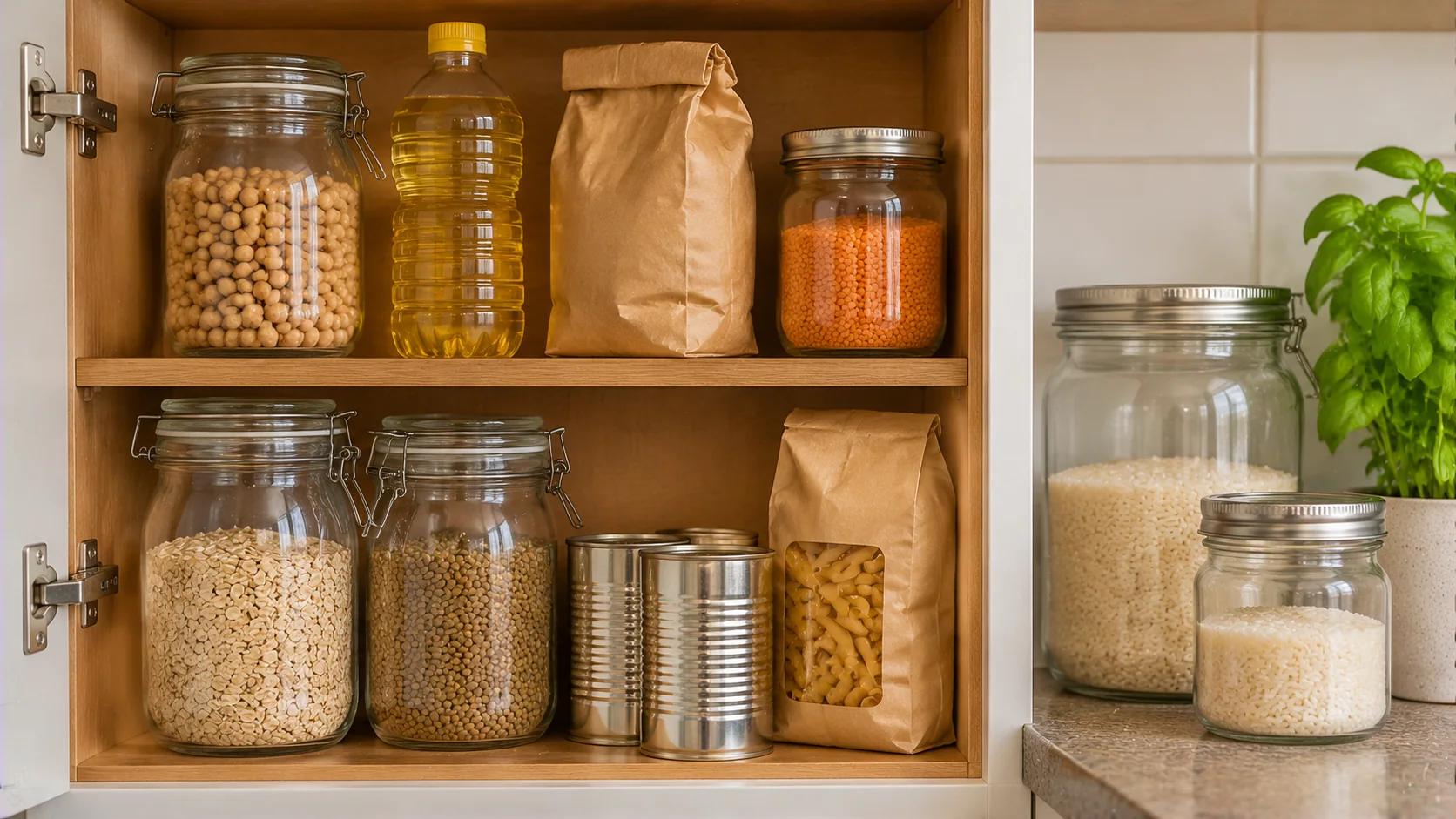
A pantry rotation is an inventory system, not a fixed meal plan. Two people record the food they already own, plan how much they will actually use, finish older packages first and only replace quantities below a pre-set threshold. This can lower duplicate purchases and spoilage, but it does not guarantee savings without comparing local receipts. The illustrative basket below is deliberately small enough for an ordinary cupboard and freezer drawer.
Start with nine useful staples
The amounts below are a model for two adults for one week, covering staple ingredients rather than every meal or nutritional need. Fresh produce, eggs, milk or fortified alternatives, optional fish, seasoning and drinks require separate purchases. Dry quantities mean uncooked weight. Bean cans are 400 g gross; drained edible weight varies by brand and must be read on the label.
| Stock item | Buy pack | Model receipt price | One-week use for two |
|---|---|---|---|
| Oats | 1 kg | €1.49 | 300 g |
| Dry rice | 1 kg | €1.99 | 300 g |
| Dry lentils | 500 g | €1.69 | 200 g |
| Wholegrain pasta | 500 g | €0.99 | 200 g |
| Canned beans (400 g gross) | 3 × 400 g | €2.67 | 2 cans |
| Canned tomatoes | 2 × 400 g | €1.58 | 1 can |
| Frozen vegetables | 1 kg | €2.29 | 600 g |
| Peanut butter | 350 g | €1.79 | 100 g |
| Rapeseed oil | 500 ml | €2.19 | 80 ml |
The cash-register total for all nine stock purchases is €16.68 using hypothetical shelf prices, not verified prices at REWE, Lidl or any retailer. Buying all nine lines once does not mean consuming their entire contents that week. This is a starter-stock receipt, not a claimed total weekly food bill. Oats, rice, lentils and oil should remain for later weeks; the two-person portions are planning allowances, not prescriptions.
A simple stock-and-reorder matrix
Keep four columns on paper or in a spreadsheet: product, unopened or usable quantity, expected weekly use, reorder point. Here is an example at the start of a week:
| Item | Usable stock now | Typical planned use | Reorder when |
|---|---|---|---|
| Oats | 650 g | 300 g/week | below 300 g |
| Rice, dry | 430 g | 300 g/week | below 300 g |
| Lentils, dry | 260 g | 200 g/week | below 200 g |
| Canned beans | 2 unopened cans | 2 cans/week | fewer than 2 cans |
| Frozen vegetables | 700 g | 600 g/week | below 600 g |
The threshold is the quantity needed until the next planned shop, not a suggestion to buy every item whenever opened. If rice starts at 430 g and you use 300 g, 130 g remains. Buying a new 1 kg packet at the next shop would bring the available stock to 1,130 g. Skip that purchase if you already have another unopened packet or limited storage space. Record dates on opened packs and use the oldest suitable stock first.
Calculate price per edible meal component
Use the actual fraction consumed, then separately track the receipt. For the example rice priced at €1.99/kg, 150 g dry rice for two costs €0.30, rounded from €1.99 × 0.15. If 150 g dry rice produces 375–450 g cooked rice, the yield is illustrative and changes with the variety and water absorbed; the cost remains €0.30 for that batch before energy and seasonings. For lentils, 200 g from a 500 g packet costing €1.69 costs €0.68. Two €0.89 bean cans would cost €1.78, but this assumes that specific hypothetical unit price and says nothing about drained grams until you check the can.
| Example use | Arithmetic | Ingredient cost |
|---|---|---|
| 150 g dry rice | €1.99 × 150/1000 | €0.30 |
| 200 g dry lentils | €1.69 × 200/500 | €0.68 |
| 300 g oats | €1.49 × 300/1000 | €0.45 |
| 400 g frozen vegetables | €2.29 × 400/1000 | €0.92 |
Ingredient cost excludes cooking energy, toppings and food waste. Do not add a whole packet price to a consumed-ingredient calculation and then count the same packet again. For a weekly budget, show cash paid, estimated ingredients used and value remaining in stock as three different figures.
Rotate the same ingredients without repeating the same dinner
- Oats for two breakfasts: cook 100 g oats total with water or milk and add fruit. Remaining oats stay dry in the original package or sealed container.
- Lentil-rice bowls: cook 120 g dry lentils and 120 g dry rice separately; mix with 300 g frozen vegetables, herbs and a little oil. Divide into two or three servings according to appetite, and calculate extra protein sources separately.
- Bean-tomato pasta: cook 160 g dry pasta; warm one drained 400 g can of beans and one 400 g can of tomatoes with spices. Portion into two dinners; count the actual edible drained bean weight for nutrition.
- Second-day variation: use remaining cooked ingredients in a different seasoning profile, rather than preparing identical meals all week. A splash of lemon, paprika or garlic changes flavor, not the purchased quantity.
These are examples of using pantry stock, not a complete, nutritionally balanced weekly menu. Add vegetables and appropriate protein or calcium sources to meet individual needs. For an example of budgeting actual dinners, see budget dinners and grocery planning; to use a measured grocery basket rather than a stock system, see measured low-cost grocery baskets.
Decide what to replenish on shopping day
Check the freezer before buying another frozen vegetable bag. Compare the price per 100 g of the usable quantity for canned foods and the price per kg for dry foods. Look at expiry and best-before dates: a best-before date is mainly about quality when packaging and storage are appropriate, whereas a use-by date is a safety deadline. Avoid deals that force you to buy an amount you cannot store or finish. The USDA MyPlate weekly-planning guidance recommends looking at the fridge, freezer and cabinets before writing a grocery list.
What happens if prices or household appetite change?
Replace each sample price with the price from your own receipt. If the price of dry lentils rises from €1.69 to €2.19 per 500 g, the cost of 200 g rises from €0.68 to €0.88, a €0.20 difference. If rice use doubles from 300 g to 600 g a week, the reorder threshold needs to reflect that consumption, not the original illustration. Keep a reserve only for foods you genuinely eat and have space to store. The point of the rotation is to make the next purchase measurable, not to accumulate a large pantry.
Food safety: dry, frozen and opened foods are different
Keep unopened dry staples sealed in a cool, dry location away from moisture and pests. Respect the package's instructions, especially after opening. Unopened shelf-stable cans belong in a suitable cupboard, but opened low-acid canned foods such as beans are refrigerated and generally used within 3–4 days, according to USDA FSIS guidance. Transfer leftovers to covered food-grade containers for quality. Cool cooked rice promptly and refrigerate or freeze safely; do not leave it on a counter overnight. Frozen vegetables remain frozen until needed and should be cooked according to their packet directions. Check manufacturer dates and instructions, not an invented universal storage life.
A five-minute weekly review
On your usual shopping day, record three numbers for each staple: what is left, what you expect to use, and what you need to buy. Compare last week's receipt with how many portions were actually eaten. If food repeatedly remains unused, reduce its stock target; if you run out early, increase it by a realistic amount. This is a modest, repeatable habit rather than a promise of fixed euro savings.
Sources
- USDA MyPlate: Make a Plan — reviewing existing food and planning purchases.
- USDA MyPlate: Healthy Eating on a Budget — food-budget methods.
- USDA FSIS: Shelf-Stable Food Safety — storage before and after opening.