
Pantry staples can lower food costs when they do more than simply sit on a shelf.
The most useful staples are affordable, keep well and can be combined with fresh or frozen ingredients to make several different meals.
That makes them valuable not only because of their price, but because they give you alternatives when plans change, fresh food runs out or an extra grocery trip would otherwise be necessary.
What makes a pantry staple useful?
A useful budget staple usually has several of these characteristics:
- relatively long shelf life;
- low or reasonable cost per serving;
- works in multiple meals;
- easy to combine with vegetables and protein foods;
- simple to portion;
- little preparation waste;
- something your household actually eats.
A cheap product that remains unused until it expires is not a real saving.
The goal is therefore not to build the largest pantry possible. It is to keep a small group of foods that repeatedly turn into meals.
Affordable staples worth considering
Prices vary by country, store, package size and brand, so there is no universal list of the cheapest foods.
However, these categories are often useful starting points:
| Pantry staple | Useful for |
|---|---|
| Oats | Breakfast, baking, yogurt bowls |
| Rice | Bowls, curries, stir-fries, side dishes |
| Pasta | Quick meals, soups, pasta salads |
| Lentils | Soups, stews, curries, bowls |
| Beans | Chili, salads, soups, wraps |
| Chickpeas | Curries, salads, soups, spreads |
| Canned tomatoes | Sauces, soups, stews |
| Flour | Baking, pancakes, sauces |
| Couscous or bulgur | Quick side dishes and bowls |
| Canned fish | Sandwiches, salads, pasta dishes |
| Shelf-stable seasonings | Making basic ingredients taste different |
You do not need all of them.
Choose staples that match the meals you actually cook.
Start with a small core pantry
Buying ten kilograms of food because it appears inexpensive can tie up money and create waste.
A better starting point is a small core pantry.
For example:
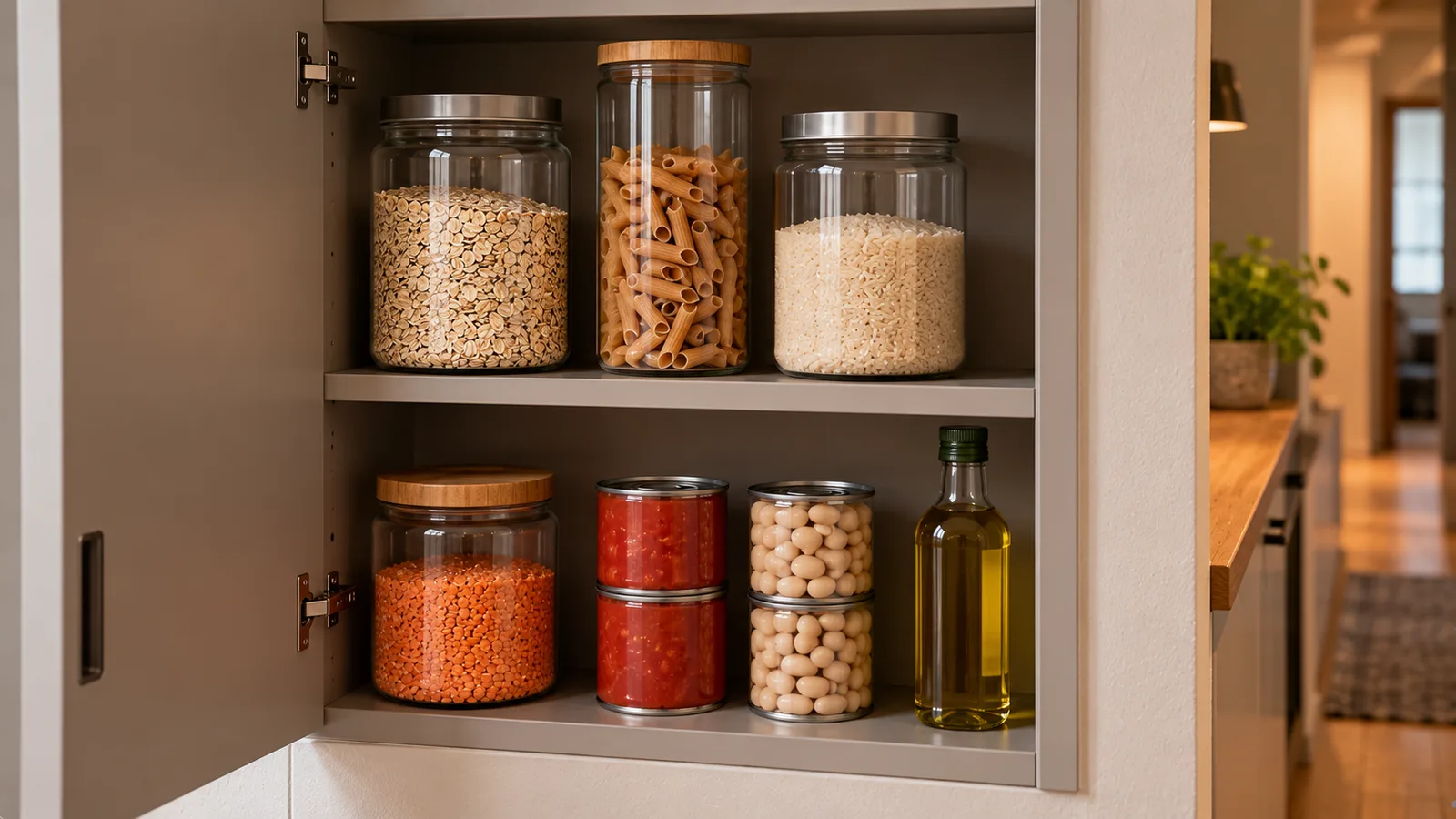
- oats;
- rice;
- pasta;
- lentils;
- one or two types of beans;
- canned tomatoes;
- flour;
- cooking oil;
- herbs and spices.
Then add products based on your normal meals.
If you rarely eat chickpeas, a large stock of chickpeas is not a budget strategy.
Build meals around a staple, not the entire pantry
A practical way to use pantry foods is to choose one staple as the base and add what is available.
Rice
Combine with:
- frozen vegetables;
- eggs;
- chicken;
- tofu;
- beans;
- leftover vegetables;
- a simple sauce.
Pasta
Combine with:
- canned tomatoes;
- vegetables;
- lentils;
- tuna;
- cheese;
- herbs.
Lentils
Combine with:
- carrots;
- onions;
- canned tomatoes;
- rice;
- potatoes;
- spices.
Beans
Combine with:
- rice;
- tomatoes;
- vegetables;
- tortillas;
- eggs;
- herbs and spices.
One inexpensive staple can therefore support several different meals instead of forcing you to repeat exactly the same dish.
Use pantry staples as backup meals
One of the hidden costs of an empty kitchen is the unplanned purchase.
If there is “nothing to eat,” it becomes easier to:
- order delivery;
- buy a ready meal;
- make an additional supermarket trip;
- buy more than originally intended.
A few pantry-based backup meals can reduce that problem.
Examples include:
Tomato-lentil pasta
Pasta + canned tomatoes + lentils + herbs
Rice and beans
Rice + beans + frozen vegetables + seasoning
Chickpea tomato stew
Chickpeas + canned tomatoes + vegetables + spices
Tuna pasta
Pasta + canned tuna + tomatoes or another simple sauce
The point is not that these meals are always the absolute cheapest possible option.
Their value is that the ingredients are available when the original plan fails.
Pair shelf-stable foods with frozen ingredients
A budget pantry becomes more useful when it works together with the freezer.
For example:
Rice + frozen vegetables + eggs
or:
Pasta + frozen spinach + canned tomatoes + lentils
or:
Beans + frozen peppers + rice
Frozen vegetables can help because you use only the amount needed and keep the rest for another meal.
This can be especially practical for foods that frequently spoil before you finish them fresh.
Canned foods can reduce preparation time
Canned beans, chickpeas, lentils, tomatoes and fish can make inexpensive meals faster.
They may cost more per kilogram than dry versions, but price is not the only consideration.
Dry beans require soaking and cooking. Canned beans are already ready to use.
If convenience makes the difference between cooking at home and buying a more expensive meal, the canned option may still make financial sense.
Compare products based on how you actually use them.
Dry beans vs canned beans
Dry legumes often have a lower cost per prepared portion, but the comparison should account for cooking yield.
A kilogram of dry beans does not remain one kilogram after cooking because the beans absorb water.
For a meaningful comparison:
- calculate the price of the dry quantity used;
- determine approximately how much cooked food it produces;
- compare that with the drained amount from canned products.
Also consider preparation time and energy use if those factors matter to you.
Use canned tomatoes as a flexible base
Canned tomatoes are one of the most versatile pantry ingredients because they can become part of:
- pasta sauce;
- lentil soup;
- bean stew;
- curry;
- chili;
- vegetable soup.
One product can therefore support several cuisines depending on the spices and other ingredients added.
This is usually more useful than buying a specialized sauce that works for only one meal.
Herbs and spices can prevent repetition
Budget cooking does not have to mean every meal tastes the same.
A basic combination of rice, beans and vegetables can change significantly depending on seasoning.
A small collection might include:
- black pepper;
- paprika;
- cumin;
- curry powder;
- dried oregano;
- garlic;
- chili;
- another seasoning you use frequently.
Do not buy a large spice collection at once.
Start with flavors that appear repeatedly in your normal cooking.
Check unit prices, not only package prices
A larger package can look expensive while actually costing less per kilogram.
A smaller package can look cheaper at checkout but cost more for the same amount of food.
For example:
- 500 g rice for €1.49 = €2.98/kg;
- 1 kg rice for €2.39 = €2.39/kg.
The larger pack has the lower unit price in this example.
But that does not automatically make it the better purchase.
If you will not use the larger package, the theoretical saving is irrelevant.
For direct comparisons, use the Grocery Unit Price Calculator.
Bulk buying only works when the food gets used
Long shelf life makes pantry products suitable for larger packages, but buying in bulk still requires judgment.
Before choosing the larger pack, ask:
- Is the unit price actually lower?
- Will I use it?
- Do I have suitable storage?
- Could quality deteriorate before I finish it?
- Does buying it now reduce money available for other groceries?
The lowest unit price is not automatically the lowest-cost shopping decision.
Rotate what you already have
A pantry can quietly accumulate half-used packages.
Before shopping, check:
- opened pasta;
- rice;
- grains;
- beans;
- canned foods;
- flour;
- sauces;
- baking ingredients.
Then deliberately include some of them in upcoming meals.
This helps turn existing inventory into food instead of continuously adding new stock.
Use a first-in, first-out habit
When adding a new package, place older products where they are easier to reach.
Use the older package first.
This simple habit is especially useful for:
- flour;
- grains;
- nuts;
- oils;
- canned products;
- sauces.
Shelf-stable does not mean permanent.
Products can still lose quality or eventually expire.
Do not stock foods only because they are discounted
A discount saves money only if it reduces the cost of something you would otherwise use.
Suppose a product normally costs €2.00 and is discounted to €1.40.
Buying it saves €0.60 only if the product is actually consumed.
If it remains unused, you did not save €0.60. You spent €1.40 unnecessarily.
This distinction is particularly important with promotions that encourage multiple purchases.
Pantry staples can stretch more expensive ingredients
Staples can also help you use smaller amounts of higher-cost foods while still making a complete meal.
For example:
- chicken + lentils in a stew;
- tuna + pasta + tomatoes;
- beef + beans in chili;
- cheese + beans in a wrap;
- fish + potatoes + vegetables.
This does not require reducing every expensive ingredient.
It simply gives you more ways to build the meal from a combination of foods rather than relying heavily on one costly component.
Example: turning one pantry into several dinners
Imagine you already have:
- rice;
- pasta;
- lentils;
- canned beans;
- canned tomatoes;
- spices.
You buy:
- eggs;
- chicken;
- carrots;
- onions;
- frozen vegetables;
- yogurt.
Those ingredients can support meals such as:
- chicken, rice and vegetables;
- lentil-tomato soup;
- pasta with tomato-lentil sauce;
- rice, beans and vegetables;
- eggs with rice and vegetables;
- bean and tomato stew with yogurt.
The exact recipes are flexible.
The important point is that the pantry ingredients connect fresh purchases into several different meals.
Avoid buying duplicate staples
Before adding another package to the cart, check whether you already have enough at home.
Duplicate purchases are common with:
- pasta;
- rice;
- flour;
- canned tomatoes;
- beans;
- spices.
Keeping a simple inventory can prevent buying the fourth package of something while another useful ingredient is missing.
Create a minimum-stock list
For foods you use constantly, a small minimum-stock system can simplify shopping.
For example:
| Item | Rebuy when |
|---|---|
| Rice | Less than one week's usual amount remains |
| Oats | One package is nearly empty |
| Canned tomatoes | Only one or two cans remain |
| Lentils | Less than one usual batch remains |
| Pasta | Last package is opened |
The exact thresholds depend on your household.
The goal is to replace staples before they run out without building excessive inventory.
Pantry staples and nutrition
Low cost alone should not determine the entire basket.
A pantry based only on refined starches may be inexpensive but offer limited variety.
Try to combine staples with:
- vegetables;
- fruit;
- protein foods;
- sources of fiber;
- appropriate sources of dietary fat.
Beans, lentils and chickpeas are particularly useful because they provide both carbohydrate and plant protein along with fiber.
For the broader nutritional side of grocery shopping, see How to Build a More Balanced Grocery Basket.
Pantry staples and meal planning
You do not need to assign every pantry product to a rigid seven-day schedule.
Instead, pantry staples can create flexibility.
You might plan four specific dinners and keep ingredients for two backup pantry meals.
If plans change, those backup meals remain available.
This is different from buying random emergency food. The backup ingredients should be foods you regularly use anyway.
Pantry staples and food waste
Long-lasting ingredients can reduce waste, but only when inventory remains manageable.
Too much stock creates a different form of waste:
- forgotten packages;
- expired products;
- duplicate purchases;
- ingredients that no longer fit your eating habits.
A smaller pantry that turns over regularly is often more useful than shelves filled with “just in case” products.
A simple pantry strategy
A practical system can be summarized in five steps:
- Choose 5–10 staples you genuinely use.
- Keep enough for several flexible meals.
- Combine them with fresh and frozen foods.
- Check inventory before shopping.
- Replace products as they are used instead of constantly expanding the pantry.
This keeps the pantry working as part of your normal food system rather than becoming a separate collection.
Example starter pantry
A simple starter pantry might contain:
Grains and starches
- oats;
- rice;
- pasta.
Legumes
- lentils;
- beans;
- chickpeas.
Cooking bases
- canned tomatoes;
- flour;
- cooking oil.
Flavor
- salt;
- pepper;
- paprika;
- cumin;
- dried herbs.
This is only an example.
Someone who rarely eats rice but frequently eats couscous should stock couscous instead. Someone who dislikes chickpeas does not need chickpeas simply because they are inexpensive.
When a cheap staple is not actually cheap
A low shelf price can still produce poor value when:
- much of the product is wasted;
- you dislike it;
- preparation is unrealistic for your schedule;
- the package is too large;
- you already own several packages;
- it requires additional ingredients you would not otherwise buy.
Real food cost is influenced by use, not only purchase price.
The practical rule
The best cheap pantry staples are not necessarily the foods with the lowest price tag.
They are foods that are inexpensive enough, store well and repeatedly help you turn other ingredients into meals.
Start with a small group you already know how to use.
Keep them in rotation, pair them with fresh and frozen foods, and replenish them when needed.
That approach can reduce waste, make last-minute meals easier and lower the number of expensive unplanned food purchases.