
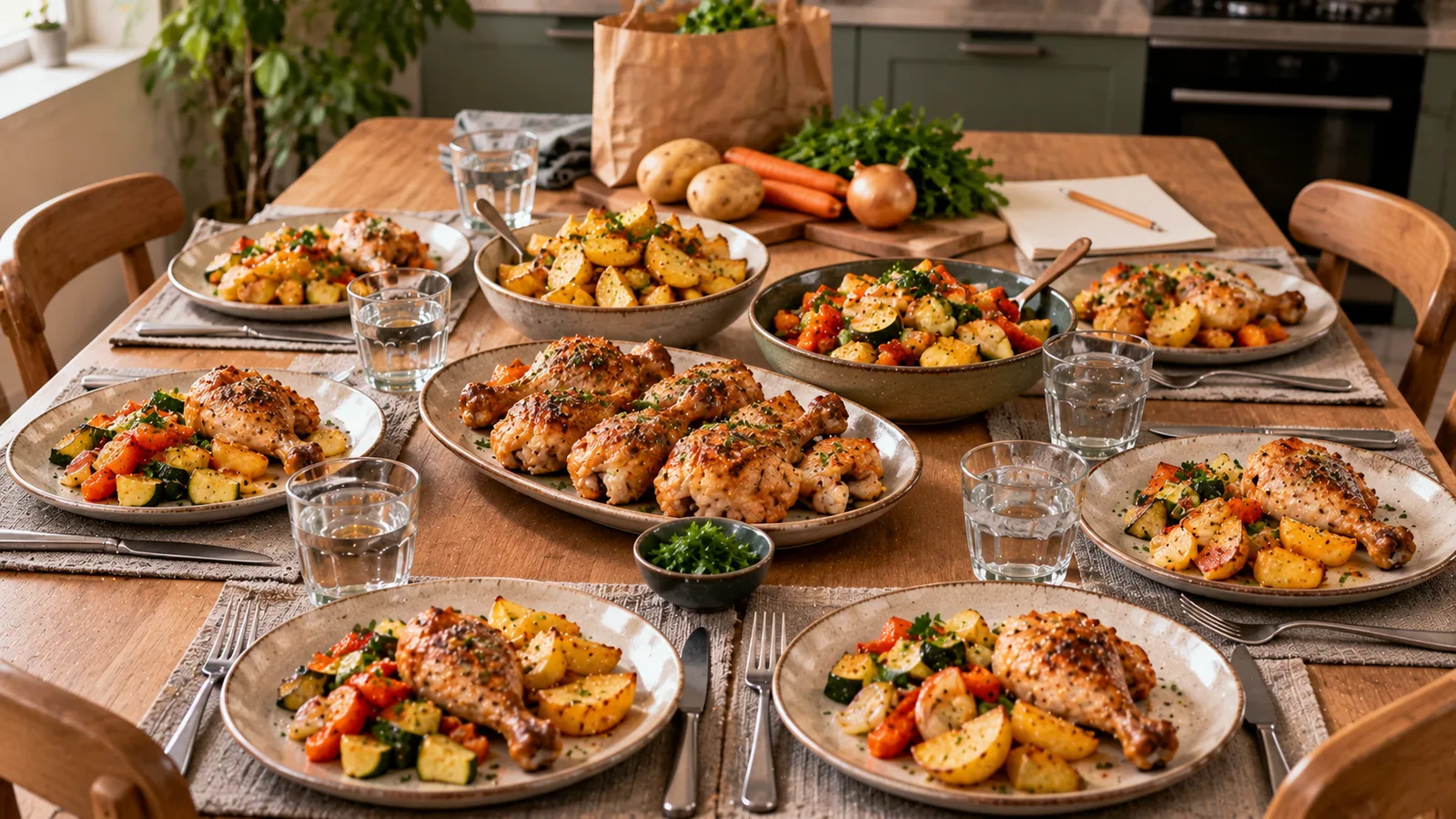
Plan for six plates, not a vague party size
A dinner-party budget becomes more useful when it begins with the exact number of people who will eat. Here the shopping list covers six invited guests and six dinner plates. If the host will also eat, plan for a seventh diner rather than silently splitting the same food seven ways. Ask beforehand about allergies, dietary restrictions and whether children need different portions. A very simple menu keeps the arithmetic transparent: oven-roasted chicken thighs with potatoes, carrots and onion, a yogurt-and-lemon accompaniment, and an apple each for a light dessert. Water is assumed to be available already; drinks, bread, utilities and other extras are not included in the example. This is a cost demonstration, not a prescribed nutritional meal plan.
A nine-item shopping list with two kinds of cost
The table makes the difference between what you buy and what you use visible. Every euro amount is an invented teaching price, not a verified shop offer, typical market price or shopping recommendation. Pack sizes and prices change by country, shop, date and brand. The food quantities are an illustrative plan: six portions share 1.5 kg of raw bone-in thighs, 1.5 kg of potatoes, 750 g of carrots, 300 g of onion, 400 g of yogurt, two lemons, 60 ml of oil, 12 g of dried seasoning and 1.2 kg of apples. A purchase might leave some packaged ingredients for later meals. Compare labels and actual shelf unit prices before making a real list.
| Item | Pack purchased | Pack price | Used for six | Used cost |
|---|---|---|---|---|
| 1. Chicken thighs, bone-in | 1.5 kg | €8.25 | 1.5 kg | €8.25 |
| 2. Potatoes | 2 kg | €2.80 | 1.5 kg | €2.10 |
| 3. Carrots | 1 kg | €1.40 | 750 g | €1.05 |
| 4. Onions | 1 kg | €1.60 | 300 g | €0.48 |
| 5. Plain yogurt | 500 g | €1.30 | 400 g | €1.04 |
| 6. Lemons | 2 pieces | €1.20 | 2 pieces | €1.20 |
| 7. Cooking oil | 500 ml | €3.50 | 60 ml | €0.42 |
| 8. Dried herbs and spices | 40 g | €1.20 | 12 g | €0.36 |
| 9. Apples | 1.5 kg | €3.60 | 1.2 kg | €2.88 |
| Total | — | €24.85 | — | €17.78 |
Calculate the basket at checkout
Add the full price of every package that must be purchased, even if only part of it goes into tonight’s food. In the example the checkout basket is €24.85. Dividing that by six guests gives €4.14 per guest, rounded to the nearest cent. That is the cash needed to buy the nine listed products in these hypothetical pack sizes; it is not the cost of the specific ingredients served. If oil or spices are already in your cupboard, you would not buy those packages again, but their used quantities still have an economic cost. The cheapest-looking unit price is not always the best basket choice when a large pack is likely to spoil.
Calculate the cost of food actually served
For items used only in part, multiply the pack price by the fraction taken: 1.5 kg potatoes ÷ 2 kg pack × €2.80 = €2.10. Likewise, 60 ml from a 500 ml oil bottle priced at €3.50 contributes €0.42. The recipe-use column totals €17.78. Dividing by six yields €2.96 of ingredient-use cost per guest after rounding. The gap between €24.85 and €17.78 is €7.07. It is value left in purchased packages, not a cash refund or guaranteed savings: leftovers only have practical value if they are used safely. Avoid counting both the full bottle of oil and the oil poured into dinner as separate expenses in a single total.
Check that the quantities make sense
A cost table is only a starting point for hosting. The illustrated 1.5 kg of bone-in chicken is 250 g raw bone-in weight per person; bones and cooking loss mean that it is not 250 g of edible meat. Potatoes contribute 250 g raw per person, carrots 125 g, onions 50 g and yogurt approximately 67 g. Dessert apples are about 200 g per guest before trimming. These are planning quantities, not guarantees of appetite or nutrition. Increase portions where guests expect a larger meal, and check whether your oven and trays fit everything without crowding. A substitution for a vegetarian guest changes both the food list and the arithmetic.
Use the remainder instead of calling it a saving
After dinner this list may leave 500 g potatoes, 250 g carrots, 700 g onions, 100 g yogurt, 440 ml oil, 28 g seasonings and 300 g apples, assuming the illustrated quantities and no prep waste. Plan a specific safe use for perishable leftovers before shopping. If you already own oil and seasonings, note their stock separately rather than assuming they are free. USDA MyPlate advises planning meals, writing a list and comparing unit prices; EFSA likewise identifies planning and thoughtful purchasing as ways to prevent household food waste. A smaller pack can sometimes cost more per kilogram yet save cash and waste if most of a large pack would remain unused.
Allow changes without losing the calculation
Keep a small buffer if local prices or the guest count may change. For example, if the chicken pack changes from €8.25 to €11.25 and every other example price stays the same, the checkout basket becomes €27.85 or €4.64 per guest. The ingredient-use amount becomes €20.78 or €3.46 per guest, because the entire chicken pack was allocated to this meal. Those figures are again purely illustrative. If seven people eat instead of six, you cannot simply promise every package will stretch: revise the serving quantities first, then recalculate the purchase sizes. Note delivery fees, paid drinks, dessert upgrades and disposable tableware as separate budget lines if relevant.
Keep food safety separate from the price
Do not sacrifice safe handling to hit a target cost. Keep raw chicken separate from ready-to-eat food, refrigerate it promptly, and use a food thermometer: poultry should reach 74 °C (165 °F) in the thickest part, without the probe touching a bone. Serve hot food appropriately; refrigerate perishable leftovers within 2 hours, using shallow containers to cool them efficiently. USDA guidance generally recommends using refrigerated cooked leftovers within 3–4 days when they have been handled correctly. Local guidance can be stricter. Treat food that was stored unsafely as a safety problem, not a budget-saving opportunity; reheating does not make every storage error harmless.
What this example does and does not prove
The shopping basket is a reusable method, not a German, French or Polish supermarket price survey. Actual purchase prices, promotional eligibility, package weights and availability must be verified where you shop. Six guests are assumed; the host is not included. No drinks, energy, transport, equipment, pantry inventory before shopping or preparation waste are priced. Ingredient-use cost also does not measure nutritional adequacy. For an actual gathering, write the menu, check what is already available, count each needed pack once, keep both totals, and revise them after reading real shelf prices. If you want more meal ideas, see one-pan dinner ideas.
Sources and calculation notes
The practical shopping approach follows USDA MyPlate budgeting advice and EFSA advice on reducing food waste. The chicken temperature comes from the US food-safety temperature chart; refrigeration, cooling and leftovers are covered by USDA FSIS. Every listed euro price is hypothetical. Arithmetic describes a chosen example and does not certify the price or safety of a real meal.