
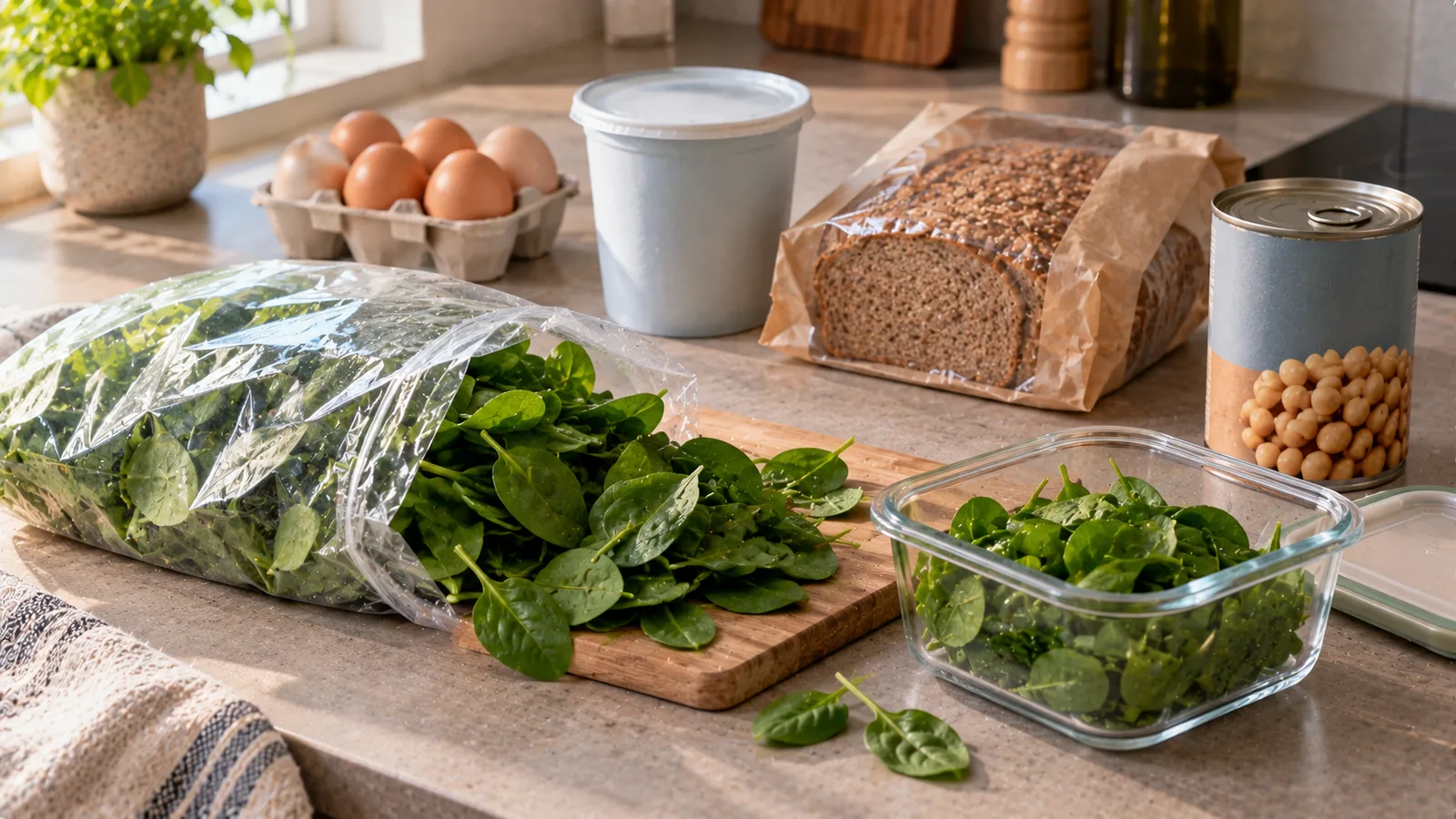
Shopping for one person creates a problem that is easy to underestimate: supermarkets usually sell packages, not individual meal portions.
A 1 kg bag of carrots may be inexpensive per kilogram. A family-size tub of yogurt may have a lower unit price. A large package of spinach may look like better value.
But if one person uses only half before the rest spoils, the cheapest package was not actually the cheapest purchase.
The goal is therefore not simply to buy the smallest package or the product with the lowest price per kilogram.
A better system is:
estimate what you can realistically use → choose the package → assign leftovers → compare the usable cost
That turns grocery shopping for one from a portion-size problem into an inventory problem you can manage.
Why shopping for one is different
Many foods are sold in quantities designed for several servings:
- bread;
- fresh herbs;
- salad leaves;
- vegetables;
- yogurt;
- cheese;
- sauces;
- meat and fish;
- tofu;
- canned foods;
- tortillas.
For a household of several people, a package may disappear in one meal.
For one person, the same package may need to work across three or four meals.
That means the useful question is not:
> Which package is cheapest?
It is:
> How much of this package am I realistically going to eat?
The cheapest unit price can cost more
Imagine two packages of spinach.
| Package | Price | Price per kg | Amount actually eaten |
|---|---|---|---|
| 150 g | €1.80 | €12.00/kg | 150 g |
| 300 g | €2.70 | €9.00/kg | 170 g |
The larger package has the lower advertised price per kilogram.
But suppose 130 g spoils.
The usable cost of the larger package becomes:
€2.70 ÷ 170 g × 1,000 = €15.88 per kg actually eaten
The smaller package cost more per kilogram on the shelf but less per kilogram of food actually consumed.
This does not mean smaller packages always win.
It means waste changes the calculation.
Start with meals, not package sizes
Before shopping, decide approximately where the food will go.
You do not need a rigid seven-day menu.
For one person, even a short plan such as this is useful:
- 3 dinners cooked at home;
- 2 lunches from leftovers;
- 2 quick breakfasts;
- 1 flexible meal;
- one evening eating out.
Now you can estimate how much food you actually need.
Without this step, it is easy to shop as if every day will involve cooking a completely new meal.
Use the two-destination rule
For ingredients that are difficult to finish in one meal, give them at least two realistic destinations before buying them.
For example:
Spinach
- Monday: omelet;
- Wednesday: pasta.
Greek yogurt
- breakfast with fruit;
- sauce for a grain bowl.
Bell peppers
- stir-fry;
- wraps.
Parsley
- lentil salad;
- soup garnish.
The second destination should be a meal you are actually likely to eat, not a hypothetical recipe you may never cook.
Some leftovers need three destinations
Large packages may need more planning.
Suppose a package contains six tortillas but you normally eat two at a time.
Before buying, decide:
- Tuesday: bean wraps;
- Thursday: breakfast wraps;
- Saturday: quesadillas.
Alternatively, check whether the tortillas freeze well and freeze the unused portion immediately.
The key is to make the decision while the package is still fresh, not after you discover it several days later.
Think in ingredient chains
An ingredient chain uses the same product in different meals without repeating the same complete dish.
For example:
Roast vegetables
Day 1:
roasted vegetables with chicken, tofu or beans.
Day 2:
remaining vegetables in a grain bowl.
Day 3:
small remaining amount in an omelet.
Cooked lentils
Day 1:
lentil curry.
Day 2:
lentil salad.
Day 3:
remaining lentils added to soup.
Greek yogurt
Breakfast:
yogurt with fruit and oats.
Dinner:
yogurt-based sauce.
Snack:
remaining portion with berries.
This is different from cooking one enormous dish and eating identical leftovers for five days.
Buy flexible ingredients
For a one-person household, flexibility often matters more than having many different products.
An ingredient is especially useful when it can fit into several meal formats.
Examples include:
- eggs;
- potatoes;
- onions;
- carrots;
- frozen vegetables;
- yogurt;
- cottage cheese;
- beans;
- lentils;
- rice;
- pasta;
- tortillas;
- bread that can be frozen;
- versatile sauces and seasonings.
A highly specific ingredient used in only one recipe may be more likely to remain unfinished.
That does not mean you should never buy specialty ingredients. It means their remaining quantity should be part of the plan.
Fresh, frozen and canned are different tools
Shopping for one does not require buying everything fresh.
Frozen and canned foods can make portion management much easier.
Frozen vegetables
You can remove only the amount needed and leave the rest frozen.
Useful examples include:
- peas;
- spinach;
- broccoli;
- mixed vegetables;
- berries.
Canned foods
Beans, lentils, tomatoes and fish can provide long shelf life before opening.
Once opened, however, leftovers still need appropriate refrigeration and timely use.
Fresh foods
Fresh produce remains useful for texture, variety and foods you regularly finish.
The practical strategy is often a combination rather than choosing one category exclusively.
Use frozen food as your buffer
A freezer can solve the mismatch between supermarket package sizes and a one-person household.
Depending on the food, you may be able to freeze:
- sliced bread;
- tortillas;
- cooked grains;
- soups;
- stews;
- portions of cooked meals;
- some cheeses;
- meat or fish portions;
- selected fruit and vegetables.
Check suitable storage and freezing guidance for the specific food.
The useful habit is to freeze surplus early.
Freezing food on the day you realize you will not use it is much more effective than waiting until it is almost spoiled.
Divide large packages immediately
If a larger package genuinely offers better value and freezes well, portion it when you get home.
Suppose you buy 800 g of a protein source but normally use 200 g per meal.
Divide it into four portions.
Keep what you need soon in the refrigerator and freeze the rest appropriately.
Now the large package behaves like four small packages without requiring you to eat it four days in a row.
Do not confuse bulk buying with saving money
Bulk buying saves money only when the food is eventually used.
Consider:
- purchase price;
- amount consumed;
- storage space;
- freezer capacity;
- likelihood of using the food;
- how long it can be stored safely.
A €10 package that you fully use may be better value than two €6 packages.
But a €10 package of which you discard €4 worth is not automatically a bargain because its unit price was lower.
Compare price per usable portion
For one person, price per portion can sometimes be more intuitive than price per kilogram.
Suppose:
- a 400 g package costs €4;
- you use 100 g per meal;
- all four portions will be eaten.
The cost is €1 per portion.
Now suppose a 700 g package costs €5.60.
At first it appears cheaper per gram.
But if you use only 400 g and discard 300 g, you still get four usable portions.
The real cost is:
€5.60 ÷ 4 = €1.40 per eaten portion
The nominal bulk saving disappeared.
Build meals around overlapping ingredients
A one-person grocery list becomes easier when neighboring meals share some ingredients.
For example:
Monday
Tofu stir-fry with broccoli, carrots and rice.
Tuesday
Lentil tomato soup with bread.
Wednesday
Rice bowl with remaining tofu, carrots and cucumber.
Thursday
Eggs with remaining broccoli and potatoes.
Friday
Lentil salad with cucumber and tomatoes.
The meals are different, but several ingredients overlap.
That allows smaller inventories without forcing repetitive meals.
Avoid buying a complete ingredient set for every recipe
One common source of waste is treating every recipe as an independent shopping project.
Recipe A needs:
- one herb;
- one sauce;
- one vegetable;
- one cheese.
Recipe B needs four completely different ingredients.
Recipe C introduces another set.
At the end of the week, the refrigerator contains partial packages from all three recipes.
Instead, choose recipes that intentionally overlap in several ingredients.
Variety can come from:
- cooking method;
- spices;
- sauce;
- grain;
- meal format.
You do not need completely different groceries for every meal to taste different.
Be careful with highly perishable garnishes
Fresh herbs, salad leaves and delicate produce can be especially difficult for one person to finish.
Before buying them, ask:
- Is this ingredient central to the meal or only a garnish?
- Can I use it again within the next few days?
- Is there a frozen, dried or longer-lasting alternative when appropriate?
- Can I buy a smaller quantity?
A bunch of herbs used for one tablespoon in a recipe can become an expensive tablespoon if the rest is discarded.
Plan around package reality
Suppose you want tacos for one.
Your shopping list might include:
- 8 tortillas;
- 500 g yogurt;
- a bag of lettuce;
- a jar of salsa;
- a block of cheese;
- beans.
The taco dinner may use only a fraction of each package.
Instead of pretending those remaining ingredients do not exist, make them part of the plan.
For example:
Day 1: bean tacos.
Day 2: yogurt with breakfast; lettuce in a sandwich.
Day 3: tortilla breakfast wrap with eggs and cheese.
Day 4: grain bowl with lettuce, beans, salsa and yogurt sauce.
Now the original taco ingredients have several destinations.
A practical one-person shopping framework
Before adding an item to the basket, classify it.
Category 1: Will definitely be finished
Examples might include:
- eggs;
- your regular milk;
- frequently eaten fruit;
- staple yogurt.
Buy the normal economical package if it fits your routine.
Category 2: Can be portioned or frozen
Examples might include:
- bread;
- tortillas;
- meat substitutes;
- cooked meals;
- selected proteins.
Larger packages may work well if you portion them promptly.
Category 3: Highly perishable and difficult to reuse
Examples might include:
- delicate herbs;
- salad leaves;
- specialty dairy;
- unusual vegetables bought for one recipe.
Be more conservative with package size.
Category 4: Shelf-stable
Examples include:
- rice;
- pasta;
- canned tomatoes;
- dry lentils;
- oats.
Larger packages may be practical when storage space is available and the food is regularly used.
This classification is more useful than applying the same "buy small" rule to every food.
Keep one flexible meal in the week
Schedules change.
If every ingredient is tied to a precise meal, one canceled dinner can leave several products stranded.
Keep one meal flexible.
Good options include:
- soup;
- omelet;
- frittata;
- stir-fry;
- grain bowl;
- pasta;
- wraps.
The purpose is to absorb ingredients that remain after the planned meals.
Check the refrigerator before shopping
Before writing the grocery list, inspect:
- vegetables;
- opened dairy;
- sauces;
- cooked leftovers;
- bread;
- eggs;
- fruit;
- freezer items.
Then ask:
> Which of these should influence this week's meals?
If half a cabbage is already in the refrigerator, buying another set of vegetables without a plan for the cabbage increases inventory rather than solving the next week's meals.
Use a simple use-first zone
Create a visible area in the refrigerator for foods that should be eaten soon.
It might contain:
- half a cucumber;
- opened yogurt;
- cooked rice;
- a ripe tomato;
- remaining tofu.
When choosing lunch or a snack, check this area first.
This small system reduces the chance that partial packages disappear behind newer groceries.
Do a midweek inventory check
A five-minute check halfway through the week can prevent a large amount of waste.
Look for:
- produce becoming soft;
- opened packages;
- leftovers;
- cooked grains;
- dairy approaching its date;
- ingredients from canceled meals.
Then adjust the remaining plan.
If the spinach needs using earlier than expected, move it into tonight's omelet rather than waiting for Friday's planned pasta.
A meal plan should respond to the actual food you have.
Example grocery list for one person
Here is an example of a compact list designed around overlapping meals.
Protein
- 6 eggs
- 400 g tofu
- 2 cans beans
- 500 g Greek yogurt
Carbohydrates
- small loaf of bread
- rice
- potatoes
- tortillas
Vegetables and fruit
- broccoli
- 4 carrots
- 2 peppers
- cucumber
- tomatoes
- onions
- apples
- bananas
Flavor and extras
- cheese
- salsa
- lemon
- garlic
This list is not universally ideal.
Its useful feature is that most ingredients can appear in more than one meal.
When a larger package makes sense
A larger package can be the better choice when:
- you use the food frequently;
- it has a long shelf life;
- it can be frozen;
- you have already assigned several portions;
- the unit-price difference is meaningful;
- you have suitable storage space.
For example, a larger bag of rice may make sense for one person because it is shelf-stable and regularly used.
A family-size bag of delicate salad leaves may not offer the same advantage.
When a smaller package can be worth the premium
Paying more per kilogram can still reduce total spending when:
- the food spoils quickly;
- you need only a small amount;
- it cannot easily be frozen;
- you rarely use it;
- the remaining quantity has no realistic destination.
You are buying usable food, not theoretical kilograms.
The goal is not zero waste
Trying to eliminate every gram of food waste can make grocery shopping unnecessarily complicated.
Some unavoidable waste exists:
- peels;
- bones;
- damaged portions;
- preparation losses;
- occasional spoiled food.
A more realistic goal is to reduce predictable waste.
If you repeatedly discard half a bag of salad, half a loaf of bread or the last third of a yogurt tub, that pattern can be changed.
The simplest rule
When shopping for one person, do not ask only:
"Is the larger package cheaper?"
Ask:
"What will I do with the rest?"
If you can answer that question before the food enters your basket, larger packages can be economical.
If you cannot answer it, the smaller package may be cheaper in practice even when its shelf price per kilogram is higher.
The best grocery plan for one person is not the one with the lowest theoretical unit prices.
It is the one in which most of what you pay for becomes food you actually eat.