
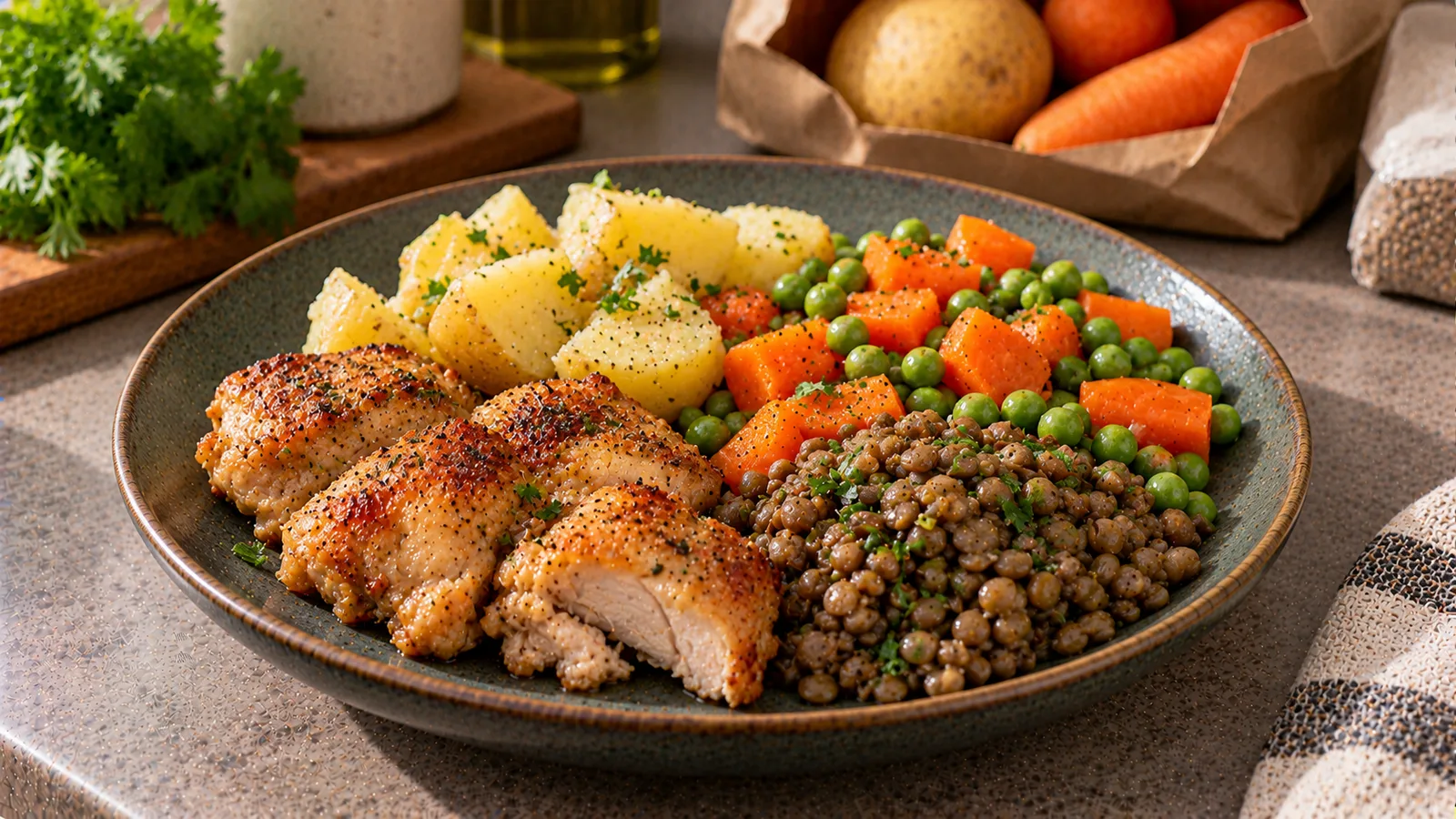
A healthy discount-store dinner does not begin with a cheap item. It begins with an edible portion of vegetables, a protein source, a grain or potato, and a price you can actually pay at the checkout. This worked example builds four different dinners for two people from 13 ordinary grocery lines. No special protein powder, branded diet product or one-off sauce is required.
The example assumes a German discount grocery store and illustrative prices, not a verified Aldi, Lidl, Netto or Penny offer. Buying every full pack in the example costs €19.29. The quantities used in the four dinners are worth €9.30 (about €1.16 per person per dinner). The difference is mainly edible food still in the cupboard or fridge, not an automatic saving. This is a method for making better purchasing decisions, not a claim that a complete week's nutrition costs €9.30.
Start with meals, not special offers
First write four dishes and the number of people beside each. Here the target is eight dinner servings, not a week's breakfast, lunch and dinner. Choose ingredients that can do more than one job: brown rice in two dishes, frozen vegetables in three, onions in all four, and passata in two. One 1 kg frozen bag and one 500 g carton of passata are completely allocated across these meals. That is a stronger form of planning than buying a promotional bag with no assigned use.
Next mark ingredients in three roles: produce (carrots, onions, frozen vegetables and potatoes), proteins (lentils, chickpeas, kidney beans, eggs and yogurt), and grain/starch (pasta and rice). A small quantity of rapeseed oil completes cooking. The German Nutrition Society recommends a plant-forward mix rich in vegetables, whole grains and legumes; its guidance supports the food-group choices, not the invented prices in this demonstration. See the [DGE food-based recommendations]({dge}). For a broader planning framework, Mealisa's budget grocery list guide covers the general list-building task; here the objective is to test a specific discounted-shopping basket against dishes and yields.
One checkout basket: pack price versus food actually eaten
| Product | Pack size | Used in four dinners | Example pack price | Value used |
|---|---|---|---|---|
| Wholegrain pasta | 500 g | 160 g | €0.79 | €0.25 |
| Brown rice (dry) | 1000 g | 300 g | €1.99 | €0.60 |
| Red lentils (dry) | 500 g | 120 g | €1.79 | €0.43 |
| Canned chickpeas, drained | 240 g | 240 g | €0.85 | €0.85 |
| Canned kidney beans, drained | 240 g | 240 g | €0.85 | €0.85 |
| Eggs | 6 pcs | 4 pcs | €1.79 | €1.19 |
| Plain frozen mixed vegetables | 1000 g | 1000 g | €2.19 | €2.19 |
| Carrots | 1000 g | 150 g | €1.19 | €0.18 |
| Onions | 1000 g | 450 g | €1.29 | €0.58 |
| Plain tomato passata | 500 g | 500 g | €0.79 | €0.79 |
| Plain unsweetened yogurt | 500 g | 250 g | €0.99 | €0.50 |
| Rapeseed oil | 1000 ml | 65 ml | €2.29 | €0.15 |
| Potatoes | 2000 g | 600 g | €2.49 | €0.75 |
| TOTAL | — | — | €19.29 | €9.30 |
The table shows both the pack you buy and the amount allocated to the four meals. Prices are fixed assumptions to illustrate arithmetic, including for cans, eggs and a 1-litre oil bottle. Kidney beans and chickpeas are represented as one can each yielding 240 g drained edible beans; the shop label might have a different drained weight. Recheck it when you buy. For eggs the unit is a piece, for oil millilitres, and all other weights are grams.
For each line, used value = pack price × used quantity ÷ usable pack quantity. This gives a useful recipe costing metric, but it is not the amount due today. A €2.29 bottle of oil might contribute only a few cents to four dinners and still require €2.29 at the till. Similarly, a 1 kg rice bag leaves 700 g for later meals; a 2 kg potato bag leaves 1.4 kg. A shopping plan should account for that food rather than call it waste.
Four dinners that use the same basket
| Dinner for two | Main measured ingredients | Cost for two | Cost per person |
|---|---|---|---|
| Lentil-tomato wholegrain pasta | 160 g pasta + 120 g dry lentils + 250 g passata | €1.42 | €0.71 |
| Chickpea and vegetable rice bowls | 150 g rice + 240 g drained chickpeas + 300 g vegetables | €2.27 | €1.13 |
| Potato, egg and vegetable skillet | 600 g potatoes + 4 eggs + 300 g vegetables | €3.03 | €1.52 |
| Kidney-bean tomato rice | 150 g rice + 240 g drained beans + 400 g vegetables | €2.58 | €1.29 |
| TOTAL | 8 servings | €9.30 | €1.16 |
For dinner A, simmer 120 g dry red lentils with 250 g passata, 100 g onion and 150 g grated carrots, then serve with 160 g dry wholegrain pasta for two. Cook the lentils in water until tender; the water added during cooking is not included as a purchased ingredient. Add 15 ml oil to the pan. This makes a substantial tomato-based dish rather than a packet of plain pasta. The ingredient-value calculation is €1.42 for two portions, excluding utilities and basic seasonings.
Dinner B combines 150 g dry brown rice, 240 g drained chickpeas, 300 g frozen vegetables, 100 g onion, 150 g yogurt and 15 ml oil. Cook the rice completely, heat chickpeas and vegetables, and use yogurt as a separate topping rather than simmering it for a long time. Its example ingredient value is €2.27 for two. Yogurt provides a different texture from tomato; the meal remains easy to adapt to a lactose-free yogurt or another suitable product if the label and price are checked.
Dinner C is a potato, egg and vegetable skillet: 600 g potatoes, four eggs, 300 g frozen vegetables, 150 g onion, 20 ml oil and 100 g yogurt on the side. Pre-cook the potatoes until tender, then finish the vegetables and eggs thoroughly in the skillet. That is €3.03 for two in the scenario. The eggs are a higher share of the cost than the potatoes, which is useful to notice when comparing alternatives.
Dinner D uses 150 g dry brown rice, 240 g drained kidney beans, the remaining 250 g passata, 400 g frozen vegetables, 100 g onion and 15 ml oil. Simmer the vegetables, tomato and ready-cooked canned beans together, and serve over cooked rice. The planned value is €2.58 for two. Using canned cooked beans avoids the separate soaking and safety requirements of raw dried kidney beans. For other inexpensive dinner arrangements without repeating this basket analysis, see Mealisa's cheap healthy dinners.
The unit-price test that can prevent a bad bargain
Compare shelf labels in euros per kilogram or litre, not simply the large printed price. For example, suppose 500 g rice costs €1.49 and 1 kg costs €1.99. The first costs €2.98/kg and the second €1.99/kg. The larger bag is cheaper per kilo but costs €0.50 more today. Both are hypothetical prices. If you only need the 300 g rice in this example and have little storage space or cash, the smaller bag may still be a sensible buy. If you regularly eat rice and store it dry, the 1 kg bag may be more economical over time.
That is also why reduced-price fresh produce can be false economy when its edible amount is small. Compare price after trimming, not only package weight; and do not use a lower unit price as permission to buy a food that will spoil. German consumer advocates specifically recommend comparing shelf unit prices and considering own-label products. See [Verbraucherzentrale's shopping guidance]({vz}).
How to decide what deserves space in the basket
At the start of the aisle, ask four questions. Does this item fill a planned role? How much of it will we eat? What else can the leftover amount become? Is the pack affordable at checkout? Rice earns a place because it is needed twice and stores well. Frozen vegetables earn one because the full bag is divided among three meals. The two cans each go into one identified recipe. A discretionary snack or special sauce has to compete with that budget rather than silently join it.
Protein does not have to come from one ingredient at every dinner. Lentils and canned beans are useful pantry foods, while eggs and yogurt widen the range. The four meals are not identical in their macronutrients and none has been assigned a made-up calorie figure. Balance depends on the rest of the day, the actual label and the person's needs. Mealisa's balanced meal guide discusses how to judge the whole plate instead of treating one low-cost shopping basket as a prescribed diet.
Use frozen and canned foods accurately
Frozen vegetables can be particularly convenient if the contents are plain vegetables without sauce. The scenario uses the full kilogram: 300 g in B, 300 g in C and 400 g in D. Heating only what is needed also reduces the chance of thawing and refreezing an entire bag. Fresh seasonal carrots are a valid alternative when their usable price is lower; the particular discount store and season will decide which is better.
For canned beans, always read drained weight as well as net weight. Two cans labelled 400 g total may not supply the same amount of edible beans. The values in this article assume 240 g drained per can, not 400 g. If a can actually supplies 220 g, either reduce a recipe's amount or add a different food; do not silently use 240 g in the calculation. Canned beans may be rinsed to reduce some surface brine, but sodium reduction varies and cannot be assigned a universal percentage. When comparing two apparently similar products, use the per-100-g nutrition panel and ingredients. Mealisa's nutrition-label reading guide helps with those comparisons.
A realistic checkout walk-through
A practical shopping route is to begin with shelf-stable lentils, pasta, rice and canned beans, then take passata and oil, then eggs and yogurt, and finally potatoes, onions, carrots and frozen vegetables. Keep chilled and frozen goods cold during transport, particularly if the journey is long. The basket's illustrative full-pack price is €19.29 before any loyalty discounts or deposit; the plan assumes no such savings. Checking a real receipt against the table is part of the method, not a sign that the original estimate failed.
If the frozen mix costs €3.19 instead of €2.19, add €1.00 to both the checkout cost and the edible cost because all 1 kg is used. If the potatoes rise by €1.00 per 2 kg, the checkout cost also rises €1.00, but these meals use only 600 g, so their ingredient value rises €0.30. This sensitivity check is more useful than treating a low basket total as a promise that all store prices are fixed.
Food safety and the order of cooking
Prepare the meals in the order that respects the ingredients. Use the opened passata for dinners A and D close together or divide it into clean portions and freeze the second part immediately; its safe open-life depends on the label and refrigeration. Keep yogurt and eggs cold, wash fresh vegetables, and follow package instructions for frozen products. Cook eggs thoroughly, and cool cooked rice rapidly in shallow containers if saving it. Do not assume that rice cooked on Sunday can be held casually in the refrigerator for an entire workweek.
The [BZfE meal-prep guidance]({bzfe}) recommends planning dishes from shared ingredients and storing cooked meals covered and chilled. Its [food-hygiene guidance]({hygiene}) emphasizes quick chilling, separation of raw and prepared foods, and short refrigerated storage. If you want dinner D much later than A, cook a fresh rice batch rather than holding warm rice on the stove. Frozen goods should go back into the freezer promptly after the trip.
How to adapt the basket without losing its purpose
The basket can be adjusted while protecting the calculation. Swap yogurt for a plain lactose-free alternative and recalculate the pack price and used fraction. Replace brown rice with another grain by its dry weight, not by comparing 150 g dry rice with 150 g cooked couscous. If a store sells only large cans, use their actual drained weights; perhaps reserve the extra beans for another dish if the opened can can be handled safely. If you already own oil, your cash outlay today falls by the bottle's price, but its cost per recipe is not zero when evaluating long-term food spending.
A larger family can double the edible ingredient quantities in each recipe but cannot simply double every package price: some items fit one larger pack, others require multiple units. A smaller household may cook two portions and freeze one promptly. All substitutions should update the basket and portion totals before a cost comparison. A published sale price can also disappear between writing and shopping.
What this basket can and cannot prove
This example supports a decision framework: four two-person dinners, a €19.29 hypothetical checkout, and €9.30 of food allocated to those dinners. It does not establish a universal cheapest supermarket, a daily calorie target or complete nutrition for an adult. It excludes cooking energy, water, seasonings, travel, and any food already owned. The remaining food has potential value only when stored and used properly; it cannot always be turned back into cash.
The broader lesson is to plan dishes, check drained and edible weights, compare price per useful unit, then look at the cash total. If prices or pack sizes change, repeat the arithmetic with the new numbers. The method still works even when the illustrative €19.29 basket cannot be reproduced in a particular store. In that sense, it is an accountable shopping method rather than a promise of a certain bargain.
Sources
German Nutrition Society (DGE): food-based dietary guidance; Verbraucherzentrale: saving money in the supermarket; BZfE: meal-prep with shared ingredients; BZfE: food hygiene and refrigeration.
Price note: All € amounts are editorial illustrations for the German market, not checked retail listings. Recalculate from actual receipts before using them for purchases.