
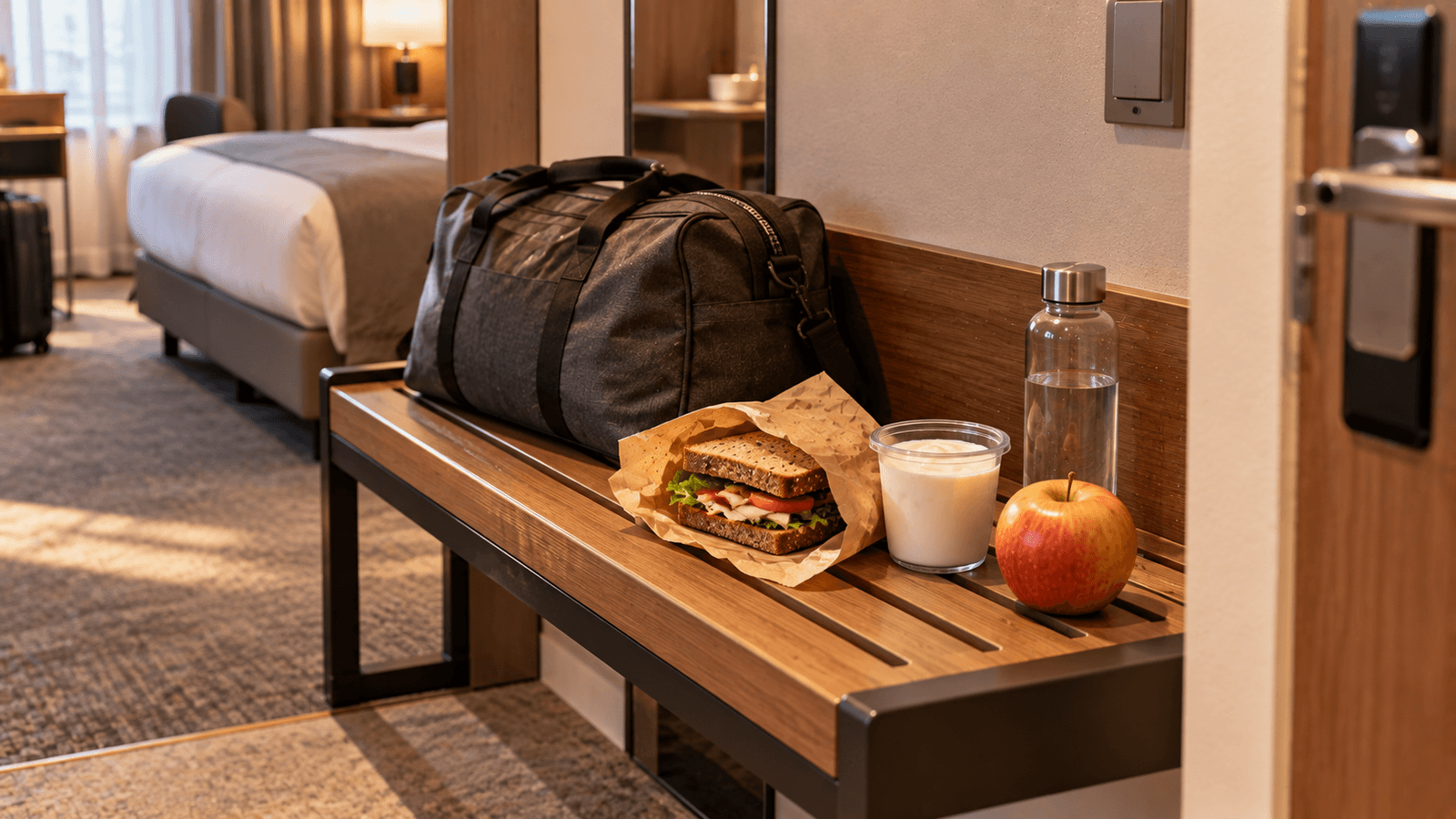
Travel changes many of the routines that normally make eating predictable.
Meal times shift. Airports limit your choices. Hotels may not have kitchens. Road trips create long gaps between stops. Breakfast may be a buffet, lunch may happen several hours late, and dinner may depend on where you happen to be.
If you are trying to lose weight, the useful goal is not to reproduce your normal routine perfectly while traveling.
It is to create enough structure that a few unusual days do not turn into completely unstructured eating.
Start by identifying what the trip will actually disrupt
Different trips create different food problems.
Before deciding what to eat, ask what will change.
| Travel situation | Likely challenge | Useful preparation |
|---|---|---|
| Early flight | Breakfast happens much earlier than usual | Decide whether to eat before leaving or at the airport |
| Long airport wait | Food is available constantly | Choose a planned meal instead of repeated snacks |
| Road trip | Long gaps between suitable stops | Carry one or two practical backup foods |
| Hotel without kitchen | Limited meal preparation | Identify supermarket and simple ready-to-eat options |
| Hotel breakfast | Large number of choices | Build one normal breakfast before considering extras |
| Sightseeing day | Meals become unpredictable | Keep a portable snack available |
| Business trip | Restaurant meals are frequent | Keep breakfast and daytime meals relatively predictable |
| Time-zone change | Hunger appears at unusual times | Use local meal times gradually rather than chasing a perfect schedule |
This makes travel planning much more specific than simply telling yourself to “eat healthy.”
Do not try to make travel days identical to normal days
Your usual meal pattern may not fit a day involving:
- a 5 a.m. departure
- several hours on a train
- airport security
- a delayed flight
- a long drive
- hotel check-in
- a different time zone
Trying to preserve every normal eating time can make the trip harder.
Instead, decide which parts of your routine are worth protecting.
For example:
- keep breakfast predictable
- carry one backup snack
- choose one substantial lunch
- allow dinner to remain flexible
That is often more realistic than trying to control every meal.
Use anchor meals
An anchor meal is one meal that remains relatively predictable even when the rest of the day changes.
For many travelers, breakfast is easiest.
A simple hotel breakfast might be:
- eggs
- yogurt or skyr
- fruit
- oats or bread
- coffee or tea
For someone else, lunch may be the anchor.
The point is not that a specific breakfast is required for weight loss.
The point is that one predictable meal reduces the number of food decisions you need to make during an unpredictable day.
Before leaving home: make three decisions
You do not need to plan every calorie of the trip.
Decide three things:
1. What will you eat during the journey?
Will you:
- eat before leaving?
- buy breakfast after security?
- take food for the train?
- stop for lunch during the drive?
2. What is your backup food?
Choose something that travels reasonably well and that you actually like.
Examples can include:
- fruit
- a simple sandwich
- yogurt when refrigeration is available
- a measured portion of nuts
- a protein-rich snack
- whole-grain crackers
- another convenient food that fits your needs
3. What happens after arrival?
Know whether you are likely to:
- eat at a restaurant
- buy groceries
- use hotel food
- prepare something in an apartment
This prevents arrival hunger from becoming the first time you think about food.
Airport strategy: choose a meal, not a sequence of snacks
Airports can create an unusual situation: you may spend several hours surrounded by food without having a normal meal.
That can turn into:
coffee → pastry → snack → another drink → sandwich → something on the plane
None of those foods is automatically a problem.
The issue is that several small purchases can unintentionally become much more food than one deliberate meal.
If you have enough time, choose a recognizable meal.
For example:
- sandwich + fruit
- yogurt + oats + fruit
- eggs + bread + vegetables
- rice or grain bowl with a protein source
- soup + sandwich
The exact choice depends on what is available.
If the flight is delayed
A delay can destroy a carefully planned meal schedule.
Do not treat that as a failed day.
Ask:
- Am I actually hungry?
- How long until I can reasonably expect the next meal?
- Do I need a snack, or would a full meal make more sense?
- What food is realistically available?
If dinner is now five hours away, a substantial snack may be useful.
If boarding is in 30 minutes and a meal will be served soon afterward, the decision may be different.
Do not save all your calories for the destination
Some travelers deliberately eat almost nothing during the day because they expect a large restaurant dinner.
That can work for some people, but it can also create intense hunger by evening.
A more moderate structure might be:
- normal breakfast
- lighter but substantial lunch
- optional snack if needed
- flexible dinner
This gives you room for a larger evening meal without requiring extreme restriction beforehand.
Road trips need a different strategy
The main problem on a road trip is not restaurant menus.
It is availability.
You may have:
- one petrol station for the next hour
- a long motorway section
- children or other passengers changing the schedule
- an arrival time that keeps moving
A small travel food kit can reduce dependence on the next available shop.
A practical road-trip kit
Depending on storage and temperature, it might include:
- water
- fruit
- sandwiches
- portioned nuts
- crackers
- yogurt in a cooler
- cut vegetables
- another portable protein source
The goal is not to bring enough food for the entire holiday.
It is to prevent one delayed stop from turning into a situation where you are extremely hungry and have only one option.
Petrol stations and convenience stores
A convenience store does not require a perfect choice.
Look for combinations rather than one supposedly ideal product.
For example:
Option 1
- sandwich
- fruit
- water
Option 2
- yogurt
- banana
- small portion of nuts
Option 3
- ready-made salad
- protein-containing item
- bread or another carbohydrate source
Option 4
- simple packaged meal
- fruit or vegetables if available
A combination that functions as a meal can be more useful than repeatedly buying small snack foods.
Hotel without a kitchen
No kitchen does not mean every meal must come from a restaurant.
Depending on local stores and hotel facilities, simple options may include:
- yogurt or skyr
- fruit
- bread
- cottage cheese
- ready-cooked eggs
- canned beans
- pre-cut vegetables
- simple salads
- ready-cooked grains
- prepared chicken or another protein source
- soup
Check whether the room has:
- a refrigerator
- kettle
- microwave
- cutlery
- bowls or cups
Even a refrigerator can substantially expand your options.
Hotel with only a kettle
A kettle is limited, but it can still support simple food.
Depending on local products, you might combine:
- instant plain oats
- yogurt
- fruit
- bread
- pre-cooked eggs
- ready-to-eat protein foods
The purpose is not to cook elaborate meals in a hotel room.
It is to create one or two predictable eating opportunities.
Hotel breakfast buffet: build the first plate deliberately
Buffets make it easy to choose food in several rounds simply because it is available.
A useful approach is to build one ordinary breakfast first.
For example:
- eggs or yogurt
- fruit
- bread or oats
- vegetables if available
- coffee or tea
Then decide whether you actually want something else.
This is different from starting with the assumption that you must avoid pastries, local foods or dessert.
If there is something you specifically want to try, include it deliberately rather than eating several extras simply because they are included in the room price.
The “I paid for it” problem
Hotel breakfasts and all-inclusive meals can create pressure to maximize how much food you receive for the price.
But the economic value of a buffet does not increase because you eat past comfortable fullness.
You already paid for access to the meal.
You do not need to extract the maximum number of calories from it.
Apartment or holiday rental
A kitchen gives you more control, but you do not need to recreate your entire home pantry.
For a short stay, buy ingredients that can work in several meals.
Example:
- eggs
- yogurt
- oats
- bread
- fruit
- vegetables
- potatoes or rice
- beans
- one or two protein sources
From that small list you can build breakfasts, simple lunches and some dinners without buying twenty ingredients that will be left behind.
A three-day hotel example
Imagine a three-day city trip with hotel breakfast and restaurant dinners.
A simple structure could look like this:
| Meal | Day 1 | Day 2 | Day 3 |
|---|---|---|---|
| Breakfast | eggs, bread, fruit | yogurt, oats, fruit | eggs, bread, yogurt |
| Lunch | sandwich + salad | soup + bread | grain bowl |
| Backup | fruit | yogurt | nuts + fruit |
| Dinner | flexible restaurant meal | flexible restaurant meal | flexible restaurant meal |
This is not a mandatory meal plan.
It illustrates how a few predictable choices can leave dinner flexible.
Sightseeing days: prevent accidental six-hour gaps
When you are walking around a new city, hunger can be easy to ignore until it becomes intense.
You may leave breakfast at 9:00, visit several places, and suddenly realize at 15:30 that you have not eaten.
A small backup snack gives you options.
It does not mean you must eat it.
It means you do not have to choose your next meal while extremely hungry.
Walking more does not require “earning” food
Travel often increases daily walking.
That may change energy expenditure, but it is difficult to estimate precisely from sightseeing alone.
Avoid turning every additional step into a calculation such as:
“I walked a lot, so I can eat anything tonight.”
The reverse is also unnecessary:
“I ate a large dinner, so I need to walk it off.”
Treat movement as part of the trip rather than a system of earning and compensating for food.
Restaurant meals during travel
Restaurants may be a major part of a trip, especially when experiencing local food is one of the reasons you are traveling.
You do not need to avoid them.
For detailed restaurant-specific strategies, see How to Eat Out While Trying to Lose Weight.
For travel itself, the more useful question is:
Which meals need structure so that restaurant meals can remain flexible?
If dinner is the main social or culinary event, breakfast and lunch can be relatively predictable without being extremely restrictive.
Local food is part of travel
Trying a regional dish is not a failure of a weight-loss plan.
Decide what is genuinely worth trying.
There is a difference between:
- deliberately ordering a local specialty you are excited about
and
- repeatedly eating food you do not particularly want simply because you are “on holiday.”
Spend flexibility on the experiences that matter to you.
Alcohol can become more frequent while traveling
Travel can change drinking patterns because alcohol appears at:
- airport lounges
- hotel bars
- dinners
- events
- celebrations
Alcohol contains energy and can also make food decisions less deliberate.
You do not need a special travel rule, but it can help to decide whether drinking is actually important to the occasion rather than treating every travel day as an automatic reason to drink.
Time-zone changes can distort hunger cues
After crossing time zones, your internal schedule may not immediately match local meal times.
You might feel hungry at unusual hours or have little appetite at a normal local meal.
Instead of trying to force an exact schedule immediately, use a few local anchors:
- morning light and breakfast
- local lunch window
- local dinner window
- normal sleep timing as practical
Your eating pattern can gradually move toward the destination schedule.
What if you wake up hungry at 4 a.m.?
If your body still expects food according to another time zone, unusual hunger is not surprising.
You can decide based on the situation rather than treating the clock as a rule.
A small snack may make sense if you are genuinely hungry and breakfast is hours away.
As your schedule adapts, the pattern may normalize.
Tracking food while traveling
Travel meals are often harder to track precisely.
You may not know:
- exact portion weights
- oil quantities
- recipe ingredients
- restaurant serving sizes
That does not make tracking useless.
Use the best information available.
A practical hierarchy is:
- official nutrition information when available
- a close database match
- ingredient-by-ingredient estimate
- photo or visual estimate
- a reasonable generic entry
The goal is useful consistency, not fictional precision.
When tracking becomes too burdensome
You do not have to spend your trip trying to reconstruct every gram.
A lighter approach can be:
- track the main meals
- estimate restaurant meals
- ignore tiny ingredients that cannot reasonably be identified
- keep portions visually consistent
- return to normal tracking after the trip
A slightly uncertain log can still be more informative than abandoning the entire routine because exact data are unavailable.
A simple travel meal decision system
When your original plan disappears, use four questions:
1. When is the next realistic eating opportunity?
Not the ideal one. The realistic one.
2. Am I choosing a snack or a meal?
Decide before buying.
3. Where is the protein or substantial main component?
This can make the choice more structured.
4. What do I actually want from this meal?
Sometimes the answer is convenience.
Sometimes it is fullness.
Sometimes it is a local specialty.
Knowing the purpose makes the decision easier.
If one day is much higher in calories than planned
Do not turn the next day into a punishment.
A large restaurant meal, buffet or celebration does not require:
- skipping all breakfast and lunch
- extreme exercise
- cutting calories dramatically
- abandoning the rest of the trip
Return to a normal eating structure at the next reasonable opportunity.
One unusual day and an entire week of unstructured eating are not the same thing.
The scale may rise during or after a trip
A short-term increase on the scale does not necessarily represent an equivalent increase in body fat.
Travel can change:
- sodium intake
- carbohydrate intake
- food volume
- hydration
- bowel routine
- sleep
- timing of weigh-ins
These can affect body weight temporarily.
If you normally track weight, compare trends after returning to your usual routine rather than drawing conclusions from one post-travel measurement.
What to do when the trip is mostly restaurants
Some trips genuinely involve restaurants for almost every meal.
In that case, do not attempt to turn the trip into a hotel-room meal-prep project.
Instead:
- keep portions intentional
- distinguish meals from constant snacking
- choose foods you actually value
- use simpler meals when convenient
- accept greater tracking uncertainty
Restaurant-specific decisions are covered separately in How to Eat Out While Trying to Lose Weight.
Business travel
Business trips often combine several challenges:
- early departures
- sitting for long periods
- catered meetings
- restaurant dinners
- alcohol
- irregular schedules
A useful structure might be:
Breakfast: predictable.
Meeting food: eat when it replaces a meal rather than automatically because it is present.
Backup snack: available for schedule changes.
Dinner: flexible.
This reduces the number of decisions you need to make without requiring perfect control.
All-inclusive holidays
An all-inclusive environment changes the decision from “Can I get food?” to “Food is always available.”
It can help to preserve normal meal boundaries.
For example:
- breakfast
- lunch
- optional snack
- dinner
rather than eating continuously because snacks, drinks and desserts are available throughout the day.
You can still choose foods specifically because you want to enjoy them.
The useful distinction is between intentional enjoyment and eating automatically because access is unlimited.
A practical minimum plan for almost any trip
If you do not want to plan much, decide only these five things:
- Your first travel-day meal
- One portable backup food
- Your likely breakfast setup
- Where you can buy basic food near your accommodation
- Which meals you want to leave completely flexible
That is often enough structure to make the rest of the trip easier.
After the trip: return to normal, not to compensation
When you get home, the most useful next step is usually simple:
Return to your normal meal pattern.
You do not need a detox, a crash diet or several days of unusually low intake because the trip was less structured.
Resume your normal groceries, meals and tracking routine.
Travel is a temporary change in environment.
Your long-term pattern is what continues after it.