
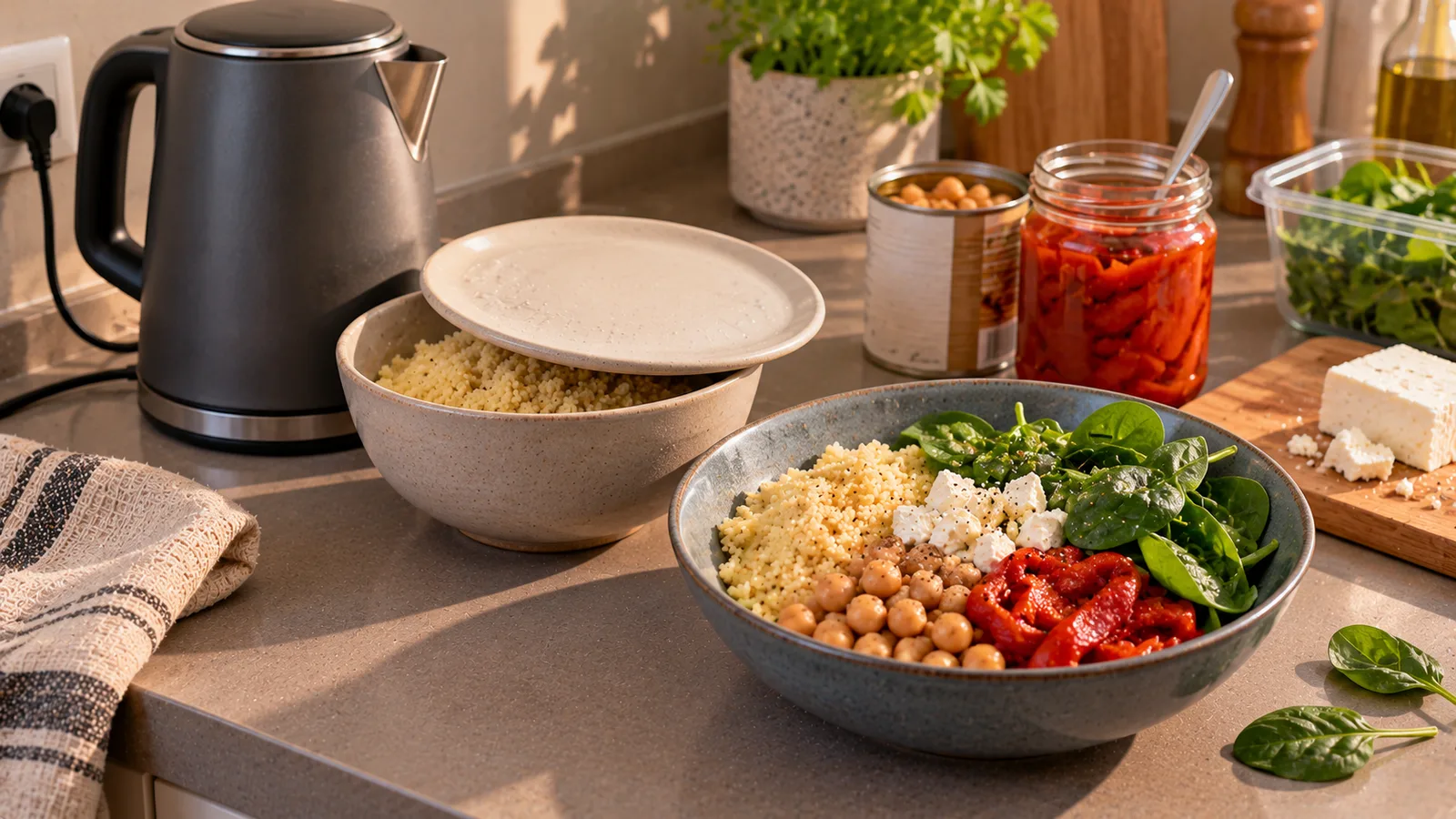
A kettle can do more than make tea.
If you are living in a hotel room, student accommodation, temporary housing or another place without a full kitchen, hot water can help turn simple foods into satisfying meals.
The limitation is important: a kettle is not a substitute for a stove. Foods that require thorough cooking should not be improvised inside an ordinary electric kettle unless the manufacturer specifically designed it for that purpose.
A better approach is to combine foods that are already safe to eat with ingredients intended to be prepared by adding boiling water.
What a kettle-only meal needs
Instead of searching for unusual "kettle recipes," start with a simple meal structure.
A practical balanced meal can combine:
- a protein source;
- a carbohydrate or other energy source;
- vegetables or fruit;
- a source of fat when appropriate.
Not every meal needs to fit an exact formula. The structure simply makes it easier to avoid building every meal around instant noodles or bread alone.
Foods that work well without conventional cooking
Useful foods fall into several groups.
Protein sources
Options can include:
- canned beans, chickpeas or lentils;
- canned tuna, salmon or other ready-to-eat fish;
- cooked packaged pulses;
- yogurt or skyr when refrigeration is available;
- cottage cheese or quark;
- ready-to-eat tofu;
- pre-cooked eggs sold for ready consumption;
- shelf-stable bean or lentil products.
Check the label to confirm whether a product is ready to eat.
Carbohydrate sources
Useful options include:
- couscous;
- instant oats;
- bread and wraps;
- crispbread;
- ready-to-eat grains;
- instant grain products specifically designed for hot-water preparation;
- fruit.
Couscous is particularly convenient because many varieties can be hydrated with boiling water rather than simmered.
Always follow the preparation instructions on the package.
Vegetables and fruit
A kettle is not required for many useful options:
- tomatoes;
- cucumber;
- peppers;
- carrots;
- salad leaves;
- fruit;
- canned vegetables;
- ready-to-eat cooked beetroot;
- vegetables specifically sold for hot-water preparation.
Frozen vegetables are less convenient without a stove or microwave because pouring hot water over them does not automatically guarantee adequate heating.
Fats and flavor
Small additions can make simple meals more satisfying:
- olive or rapeseed oil;
- nuts;
- seeds;
- nut butter;
- hummus;
- pesto;
- herbs;
- spices;
- lemon juice;
- vinegar.
Sauces and spreads can vary considerably in calories and salt, so the amount still matters when those nutrients are being tracked.
A useful kettle-only meal formula
A flexible formula is:
base + protein + produce + flavor
For example:
- couscous + chickpeas + tomatoes + olive oil and lemon;
- instant oats + yogurt + banana + nuts;
- bread + tuna + cucumber + hummus;
- couscous + ready-to-eat lentils + peppers + pesto.
This method is more flexible than relying on a fixed meal plan because ingredients can be changed according to budget, storage and availability.
Meal 1: chickpea couscous bowl
For one substantial serving:
- 70 g dry couscous;
- 120 g drained chickpeas;
- 100 g tomatoes;
- 80 g cucumber;
- 10 g olive oil;
- lemon juice;
- herbs or spices.
Preparation
Place the couscous in a heat-safe bowl.
Add the amount of boiling water specified on its package, cover and leave it for the recommended time.
Fluff the couscous and mix in the drained chickpeas, chopped vegetables, oil and seasoning.
The chickpeas should already be cooked and ready to eat. Do not use dry chickpeas and expect kettle water to cook them.
Meal 2: savory couscous with tuna
Combine:
- 70 g couscous;
- one appropriate portion of canned tuna;
- chopped tomato or pepper;
- a small amount of olive oil or another dressing;
- herbs, lemon juice or pepper.
Prepare the couscous according to the package instructions, then add the ready-to-eat ingredients.
If the tuna is packed in oil, decide whether you are consuming the oil before calculating or logging the portion.
Meal 3: oats, yogurt and fruit
Not every kettle meal has to be savory.
Try:
- 50 g instant or quick oats;
- hot water as needed;
- 150–200 g yogurt or skyr;
- one banana or another fruit;
- 15–20 g nuts or seeds.
Prepare the oats according to their package directions.
Let them cool somewhat before adding chilled yogurt if you prefer the textures to remain distinct.
This combination adds protein and fruit to what would otherwise be a plain bowl of oats.
Meal 4: lentil couscous
Use:
- 70 g couscous;
- 120–150 g ready-to-eat cooked lentils;
- chopped vegetables;
- 10 g oil or a measured dressing;
- herbs and spices.
The important distinction is that the lentils are already cooked.
Dry lentils generally require sustained cooking and should not be treated as an instant kettle food.
Meal 5: no-cook bread plate
The kettle does not have to be used at every meal.
A practical combination could include:
- whole-grain bread;
- cottage cheese, quark or hummus;
- tomatoes and cucumber;
- fruit;
- a small portion of nuts.
This can be easier than trying to convert every normal cooked dish into a kettle recipe.
Meal 6: quick oat and peanut butter breakfast
Combine:
- 50 g quick oats;
- boiling water according to package directions;
- 15–20 g peanut butter;
- sliced banana or apple;
- cinnamon.
For more protein, add an appropriate ready-to-eat dairy or fortified alternative alongside it.
Peanut butter is energy-dense, so measuring it can be useful if you track calories.
Meal 7: couscous with beans and salsa
Use:
- 70 g couscous;
- 120 g drained ready-to-eat beans;
- salsa;
- chopped pepper or tomato;
- optional avocado.
Prepare only the couscous with boiling water.
The beans should be canned or otherwise fully cooked and suitable for direct consumption.
This creates a simple meal without trying to cook beans from dry.
What not to cook in a standard kettle
An electric kettle is designed primarily to heat water.
Unless its manufacturer explicitly says otherwise, avoid putting foods directly into the kettle.
That includes:
- raw meat;
- raw poultry;
- raw fish;
- eggs;
- pasta;
- rice;
- soup mixtures;
- milk;
- sauces.
Cooking food directly inside an unsuitable kettle can create problems with cleaning, temperature control, electrical components and food safety.
Heat the water in the kettle and prepare suitable foods in a separate heat-safe container.
Boiling water does not make every food safe
A common mistake is assuming that pouring boiling water over an ingredient is equivalent to cooking it properly.
It is not.
The water begins cooling as soon as it leaves the kettle. The food and container lower the temperature further.
Some foods require sufficient time at appropriate temperatures to cook safely and properly.
Do not improvise hot-water preparation for foods whose instructions require boiling, frying, baking or another cooking method.
Follow the package instructions
Products designed for hot-water preparation normally provide instructions for:
- water quantity;
- standing time;
- whether the container should be covered;
- stirring;
- preparation temperature.
Follow those instructions rather than assuming all instant foods behave the same way.
This is especially important for dried products.
Refrigeration changes your options
If you have a refrigerator, kettle-only eating becomes much easier.
You can keep foods such as:
- yogurt;
- skyr;
- quark;
- cottage cheese;
- hummus;
- opened canned foods transferred to appropriate containers;
- ready-to-eat cooked pulses;
- salad vegetables;
- some ready-to-eat protein foods.
Without refrigeration, choose products that are shelf-stable before opening and buy perishable foods in quantities you can safely consume.
Do not keep foods that require refrigeration at room temperature simply because you have no cooking facilities.
Think about storage before buying
A kettle solves only the heating problem.
It does not solve:
- refrigeration;
- safe storage;
- washing produce;
- food preparation surfaces;
- leftovers.
Before buying a large container, ask whether it can be stored safely after opening.
Single-serve or smaller packages may sometimes be more practical when refrigeration is limited, even if their unit price is higher.
Protein is often the missing component
A kettle-only diet can easily become dominated by:
- instant noodles;
- bread;
- oats;
- crackers;
- couscous.
These foods can be useful, but relying on them alone may produce meals with relatively little protein.
Add an intentional protein source such as:
- beans;
- lentils;
- fish;
- yogurt;
- skyr;
- quark;
- cottage cheese;
- tofu;
- hummus.
The appropriate amount depends on the person and the rest of the diet; there is no need to force every meal into a high-protein format.
Vegetables do not need to be hot
Limited cooking equipment does not mean vegetables must disappear from the diet.
Raw or ready-to-eat options can be simpler than attempting to cook vegetables with kettle water.
Examples include:
- cherry tomatoes;
- cucumber;
- peppers;
- carrots;
- salad leaves.
Fruit is another convenient option because it requires little or no preparation.
Canned foods are useful—but read the label
Canned beans, lentils, vegetables and fish can be especially useful in limited kitchens because many are already cooked.
Check:
- whether the product is ready to eat;
- net and drained weight;
- salt or sodium;
- packing liquid;
- storage instructions after opening.
If you discard brine or oil, use the appropriate drained amount when tracking the food.
Instant noodles can be improved
Instant noodles are convenient with a kettle, but the packet alone does not have to be the entire meal.
Depending on the product and available storage, you can add ready-to-eat ingredients such as:
- cooked beans;
- ready-to-eat tofu;
- sliced vegetables;
- pre-cooked protein.
Be cautious about adding raw ingredients that require cooking.
Seasoning sachets can also contain substantial salt, so using the whole packet is not obligatory if you prefer less seasoning.
Build variety from a small ingredient set
You do not need dozens of foods.
For example, a small shopping list might include:
- couscous;
- instant oats;
- whole-grain bread;
- canned chickpeas;
- canned tuna;
- yogurt or skyr if refrigerated;
- tomatoes;
- cucumber;
- carrots;
- bananas;
- apples;
- nuts;
- olive oil;
- lemon;
- herbs or spices.
These ingredients can produce breakfasts, cold meals and hot-water meals without requiring a conventional kitchen.
Example one-day structure
A kettle-only day could look like this:
Breakfast
Instant oats with yogurt, banana and nuts.
Lunch
Couscous with chickpeas, tomato, cucumber and olive oil.
Snack
Fruit with yogurt or a small portion of nuts.
Dinner
Couscous or bread with tuna, vegetables and hummus.
This is an example of meal construction, not a personalized calorie prescription.
Portions should be adjusted according to appetite, energy needs and the foods available.
If you track calories or macros
Kettle-only meals can be logged using the same principles as other meals.
For packaged foods, check whether nutrition is given:
- per 100 g;
- per 100 ml;
- per serving;
- as sold;
- as prepared.
For couscous, oats and similar foods, be especially clear about whether the database entry refers to dry or prepared weight.
If you weigh 70 g of dry couscous, use an entry corresponding to dry couscous rather than 70 g of cooked couscous.
Water adds weight but not calories.
Example: why dry versus prepared weight matters
Suppose you prepare 70 g of dry couscous with water.
After hydration, it may weigh substantially more.
The extra weight mainly comes from absorbed water.
If you log the finished weight against a dry-food database entry, calories can be greatly overstated.
Either:
- log the original dry quantity;
- or use a database entry specifically describing prepared couscous.
Keep the state of the food and the database entry consistent.
Food safety matters more with limited facilities
A restricted kitchen can make safe handling harder.
Useful habits include:
- wash hands before food preparation;
- use clean utensils and containers;
- follow package preparation instructions;
- refrigerate foods that require refrigeration;
- avoid leaving perishable leftovers at room temperature;
- keep raw foods requiring cooking separate from ready-to-eat foods;
- do not rely on kettle water to make unsuitable raw foods safe.
If safe storage is not available, choose foods that fit the facilities you actually have.
A kettle is a tool, not a complete kitchen
The easiest way to eat well with only a kettle is not to imitate a stove.
Use the kettle for what it does reliably: producing hot water.
Then build meals from:
- foods specifically designed for hot-water preparation;
- ready-to-eat proteins;
- bread and other no-cook staples;
- raw or ready-to-eat vegetables;
- fruit;
- measured fats, nuts, seeds and spreads.
This approach gives you far more practical combinations while avoiding unsafe improvised cooking methods.
Practical checklist
Before preparing a kettle-only meal, ask:
- Is every ingredient either ready to eat or specifically suitable for hot-water preparation?
- Am I following the package preparation instructions?
- Does the meal contain a useful protein source?
- Can I add vegetables or fruit?
- Do opened ingredients require refrigeration?
- Can leftovers be stored safely?
- If tracking nutrition, am I using the correct dry, cooked, drained or prepared weight?
A kettle cannot replace a full kitchen, but it can support a surprisingly flexible food routine when meals are built around safe, appropriate ingredients.
Sources
- European Food Safety Authority (EFSA), consumer information on food safety and nutrition.
- German Federal Institute for Risk Assessment (BfR), consumer guidance on food hygiene and safe food handling.
- German Federal Centre for Nutrition (BZfE), practical food, nutrition and food-storage guidance.
- U.S. Food and Drug Administration (FDA), safe food handling guidance.
- USDA FoodData Central, reference food composition data.