
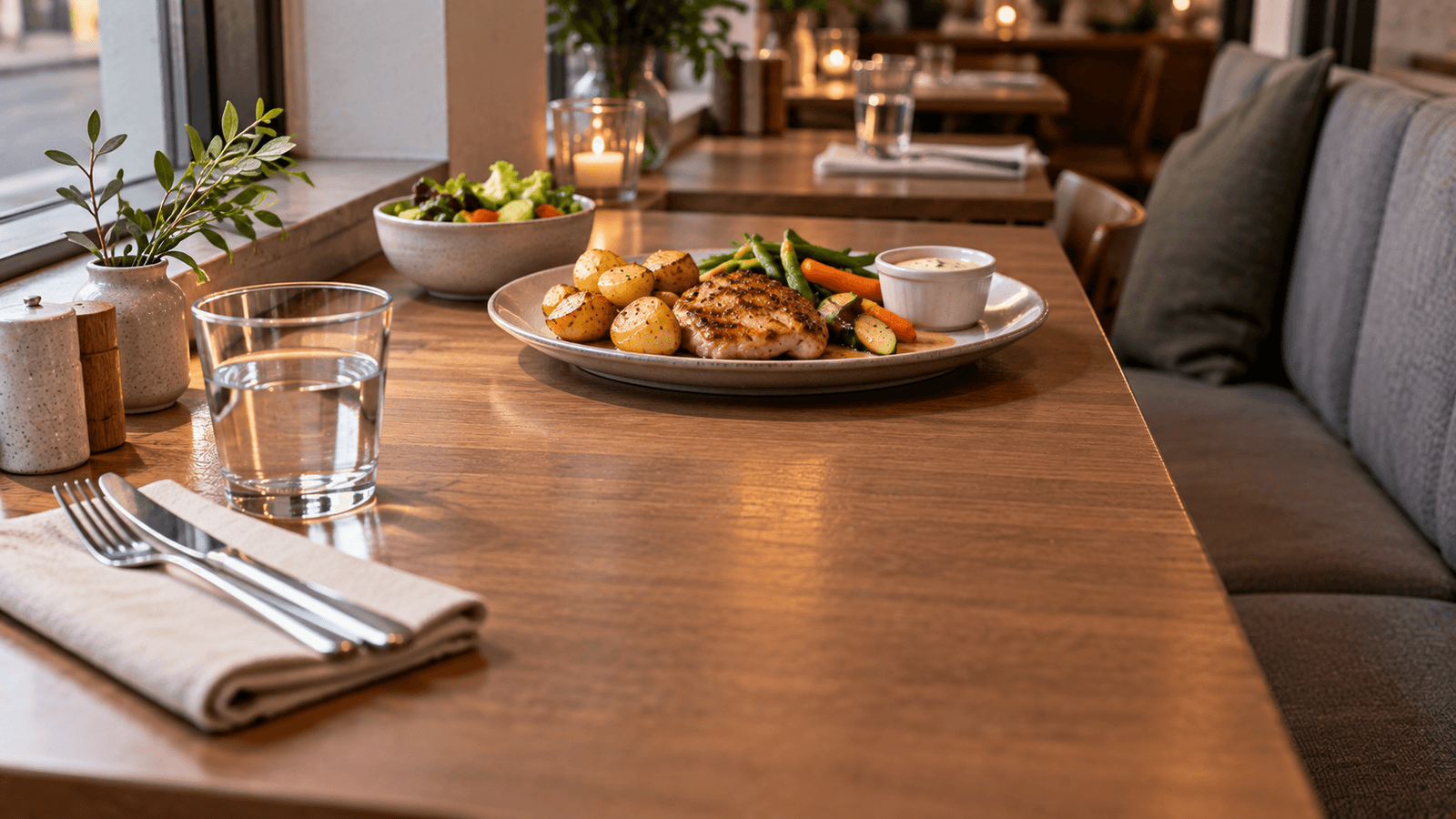
Eating out does not have to stop when you are trying to lose weight.
Restaurant meals can be harder to estimate than meals prepared at home, but weight loss depends on your overall pattern over time rather than making every individual meal perfectly predictable.
The goal is therefore not to find the lowest-calorie item on every menu.
A more practical goal is to enjoy the meal while making a few decisions that keep the portion and total energy intake reasonably aligned with your plan.
Before you go: decide how much structure you actually need
A casual lunch, a weekly restaurant dinner and a special celebration do not necessarily need the same strategy. (CDC — Steps for Losing Weight)
Ask yourself:
- Is this an ordinary meal or a special occasion?
- Is calorie information available?
- Will the restaurant portion probably be large?
- Do I want an appetizer, main course, dessert or drinks?
- Which part of the meal matters most to me?
This prevents a common problem: ordering several extras automatically and only thinking about the total after the meal.
Check the menu before arriving when practical
If the restaurant publishes its menu online, a quick look beforehand can reduce last-minute decisions.
You do not need to choose the supposedly “healthiest” dish.
Instead, identify two or three meals that seem compatible with your goal.
Useful clues include:
- cooking method
- main protein source
- size of the starch portion
- vegetables or salad included
- creamy or oil-rich sauces
- fried or breaded components
- calorie information, when provided
Official weight-management guidance from organizations such as NIDDK and CDC also recommends planning ahead and using available menu information when eating out.
Do not arrive extremely hungry on purpose
Skipping most of the day to “save calories” for dinner can make the restaurant meal harder to manage for some people.
If dinner is unusually late, eating normal earlier meals or a modest snack may make it easier to choose deliberately instead of ordering while extremely hungry.
The objective is not to eat extra food before the restaurant. It is to avoid creating a situation where hunger makes your original plan difficult to follow.
Build the meal around what matters most
Restaurant meals often contain several calorie-dense components at once:
- large main course
- bread or chips
- appetizer
- rich sauce
- side dish
- caloric drinks
- dessert
You do not have to remove all of them.
Instead, choose deliberately.
For example:
| If this matters most | You could simplify elsewhere |
|---|---|
| Main course | Skip an unnecessary appetizer |
| Dessert | Choose a simpler main meal |
| Wine or another caloric drink | Keep other extras modest |
| Fries or another favorite side | Choose a less rich sauce |
| Rich restaurant specialty | Keep the rest of the meal simple |
This is usually more sustainable than trying to order a meal you do not actually want.
Use the main dish as your anchor
A useful restaurant meal often becomes easier to manage when the main dish has a clear structure:
- a protein source
- vegetables or another high-volume component
- a carbohydrate source if desired
- sauces, oils and extras in an amount that fits the meal
Examples could include:
- grilled fish + potatoes + vegetables
- chicken + rice + salad
- tofu + vegetables + noodles
- steak + vegetables + baked potato
- bean-based dish + rice + vegetables
There is no requirement to avoid rice, pasta, bread or potatoes simply because you are losing weight.
Portion size and the complete meal matter more than assigning one ingredient to a “good” or “bad” category.
Restaurant portions may be larger than you need
The amount served by a restaurant is not automatically the amount you need to finish.
NIDDK notes that restaurant portions can exceed one serving and suggests strategies such as sharing a meal or taking part of it home.
You can:
- stop when comfortably satisfied
- leave part of the starch or side
- share a large dish
- ask for part of the meal to be packed
- choose a smaller option when one exists
You do not need to estimate the exact percentage left on the plate for this to be useful.
Sauces and oils deserve attention
One of the hardest parts of estimating restaurant meals is that some calories are not visually obvious.
A dish may contain:
- cooking oil
- butter
- mayonnaise
- creamy sauce
- dressing
- glaze
- cheese
- pesto
- finishing oil
This does not make those ingredients forbidden.
It simply means that a dish that looks relatively simple can contain more energy than the visible meat, vegetables or starch suggest.
If you want more control, you can ask for dressing or sauce on the side when that suits the dish.
For tracking specifically, see How to Track Restaurant Meals With Less Manual Entry.
Cooking words can provide useful clues
Menu descriptions are imperfect, but preparation terms can help you understand the dish.
Often more straightforward to estimate:
- grilled
- baked
- steamed
- roasted
- poached
Potentially more variable in added fat or energy:
- fried
- breaded
- battered
- creamy
- crispy
- glazed
- buttered
This is not a rule that grilled food is always low calorie or fried food can never fit.
A grilled dish can still contain substantial oil or sauce, and a small fried portion can fit within an overall plan.
Use the description as information, not as a moral label.
What if calories are listed on the menu?
Use them as a planning tool.
You can compare two dishes, understand the approximate scale of a meal and decide whether extras still fit.
But a menu number does not mean you have to choose the lowest-calorie item.
For example, if one meal is more satisfying and still fits reasonably within your day, it may be a more practical choice than a smaller option followed by several unplanned snacks.
What if calories are not listed?
You do not need an exact number to make a useful decision.
Break the meal into components:
- protein or main ingredient
- starch or grain
- vegetables
- sauce or cooking fat
- toppings
- drinks
- appetizer or dessert
Then estimate the components that are likely to contribute most.
Do not spend excessive effort estimating a few lettuce leaves while ignoring a generous creamy dressing or several tablespoons of oil.
Example: estimating an unknown restaurant meal
Suppose you order grilled chicken, roasted potatoes, vegetables and a creamy sauce.
Instead of searching for one database entry called “restaurant chicken dinner,” think about:
- chicken portion
- potato portion
- vegetables
- likely cooking oil
- sauce amount
The estimate will still contain uncertainty.
That is normal.
For weight management, a reasonable repeatable estimate is often more useful than pretending an unknown restaurant recipe can be reconstructed exactly.
Drinks can change the meal substantially
Calories from drinks are easy to overlook because they do not change the amount of food on the plate.
Depending on what you choose, the meal may also include:
- soft drinks
- juice
- sweetened coffee
- cocktails
- beer
- wine
Water and unsweetened drinks can keep the meal simpler when the drink itself is not important to you.
If you do want a caloric drink, include it as part of the meal rather than treating it as invisible.
Appetizers, bread and table snacks
Food arriving before the main meal can add substantially to the total without being the part of the restaurant experience you value most.
Examples include:
- bread with butter or oil
- tortilla chips
- fried appetizers
- shared starters
You do not need a blanket rule against them.
Ask whether you actually want that food.
If the answer is yes, have it deliberately.
If you are eating it only because it is sitting on the table, it may be an easy place to simplify the meal.
Dessert can fit too
Trying to lose weight does not require never ordering dessert.
Possible approaches include:
- order the dessert you actually want and keep the main meal simpler
- share dessert
- choose a smaller dessert
- have dessert and accept that this particular meal is larger than usual
The last option is also valid.
One restaurant dinner does not need to be “corrected” through extreme restriction.
What to do with the rest of the day
There is a difference between planning and compensation.
Planning might mean knowing you have dinner out and choosing fairly ordinary meals earlier in the day.
Extreme compensation might mean skipping food for most of the day or trying to “earn” the restaurant meal with excessive exercise.
The first can be a practical way to manage daily intake.
The second can make the eating pattern harder to sustain.
Keep the day reasonably normal.
Example of a restaurant day
Suppose dinner is at 19:30.
A practical day might look like:
Breakfast: normal breakfast with protein and fruit
Lunch: regular balanced lunch
Afternoon: optional small snack if dinner is late
Dinner: restaurant main course and the extras you deliberately choose
The important feature is not the exact foods.
It is that dinner does not begin after an entire day of unnecessary deprivation.
Buffets require a different strategy
Buffets remove the natural stopping point created by ordering one meal.
If you eat at one, decide what you genuinely want before repeatedly returning for more food.
A simple approach:
- look at the available food first
- choose one main plate intentionally
- eat it before deciding whether you want more
- return only for something you still genuinely want
You do not need to sample everything simply because it is available.
Fast food can also fit
The same principles apply.
Look at the complete order rather than a single item.
A burger may be accompanied by:
- large fries
- caloric drink
- sauce
- dessert
If you want the burger most, you can adjust the size or choice of the other components.
Weight-loss decisions at restaurants are often about the combination rather than banning a specific food.
Social meals are not just nutrition problems
Sometimes the purpose of eating out is:
- seeing friends
- celebrating
- trying a particular restaurant
- enjoying a special dish
- spending time with family
Your strategy should leave room for that purpose.
A plan that technically minimizes calories but makes every restaurant visit stressful is unlikely to be useful long term.
If you eat out several times per week
Frequency changes the strategy.
An occasional large restaurant meal has a different impact from restaurant lunches and dinners occurring most days.
If you eat out frequently, build repeatable defaults.
For example:
- two or three reliable lunch orders
- a usual drink
- a familiar portion strategy
- sauce on the side when useful
- a standard way to track uncertain meals
You then need fewer decisions each time.
If you eat out only occasionally
You may need much less structure.
If most of your meals support your goal, an occasional restaurant meal can simply be a more flexible meal.
Trying to optimize every component may provide little benefit while making the experience less enjoyable.
What if you eat more than planned?
Continue normally at the next meal.
There is no need to turn one larger dinner into several days of severe restriction.
A restaurant meal can also temporarily increase scale weight because of food mass, carbohydrate intake, sodium and associated water.
That does not mean the entire change on the scale is body fat.
Judge progress using trends rather than the morning after one meal.
A simple restaurant decision system
When you want structure without tracking every detail, use these five questions:
- What do I actually want from this meal?
- Where is the main protein or substantial component?
- Is the portion much larger than I need?
- Which sauces, oils, drinks or extras matter enough to keep?
- Can I finish comfortably satisfied rather than automatically clearing the plate?
That is enough for many restaurant meals.
If you track calories
Restaurant tracking should acknowledge uncertainty.
Use available menu nutrition information when possible.
Otherwise:
- log the main components
- include obvious sauces and cooking fats
- estimate the portion realistically
- use a comparable restaurant entry when appropriate
- avoid false precision
If you regularly order the same dish, save or reuse the estimate rather than rebuilding it from zero every time.
The dedicated restaurant-tracking workflow is covered in How to Track Restaurant Meals With Less Manual Entry.
The goal is consistency, not restaurant avoidance
Eating out while losing weight becomes easier when you stop treating restaurant food as an exception that must be either perfectly controlled or completely unrestricted.
Plan enough to make the meal fit your broader pattern.
Pay attention to portions and calorie-dense extras when they matter.
Choose the foods you actually want.
Then return to your normal routine afterward.
That makes restaurant eating part of a sustainable weight-management strategy rather than something that has to wait until the diet is over.