
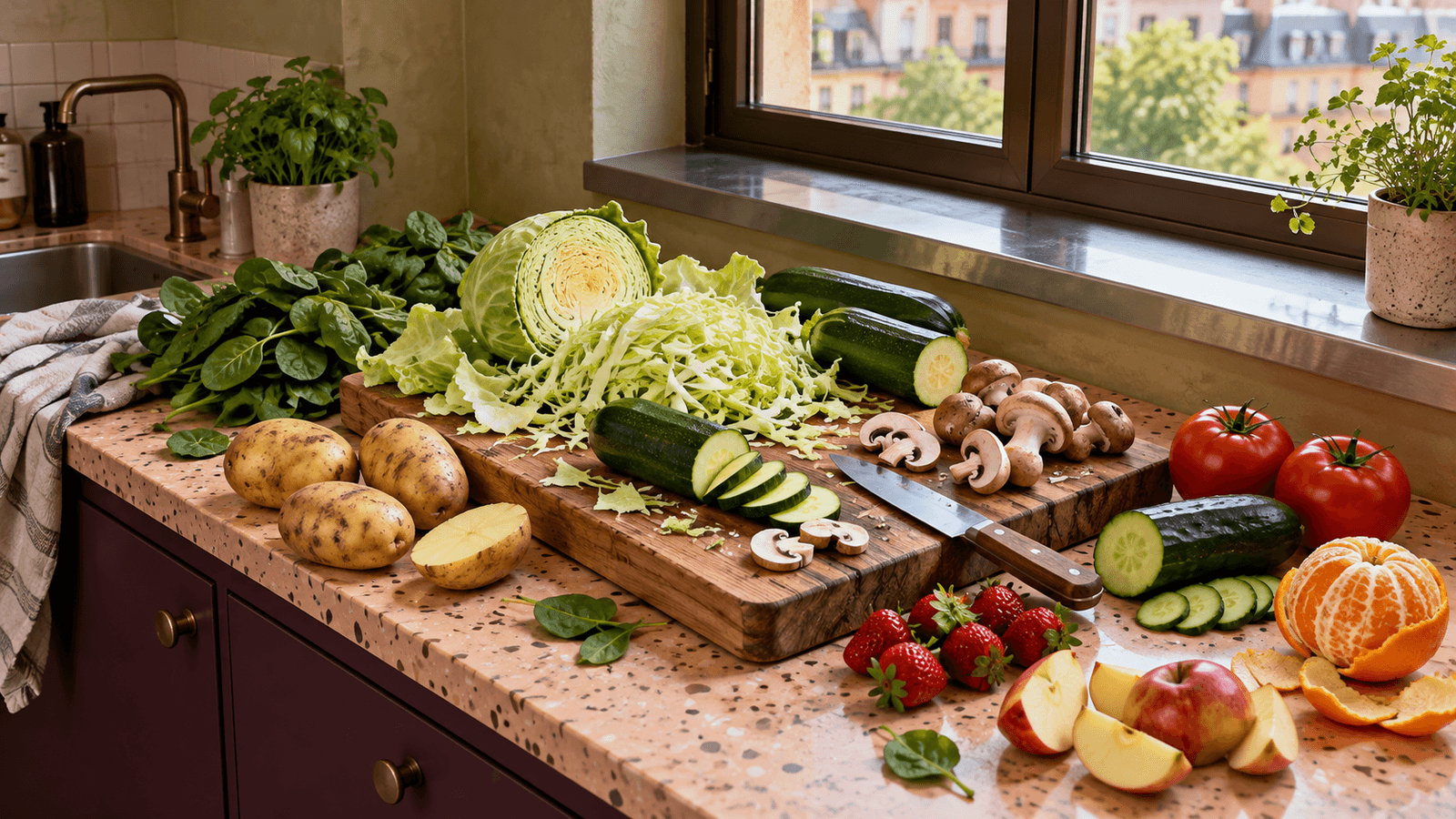
High-volume foods let you eat a physically larger amount of food without necessarily consuming a large number of calories.
This can be useful during weight loss because reducing calories does not automatically mean every meal needs to look small.
Foods with a high water content, plenty of vegetables, fruit, soups and other relatively low-energy-density foods can increase the physical volume of a meal.
The result can be a more generous-looking and often more satisfying way to structure a calorie deficit.
The important idea is not to eat the largest possible quantity of food.
It is to use food volume strategically so that your eating pattern remains practical and enjoyable.
What are high-volume foods?
High-volume foods are foods that provide a relatively large physical amount for their calorie content.
This is closely related to energy density.
Energy density describes how many calories a food provides relative to its weight.
Foods containing a lot of water or fiber often have lower energy density.
Examples include:
- many vegetables
- many fruits
- broth-based soups
- potatoes prepared with moderate added fat
- low-fat dairy products
- some lean protein foods
- air-popped popcorn
By contrast, foods high in fat or with very little water can provide many calories in a relatively small amount.
That does not make them unhealthy.
It simply means their portion size can contribute more calories with less physical volume.
Why food volume can matter during weight loss
Weight loss requires a sustained calorie deficit over time.
But the experience of that deficit matters.
If your meals become dramatically smaller, you may find the eating pattern difficult to maintain.
Adding lower-energy-density foods can allow you to reduce calories without reducing meal size to the same degree.
For example, a meal can become physically larger by adding:
- vegetables
- salad ingredients
- fruit
- broth-based soup
- other water-rich foods
The goal is not to remove everything calorie-dense.
It is to create a better balance between calories and physical food volume.
High volume does not mean zero calories
A common misunderstanding is that high-volume foods can be eaten without limits.
They still contain calories.
The concept is relative.
A large portion of strawberries, for example, generally provides fewer calories than the same weight of many calorie-dense snack foods.
But the calories still count toward total intake.
High-volume eating works because some foods give you more physical food for a given calorie amount.
It does not eliminate energy balance.
Energy density explained simply
Imagine two foods with the same weight.
One contains a lot of water and relatively little fat.
The other contains little water and more fat.
The second food will often contain substantially more calories.
This is because:
- water adds weight and volume without adding calories
- fat provides more calories per gram than protein or carbohydrate
- fiber can add bulk and may support fullness
This is why vegetables, fruit and soups can occupy a lot of space while remaining relatively moderate in calories.
Vegetables
Vegetables are among the easiest ways to increase meal volume.
Examples include:
- broccoli
- cauliflower
- zucchini
- cucumber
- tomatoes
- mushrooms
- cabbage
- carrots
- peppers
- green beans
- leafy greens
- eggplant
They can be:
- roasted
- steamed
- grilled
- sautéed
- added to soups
- mixed into pasta dishes
- added to rice dishes
- incorporated into omelets
- used in sandwiches and wraps
Preparation matters.
Vegetables themselves may be relatively low in calories, but large amounts of oil, butter, cheese or creamy sauce can substantially increase the energy density of the final dish.
Fruit
Many fruits combine water, fiber, sweetness and substantial physical volume.
Examples include:
- strawberries
- watermelon
- melon
- oranges
- grapefruit
- apples
- peaches
- berries
- kiwi
Whole fruit generally provides more physical volume than juice.
Juice removes much of the structure of the whole fruit and is easier to consume quickly.
For someone using food volume to support fullness, whole fruit is usually more useful than drinking the equivalent calories.
Potatoes
Potatoes can fit very well into a high-volume eating pattern.
The potato itself is not exceptionally calorie-dense.
The final calorie content depends heavily on preparation.
Boiled or baked potatoes can provide substantial food volume.
Deep-fried potatoes or potatoes prepared with large quantities of oil, butter, cream or cheese can be much more calorie-dense.
This illustrates an important principle:
the same basic food can have very different energy density depending on how it is prepared.
Soups
Broth-based soups can provide considerable volume because much of the dish is water.
Useful ingredients can include:
- vegetables
- potatoes
- beans
- lentils
- lean meat
- chicken
- fish
- herbs
- broth
A soup can also be nutritionally substantial rather than simply being flavored water.
Protein, vegetables and a carbohydrate source can turn soup into a complete meal.
Cream-heavy soups may contain significantly more calories, so the specific recipe matters.
Lean protein foods
Protein is not automatically low in calories, but lean protein sources can provide useful food volume while helping you meet protein needs.
Examples include:
- chicken breast
- turkey breast
- lean fish
- tuna in water
- low-fat skyr
- low-fat Greek-style yogurt
- cottage cheese with lower fat content
- some lean cuts of meat
- tofu depending on type and preparation
Protein can also contribute to satiety, making it particularly useful when combined with high-volume vegetables and other foods.
Low-fat yogurt and skyr
Plain lower-fat yogurt and skyr can provide:
- protein
- substantial portion volume
- flexibility for sweet or savory meals
They can be combined with:
- fruit
- berries
- oats
- spices
- herbs
Check the specific product because calorie and protein content varies.
Sweetened products may contain more added sugar and calories.
Legumes
Beans, lentils and chickpeas are not among the lowest-calorie foods per gram, but they can still be valuable in filling meals.
They provide:
- protein
- carbohydrates
- fiber
- substantial food structure
They work particularly well when combined with vegetables and broth in:
- soups
- stews
- salads
- grain dishes
High-volume eating does not mean choosing only the foods with the absolute lowest calorie density.
Nutrition, protein, fiber, taste and practicality also matter.
Popcorn
Plain air-popped popcorn is a classic example of a food that occupies a large physical volume.
The situation changes when large amounts of:
- butter
- oil
- caramel
- sugar
are added.
If you enjoy crunchy snacks, relatively simply prepared popcorn can provide more physical volume than many compact snack foods.
Portion size and toppings still matter.
Egg whites and whole eggs
Egg whites provide protein with relatively few calories.
Whole eggs contain more calories because the yolk contains fat, but they also provide important nutrients.
You do not necessarily need to choose one or the other.
For example, a larger omelet can combine whole eggs with additional egg whites and vegetables.
This increases volume and protein while still including the yolks.
Oats
Oats absorb water during cooking.
That makes cooked oatmeal much larger in volume than the dry oats used to prepare it.
The calorie content depends on:
- amount of dry oats
- milk
- toppings
- nuts
- nut butter
- sugar
- honey
- chocolate
A large bowl is not automatically low in calories.
The ingredients determine the total.
How to make breakfast higher in volume
A higher-volume breakfast might combine:
- oats cooked with extra water
- fruit
- berries
- yogurt or skyr
Another option could be:
- eggs
- extra egg whites
- mushrooms
- tomatoes
- spinach
- bread or potatoes according to your needs
The goal is not simply to make breakfast huge.
It is to combine volume with protein and foods you actually enjoy.
How to make lunch higher in volume
Suppose your normal lunch is rice with chicken.
You could increase volume by adding:
- broccoli
- cabbage
- zucchini
- mushrooms
- peppers
- a broth-based vegetable side
The amount of rice and chicken can still fit your needs.
The vegetables increase the overall size of the meal without necessarily adding many calories.
How to make dinner higher in volume
The same principle works at dinner.
Start with the meal you already enjoy.
Then ask:
What can I add that provides useful volume?
Possibilities include:
- roasted vegetables
- steamed vegetables
- salad
- vegetable soup
- mushrooms
- cabbage
- zucchini
- cauliflower
You do not need a special "diet dinner."
You can modify ordinary meals.
Pasta dishes
Pasta itself is relatively compact compared with many vegetables.
Instead of replacing pasta entirely, you can combine it with:
- zucchini
- mushrooms
- tomatoes
- spinach
- eggplant
- peppers
- lean protein
This creates a larger finished dish while preserving actual pasta.
The result often feels more like a normal meal than replacing pasta with a vegetable substitute entirely.
Rice dishes
Rice can be combined with high-volume ingredients such as:
- cauliflower
- cabbage
- mushrooms
- carrots
- peas
- zucchini
- broccoli
Again, the goal does not need to be eliminating rice.
It can simply be changing the ratio of ingredients.
Sandwiches and wraps
Sandwiches and wraps can gain volume through:
- lettuce
- tomato
- cucumber
- cabbage
- peppers
- pickles
- lean protein
Be aware that sauces, cheese and spreads can significantly affect the calorie total.
A physically large sandwich is not automatically low in calories.
Snacks
High-volume snack ideas can include:
- whole fruit
- berries
- plain popcorn
- cucumber
- carrots
- tomatoes
- lower-fat yogurt or skyr
But snacks do not need to be high-volume.
Sometimes a smaller, more calorie-dense food is exactly what you want.
The concept is a tool, not a rule.
Water-rich foods
Water contributes strongly to food volume.
This is one reason foods such as:
- cucumber
- tomatoes
- watermelon
- oranges
- berries
- zucchini
can provide relatively large portions.
Drinking water alongside a calorie-dense food is not necessarily identical to eating water incorporated into the food's structure.
The eating experience, texture and food matrix differ.
Fiber and fullness
Many high-volume plant foods also contain fiber.
Fiber contributes to:
- digestive health
- stool bulk
- slower digestion in some contexts
- the overall structure of foods
However, suddenly increasing fiber substantially can cause digestive discomfort for some people.
Increase fiber gradually and drink adequate fluids.
Protein plus volume
One of the most practical combinations for weight-loss meals is:
protein + high-volume foods.
For example:
- chicken + roasted vegetables
- fish + potatoes + vegetables
- skyr + berries + fruit
- eggs + mushrooms + tomatoes
- lentil soup + vegetables
- tofu + vegetable stir-fry
This gives the meal both nutritional structure and physical size.
Fat still belongs in the diet
High-volume eating should not become an attempt to eliminate dietary fat.
Fat is essential and contributes to:
- absorption of fat-soluble vitamins
- essential fatty acids
- flavor
- texture
- satisfaction
Foods such as olive oil, nuts, seeds and avocado can fit a weight-loss diet.
Because fat is energy-dense, portion awareness can be useful when your goal is a calorie deficit.
The hidden effect of cooking oil
A tray of roasted vegetables may look like a low-calorie, high-volume food.
But the calorie total can change considerably depending on the amount of oil used.
The same applies to:
- stir-fries
- salads
- grilled vegetables
- pan-fried foods
You do not need to avoid oil.
Simply recognize that preparation affects energy density.
Sauces can change the equation
Sauces can make food more enjoyable.
They can also change the calorie density of a meal.
Examples that may add substantial calories include:
- mayonnaise
- creamy dressings
- cheese sauces
- pesto
- oil-heavy dressings
Lower-calorie alternatives may include some:
- tomato-based sauces
- yogurt-based sauces
- salsa
- mustard-based sauces
The exact nutrition depends on the recipe.
High-volume eating and hunger
Food volume is only one factor affecting hunger.
Others include:
- protein
- fiber
- meal timing
- sleep
- activity
- individual preferences
- habitual eating patterns
If hunger is a major challenge during weight loss, read How to Manage Hunger While Losing Weight.
High-volume foods can be one part of the solution rather than the entire strategy.
High-volume foods and satiety
Volume and satiety are related but not identical.
A very large portion of a low-calorie food may fill the stomach temporarily.
But a satisfying meal often also needs:
- protein
- enough total energy
- some fat
- enjoyable flavors
- appropriate carbohydrates
This is why simply eating enormous salads may not work well for everyone.
A balanced structure is usually more practical.
High-volume foods versus filling foods
A food can be high-volume without being particularly satisfying on its own.
Likewise, a smaller food can be very satisfying despite being more calorie-dense.
For example, foods containing protein or fat may contribute to satisfaction even if their physical volume is smaller.
The best weight-loss meals often combine both ideas:
- enough physical volume
- enough protein
- adequate nutrition
- enjoyable food
For more on this topic, see What Is Satiety and Which Foods Help You Feel Full?.
Do you need huge meals?
No.
Some people naturally prefer larger meals.
Others feel better eating smaller portions more frequently.
High-volume eating is most useful for people who find small portions frustrating or who prefer visually and physically substantial meals.
If large meals make you uncomfortable, you do not need to force more volume.
Can high-volume eating cause bloating?
It can.
Large amounts of:
- vegetables
- fiber
- legumes
- bulky foods
may cause bloating or digestive discomfort in some people, particularly if intake increases suddenly.
You can adjust:
- portion size
- vegetable type
- cooking method
- fiber intake
- meal frequency
The goal is comfort and sustainability, not maximum food volume.
High-volume foods on a budget
Many useful high-volume foods can also be inexpensive.
Examples include:
- cabbage
- carrots
- potatoes
- frozen vegetables
- seasonal fruit
- lentils
- beans
- oats
Frozen vegetables can be particularly practical because they:
- keep longer
- reduce waste
- require little preparation
- can be used in small or large quantities
If cost is important, see Healthy Eating on a Budget: A Practical Guide.
Frozen versus fresh vegetables
Frozen vegetables can work just as well for high-volume meals.
They are convenient for:
- soups
- stir-fries
- rice dishes
- pasta dishes
- side dishes
Fresh vegetables may offer different textures, but there is no requirement that high-volume eating rely only on fresh produce.
Use what fits your budget and routine.
Restaurant meals
Restaurant meals can be harder to modify because you do not control every ingredient.
Practical options can include:
- choosing a vegetable side
- adding a salad
- selecting broth-based soup
- asking for sauces separately when appropriate
- choosing grilled or less heavily fried preparations
You do not need to turn every restaurant meal into a low-calorie meal.
One restaurant meal does not determine your overall progress.
High-volume foods do not need to look like diet food
This is important.
You can use volume inside ordinary meals:
- pasta
- curry
- soup
- sandwiches
- rice bowls
- omelets
- stews
The strategy is not about eating a mountain of raw vegetables beside every meal.
It is about changing the composition of meals in ways that remain enjoyable.
How to increase volume without changing the meal completely
Try this simple process.
1. Keep the main meal idea
If you want pasta, make pasta.
If you want rice, make rice.
If you want a sandwich, make a sandwich.
2. Identify the calorie-dense components
Examples might include:
- oil
- cheese
- creamy sauce
- large portions of refined starch
- fatty meat
You do not necessarily need to remove them.
3. Add useful volume
Add ingredients such as:
- vegetables
- fruit
- broth
- mushrooms
- potatoes where appropriate
4. Keep a meaningful protein source
This can help make the larger meal more satisfying.
5. Adjust the proportions
The final meal can still taste and look like the food you wanted.
Tracking high-volume meals
Large mixed meals can sometimes look deceptively low in calories.
A huge bowl of vegetables may contain little energy by itself.
But if it also contains:
- oil
- cheese
- nuts
- dressing
- avocado
- fatty meat
the total can be much higher.
Tracking the major calorie contributors can help you understand the real meal rather than judging it only by size.
Photo-based food tracking
Photo-based tracking can be particularly convenient for mixed high-volume meals because manually entering many visible ingredients can take time.
A photo can help identify:
- vegetables
- protein sources
- starches
- approximate portions
However, hidden oil, dressings and sauces may not be visible.
Mealisa can use a meal photo as a starting point and allow the estimate to be refined when needed.
High-volume foods and Mealisa
Mealisa is designed to help connect the food you actually eat with your daily nutrition targets.
You can use food tracking to see how changes in meal composition affect:
- calories
- protein
- carbohydrates
- fat
This can make high-volume eating more practical.
Instead of assuming that a large meal is automatically high or low in calories, you can evaluate the actual ingredients.
Over time, this helps you learn which meal changes give you more food volume while still fitting your goals.
A practical grocery list
You do not need to buy special diet products.
A useful high-volume grocery list might include:
- potatoes
- cabbage
- carrots
- zucchini
- broccoli
- cauliflower
- mushrooms
- tomatoes
- cucumber
- frozen vegetables
- apples
- oranges
- berries
- melon
- oats
- lentils
- beans
- eggs
- skyr or yogurt
- lean protein foods
- popcorn kernels
Choose foods you actually enjoy.
Buying low-calorie vegetables you never eat does not improve your diet.
Common mistakes
Eating only vegetables
Volume alone does not create a nutritionally complete meal.
Include protein, appropriate carbohydrates and dietary fat.
Avoiding all calorie-dense foods
Nuts, oils, avocado and other energy-dense foods can still be nutritious and useful.
Assuming a large meal is low in calories
Oil, sauces, cheese and other ingredients can make a large meal calorie-dense.
Making portions uncomfortably large
More volume is not always better.
Increasing fiber too quickly
This may cause digestive discomfort.
Drinking calories without noticing
Some beverages provide little food volume relative to their calorie content.
Choosing foods you dislike because they are low in calories
A sustainable eating pattern should still be enjoyable.
Treating high-volume eating as a rule
It is one strategy among many.
Example: increasing the volume of a pasta meal
Original meal:
- pasta
- meat sauce
- cheese
Higher-volume version:
- pasta
- meat sauce
- mushrooms
- zucchini
- tomatoes
- spinach
- moderate cheese
The meal is still pasta.
It simply contains more lower-energy-density ingredients.
Example: increasing the volume of breakfast
Original breakfast:
- oats
- milk
- honey
Higher-volume version:
- oats cooked with additional water
- milk
- skyr
- berries
- chopped apple
- smaller amount of honey if desired
The exact calories depend on quantities.
The point is the structure.
Example: increasing the volume of a snack
Instead of relying only on a small calorie-dense snack, you could combine:
- a smaller portion of the calorie-dense food
- fruit
- yogurt
- plain popcorn
This preserves foods you enjoy while adding more physical volume.
Should you replace rice with cauliflower rice?
Only if you enjoy it.
You do not need to replace ordinary foods completely.
Another approach is to combine rice and cauliflower.
That increases the physical size of the portion while keeping real rice in the meal.
The same principle can be used with many foods.
Should you replace pasta with zucchini?
Again, only if you want to.
You can combine zucchini with normal pasta rather than treating them as mutually exclusive.
High-volume eating works best when it improves meals instead of turning them into substitutes you do not enjoy.
Is soup good for weight loss?
Soup can be useful because broth-based recipes can provide substantial volume.
But soups vary enormously.
A vegetable and chicken soup is very different in energy density from a cream-based soup containing large amounts of cheese or cream.
Judge the actual ingredients rather than the word "soup."
Are salads always low in calories?
No.
A salad can contain:
- oil
- cheese
- nuts
- avocado
- croutons
- creamy dressing
and become relatively calorie-dense.
There is nothing inherently wrong with those ingredients.
Just remember that a large physical size does not guarantee a low calorie total.
Are potatoes good for weight loss?
Potatoes can fit very well into a weight-loss diet.
Preparation and total portion matter.
Boiled or baked potatoes are different from deep-fried potatoes or potatoes covered in large amounts of butter, cream or cheese.
No single food determines whether weight loss occurs.
Are fruits too high in sugar for weight loss?
Whole fruit can fit comfortably into a weight-loss diet.
Fruit provides water, fiber and nutrients along with naturally occurring sugars.
Weight loss depends on overall energy intake over time rather than avoiding fruit because it contains sugar.
Do high-volume foods burn more calories?
High-volume foods do not create weight loss because they magically burn calories.
Their practical advantage is that they can help you structure meals with more physical food for a manageable calorie intake.
That may make a calorie deficit easier to maintain for some people.
Frequently asked questions
What foods have the highest volume for the fewest calories?
Many non-starchy vegetables, water-rich fruits and broth-based soups provide substantial physical volume for relatively few calories.
Is high-volume eating necessary for weight loss?
No. Weight loss can occur without deliberately using high-volume foods. It is simply one strategy that some people find helpful.
Can I eat unlimited vegetables?
Vegetables still contain calories, and preparation can add substantial energy. There is no need to treat any food as literally unlimited.
Can I eat high-volume foods without counting calories?
Yes. Some people use the concept qualitatively by adding more vegetables, fruit and other lower-energy-density foods without tracking every calorie.
What is the best high-volume carbohydrate?
There is no single best choice. Potatoes, oats, fruit, legumes and other foods can all be useful depending on the meal and preparation.
Is popcorn good for weight loss?
Plain or lightly prepared popcorn can provide substantial physical volume. Added butter, oil, sugar or caramel can significantly increase calories.
Can high-volume eating make me too full?
Yes. Excessively large meals can be uncomfortable. More volume is not automatically better.
Should every meal be high-volume?
No. Use the strategy where it helps you. Some meals and snacks can remain smaller and more energy-dense.
Does Mealisa recognize high-volume meals from photos?
Photo-based tracking can help identify visible foods and estimate portions, but hidden oils, sauces and preparation details may require adjustment.
The bottom line
High-volume foods can make weight-loss meals feel more generous without requiring you to live on tiny portions.
The most useful strategy is not to chase the biggest possible meal.
Instead:
- include plenty of vegetables and other water-rich foods
- keep a useful protein source
- choose carbohydrates that fit your preferences
- include dietary fat in appropriate amounts
- pay attention to oils and sauces
- increase fiber gradually
- use food volume where it genuinely improves your meals
You can still eat pasta.
You can still eat rice.
You can still eat bread, potatoes and foods containing fat.
High-volume eating is simply a way to change the proportions of your meals so that a calorie deficit can feel more practical.
This article provides general nutrition information and is not a substitute for individualized medical or dietetic advice.