
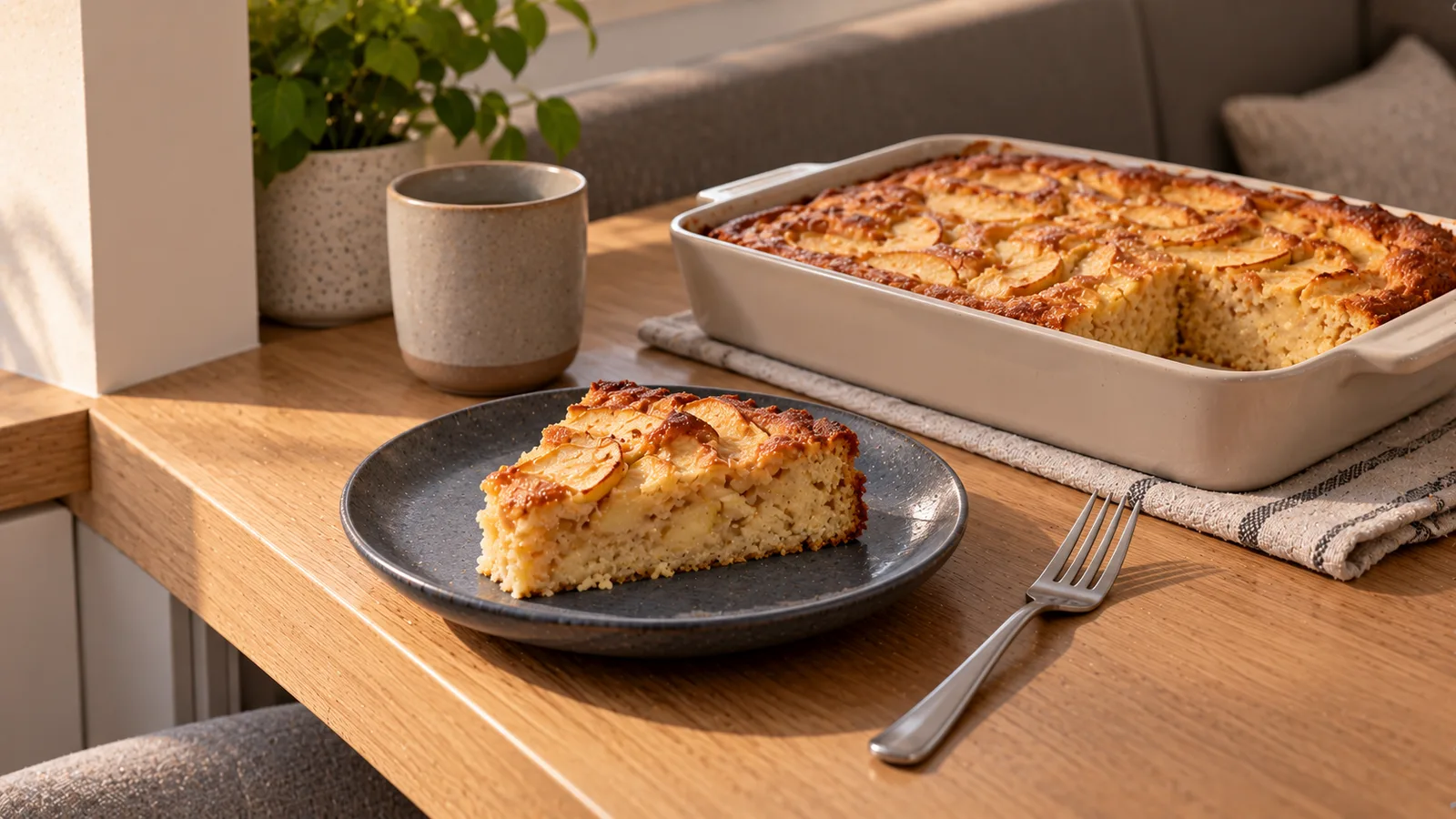
Dessert does not automatically prevent weight loss.
If your overall calorie intake remains compatible with a calorie deficit over time, foods such as chocolate, cake, ice cream or cookies can still fit into your diet.
The practical challenge is not deciding whether dessert is “allowed.” It is finding an amount and frequency that let you enjoy it without repeatedly pushing your overall intake far beyond what you intended.
You do not need to make dessert forbidden
A weight-loss diet does not have to consist only of foods traditionally labeled as healthy. (CDC — Steps for Losing Weight)
Body weight is influenced by overall energy balance over time. A dessert contributes calories, but so do all other foods.
That means the useful question is not:
“Can I eat dessert?”
It is:
“How can this dessert fit into the rest of my day?”
This shift makes dessert a planning decision rather than a pass-or-fail test.
Start with the dessert you actually want
Choosing a substitute you do not enjoy can sometimes leave you eating the substitute and then still wanting the original dessert.
If you genuinely want a piece of chocolate cake, a planned portion of chocolate cake may be more satisfying than several foods chosen only because they appear more “diet-friendly.”
This does not mean portion size is irrelevant.
It means both satisfaction and quantity matter.
Look at the whole day, not one food
Suppose your planned daily intake is 1,900 kcal.
Your meals and snacks before dessert total 1,650 kcal.
That leaves approximately:
1,900 − 1,650 = 250 kcal
A dessert around 200–250 kcal could fit without requiring a major change to the day.
Now imagine your food before dessert already totals 1,900 kcal.
Adding a 400 kcal dessert brings the day to roughly 2,300 kcal.
That does not mean the day is ruined. It simply means the dessert is additional energy that should be considered in the larger pattern.
One day matters much less than what repeatedly happens across weeks.
A practical calorie-budget example
Imagine you want dessert after dinner most evenings.
Instead of hoping there will be calories left, you could reserve part of your daily intake in advance.
For example:
| Part of day | Example calories |
|---|---|
| Breakfast | 400 |
| Lunch | 500 |
| Snack | 200 |
| Dinner | 550 |
| Dessert | 200 |
| Total | 1,850 |
The exact numbers are only an example.
The important idea is that dessert is included from the beginning rather than added after an already complete day of eating.
Portion size can matter more than the type of dessert
Two portions of the same dessert can have very different calorie totals.
If ice cream contains 210 kcal per 100 g:
- 75 g = about 158 kcal;
- 100 g = 210 kcal;
- 150 g = 315 kcal;
- 250 g = 525 kcal.
You do not necessarily need a special low-calorie ice cream.
Sometimes the easiest adjustment is simply choosing the amount that fits your day.
Use the package when possible
Desserts vary enormously.
One chocolate bar may contain 450 kcal per package while another contains 650 kcal.
A slice of cheesecake from one café can be very different from a homemade slice or a supermarket product.
When you have packaging, use its nutrition information and serving weight.
For unpackaged desserts, use a reasonable estimate rather than assuming every piece has the same calorie content.
Do not confuse a serving with the amount you eat
A package might list nutrition for one serving even though the package contains two, three or more servings.
For example:
- label serving: 30 g;
- package size: 90 g;
- calories per serving: 160 kcal.
Eating the whole package would be:
3 × 160 = 480 kcal
The serving printed on the package is a reference quantity, not a rule about how much you must eat.
You can make room without skipping meals
One common approach is to skip breakfast or lunch because dessert is planned later.
That can work mathematically, but it is not always the most practical strategy.
Arriving at dinner extremely hungry may make it harder to manage both the meal and dessert.
A more balanced approach is often to keep normal meals but adjust calorie-dense extras.
For example, you might:
- use a little less cooking oil;
- choose a smaller portion of a calorie-dense sauce;
- reduce an oversized starch portion;
- skip a drink you do not particularly want;
- choose a smaller dessert portion.
The goal is not to make earlier meals nutritionally inadequate just to “earn” dessert.
Keep protein and fiber in the rest of the day
If you allocate calories to dessert, it can be tempting to cut foods randomly from your other meals.
A better approach is to preserve foods that help the day remain nutritionally useful.
Meals can still include:
- protein-rich foods;
- vegetables;
- fruit;
- whole grains or other fiber-rich carbohydrate sources;
- legumes;
- appropriate sources of fat.
Dessert can then occupy part of the available energy rather than replacing the nutritional foundation of the entire day.
Dessert after a meal vs dessert when very hungry
Dessert may be easier to portion when it follows a normal meal rather than when you are extremely hungry.
If you have gone many hours without eating and open a large package of cookies, portion control may be more difficult than if you choose a planned amount after dinner.
This is not a universal rule.
Some people prefer dessert as a separate snack.
The useful approach is the one that helps you eat the amount you intended without creating unnecessary restriction earlier in the day.
Pre-portion large packages
Large packages make it easy to lose track of quantity.
Instead of eating directly from the container:
- decide roughly how much you want;
- place that amount in a bowl or on a small plate;
- put the package away;
- eat the chosen portion.
This does not require weighing every dessert forever.
It is simply a way to make the portion visible.
Example: chocolate
Suppose chocolate contains 550 kcal per 100 g.
Then:
| Chocolate | Approx. calories |
|---|---|
| 10 g | 55 kcal |
| 20 g | 110 kcal |
| 30 g | 165 kcal |
| 40 g | 220 kcal |
| 50 g | 275 kcal |
| 100 g | 550 kcal |
If you want chocolate frequently, a 20–30 g portion may fit very differently into your calorie budget than eating a full 100 g bar.
There is no universally correct portion. The useful amount depends on your overall intake and preferences.
Example: ice cream
Suppose your ice cream contains 220 kcal per 100 g.
A 150 g bowl contains:
150 × 220 ÷ 100 = 330 kcal
A 90 g bowl contains:
90 × 220 ÷ 100 = 198 kcal
Both are the same food.
The difference comes from portion size.
This is why measuring a few familiar desserts once can be useful even if you do not want to weigh food indefinitely.
Restaurant desserts require wider estimates
Restaurant desserts can be difficult to estimate because you may not know:
- the recipe;
- portion weight;
- amount of butter or cream;
- sugar quantity;
- sauces;
- toppings;
- ice cream served alongside the dessert.
In that situation, avoid false precision.
A reasonable estimate or calorie range is more useful than pretending you know the dessert contains exactly 487 kcal.
If the restaurant publishes nutrition information, use it.
Sharing can work when you want the taste, not a full portion
If you want dessert but do not particularly want a large serving, sharing one can be an easy option.
This is especially practical in restaurants, where desserts may be substantially larger than the portion you would serve yourself at home.
Sharing is optional, not a requirement.
If you want the full dessert and it fits your plan, there is no nutritional rule requiring you to split it.
Frequency matters differently from permission
A food can fit into a weight-loss diet without needing to appear every day.
For some people, a small dessert every evening is easier to manage.
Others prefer a larger dessert once or twice per week.
For example:
Pattern A
150 kcal × 7 days = 1,050 kcal per week
Pattern B
500 kcal × 2 days = 1,000 kcal per week
The weekly energy contribution is similar even though the eating patterns are different.
Choose the pattern that is easier for you to maintain.
Planned dessert vs unplanned grazing
A defined dessert can be easier to account for than repeated small bites throughout the evening.
For example:
- two cookies after dinner may be straightforward to track;
- one cookie, then chocolate, then a few spoonfuls of ice cream, then another snack can become harder to estimate.
Each individual amount may look small, while the combined total becomes substantial.
If this happens often, deciding on the dessert before you start eating can simplify the situation.
Do not compensate aggressively the next day
If you eat more dessert than planned, you do not need to respond with extreme restriction.
Suppose your planned intake was 1,900 kcal and you ended the day at approximately 2,300 kcal.
That is a difference of about 400 kcal.
It does not require skipping meals the next day.
Returning to your usual plan is generally more useful than creating a cycle of overeating followed by severe restriction.
What if dessert triggers more eating?
Not everyone responds to dessert in the same way.
For some people, a small planned portion is easy to enjoy and stop.
For others, certain foods make it difficult to stop at the intended amount.
If that consistently happens, experiment with the environment rather than assuming you simply need more willpower.
You might:
- buy individual portions instead of large packages;
- keep fewer trigger foods immediately accessible;
- choose dessert outside the home occasionally rather than storing a large supply;
- eat dessert after a complete meal;
- choose a different dessert that is easier for you to portion.
The best strategy is the one that makes your actual behavior easier to manage.
“Healthy” desserts still contain calories
A dessert made from dates, nuts, peanut butter, oats or dark chocolate may contain nutritious ingredients.
It can also be very calorie-dense.
For example, replacing sugar with dates does not make the energy content disappear.
Similarly, desserts made with nuts or nut butter may contain substantial calories because these ingredients are energy-dense.
Evaluate the actual ingredients and portion rather than relying on labels such as:
- healthy;
- natural;
- clean;
- refined-sugar-free;
- protein dessert.
These descriptions do not tell you the total calorie content.
Low-calorie desserts can be useful, but they are optional
Lower-calorie options can help when you prefer a larger dessert volume.
Examples might include:
- fruit with yogurt;
- berries with skyr;
- a smaller portion of ice cream with fruit;
- yogurt-based desserts;
- fruit ice pops.
But you do not have to replace every traditional dessert.
Sometimes a smaller portion of the dessert you genuinely want is the more satisfying option.
Dessert and social events
Birthdays, dinners and celebrations often include dessert.
Trying to control these occasions perfectly can make weight loss unnecessarily rigid.
A practical approach is:
- eat your normal meals earlier in the day;
- avoid arriving extremely hungry;
- choose the dessert you actually want;
- eat a reasonable portion;
- return to your normal routine afterward.
For a broader strategy, see How to Handle Social Events While Trying to Lose Weight.
Dessert does not need to be “earned”
Exercise can increase energy expenditure, but thinking of dessert as something that must be earned through exercise can make food decisions unnecessarily transactional.
It is usually more practical to consider both food intake and activity as parts of the larger energy-balance picture.
If dessert fits your eating pattern, you do not need to perform a specific workout to justify it.
When progress slows, look at frequency and portions
If your weight trend is not moving as expected, desserts are one place to review — but not the only one.
Look at the full pattern:
- portion sizes;
- cooking oils;
- drinks;
- snacks;
- restaurant meals;
- weekend intake;
- desserts;
- tracking accuracy.
A dessert that contributes 150 kcal a few times per week is different from an untracked 600–800 kcal dessert most evenings.
The useful question is how much the habit contributes over time.
A simple decision system
Before dessert, ask four questions:
1. Do I actually want it?
If not, you do not need to eat it just because it is available.
2. What portion would satisfy me?
Start with that amount rather than automatically taking the largest available portion.
3. How does it fit into the rest of today?
You do not need perfect arithmetic, but some awareness helps.
4. Is this pattern sustainable?
A plan that works for three highly restrictive days and then collapses is less useful than a flexible approach you can maintain.
The practical takeaway
You can include dessert while trying to lose weight.
The key variables are not whether the food is officially “diet-friendly,” but:
- total calorie intake;
- portion size;
- frequency;
- the nutritional quality of the rest of your diet;
- how reliably you can maintain the pattern.
Plan dessert when useful, choose the dessert you actually enjoy, keep the portion visible and avoid treating one higher-calorie occasion as a failure.
Weight loss is determined by the broader pattern over time, not by a single slice of cake.