
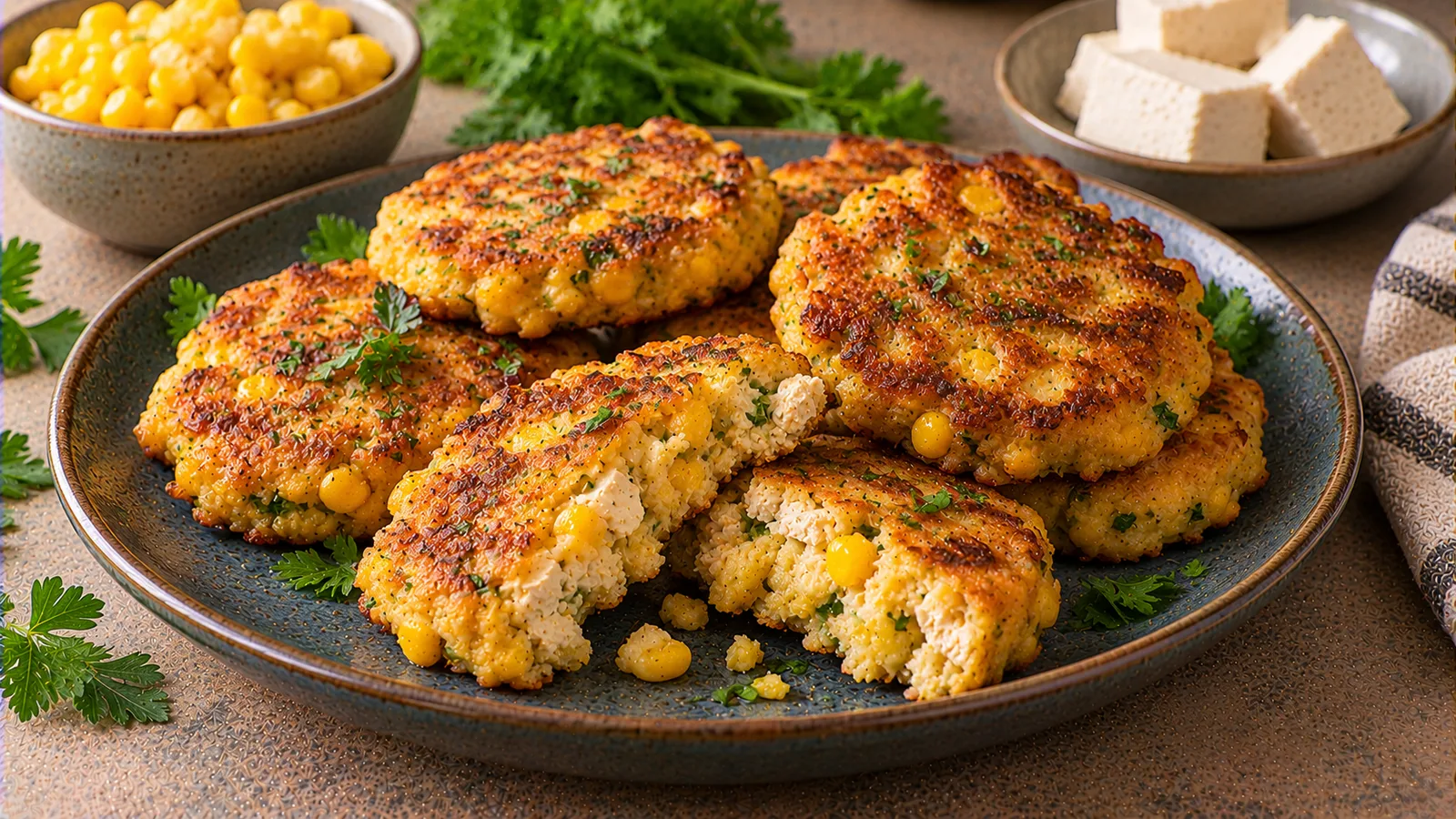
Crisp edges, a soft centre and kernels of sweetcorn make these tofu fritters useful as a quick lunch, a light dinner or part of a larger plate. This is one fully specified recipe design, not a collection of vaguely interchangeable fritter ideas: firm tofu provides the base, an egg-and-flour mixture binds it, and a measured amount of corn adds sweetness. The directions specify how wet the mixture should be before it touches the pan, because moisture—not the seasoning—is the usual reason a tofu fritter breaks apart.
The batch makes 8 small fritters, enough for 2 servings of 4. Plan on about 15 minutes of preparation and 18 minutes at the stove, or roughly 33 minutes in total. These are planning estimates, not a guarantee for every hob. The recipe contains soy, egg and wheat and is vegetarian, not vegan.
Ingredients for eight fritters
All weights refer to ingredients before frying. Weigh the sweetcorn after draining or thawing and patting dry; the tofu weight is the amount used after discarding its packing liquid. A medium egg is about 50 g without its shell; if yours is significantly larger, adjust the batter's flour only if needed.
| Ingredient | Amount | What it does |
|---|---|---|
| Firm tofu, drained | 250 g | Crumbly base and structure |
| Sweetcorn kernels, thoroughly drained | 150 g | Texture and sweetness |
| Plain wheat flour | 60 g | Absorbs moisture and binds |
| Egg, without shell | 1 (about 50 g) | Helps the mixture set |
| Spring onion, finely chopped | 40 g | Fresh, savoury flavour |
| Garlic, finely grated | 6 g | Seasoning |
| Baking powder | 4 g | Lightens the inside slightly |
| Smoked paprika | 2 g | Warm smoky flavour |
| Lemon juice | 10 ml | Brightness |
| Neutral cooking oil | 20 g | For the two frying batches |
| Salt and black pepper | To taste | Adjust to the tofu and accompaniments |
Use plain, unseasoned firm tofu, not silken tofu. Silken tofu holds substantially more free moisture and does not reliably produce the same spoonable mixture. Tinned sweetcorn should be drained in a sieve; frozen corn should be thawed safely, prepared according to its package instructions, cooled if necessary and dried well. The 150 g is the actual quantity added, not the original weight of a can.
Equipment and preparation
A wide non-stick frying pan, mixing bowl, fork, sieve, spatula and ideally an instant-read food thermometer are enough. Put a clean towel or absorbent kitchen paper around the drained tofu for 10 minutes while measuring the other ingredients. You do not have to crush it under a heavy weight: the aim is to remove obvious surface water without turning the block into a dry powder.
Chop the spring onion as finely as possible so long pieces do not pull a fritter apart. Pat the corn dry even if it has been in a colander for several minutes. Place a small plate beside the cooker for the cooked fritters. Because the mixture contains raw egg and flour, do not taste the uncooked batter; taste and adjust seasoning after cooking a small test fritter.
Step-by-step pan method
- Break down the tofu. Crumble the drained 250 g tofu into pea-sized pieces, then mash about one-third with a fork. Keep some small pieces for a recognisable tofu texture, but the mashed portion helps the mixture hold together.
- Prepare the sweetcorn. Add 150 g dry kernels and press a few lightly against the bowl with the fork. The goal is to keep most kernels intact while giving the binder something to grip.
- Build the binder. Beat the 50 g egg with 10 ml lemon juice. Mix 60 g flour, 4 g baking powder and 2 g paprika separately to distribute the baking powder. Fold the egg, dry ingredients, 40 g spring onion and 6 g garlic into the tofu and corn. Season modestly; you can add more salt at the table.
- Check the consistency. Let the mixture rest for 5 minutes. Squeeze one spoonful in your palm: it should form a soft mound that holds when moved onto a spatula. If liquid pools in the bowl, fold in 5 g additional flour at a time, recording the added quantity if you track nutrition. If the mixture is too dry to clump, add 5 ml water at a time, not a large splash.
- Shape eight equal pieces. Divide into 8 fritters and flatten to roughly 1.5 cm thick. Compact the edges and avoid making them paper-thin. Shape on a board; handle gently when transferring.
- Heat the pan. Set a wide non-stick pan over medium heat. Add 10 g oil for the first four fritters. The oil should shimmer lightly, not smoke.
- Cook the first batch. Place four fritters into the pan without crowding. Cook about 3–4 minutes on the first side, until a browned crust forms, then turn once with a broad spatula. Cook about 3–4 minutes on the second side. Adjust heat if the outside darkens before the middle firms.
- Repeat and check. Use the remaining 10 g oil for four more fritters. Because the batter includes egg, check that the centre of the thickest fritter reaches 71 °C (160 °F) with a food thermometer; colour alone is not a safety test. Rest cooked fritters for 2 minutes before serving.
The two batches take approximately 16 minutes of actual pan time, plus a short period to heat the pan and move the fritters; that is the basis for the 18-minute cook estimate. If the pan is smaller, cook in three batches and allow more time. For egg-containing mixed dishes, FoodSafety.gov lists 71 °C as the minimum internal temperature (safe temperature chart).
The binding test: why fritters fall apart
| What you notice | Likely reason | What to do next |
|---|---|---|
| A wet puddle forms before frying | Corn or tofu was not dried | Drain again, then add 5 g flour at a time |
| A fritter cracks while shaping | Too little binder or pieces too coarse | Mash more tofu; rest the mix 5 minutes |
| The bottom sticks and breaks | Turned before a crust formed | Use a non-stick pan and wait until it releases |
| The outside browns while the middle stays soft | Heat too high or fritter too thick | Lower heat, flatten to about 1.5 cm, check centre temperature |
| The fritter is dry and heavy | Too much additional flour | Add only 5 ml water at a time before frying |
A quick test fritter is more informative than guessing. Fry one small spoonful, wait until the binder sets, then adjust only the remaining uncooked mixture. Do not fix a wet mixture by raising the heat: the outside can burn while the interior stays undercooked. Likewise, a sharp spatula and constant flipping usually damage the crust. The mixture is intentionally moist but should never be pourable like pancake batter.
What to serve with two portions
For a simple plate, give each person 4 fritters with cucumber and tomato, a squeeze of lemon and a dip. Plain yogurt with chopped herbs works if dairy is suitable; a tahini-lemon sauce works for a dairy-free accompaniment, but the fritters themselves still contain egg and wheat. The vegetables and sauce are not included in the ingredient amounts above, so do not present a total calorie or protein value for the whole plate without counting them.
For a bigger meal, add a side salad and cooked grains or bread according to appetite. Four fritters are not automatically a complete meal for everyone; serving size depends on the rest of the plate. If you want a different way to cook tofu without turning it into a patty, see our tofu scramble with vegetables. For another example of how legumes and binders become a pan-cooked patty, compare the method in black bean burgers with oats. Those recipes have distinct ingredients and should not be treated as interchangeable without adjusting moisture.
Make-ahead, cooling and leftovers
Serve freshly cooked fritters for the crispest texture. If keeping leftovers, move them into shallow containers, cool promptly and refrigerate at 4 °C or colder within 2 hours. As a conservative home-cooking plan, use refrigerated fritters within 3 days, even though official general leftover guidance may allow 3–4 days. Reheat once until steaming and to 74 °C (165 °F) in the centre, then serve immediately. You can freeze fully cooled fritters in separated layers and thaw in the refrigerator before reheating.
Never leave the egg-containing mixture on the counter while preparing another meal. Keep it chilled if there is a gap before frying, and wash utensils that have touched raw egg or flour. The FDA safe food-handling guidance recommends prompt refrigeration of perishables and keeping a refrigerator at 4 °C / 40 °F or colder. The FoodSafety.gov chart lists 74 °C for reheated leftovers.
Ingredient swaps without losing the method
You can use chopped chives instead of spring onion in roughly the same volume, or change smoked paprika to mild paprika. Neither alters the main binding mechanism. Dried, cooked sweetcorn works only if it is soft enough and weighed in its edible state. A wetter tofu or a different flour may change how much liquid the mixture retains, so do the palm test before shaping. Firm tofu varies by brand; the instruction to drain and press matters more than a strict claim that all tofu has the same moisture content.
For an egg-free version, do not simply omit the egg and expect this recipe to work. A flax or starch binder requires a separate tested formulation and cooking check. Gluten-free flours also vary widely in binding, so the recipe as written is not gluten-free. Sweetcorn's natural sweetness does not make the finished fritters sweet breakfast pancakes; serve them as a savoury dish. Always check ingredient labels for soy, wheat, egg and any hidden allergens in flavoured tofu or sauces.
Recipe at a glance
| Measure | This batch |
|---|---|
| Yield | 8 small fritters |
| Servings | 2, with 4 fritters each |
| Prep / cook / total | 15 / 18 / about 33 minutes |
| Tofu / drained corn | 250 g / 150 g |
| Flour / egg | 60 g / 1 egg (about 50 g) |
| Oil in pan | 20 g across 2 batches |
| Main allergens | Soy, egg, wheat |
| Temperature target for egg-containing fritters | 71 °C in the centre |
A measured, gently packed mixture and a medium-hot pan are what make these fritters repeatable. Drain first, bind second, test the texture, then let each side form a crust before flipping. The recipe gives a practical starting point; the exact cooked weight and nutritional values depend on the tofu, flour, corn and oil actually used.
Sources
- FoodSafety.gov — Safe Minimum Internal Temperatures: egg dishes 71 °C, leftovers 74 °C.
- U.S. FDA — Safe Food Handling: hygiene, prompt chilling, refrigerator temperatures and reheating safety.
The ingredient quantities, cooking schedule and yield are an original recipe specification, not nutrition figures taken from those food-safety agencies. Check doneness with a thermometer rather than relying only on the planned minutes.