
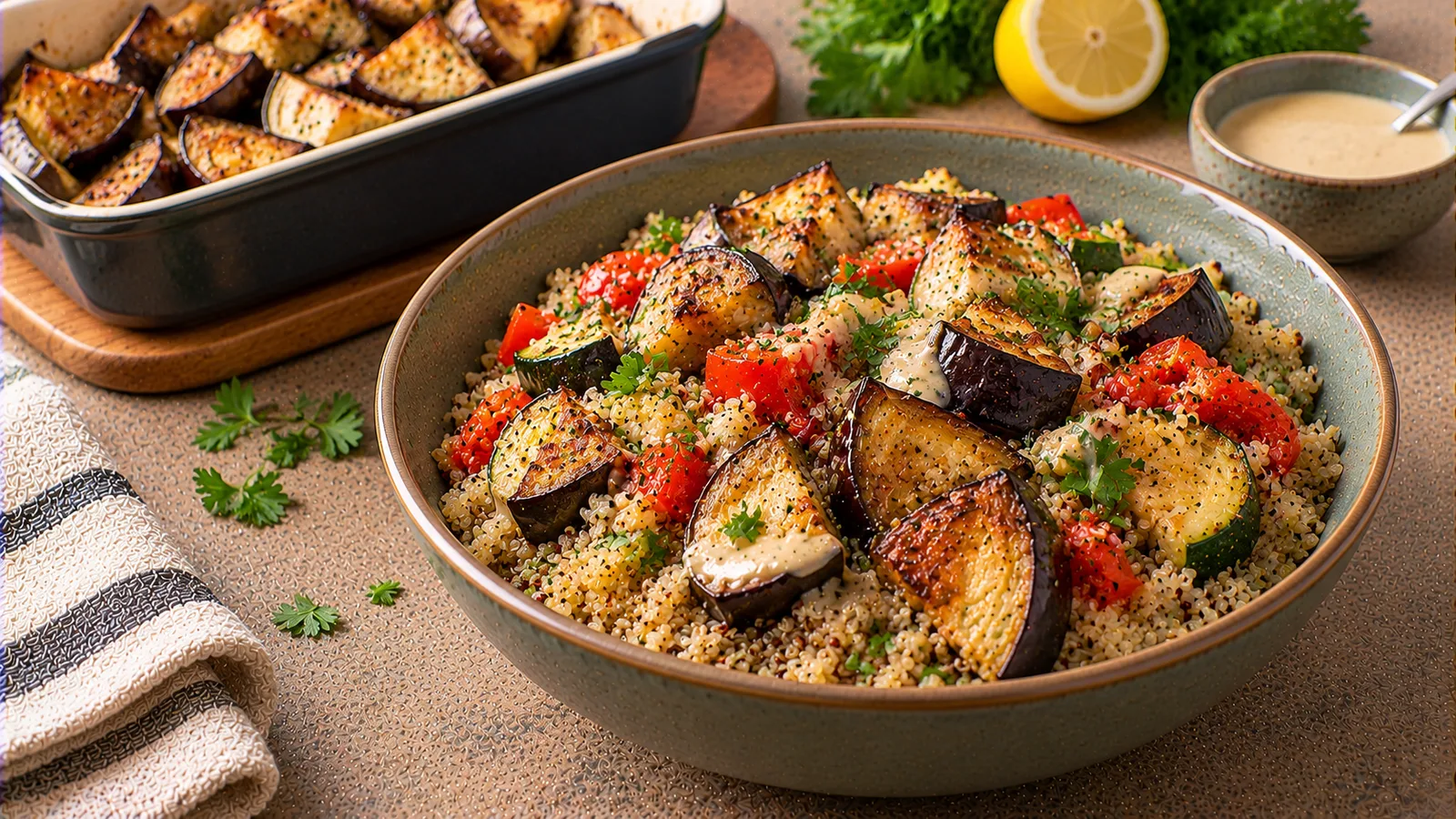
Roasted aubergine and quinoa bowls work best when the aubergine has browned edges, the quinoa stays loose, and the lemon–tahini yogurt sauce goes on only at serving time. This version makes two main-course bowls with spiced aubergine, chickpeas, red onion, tomatoes and spinach. It is a complete, reproducible recipe rather than a general grain-bowl formula. The distinctive step is to roast the aubergine first, then add the chickpeas and onion for the final part of roasting; that way the vegetables caramelise without drying out the chickpeas.
Recipe at a glance
| Detail | This recipe |
|---|---|
| Yield | 2 generous main-course bowls |
| Preparation | About 15 minutes |
| Oven time | About 30–37 minutes, depending on oven and cut size |
| Total elapsed time | Roughly 45–55 minutes, with quinoa cooked while the oven is on |
| Oven setting | 220 °C conventional or 200 °C fan |
| Quinoa | 120 g dry, cooked with approximately 330 ml water |
| Chickpeas | 240 g drained, already cooked, not their can's total weight |
| Sauce | Yogurt, tahini, lemon and garlic; served cold |
These are recipe timings, not a guarantee: aubergine size, tray crowding and oven calibration change how quickly the edges colour. Cook until tender all the way through rather than relying only on the timer.
Ingredients for two bowls
| Component | Ingredient | Amount and measuring basis |
|---|---|---|
| Roast | Aubergine / eggplant | 450 g, trimmed raw weight, cut into roughly 2 cm cubes |
| Roast | Cooked chickpeas | 240 g after draining and rinsing |
| Roast | Red onion | 100 g peeled raw weight, sliced into thick wedges |
| Roast | Olive oil | 25 ml total: 15 ml for aubergine, 10 ml for chickpeas and onion |
| Roast | Smoked paprika | 2 g |
| Roast | Ground cumin | 2 g |
| Grain | Quinoa | 120 g dry, before rinsing |
| Grain | Water | Approximately 330 ml, or follow the particular packet |
| Fresh finish | Cherry tomatoes | 160 g raw, halved |
| Fresh finish | Baby spinach | 60 g fresh, washed if not labelled ready-to-eat |
| Fresh finish | Parsley | 12 g leaves, chopped |
| Sauce | Plain unsweetened Greek-style yogurt | 120 g |
| Sauce | Tahini | 20 g, stir the jar first |
| Sauce | Lemon juice | 25 ml |
| Sauce | Garlic | 5 g, finely grated |
| Sauce | Water | 20–30 ml, added gradually to thin |
| Seasoning | Fine salt | 1 g total: 0.5 g roast, 0.5 g sauce; adjust at table |
| Seasoning | Black pepper | To taste |
The quantities above cover both bowls, including the sauce. Use a kitchen scale for the dry quinoa and drained chickpeas; a can labelled 400 g may contain considerably less than 400 g of chickpeas once the liquid is removed. Do not count the liquid as part of the 240 g. The 25 ml oil is already included in the ingredient list; adding a freehand extra pour changes the finished dish.
Equipment and preparation
You need a large baking tray (or two smaller trays), parchment if desired, a saucepan with a lid, a sieve, a mixing bowl and a small bowl for the sauce. A broad roasting surface matters more than elaborate equipment: when aubergine is stacked several layers deep, it steams instead of browning. If a single tray looks crowded once the chickpeas are added, split the vegetables across two trays and rotate their positions during the last part of cooking.
Wash the aubergine, tomatoes and parsley under running water. Rinse the quinoa in a fine sieve unless the pack explicitly says it has been pre-rinsed; this can reduce bitterness from surface saponins. Rinse and drain the chickpeas, then pat them dry so their surface does not hold unnecessary water. Cut the aubergine into similar-size 2 cm cubes; tiny pieces may collapse before the larger pieces become soft. Leave the onion in substantial wedges so it does not burn.
Step-by-step: roast, simmer and assemble
- Heat the oven and begin with aubergine. Set to 220 °C conventional or 200 °C fan. Coat 450 g aubergine with 15 ml olive oil, 2 g smoked paprika, 2 g ground cumin, 0.5 g salt and black pepper. Spread in a single layer. Roast for 18–22 minutes before adding the other roasted ingredients.
- Start the quinoa while the aubergine roasts. Rinse 120 g dry quinoa. Bring to a gentle boil with approximately 330 ml water, cover and simmer at low heat for 12–15 minutes, or the packet's time, until the liquid is absorbed and the grains have opened. Turn off the heat, let stand covered 5 minutes, then fluff with a fork. Do not measure 120 g of cooked quinoa by mistake: that would make a much smaller base.
- Add chickpeas and onion. Toss 240 g drained chickpeas and 100 g onion with the remaining 10 ml olive oil. Stir the aubergine, add the chickpea mixture in a single layer and roast for a further 12–15 minutes. The total roasting interval is therefore approximately 30–37 minutes. Look for soft aubergine flesh with dark golden edges and heated chickpeas; adjust for the oven rather than burning the onion to meet a number.
- Mix the lemon–tahini sauce. Stir together 120 g yogurt, 20 g tahini, 25 ml lemon juice, 5 g grated garlic and the remaining 0.5 g salt. Add 20 ml water, then up to 10 ml more if a pourable dressing is wanted. Tahini may thicken unexpectedly when it meets lemon; continue stirring and add the water gradually. The sauce should coat a spoon, not resemble soup.
- Prepare the fresh ingredients. Halve 160 g tomatoes, prepare 60 g spinach, and chop 12 g parsley. Keep these away from the hot tray until assembly so the spinach retains texture and the tomatoes do not turn watery.
- Divide the meal. Split the cooked quinoa evenly between two bowls. Add half the aubergine, chickpeas and onion to each, followed by half the tomatoes and spinach. Spoon on half the sauce per bowl and finish with parsley. Taste before adding further salt or lemon.
The roast should smell nutty and savoury, with soft centres rather than chewy, pale aubergine. If the cubes still resist a fork, continue roasting for a few minutes. If they brown too aggressively, lower the oven slightly and ensure the tray is not directly under the top heating element.
Portion math: what goes in one bowl?
Before cooking, the quantities divide into 225 g trimmed raw aubergine, 120 g drained chickpeas, 60 g dry quinoa, 50 g raw onion, 80 g tomatoes, 30 g spinach, 12.5 ml olive oil, 60 g yogurt, 10 g tahini, 12.5 ml lemon juice, 2.5 g garlic and 6 g parsley per person. These are ingredient inputs, not promises of cooked serving weight. Quinoa absorbs water, the roast loses moisture and different brands of drained chickpeas contain different residual water. Weighing the finished bowl is optional, but do not interpret the dry quinoa as its cooked weight.
| For one bowl | Starting quantity | Why the basis matters |
|---|---|---|
| Aubergine | 225 g raw trimmed | Loses water in the oven |
| Chickpeas | 120 g cooked and drained | Not dry chickpea weight and not can weight |
| Quinoa | 60 g dry | Gains water while simmering |
| Olive oil | 12.5 ml | Measured before cooking |
| Yogurt and tahini | 60 g + 10 g | Both are counted in the dressing |
An exact calorie or protein figure would require the actual product labels, the quantity of oil that stays on the tray and a consistent recipe calculation. We have deliberately not assigned a universal macro value to a bowl. For a general discussion of other quinoa bowl formats, see quinoa and black bean bowl; it uses black beans and has a different flavour and preparation intent. A contrasting roasted cauliflower-and-chickpea dish with tahini appears in roasted cauliflower and chickpeas with tahini; it is not the same aubergine-and-quinoa recipe.
Three texture details that make this recipe work
Aubergine is a sponge before it is browned. Measuring the oil first keeps the roast controlled. Spread the cubes so hot air can reach their edges; piling them into a deep dish produces a softer, wetter vegetable rather than the browned coating intended here. Roast a larger aubergine on two trays if needed, but keep the same total oil amount. The skin is edible and helps maintain shape, so peeling is not necessary unless personally preferred.
Chickpeas belong in the second part of roasting. They are already cooked in the tin. Their role is to warm, pick up the spices and become slightly dry on the surface; putting them in for the entire aubergine roasting time can make them hard. Drain thoroughly and add them at the 18–22 minute mark, not with the first batch. A few golden spots are enough.
A yogurt sauce should not go into a hot oven. Apply it after plating. Heating can split some yogurts and makes the fresh contrast disappear. If tahini tastes assertive, add a little extra water and lemon before adding salt. If the finished bowl seems dry, first redistribute the sauce rather than automatically adding extra oil.
Adaptations without losing the method
For a dairy-free bowl, replace the 120 g yogurt with 120 g unsweetened dairy-free alternative that is suitable for savoury use. Check its allergens and thickness; the sauce may require less water. For a sesame-free dressing, omit the 20 g tahini and use a yogurt–lemon–garlic dressing instead. That changes the recipe and its nutritional composition. For a chickpea-free variation, use another cooked legume in the same 240 g drained weight, but season and cooking texture may change.
Quinoa itself is naturally gluten-free, yet packaged ingredients may be cross-contacted during processing. If you are preparing the bowl for someone with coeliac disease, check the particular quinoa, spices and sauce ingredients rather than declaring every version guaranteed gluten-free. This recipe contains milk and sesame as written. It does not rely on eggs or meat. For extra heat, add a little chilli at serving rather than increasing the roast time.
Make-ahead, storage and reheating
If you plan to pack lunch tomorrow, roast the vegetables and cook the quinoa ahead, and keep the chilled sauce and fresh tomato–spinach components in separate covered containers. Divide the hot components into shallow containers and refrigerate promptly; within 2 hours, or within 1 hour if ambient temperature is above 32 °C, according to USDA food-safety guidance. Use a refrigerator at 4 °C or below. USDA gives 3–4 days as a general refrigerated-leftovers window when properly handled; for the best spinach and sauce texture, assembling on the day of eating is preferable. Freeze the cooked components if you need longer storage, but make the yogurt sauce fresh.
Reheat the cooked quinoa, aubergine and chickpeas thoroughly to 74 °C (165 °F) for leftovers, then add the chilled sauce and fresh components. Do not leave a packed bowl at room temperature all morning. If ingredients have sat unrefrigerated beyond the safe time window, do not try to rescue them by reheating. Keep the cooked quinoa separate from raw items while packing to minimise sogginess.
Troubleshooting and serving options
| Problem | Likely reason | Practical fix |
|---|---|---|
| Aubergine is grey and wet | Tray crowded or oven insufficiently hot | Spread on two trays and roast until the edges brown |
| Quinoa is hard | Not enough water or heating time | Add a splash of hot water, cover briefly and recheck |
| Quinoa is mushy | Too much water or excessive simmering | Drain any excess, rest uncovered briefly; measure dry grain next time |
| Chickpeas are tough | Added from the start, stayed too long | Add only for the final 12–15 minutes |
| Sauce is too thick | Tahini firms when mixed with lemon | Whisk in a few millilitres of water at a time |
| Bowl tastes flat | Sauce and vegetables insufficiently balanced | Taste the sauce, add a little lemon or parsley before adding salt |
Serve the bowl warm with a cool sauce. If preparing it for children, adjust the garlic and spices to preference and cut the vegetables appropriately; do not rely on broad nutrition claims to decide an individual's portion size. This recipe intentionally excludes an invented ingredient-price estimate because checkout price, can drained weight and purchase location vary.
Sources
- FDA — selecting and serving produce safely: washing, handling and separating produce.
- Whole Grains Council — cooking whole grains: quinoa-to-water ratio and indicative simmer time; the packet remains the practical final guide.
- USDA FSIS — leftovers and food safety: cooling, refrigeration and leftovers.