
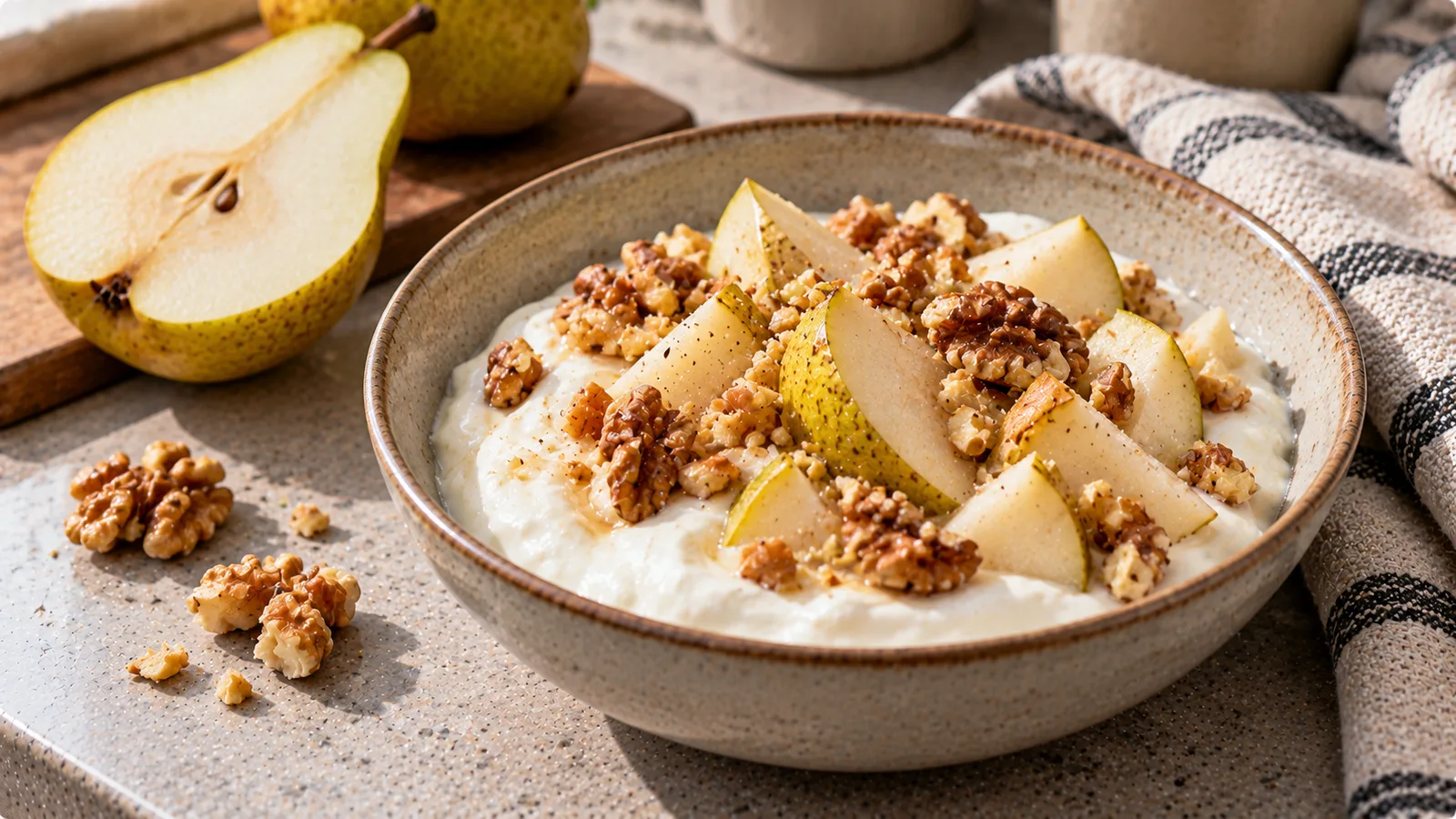
A pear and walnut yogurt bowl is a simple breakfast built around contrasting textures: creamy yogurt, juicy pear, crunchy walnuts and soft oats.
It requires no cooking, uses ordinary supermarket ingredients and can be prepared in about five minutes.
The combination is particularly useful when you want something more substantial than plain yogurt but do not want to prepare a cooked breakfast.
The recipe below makes one generous serving.
Ingredients for one bowl
| Ingredient | Quantity |
|---|---|
| Plain natural yogurt | 200 g |
| Ripe pear, edible portion | 150 g |
| Walnuts, shelled | 20 g |
| Rolled oats | 25 g |
| Ground cinnamon | ½ teaspoon |
| Honey, optional | 5 g |
Use plain yogurt without added sugar if you want to control the sweetness yourself.
A ripe pear often provides enough sweetness without honey.
Walnuts should be weighed without their shells.
The pear weight refers to the edible portion after removing the core.
How to make a pear and walnut yogurt bowl
Preparation time: approximately 5 minutes.
Cooking time: none.
Yield: one serving.
- Wash the pear under running water and dry it.
- Remove the core and cut the edible fruit into small cubes or thin slices.
- Spoon 200 g of yogurt into a breakfast bowl.
- Stir in the rolled oats or scatter them evenly over the yogurt.
- Add the pear pieces.
- Roughly chop the walnuts and sprinkle them on top.
- Finish with cinnamon.
- Drizzle with honey if the pear is not sweet enough.
Serve immediately if you prefer crunchy walnuts and distinct textures.
For softer oats, let the assembled bowl stand in the refrigerator for 10–15 minutes.
Do not leave perishable dairy foods unrefrigerated for extended periods. General handling advice is available from the FDA.
What does this breakfast taste like?
The pear contributes a delicate sweetness and juicy texture.
Walnuts add a slightly earthy, mildly bitter flavour that balances the fruit.
Cinnamon provides warmth without needing a large amount of sweetener.
Oats make the bowl more substantial and absorb some moisture from the yogurt.
The result is a breakfast that combines soft, creamy and crunchy ingredients without complicated preparation.
The flavour depends strongly on the ripeness and variety of pear.
A firm pear creates more contrast, while a very ripe pear gives a softer, sweeter result.
Estimated nutrition per serving
The following values are illustrative estimates for the complete recipe with 200 g plain yogurt, 150 g pear, 20 g walnuts, 25 g oats and 5 g honey.
| Nutrient | Approximate amount |
|---|---|
| Energy | 470 kcal |
| Protein | 17 g |
| Fat | 20 g |
| Carbohydrates | 58 g |
| Fibre | 8 g |
These are rounded estimates, not laboratory measurements.
The actual nutrition depends particularly on the yogurt's fat and protein content, the pear's edible weight and the specific products used.
A high-protein yogurt, low-fat yogurt and whole-milk yogurt can produce noticeably different totals.
For ingredient-specific calculations, use the corresponding records in USDA FoodData Central or the nutrition labels on your packages.
If you omit honey, subtract the energy and carbohydrates contributed by the 5 g used in the estimate.
How the ingredients contribute
Yogurt: the creamy base
Plain yogurt provides moisture, protein and a mild acidity that balances the sweetness of the pear.
A thick yogurt produces a spoonable bowl with clear layers.
A thinner yogurt allows the oats to absorb moisture more quickly.
Greek-style yogurt, skyr and ordinary natural yogurt can all work, but they are not nutritionally interchangeable.
Choose the product according to the texture and nutritional profile you prefer.
Pear: sweetness and freshness
Pear is the main fruit in this recipe.
Using 150 g of edible pear gives a substantial fruit portion without overwhelming the yogurt.
Leave the peel on if it is suitable for eating and you prefer the texture.
Wash the fruit before cutting it.
Very ripe pears can be mashed slightly into the yogurt for a naturally sweeter base.
Walnuts: crunch and richness
Walnuts provide the strongest crunchy contrast.
The recipe uses 20 g of shelled walnuts.
Because walnuts are energy-dense, weighing them is more reliable than estimating a handful.
Chopping them roughly distributes the flavour throughout the bowl.
For a softer texture, break the pieces smaller.
Oats: a more filling texture
Rolled oats absorb moisture and add body.
The recipe uses 25 g.
Fine oats soften quickly, while larger rolled oats retain more texture.
You can mix them into the yogurt before preparing the fruit if you want them to hydrate slightly.
The nutritional values of oats depend on the product and serving size. Check USDA FoodData Central or the package for detailed values.
Three practical variations
Higher-protein version
Replace the natural yogurt with 200 g of plain skyr or another high-protein dairy product.
Keep the pear, walnuts and oats unchanged.
This can increase the protein content, but the exact result depends on the product.
Recalculate the nutrition using the label rather than assuming every high-protein yogurt has the same composition.
No-added-sugar version
Leave out the honey.
Use a ripe pear and a little extra cinnamon if desired.
This removes the added honey without eliminating the naturally occurring sugars in the fruit and dairy ingredients.
Warm pear version
Cut the pear into pieces and warm it briefly in a small saucepan with a spoonful of water and cinnamon.
Allow it to cool slightly before adding it to cold yogurt.
This version is useful when the pear is firm or when you prefer a softer fruit texture.
Do not cook the yogurt itself.
Can you replace the walnuts?
Yes.
If you do not have walnuts, try another suitable topping such as pumpkin seeds, sunflower seeds or chopped almonds.
Each substitution changes the flavour, texture and nutritional profile.
For someone with a tree-nut allergy, do not assume that another nut is a safe alternative.
Check the relevant allergen information and individual dietary requirements.
The EU Food Information Regulation establishes requirements for allergen information on food labels.
Can you make the bowl without oats?
Yes.
Simply omit the oats for a lighter-textured bowl.
You can increase the fruit slightly or serve the yogurt and walnuts alone.
However, removing 25 g of oats also changes the calories, carbohydrates, protein and fibre.
Do not use the original nutrition estimate for the modified recipe.
If you want a different grain, cooked and cooled buckwheat or another suitable cereal may be used, but the quantity and nutritional values should be recalculated.
Choosing the right pear
The best pear is ripe enough to taste sweet but still firm enough to cut cleanly.
A very hard pear may taste less sweet and can feel out of place against the creamy yogurt.
An overripe pear is still useful if it is wholesome, but it may be better mashed into the yogurt.
Common supermarket varieties can all work.
The exact variety matters less than ripeness, texture and flavour.
If the pear is especially juicy, add the oats immediately before eating to preserve more crunch.
Choosing the yogurt
The recipe is intentionally flexible about the type of plain yogurt.
However, this choice has a major effect on the nutrition estimate.
For example:
- Whole-milk natural yogurt gives a creamier texture.
- Low-fat yogurt may reduce the fat content.
- Skyr generally has a different protein profile.
- Unsweetened plant-based yogurt can be used for a dairy-free version.
Plant-based yogurts vary widely in protein, fat, calcium fortification and added ingredients.
Choose a product that meets your needs and use its actual nutrition label.
Do not assume that coconut, soy and oat-based yogurts provide the same nutrition.
How to prepare it ahead
For the best texture, store the components separately.
You can:
- Portion the yogurt into a covered container.
- Measure the oats and walnuts into a separate dry container.
- Keep the pear whole until shortly before serving.
- Cut the pear and assemble the bowl when ready to eat.
Cut pear may brown during storage because of oxidation.
A little lemon juice can slow visible browning, but it changes the flavour.
Prepared bowls containing yogurt should be kept refrigerated.
Follow product instructions and safe storage practices. See the FoodSafety.gov cold-storage guidance.
Is it suitable as a snack?
Yes, but the full recipe is a substantial portion.
For a smaller snack, you could use:
- 125 g yogurt.
- 75 g pear.
- 10 g walnuts.
- 10 g oats.
- Cinnamon to taste.
This is a different recipe quantity and will have different nutrition values.
The smaller portion may be more suitable between meals, while the full bowl can serve as breakfast.
The appropriate portion depends on your appetite and overall eating pattern.
How to track this recipe accurately
When entering the bowl into a nutrition app, record the ingredients separately or save the complete recipe.
Use:
- 200 g of the actual yogurt product.
- 150 g edible pear.
- 20 g shelled walnuts.
- 25 g oats.
- 5 g honey if added.
- Cinnamon, if your tracking method includes spices.
The most important sources of variation are the yogurt type, walnut quantity and optional honey.
If you regularly make this breakfast, save it as a recipe and adjust the ingredient weights when necessary.
For general dietary context, the German Nutrition Society publishes food-based dietary guidance.
A simple breakfast worth repeating
A pear and walnut yogurt bowl works because each ingredient has a clear purpose.
Yogurt provides the base, pear adds freshness, walnuts bring crunch and oats make the meal more substantial.
The recipe takes approximately five minutes and can be adjusted to different tastes.
For reliable nutrition tracking, weigh the walnuts and oats, use the actual yogurt label and treat generic calorie estimates as approximate.