
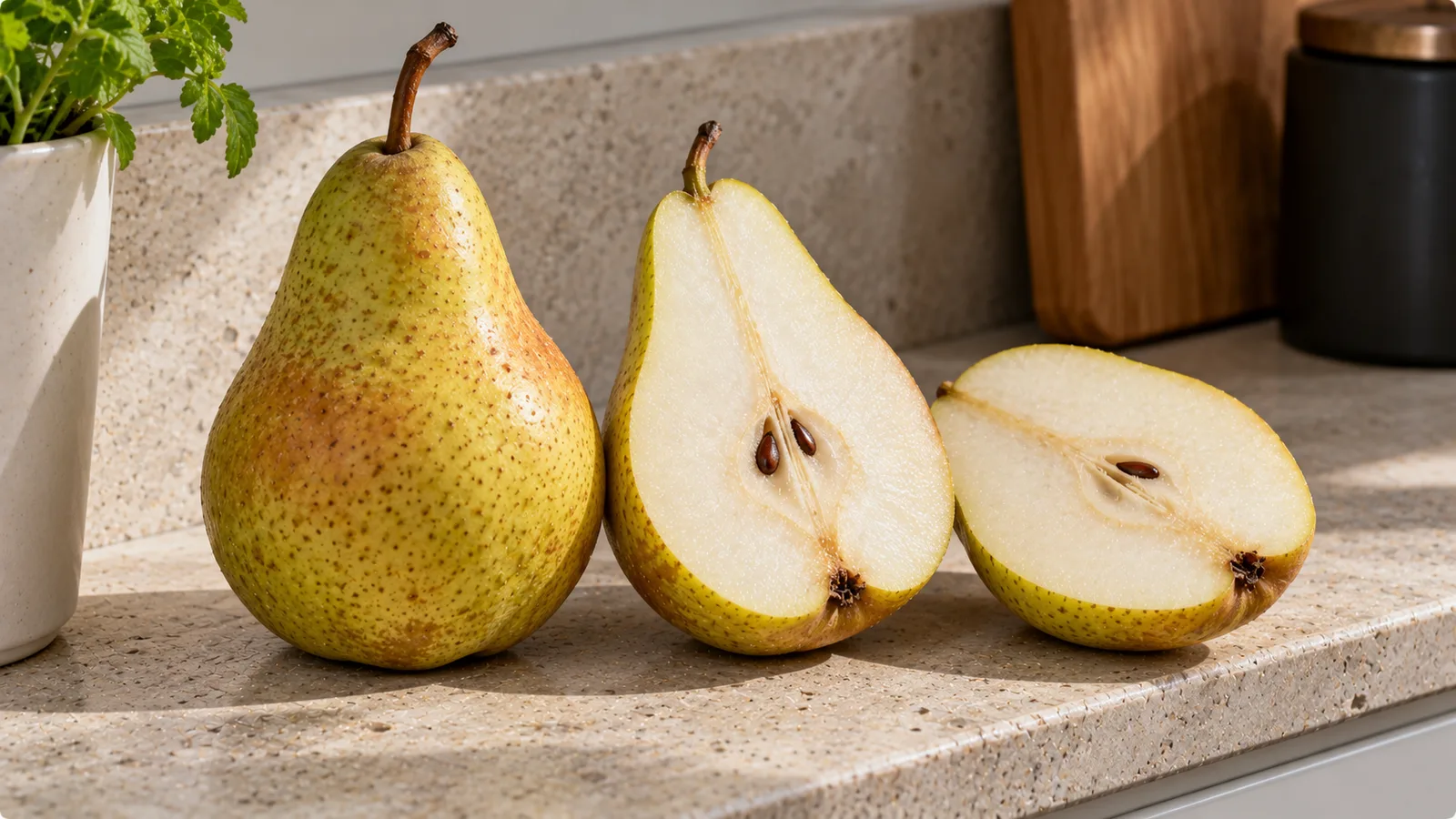
A raw pear with its skin contains approximately 57 calories per 100 g of edible fruit. A medium pear weighing 178 g after removing the core and stem provides about 101 calories.
The important distinction is between the weight of the whole fruit and the weight you actually eat. Pears vary considerably in size, and the core and stem are normally discarded.
This guide uses reference values for raw pears with skin. Cooked pears, canned pears, pear juice and dried pears are discussed separately because their calorie density or ingredients may differ.
Pear calories per 100 g and serving
The following estimates use 57 kcal per 100 g of edible raw pear.
| Edible pear weight | Approximate calories |
|---|---|
| 50 g | 29 kcal |
| 75 g | 43 kcal |
| 100 g | 57 kcal |
| 125 g | 71 kcal |
| 150 g | 86 kcal |
| 175 g | 100 kcal |
| 178 g | 101 kcal |
| 200 g | 114 kcal |
| 225 g | 128 kcal |
| 250 g | 143 kcal |
| 300 g | 171 kcal |
| 400 g | 228 kcal |
| 500 g | 285 kcal |
Values are rounded. Actual pears may differ because of variety, maturity, growing conditions and water content.
Source: USDA FoodData Central.
How many calories are in one pear?
The calorie content of a pear depends primarily on its edible weight.
Common US reference serving sizes provide useful examples.
| Pear size | Approximate edible weight | Calories |
|---|---|---|
| Small pear | 148 g | 84 kcal |
| Medium pear | 178 g | 101 kcal |
| Large pear | 230 g | 131 kcal |
These are reference weights, not universal definitions. A pear sold as medium in one supermarket may be heavier than another.
A particularly large pear can exceed the values in the table, while a small pear may contain considerably fewer calories.
If accuracy matters, weigh the edible flesh rather than relying on size descriptions.
Does the core count?
Normally, no.
The stem, central core and seeds are usually discarded, so they should not be included in the edible portion.
For example, imagine that a pear weighs 210 g before preparation and 185 g after removing the core and stem.
Using 185 g of edible fruit:
185 × 57 ÷ 100 = approximately 105 kcal.
Using the original 210 g would give about 120 kcal and overestimate the quantity actually eaten.
The amount discarded varies between pears, so there is no single exact conversion from whole-fruit weight to edible weight.
Pear nutrition per 100 g
Approximate reference values for raw pear with skin:
| Nutrient | Per 100 g |
|---|---|
| Energy | 57 kcal |
| Water | 84.0 g |
| Total carbohydrates, US definition | 15.2 g |
| Total sugars | 9.8 g |
| Dietary fibre | 3.1 g |
| Protein | 0.4 g |
| Fat | 0.1 g |
| Vitamin C | 4.3 mg |
| Potassium | 116 mg |
Pears contain mostly water and carbohydrates, with very little fat or protein.
They also provide dietary fibre, particularly when eaten with the skin.
These figures describe the whole raw fruit, not pear juice or a sweetened pear product.
Reference: USDA FoodData Central.
Why US and European carbohydrate figures can differ
US nutrient databases generally report total carbohydrates including dietary fibre.
European food labels declare carbohydrates and fibre separately, with the carbohydrate figure referring to available carbohydrates.
Therefore, the US total-carbohydrate figure of approximately 15.2 g per 100 g should not be copied directly into a European nutrition label as though it excluded fibre.
For a packaged product, follow the applicable label and its definitions.
Source: Regulation (EU) No 1169/2011.
Nutrition in a medium pear
A reference medium pear containing 178 g of edible fruit provides approximately:
| Nutrient | Amount |
|---|---|
| Energy | 101 kcal |
| Total carbohydrates, US definition | 27.1 g |
| Sugars | 17.4 g |
| Fibre | 5.5 g |
| Protein | 0.7 g |
| Fat | 0.2 g |
| Vitamin C | 7.7 mg |
These values are calculated from the 100 g reference and rounded.
A medium pear can make a convenient snack, but it is not a substantial source of protein or fat.
If the pear is intended to form a larger meal, combining it with a suitable protein-containing food may make the meal more complete.
For example, pear slices can be served with plain yogurt or quark.
How much sugar is in a pear?
Raw pears contain approximately 9.8 g of naturally occurring sugars per 100 g.
| Edible portion | Approximate sugar |
|---|---|
| 50 g | 4.9 g |
| 100 g | 9.8 g |
| 150 g | 14.7 g |
| 178 g | 17.4 g |
| 200 g | 19.6 g |
| 250 g | 24.5 g |
These sugars occur naturally within the fruit.
Whole pears also provide water and fibre. They should not be considered nutritionally identical to pear syrup, sweetened canned pears or confectionery.
The amount of sugar in an individual pear can vary with ripeness and variety.
For everyday calorie tracking, the standard reference values are usually sufficient unless a specific product label is available.
Pear fibre: with skin versus peeled
A raw pear with skin contains approximately 3.1 g of fibre per 100 g.
The skin contributes to the fruit's overall fibre content.
Peeling removes some fibre, although the flesh also contains fibre.
The exact difference depends on the variety and how much flesh is removed with the peel.
If you regularly eat pears with the skin, wash them thoroughly under running water before eating.
If you prefer peeled pears, they can still be part of a balanced diet.
There is no need to treat the skin as mandatory for a healthy meal.
Pear calories compared with other fruit
Approximate energy values per 100 g of raw edible fruit:
| Fruit | Calories per 100 g |
|---|---|
| Strawberries | 32 kcal |
| Orange | 47 kcal |
| Apple with skin | 52 kcal |
| Pear with skin | 57 kcal |
| Blueberries | 57 kcal |
| Banana | 89 kcal |
These are reference values rather than exact figures for every variety.
Pears and apples have relatively similar calorie densities.
A banana is more calorie-dense per 100 g, but this does not make it a poor food choice.
Different fruits contribute different nutrients, and serving size matters more than small differences in reference calories.
Source: USDA FoodData Central.
Are green and red pears different in calories?
Colour alone is not a reliable way to estimate calories.
Different pear varieties can vary in water content, sweetness, texture and size.
A red-skinned pear is not necessarily more calorie-dense than a green-skinned pear.
For practical tracking, use a suitable raw-pear database entry and the edible weight.
If a product has a specific verified nutrition label, that value takes precedence over a general estimate.
Does ripeness change pear calories?
As pears ripen, their texture, aroma and perceived sweetness can change.
Some carbohydrates may be converted into different forms during ripening.
However, the fruit does not suddenly gain a large amount of energy simply because it becomes softer.
Differences in water content and variety may affect calories per 100 g, but ordinary calorie tracking does not require a separate calculation for every stage of ripeness.
A ripe pear and a firmer pear of the same edible weight can generally be logged using the same reference entry.
Fresh versus canned pears
Fresh pears and canned pears are not always nutritionally equivalent.
Canned products may be packed in water, fruit juice or syrup.
| Product | What to check |
|---|---|
| Fresh raw pear | Edible weight, approximately 57 kcal per 100 g |
| Pear canned in water | Product label and drained weight |
| Pear canned in juice | Label, whether juice is consumed, drained weight |
| Pear canned in light syrup | Added sugars and serving definition |
| Pear canned in heavy syrup | Added sugars and whether syrup is eaten |
| Unsweetened pear purée | Ingredients and actual fruit quantity |
If the label provides nutrition for the drained fruit, use that basis when the liquid is discarded.
If the syrup or juice is consumed, its calories must also be included.
Do not apply the raw-pear value automatically to sweetened canned pears.
How many calories are in cooked or baked pears?
Cooking does not create calories by itself.
However, heating can change the water content of pears, which affects calories per 100 g of the finished dish.
A pear baked without added ingredients retains approximately the same total energy as the original edible fruit, assuming none is discarded.
If water evaporates, the cooked pear weighs less and its calorie density per 100 g can increase.
For example:
- Start with 200 g edible pear: approximately 114 kcal.
- Bake without additions.
- Finished pear weighs 170 g after moisture loss.
- Total energy remains approximately 114 kcal.
- Per 100 g of finished pear: approximately 67 kcal.
This example is illustrative and assumes no meaningful loss of edible material.
Butter, honey, sugar, pastry or ice cream must be counted separately.
Dried pears versus fresh pears
Dried pears are substantially more energy-dense per 100 g because much of the water has been removed.
A small portion of dried pear may still contain fewer total calories than a large fresh pear.
The correct comparison is between the actual portions eaten, not simply between equal weights.
Some dried pear products contain added sugar or other ingredients.
Use the nutrition information on the package whenever available.
Do not log dried pears using the 57 kcal per 100 g value for fresh fruit.
Pear juice versus whole pears
Pear juice usually contains less fibre than whole pears because much of the solid fruit material is removed.
Its calorie content depends on concentration, processing and added ingredients.
A glass of pear juice may be consumed more quickly than the equivalent quantity of whole fruit.
For accurate logging, use the juice's volume and nutrition label.
A whole pear's calorie and fibre values cannot be transferred directly to a glass of juice.
Pear calories with common toppings
Pears are often eaten with yogurt, nuts, cheese, honey or chocolate.
The fruit's own calories may be modest, but the full snack depends on every ingredient.
Example:
| Ingredient | Amount | Approximate calories |
|---|---|---|
| Raw pear | 150 g | 86 kcal |
| Plain yogurt, 1.5% fat | 150 g | 75 kcal |
| Walnuts | 15 g | 98 kcal |
| Total | 259 kcal |
The yogurt and walnut values are representative estimates.
Different brands and products may vary.
This combination provides a different nutritional profile from eating a pear alone, including additional protein and fat.
If honey or granola is added, include it in the total.
Can pears fit into a weight-loss diet?
Yes. Pears can fit into an eating pattern intended for weight management.
A medium pear provides approximately 101 calories and 5.5 g fibre based on reference values.
The fruit can be a convenient snack or part of a larger meal.
However, pears do not independently cause weight loss.
Long-term body-weight changes depend on overall energy balance and other individual factors.
A practical approach is to choose portions that suit your appetite and dietary needs.
For general guidance, see the World Health Organization's healthy diet recommendations.
How to calculate pear calories accurately
Use the weight of the edible fruit.
Formula:
Calories = edible weight in grams × 57 ÷ 100.
Examples:
- 90 g edible pear: approximately 51 kcal.
- 135 g edible pear: approximately 77 kcal.
- 185 g edible pear: approximately 105 kcal.
- 260 g edible pear: approximately 148 kcal.
If you weigh a whole pear before removing the core, either weigh the discarded parts or weigh the prepared fruit again.
For a recipe containing several pears, add their edible weights before calculating the fruit calories.
Then include all other ingredients.
Common mistakes when tracking pear calories
Using whole-fruit weight without accounting for the core. This can overestimate the edible portion.
Assuming every medium pear weighs 178 g. That is a reference serving, not a universal weight.
Using raw-pear values for dried pears. Removing water changes calories per 100 g.
Ignoring syrup in canned pears. Sweetened liquids can add energy.
Counting baked pears without toppings. Honey, butter, pastry and ice cream can change the total considerably.
Treating pear juice like whole fruit. Fibre content and serving behaviour differ.
Quick answers
How many calories are in 100 g of pear?
Approximately 57 kcal for raw pear with skin.
How many calories are in a small pear?
Approximately 84 kcal for a reference edible portion of 148 g.
How many calories are in a medium pear?
Approximately 101 kcal for a reference edible portion of 178 g.
How many calories are in a large pear?
Approximately 131 kcal for a reference edible portion of 230 g.
How many calories are in 200 g of pear?
Approximately 114 kcal.
How much fibre does a pear contain?
Approximately 3.1 g per 100 g of raw pear with skin.
Does peeling a pear remove all its fibre?
No. The flesh also contains fibre, although removing the skin reduces some of the total.
Are baked pears higher in calories?
Not necessarily in total. Baking without added ingredients does not add calories, but moisture loss can increase calories per 100 g of finished fruit.
Sources
- USDA FoodData Central — reference nutrient composition and pear serving sizes.
- Regulation (EU) No 1169/2011 — European nutrition-labelling definitions.
- World Health Organization: Healthy diet — general dietary guidance.
All values are approximate. Calculations for fresh raw pear use 57 kcal per 100 g of edible fruit.