
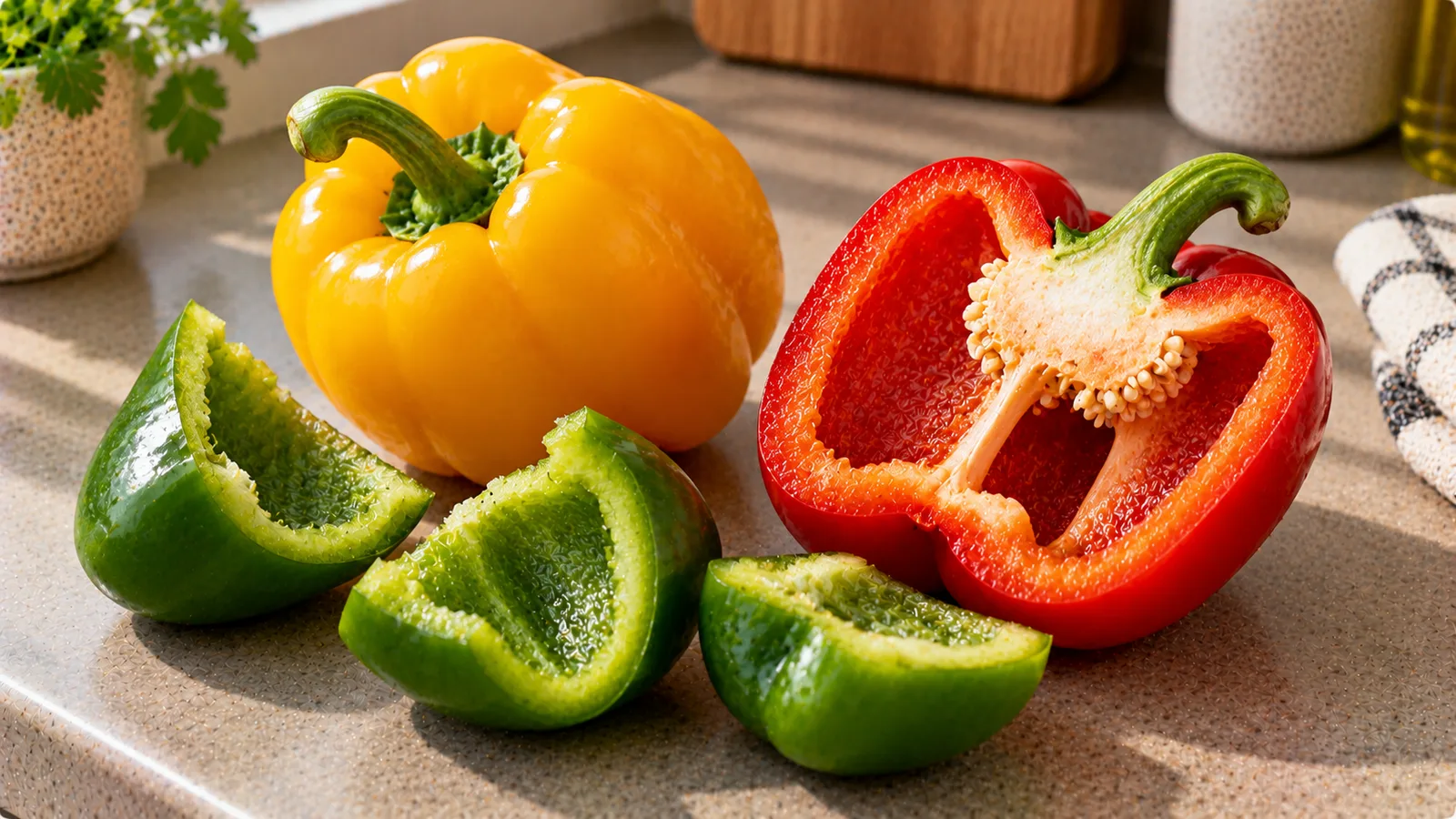
Bell peppers are colorful vegetables used in salads, stir-fries, soups, sandwiches and roasted dishes. They are naturally low in calories, contain very little fat and provide vitamin C and dietary fiber.
The exact calorie content depends on the pepper's color, variety, ripeness and preparation.
A useful reference is approximately 20 kcal per 100 g of raw green bell pepper and 31 kcal per 100 g of raw red bell pepper.
Yellow bell peppers commonly fall within a similar low-calorie range, but their precise nutritional values depend on the database entry and product.
The figures below refer to the edible pepper flesh, excluding the stem, core and seeds.
Bell pepper calories per 100 g
| Bell pepper | Approximate calories per 100 g |
|---|---|
| Green, raw | 20 kcal |
| Red, raw | 31 kcal |
| Yellow, raw | 27 kcal |
| Green, raw, 150 g | 30 kcal |
| Red, raw, 150 g | 47 kcal |
| Yellow, raw, 150 g | 41 kcal |
These are representative values, not guaranteed figures for every pepper.
The green and red references correspond to common USDA nutrient data. Yellow pepper values can differ across datasets, so 27 kcal per 100 g is used here as a practical estimate.
Source: USDA FoodData Central.
Color is useful for choosing an approximate entry, but weighing the edible portion is more important than trying to identify an exact calorie value from appearance.
Calories by serving size
The following table uses 31 kcal per 100 g for raw red bell pepper.
| Edible red pepper weight | Approximate calories |
|---|---|
| 25 g | 8 kcal |
| 50 g | 16 kcal |
| 75 g | 23 kcal |
| 100 g | 31 kcal |
| 125 g | 39 kcal |
| 150 g | 47 kcal |
| 175 g | 54 kcal |
| 200 g | 62 kcal |
| 250 g | 78 kcal |
| 300 g | 93 kcal |
| 400 g | 124 kcal |
| 500 g | 155 kcal |
For green bell peppers, multiply the edible weight in grams by 0.20 instead.
For yellow bell peppers using the reference estimate, multiply the weight by 0.27.
Example: 180 g of red bell pepper
180 × 0.31 = approximately 56 kcal.
Example: 180 g of green bell pepper
180 × 0.20 = approximately 36 kcal.
Example: 180 g of yellow bell pepper
180 × 0.27 = approximately 49 kcal.
These differences are relatively small in an ordinary mixed meal, but they can be included when tracking nutrition.
How many calories are in one whole bell pepper?
Bell peppers vary considerably in size.
A small pepper may contain much less edible flesh than a large one.
The weight of the stem, seeds and core should not be counted when calculating the edible portion.
| Edible weight of one pepper | Green | Red | Yellow |
|---|---|---|---|
| 100 g | 20 kcal | 31 kcal | 27 kcal |
| 125 g | 25 kcal | 39 kcal | 34 kcal |
| 150 g | 30 kcal | 47 kcal | 41 kcal |
| 175 g | 35 kcal | 54 kcal | 47 kcal |
| 200 g | 40 kcal | 62 kcal | 54 kcal |
| 250 g | 50 kcal | 78 kcal | 68 kcal |
A whole pepper weighing 200 g before trimming does not necessarily provide 200 g of edible flesh.
For accurate tracking, remove the stem and core, then weigh the portion you will eat.
If you do not have a scale, an edible weight of around 150 g can be used as an illustrative medium-pepper estimate, but actual sizes vary.
Red versus green versus yellow bell peppers
All three colors are low-calorie vegetables.
Green peppers are commonly harvested at an earlier stage of ripeness, while red peppers are generally more mature. Yellow varieties can follow different ripening patterns depending on the cultivar.
Their flavor and nutritional composition can differ.
Green bell peppers
Green peppers have a more grassy, slightly bitter taste.
A representative raw value is approximately 20 kcal per 100 g.
They work well in stir-fries, soups, fajitas and savory sauces.
Red bell peppers
Red peppers usually taste sweeter than green peppers.
A representative raw value is approximately 31 kcal per 100 g.
They are useful in salads, roasting, pasta sauces and sandwiches.
Yellow bell peppers
Yellow peppers often have a mild, sweet flavor.
For practical calculations, approximately 27 kcal per 100 g is a reasonable reference, although published values vary.
They can be eaten raw, grilled or roasted.
Which color is best for weight management?
No color is inherently required for weight loss.
All three provide relatively few calories for their volume.
The amount of oil, cheese, dressing or other ingredients added to the peppers often has a greater effect on the meal's calorie total than the difference between pepper colors.
Bell pepper nutrition facts
Representative nutrition values for raw green and red bell peppers are shown below.
| Nutrient | Green pepper, 100 g | Red pepper, 100 g |
|---|---|---|
| Calories | 20 kcal | 31 kcal |
| Protein | 0.86 g | 0.99 g |
| Total fat | 0.17 g | 0.30 g |
| Total carbohydrate, US definition | 4.64 g | 6.03 g |
| Fiber | 1.7 g | 2.1 g |
| Total sugars | 2.4 g | 4.2 g |
| Vitamin C | 80.4 mg | 127.7 mg |
Source: USDA FoodData Central.
These figures are representative and can vary with cultivar, ripeness, storage and laboratory methodology.
Bell peppers are not a significant source of fat or protein.
They contribute carbohydrates in modest amounts, including naturally occurring sugars and fiber.
Carbohydrate labeling differences
US nutrition databases generally include dietary fiber in total carbohydrates.
European nutrition labels list available carbohydrates and fiber separately.
Using the representative values above:
- Green pepper: 4.64 g total carbohydrate minus 1.7 g fiber = approximately 2.94 g available carbohydrate per 100 g.
- Red pepper: 6.03 g total carbohydrate minus 2.1 g fiber = approximately 3.93 g available carbohydrate per 100 g.
These are calculated estimates rather than product-specific European label values.
Reference: Regulation (EU) No 1169/2011.
How many calories are in sliced bell peppers?
Cutting a pepper into strips, cubes or rings does not change its total calories.
A 100 g portion contains the same approximate energy whether the pepper is whole or sliced.
The problem is that cups and handfuls of sliced peppers can contain different weights.
A loosely filled cup of large strips may weigh less than a tightly packed cup of finely diced pepper.
For precise tracking, weigh the slices rather than relying on cup measurements.
Example: raw pepper strips
A snack contains:
- 80 g red bell pepper.
- 70 g green bell pepper.
Estimated energy:
- Red: 80 × 0.31 = 25 kcal.
- Green: 70 × 0.20 = 14 kcal.
Total: approximately 39 kcal, before dips or other additions.
If the peppers are served with hummus, yogurt dip or dressing, count those separately.
Calories in cooked bell peppers without oil
Bell peppers can be steamed, boiled, grilled, roasted or cooked in a nonstick pan without added oil.
Cooking changes their water content and sometimes their weight.
Cooking without added oil does not automatically add calories to the pepper.
However, calories per 100 g of cooked pepper may differ from the raw value because water can evaporate or be absorbed.
Example: roasted red pepper without oil
Suppose you start with 200 g raw red pepper flesh.
Using 31 kcal per 100 g, the raw pepper contains approximately 62 kcal.
After roasting and removing some moisture, the edible cooked pepper weighs 150 g.
If no meaningful energy-containing material is lost or added, the entire cooked portion still contains approximately 62 kcal.
But its calculated energy density becomes:
62 ÷ 150 × 100 = approximately 41 kcal per 100 g cooked pepper.
This is an illustrative calculation, not a universal cooked-pepper database value.
Example: steamed green pepper
Suppose 150 g raw green pepper provides approximately 30 kcal.
After steaming, its weight changes slightly.
The total energy remains approximately 30 kcal if no significant nutrients are lost and no other ingredients are added.
For homemade cooking, recording the original raw edible weight is often the simplest approach.
Roasted peppers with olive oil
Oil can change the calorie total substantially.
Olive oil provides approximately 9 kcal per gram.
Consider a tray containing:
- 300 g raw red bell pepper.
- 15 g olive oil.
Estimated calories:
300 g red pepper × 0.31 = 93 kcal.
15 g olive oil × 9 = approximately 135 kcal.
Total: approximately 228 kcal for the tray, assuming all the oil is consumed.
If divided into three equal portions, that is approximately 76 kcal per portion.
Without the oil, the peppers alone would provide approximately 31 kcal per portion.
If some oil remains on the tray and is not eaten, the actual consumed energy may be lower.
Calories in fried bell peppers
Fried bell peppers should be calculated from both the peppers and the cooking fat.
Example: peppers sautéed in oil
Ingredients:
- 200 g green bell pepper.
- 200 g red bell pepper.
- 20 g olive oil.
Approximate energy:
- Green pepper: 40 kcal.
- Red pepper: 62 kcal.
- Olive oil: 180 kcal.
Total: approximately 282 kcal.
If the dish makes two equal portions, each provides approximately 141 kcal.
Onions, garlic, sauces or other ingredients would add to the total.
This explains why fried peppers can be much more caloric than raw pepper slices.
Calories in stuffed bell peppers
Stuffed peppers cannot be estimated from the pepper alone.
The filling often contributes most of the calories.
Common ingredients include:
- Ground meat or poultry.
- Rice, couscous or quinoa.
- Beans or lentils.
- Cheese.
- Tomato sauce.
- Cooking oil.
Example: one stuffed pepper
Suppose the edible pepper flesh weighs 150 g.
If it is red, the pepper contributes approximately 47 kcal.
The filling might contain rice, meat, cheese and oil.
Those ingredients must be calculated individually.
A stuffed pepper can therefore have several times more calories than an unfilled pepper, depending on the recipe.
For homemade stuffed peppers, calculate the full recipe and divide by the actual number or weight of servings.
Bell peppers in salads
Bell peppers add crunch, color and volume to salads.
For example:
- Red pepper: 100 g = approximately 31 kcal.
- Green pepper: 50 g = approximately 10 kcal.
- Yellow pepper: 50 g = approximately 14 kcal.
The peppers together contribute approximately 55 kcal.
If the salad also contains feta, avocado, nuts, croutons or dressing, these ingredients should be included separately.
The total calories of a salad are not determined by the vegetables alone.
Bell peppers in soups and sauces
Bell peppers are often cooked with tomatoes, onions and other vegetables.
Their calories are included in the complete recipe.
Example: vegetable soup
A soup contains 250 g raw red bell pepper.
The pepper contributes approximately:
250 × 0.31 = 78 kcal to the entire pot.
If the soup makes five equal servings, the pepper accounts for approximately 16 kcal per serving.
Other ingredients must be counted separately.
Example: homemade pepper sauce
Roasted peppers may be blended with garlic, tomato, olive oil or cream.
The pepper itself is low in calories.
Oil and cream can raise the energy density significantly.
Use the actual recipe quantities and final edible weight for an accurate calculation.
Vitamin C in bell peppers
Bell peppers can be an important dietary source of vitamin C.
Representative raw values are approximately:
- Green pepper: 80 mg vitamin C per 100 g.
- Red pepper: 128 mg vitamin C per 100 g.
Vitamin C supports normal physiological functions, including collagen formation and the functioning of the immune system.
It also contributes to normal iron absorption from plant-based foods.
Cooking and storage can reduce vitamin C because it is sensitive to heat and other conditions.
The amount retained depends on the cooking method and duration.
Bell peppers do not need to be eaten raw exclusively, but raw and lightly cooked preparations can be useful ways to include them in the diet.
Source: NIH Office of Dietary Supplements — Vitamin C.
Are bell peppers high in sugar?
Bell peppers contain naturally occurring sugars, but relatively modest amounts.
Representative values are approximately:
- Green pepper: 2.4 g sugars per 100 g.
- Red pepper: 4.2 g sugars per 100 g.
The sweeter taste of red peppers is consistent with differences in their composition and ripeness.
However, sweetness alone is not a reliable way to calculate the exact sugar content of an individual pepper.
Bell peppers are not equivalent to sweetened pepper sauces or products containing added sugar.
For packaged sauces, check the ingredient list and nutrition label.
Are bell peppers suitable for a calorie deficit?
Bell peppers can be useful in meals where calorie intake is being managed.
They add volume, flavor and texture while contributing relatively little energy.
Examples include:
- Adding sliced peppers to sandwiches.
- Replacing part of a high-calorie filling with chopped peppers.
- Serving raw pepper strips with a measured dip.
- Adding peppers to omelets or vegetable soups.
- Roasting peppers with a measured amount of oil.
No individual vegetable creates a calorie deficit by itself.
Weight management depends on overall energy intake, eating patterns and other factors.
It is also important to include adequate protein, dietary fat and other nutrients across the complete diet.
How to weigh bell peppers accurately
For the most accurate result:
- Wash and dry the pepper.
- Remove the stem, seeds and core.
- Weigh the edible flesh.
- Select the appropriate color and preparation entry.
- Record any oil, sauce, cheese or filling separately.
If you weigh the pepper before trimming, the total weight includes parts you may not eat.
If you roast peppers and then remove the skin, consider the edible weight and the ingredients actually consumed.
For a homemade recipe, recording raw ingredient weights before cooking usually makes calculations easier.
How to calculate bell pepper calories
Use:
Calories = edible weight in grams × calories per gram
Reference multipliers:
- Raw green pepper: 0.20 kcal per gram.
- Raw red pepper: 0.31 kcal per gram.
- Raw yellow pepper: approximately 0.27 kcal per gram.
Examples:
| Food | Calculation | Approximate calories |
|---|---|---|
| 80 g green pepper | 80 × 0.20 | 16 kcal |
| 120 g red pepper | 120 × 0.31 | 37 kcal |
| 160 g yellow pepper | 160 × 0.27 | 43 kcal |
| 220 g green pepper | 220 × 0.20 | 44 kcal |
| 250 g red pepper | 250 × 0.31 | 78 kcal |
Use product-specific nutrition information when available.
For cooked peppers, consider whether water loss, added oil or other ingredients have changed the composition.
Storage and food safety
Store fresh bell peppers according to appropriate produce-handling guidance.
Wash them under running water before cutting or eating.
Use a clean knife and cutting board.
Keep cut peppers refrigerated and avoid leaving prepared vegetables at room temperature for extended periods.
Discard peppers showing mold or clear signs of spoilage.
When cooking with meat or other perishable ingredients, follow the food-safety requirements of the complete dish.
Source: USDA Food Safety and Inspection Service.
Frequently asked questions
How many calories are in 100 g of bell pepper?
Approximately 20 kcal for raw green pepper and 31 kcal for raw red pepper. Yellow peppers are also low in calories.
How many calories are in one red bell pepper?
A red pepper with 150 g edible flesh contains approximately 47 kcal.
Are red peppers higher in calories than green peppers?
Representative raw values are higher for red peppers, but both are low-calorie foods.
How many calories are in 200 g of bell pepper?
Approximately 40 kcal for green pepper or 62 kcal for red pepper.
Does roasting increase bell pepper calories?
Roasting without oil does not add energy. Water loss can increase calories per 100 g of the finished pepper.
How many calories do peppers have with oil?
Count the pepper and the oil. For example, 300 g red pepper plus 15 g olive oil contains approximately 228 kcal if all the oil is consumed.
Are bell peppers a source of protein?
They contain small amounts of protein but are not a major protein source.
Should I weigh peppers before or after cooking?
For homemade recipes, weighing the edible raw pepper before cooking is often easiest.
Sources and methodology
- USDA FoodData Central — representative nutrient values for raw bell peppers.
- NIH Office of Dietary Supplements — Vitamin C — vitamin C functions and dietary information.
- Regulation (EU) No 1169/2011 — European nutrition labeling conventions.
- USDA Food Safety and Inspection Service — general food handling guidance.
The calorie calculations use 20 kcal per 100 g for raw green peppers, 31 kcal for raw red peppers and an approximate reference of 27 kcal for raw yellow peppers. Values refer to edible flesh. Cooked-food examples are recipe calculations rather than universal database values.