
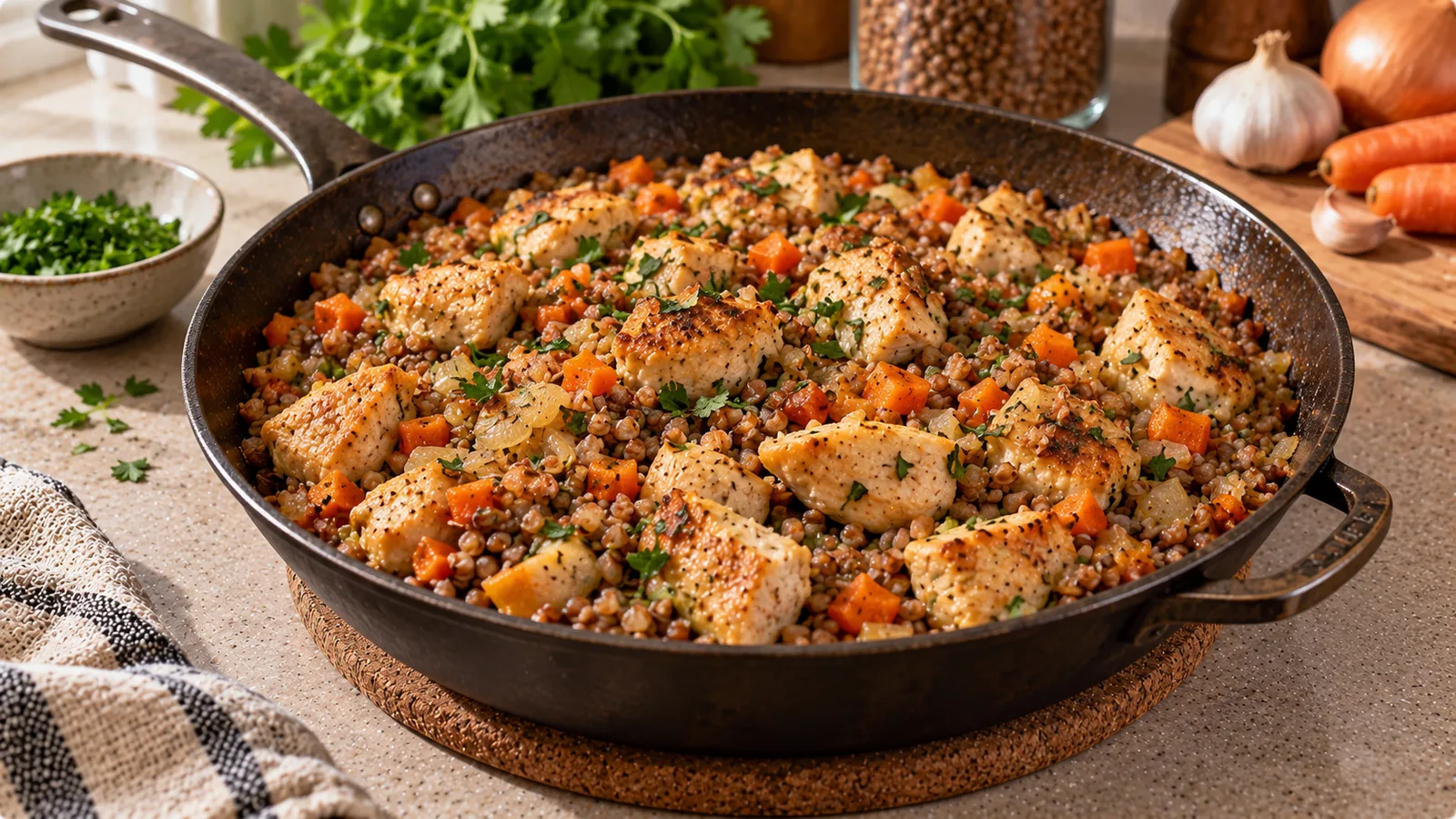
Chicken and buckwheat skillet is a practical meal built around three ingredients that work particularly well together: tender chicken, nutty buckwheat and vegetables cooked in the same pan.
The recipe uses dry buckwheat groats rather than buckwheat flour or noodles. The grains absorb seasoned cooking liquid, while the chicken and mushrooms provide savory flavor.
It is a useful option when you want a complete homemade meal without preparing a separate grain side dish.
This version makes four servings and takes approximately 40–45 minutes.
Recipe overview
| Detail | Amount |
|---|---|
| Servings | 4 |
| Preparation | 15 minutes |
| Cooking | 25–30 minutes |
| Total time | 40–45 minutes |
| Main protein | Chicken breast |
| Main grain | Buckwheat groats |
| Cooking method | Covered skillet |
| Estimated energy | About 485 kcal per serving |
| Estimated protein | About 45 g per serving |
Nutrition values are estimates based on typical ingredient composition. Actual results depend on product labels, trimming, cooking losses and portion sizes.
Ingredients
| Ingredient | Quantity |
|---|---|
| Boneless, skinless chicken breast | 600 g |
| Dry buckwheat groats | 240 g |
| Mushrooms | 250 g |
| Carrots | 180 g |
| Onion | 150 g |
| Olive oil | 20 g |
| Garlic | 12 g |
| Low-sodium chicken stock or water | 550–650 ml |
| Sweet paprika | 5 g |
| Dried thyme | 2 g |
| Black pepper | To taste |
| Salt | To taste |
| Fresh parsley | 15 g |
| Lemon juice | 15 g |
The chicken weight refers to raw, boneless meat.
The buckwheat weight refers to dry groats before cooking. Do not substitute the same weight of cooked buckwheat, because cooked grains contain substantially more water.
Use a large, deep skillet with a well-fitting lid. A diameter of approximately 28–30 cm is convenient for four servings.
Step 1: Prepare the ingredients
Cut the chicken into bite-sized pieces, approximately 2–3 cm across.
Clean the mushrooms and slice them.
Peel the carrots and cut them into small cubes or thin half-moons.
Finely chop the onion and garlic.
Rinse the buckwheat if recommended by the package instructions, then drain thoroughly.
Keep raw chicken separate from ready-to-eat ingredients. Wash hands and clean utensils and surfaces after handling it.
You do not need to wash raw chicken. Washing can spread contaminated droplets around the kitchen.
Step 2: Brown the chicken
Heat the skillet over medium-high heat.
Add approximately half the olive oil.
Place the chicken pieces in the pan in a single layer.
Cook for several minutes, turning occasionally, until the surfaces begin to brown.
If the skillet is crowded, brown the chicken in two batches.
Browning develops flavor, but the chicken does not need to be fully cooked at this stage because it will finish cooking with the buckwheat.
Transfer the browned chicken to a clean plate.
Do not reuse a plate that held raw chicken unless it has been washed.
Step 3: Cook the vegetables
Reduce the heat to medium and add the remaining olive oil.
Add the onion and carrot.
Cook for approximately 4–5 minutes, stirring occasionally.
Add the mushrooms and continue cooking until they release moisture and begin to soften.
Stir in the garlic, paprika and thyme.
Cook for another 30–60 seconds, just until fragrant.
Avoid burning the garlic or paprika, as this can create a bitter taste.
If the pan becomes too dry, add a small splash of water rather than automatically adding more oil.
Step 4: Add the buckwheat
Add the drained dry buckwheat to the vegetables.
Stir gently for approximately one minute so the grains mix with the aromatic ingredients.
Return the browned chicken and any collected juices to the skillet.
Pour in approximately 550 ml of stock or water.
Season lightly with salt and black pepper.
If using commercial stock, taste before adding much salt. Stock products vary substantially in sodium content.
Bring the liquid to a gentle simmer.
Step 5: Simmer until tender
Reduce the heat to low.
Cover the skillet and cook for approximately 15–20 minutes, or according to the buckwheat package instructions.
The exact cooking time depends on whether the groats are raw, toasted or partially processed.
Check the pan periodically without stirring excessively.
If the grains are still firm and the liquid has nearly disappeared, add a little hot water, cover again and continue cooking.
If the buckwheat is tender but the pan contains excess liquid, remove the lid and simmer briefly.
The chicken must be fully cooked before serving.
According to FoodSafety.gov, poultry should reach a safe minimum internal temperature of 74°C / 165°F, measured with a food thermometer.
Do not judge chicken safety only by its color.
Step 6: Finish and serve
Turn off the heat once the buckwheat is tender and the chicken is safely cooked.
Let the skillet rest, covered, for approximately five minutes.
This allows remaining moisture to distribute more evenly.
Fluff the buckwheat gently with a fork.
Add lemon juice and chopped parsley.
Taste and adjust the seasoning.
Divide into four portions.
For a fresh contrast, serve with sliced cucumber, tomato or a simple green salad. Count additional dressings or toppings separately if tracking calories.
Estimated nutrition per serving
The following values are calculated from illustrative ingredient averages and divided into four equal servings.
| Nutrient | Approximate amount |
|---|---|
| Calories | 485 kcal |
| Protein | 45 g |
| Carbohydrates | 53 g |
| Fat | 10 g |
| Fiber | 7 g |
These are planning estimates, not laboratory-tested values.
Ingredient data can be compared with USDA FoodData Central.
For accurate tracking, use the nutrition labels of your specific chicken, buckwheat, oil and stock.
Understanding the calorie calculation
A recipe's calories come from its ingredients, not from the amount of water absorbed during cooking.
An illustrative calculation is:
| Ingredient group | Estimated energy for full recipe |
|---|---|
| Chicken breast, 600 g | 720 kcal |
| Dry buckwheat, 240 g | 825 kcal |
| Mushrooms, carrots, onion, garlic | 205 kcal |
| Olive oil, 20 g | 180 kcal |
| Stock, lemon, herbs and seasonings | 10 kcal |
| Total | 1,940 kcal |
Dividing 1,940 kcal by four gives approximately 485 kcal per serving.
The chicken estimate assumes approximately 120 kcal per 100 g of raw meat, and the buckwheat estimate assumes approximately 344 kcal per 100 g of dry groats. Actual products may differ.
If you add another 10 g of olive oil, the recipe gains approximately 90 kcal in total, or around 23 kcal per serving.
If you reduce the dry buckwheat from 240 g to 200 g, the total energy decreases by approximately 138 kcal, before considering any other changes.
These calculations help you adjust the meal without guessing.
Why buckwheat works in a skillet
Despite its name, buckwheat is not a type of wheat.
It is a pseudocereal: its seeds are prepared and eaten much like grains.
Buckwheat has a distinctive earthy, nutty flavor that pairs well with mushrooms, onions and browned chicken.
Its grains absorb cooking liquid and become tender while generally retaining some structure when cooked correctly.
Buckwheat also contributes carbohydrates, fiber and some plant protein.
However, the chicken provides most of the protein in this particular recipe.
Naturally plain buckwheat does not contain gluten, but packaged products may be exposed to gluten-containing grains during processing. People who need strict gluten avoidance should choose appropriately labeled products and check the stock and seasonings.
Raw versus toasted buckwheat
Buckwheat groats are sold in different forms.
Raw buckwheat is generally lighter in color and has a milder flavor.
Toasted buckwheat, sometimes called kasha, is darker and has a more pronounced nutty aroma.
Both can work in this recipe, but cooking times and liquid requirements may differ.
Follow the instructions for the product you purchase.
Avoid using buckwheat flour or buckwheat flakes as a direct substitute. They behave differently in liquid and will not produce the same skillet texture.
How to keep chicken tender
Chicken breast can become dry when cooked for too long.
Cut the pieces into similar sizes so they cook evenly.
Brown them briefly rather than cooking them completely before adding the buckwheat.
Keep the skillet at a gentle simmer rather than a vigorous boil.
Use a food thermometer to confirm the safe internal temperature without unnecessarily extending the cooking time.
If using larger chicken pieces, the cooking time may need adjustment.
Boneless chicken thighs are another option. They usually tolerate simmering well but have a different nutritional profile.
Preventing mushy buckwheat
The most common problem is adding too much liquid or cooking the grains too long.
Begin with the lower end of the recommended liquid range.
Remember that mushrooms release moisture during cooking.
Keep the heat low enough for a gentle simmer.
Check the grains near the end of the package's suggested cooking time.
Once tender, stop cooking rather than continuing until every grain breaks apart.
If the mixture becomes slightly wet, remove the lid for a short final simmer.
Avoid aggressive stirring, which can break the cooked grains.
Making the recipe with chicken thighs
Boneless, skinless chicken thighs can replace chicken breast.
Use approximately the same raw weight.
The flavor will be somewhat richer, and the meat may remain tender during a longer simmer.
However, thigh meat generally has a different fat and calorie content than breast meat.
Use the nutrition information for the actual cut you buy.
The final recipe should still be cooked until the chicken reaches 74°C / 165°F.
Do not assume that switching cuts leaves the original nutrition table unchanged.
Adding more vegetables
This recipe can accommodate additional vegetables without changing its basic method.
Diced bell pepper adds sweetness and color.
Zucchini can be added during the latter part of cooking because it softens relatively quickly.
Spinach can be stirred in near the end, allowing it to wilt in the residual heat.
Frozen peas are another convenient option, provided they are heated thoroughly.
When adding vegetables that release substantial moisture, reduce the initial liquid slightly if necessary.
When adding a large quantity of extra ingredients, use a larger skillet.
Increasing the protein
The recipe already provides substantial protein from chicken.
For a higher-protein version, increase the chicken quantity while keeping the buckwheat amount unchanged.
For example, increasing raw chicken breast from 600 g to 700 g adds approximately 120 kcal to the complete recipe using the illustrative chicken value above.
It also increases protein, although the exact amount depends on the product.
The additional meat must fit comfortably in the skillet and reach the safe cooking temperature.
Another approach is to serve the dish with a protein-rich side.
Recalculate the meal rather than assuming the original values still apply.
Making a smaller portion
For a lighter meal, divide the finished recipe into five portions instead of four.
Using the illustrative 1,940 kcal total, five equal servings would contain approximately 388 kcal each.
The protein and other nutrients per serving would also decrease because each serving is smaller.
Alternatively, reduce the dry buckwheat slightly while keeping the chicken and vegetables unchanged.
Do not confuse reducing portion size with changing the total calories in the skillet.
The complete recipe contains the same energy unless ingredients are removed or added.
Meal prep and storage
Chicken and buckwheat skillet is suitable for preparing several meals at once.
Divide the cooked food into shallow containers so it cools promptly.
Refrigerate within two hours of cooking, or within one hour if the surrounding temperature is above 32°C / 90°F.
Store covered at 4°C / 40°F or below.
As a general guideline, cooked poultry leftovers should be used within three to four days when properly refrigerated. See FoodSafety.gov storage guidance.
Reheat leftovers thoroughly. FoodSafety.gov recommends reheating leftovers to 74°C / 165°F.
If you will not eat the portions within the recommended refrigerated storage period, freeze them promptly.
The texture of buckwheat may soften slightly after freezing and reheating.
How to reheat without drying it out
Place a portion in a covered microwave-safe container or skillet.
Add one or two tablespoons of water if the grains appear dry.
Reheat until the food is thoroughly hot throughout.
Stir during microwave reheating to reduce cold spots.
Check the temperature with a food thermometer where practical.
Avoid repeatedly heating and cooling the entire batch.
Instead, refrigerate individual portions and reheat only what you intend to eat.
Common adjustments
The buckwheat is still firm. Add a little hot water, cover and continue simmering.
The dish is watery. Remove the lid and cook briefly until excess liquid evaporates.
The chicken seems dry. Use smaller cooking batches when browning and avoid unnecessarily long simmering.
The flavor is flat. Add a little lemon juice, fresh parsley or black pepper before adding more salt.
The mushrooms released too much liquid. Cook them slightly longer before adding the buckwheat next time.
The pan is overcrowded. Use a wider skillet or brown the chicken in batches.
These changes preserve the recipe's basic structure while improving texture and flavor.
Scaling the recipe
For two servings, halve all ingredients.
For eight servings, double them, but consider using two skillets or a sufficiently large covered pot.
A larger quantity does not necessarily cook in exactly the same time.
Check the buckwheat texture, available liquid and chicken temperature rather than relying only on the clock.
Remember to measure the buckwheat dry and the chicken raw when calculating ingredient quantities.
A practical one-pan dinner
Chicken and buckwheat skillet is built from accessible ingredients and a straightforward cooking method.
The most important steps are to brown the chicken briefly, cook the vegetables until aromatic, add the correct amount of liquid and finish at a gentle simmer.
With the ingredients measured consistently, it is also easy to divide into portions and calculate the meal's approximate nutrition.