
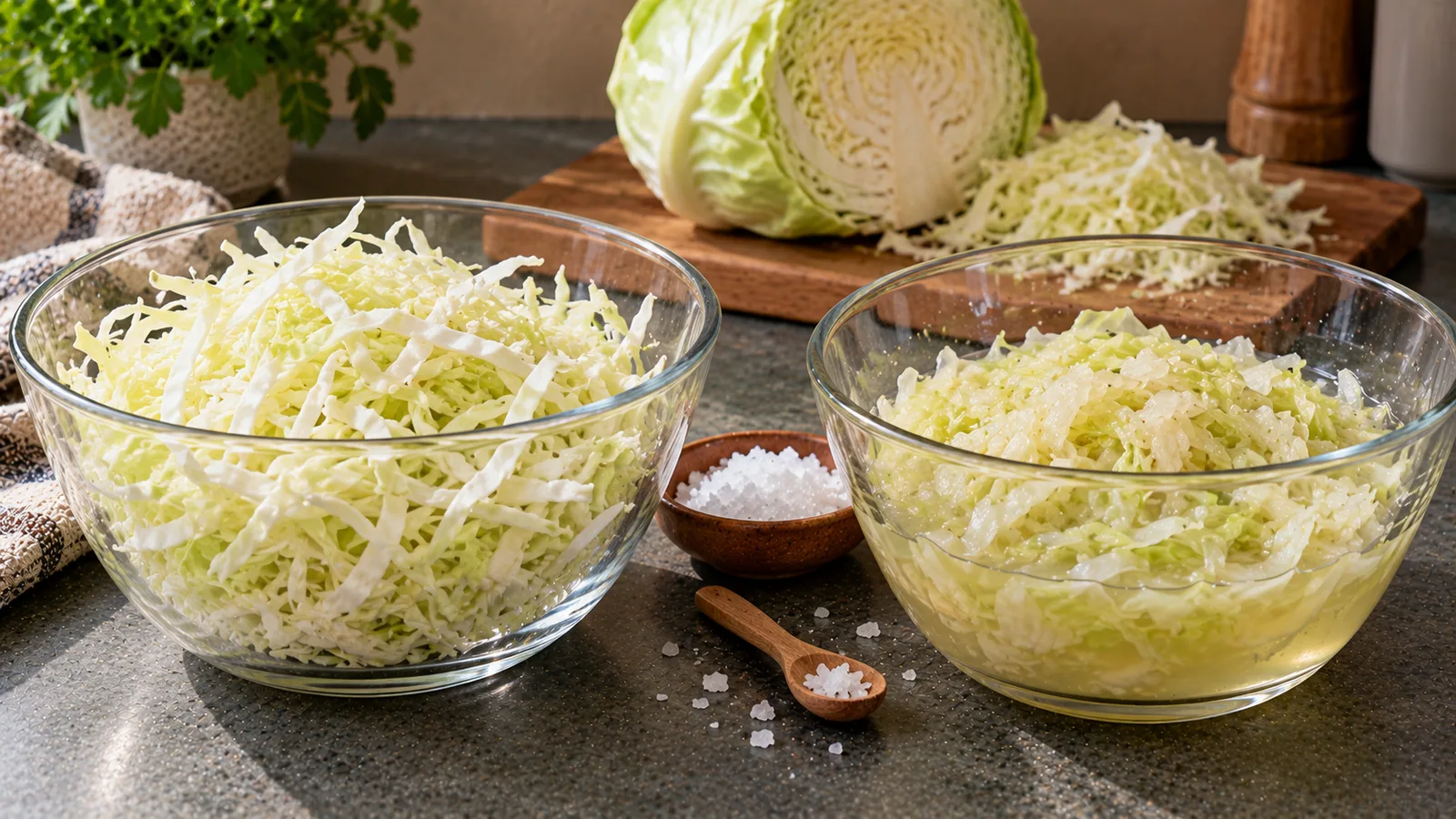
Salt can turn a bowl of crisp, shredded cabbage into a smaller, softer pile sitting in its own liquid. Nothing mysterious has been added: much of that liquid was already inside the vegetable. The useful kitchen question is not simply why water appears, but what changes when you wait, massage, drain or rinse the cabbage—and how to record the weight accurately.
Why salted cabbage becomes wet
Cabbage leaves are made of cells that contain water, dissolved substances and supportive structures. Shredding cuts through tissue and exposes many edges. Sprinkled salt dissolves in the moisture already present on those surfaces; as the surroundings become saltier, water moves out of cells and into the increasingly concentrated liquid between the shreds. You can see droplets collect even without squeezing. A pile that previously contained plenty of air gaps slowly collapses as leaves lose some firmness. The resulting liquid is brine, not pure water: it can contain salt and small amounts of material dissolved from the vegetable.
What osmosis actually explains
Osmosis describes water movement across selectively permeable membranes in response to differences in dissolved-substance concentration. Salting creates a concentrated environment outside the cabbage cells, so the balance of water movement changes. This is a useful model, but a chopped leaf is not a perfect laboratory membrane: cutting, bruising, diffusion and pressing also affect liquid release. Salt does not literally suck every drop of water out, and a wet bowl is not evidence that the vegetable has lost all its moisture. The softened texture comes from changes in cell turgor and the structural effects of handling; it is not the same process as cooking or fermentation.
A small experiment you can repeat
For a short-term salad demonstration, shred 500 g fresh white cabbage and toss it with 5 g salt—1% of the starting cabbage weight. Weigh the mixing bowl empty first, then record the cabbage and salt separately. Leave the mixture for roughly 20–30 minutes, turning once, and transfer it to a sieve over a weighed container. Do not squeeze for the first test. Weigh the drained liquid and the retained cabbage mixture. Results vary with cut size, freshness, temperature and how thoroughly you drain. The following figures are an illustrative mass balance, not a claim that a real experiment always releases this amount.
| What you weigh | Example mass |
|---|---|
| Fresh shredded cabbage | 500 g |
| Added salt | 5 g |
| Mixture before draining | 505 g |
| Liquid poured off | 65 g |
| Mixture remaining | 440 g |
The arithmetic is 500 + 5 − 65 = 440 g. If you repeat the trial, replace 65 g with your own measured discarded liquid. Do not interpret the difference as exactly 65 g of water leaving the cells: the discarded liquid includes salt and other solutes, and some salt remains on the cabbage.
Why draining and squeezing give different weights
A brief drain removes mostly free liquid between shreds. Pressing with a spoon or squeezing by hand can remove more liquid, deform leaves further and change how juicy the finished salad feels. Rinsing removes some surface salt but also adds fresh water that must be drained again; the final weight after rinsing cannot be compared directly with the un-rinsed result unless you record both steps. A bowl weighed with its accumulated brine will look heavier than the same cabbage after draining, although both started with the same vegetable. Use the same method every time if you are comparing recipes or testing texture.
How to use the technique in everyday cooking
For coleslaw, pre-salting can reduce the water that would otherwise dilute a creamy dressing later. You can drain and pat the shreds dry before adding yogurt, mayonnaise or vinaigrette. For a quick pan dish, a short salting step can reduce some surface moisture, although heating releases additional water; it will not guarantee a dry frying pan. In a raw chopped salad, deliberately keeping a little of the brine may be desirable. Taste before adding more seasoning because salt may remain even when most visible liquid has been discarded. Start with a small measured batch rather than relying on spoon volumes for consistent results.
What changes in nutrition and portion tracking
Salt contributes sodium but essentially no calories; the original cabbage does not suddenly become calorie-free when water comes out. However, the calories per 100 g of the drained product can differ from those of raw cabbage because water loss changes the concentration and some dissolved nutrients may also enter the discarded brine. Do not calculate a new nutrient value by pretending all 65 g lost was pure water or by treating the full 5 g added salt as retained sodium. For a careful food diary, record the raw cabbage quantity, salt added, any discarded brine and the final weight, and state whether your nutrient estimate assumes complete or partial salt retention.
This is not a safe sauerkraut recipe
The 1% salt in the demonstration is for a promptly eaten salad experiment, not a validated fermentation proportion. Sauerkraut depends on a specific tested recipe, salt concentration, clean vessels, submersion and controlled fermentation conditions. Salt plays a safety role during fermentation, so do not cut it back based on a coleslaw tip or assume a 20–30-minute rest makes the mixture shelf-stable. Keep short-term salted cabbage refrigerated if not serving immediately; discard food with obvious spoilage signs. University of Illinois Extension discusses short rests and extraction, and the National Center for Home Food Preservation warns against altering salt amounts in tested fermented-vegetable recipes.