
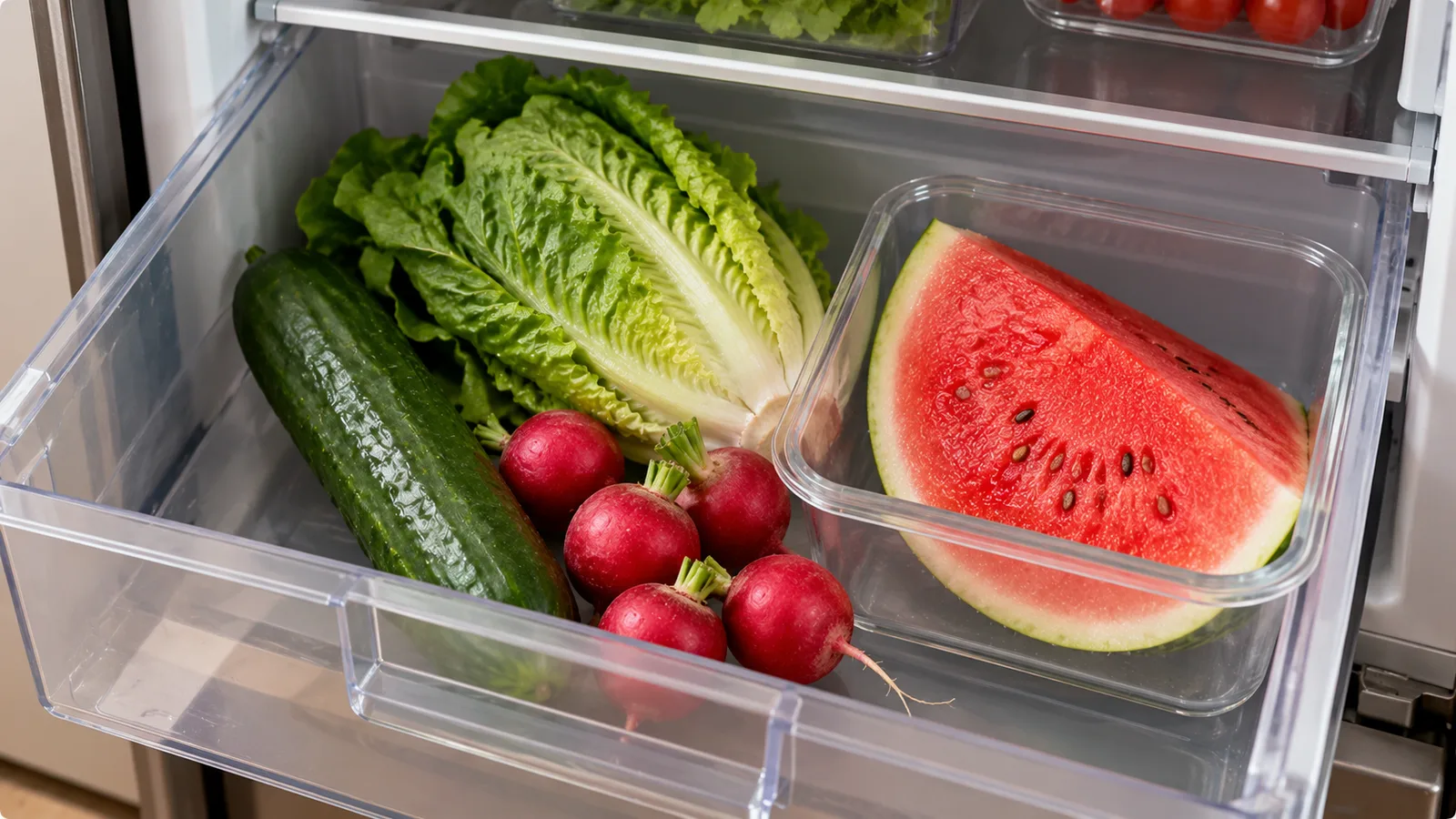
Drinking water is not the only way the body receives water. Fruits, vegetables, soups, yogurt and many other foods also contribute to daily water intake.
A cucumber, for example, consists of approximately 95% water. Watermelon contains roughly 91% water, while strawberries contain about 91%.
But there is an important distinction: water-rich foods contribute to hydration, yet they do not necessarily replace the need to drink fluids.
How much they contribute depends on portion size, the foods eaten throughout the day, activity, temperature and individual circumstances.
How food contributes to hydration
The body receives water from three main sources:
- Beverages, including plain water, milk, tea and other drinks.
- Water naturally present in foods.
- A smaller amount of metabolic water produced during normal nutrient metabolism.
Water from food is absorbed through the digestive system and contributes to the body's overall water balance.
There is no special biological category of water that makes the water inside a cucumber fundamentally different from water in a glass.
However, foods and drinks differ in how much water they deliver per serving, how quickly and conveniently they can be consumed, and which other nutrients they provide.
For example, eating 200 g of cucumber may supply around 190 g of water. Drinking a 250 ml glass of water supplies approximately 250 g of water with no need to eat a large portion of food.
The water from both sources counts toward total water intake.
Which foods contain the most water?
The table shows approximate water content for common foods. Values vary with variety, preparation and food-composition database.
| Food | Water per 100 g, approximately | Water in a 200 g portion |
|---|---|---|
| Cucumber, raw | 95 g | 190 g |
| Lettuce, raw | 95 g | 190 g |
| Celery, raw | 95 g | 190 g |
| Radishes, raw | 95 g | 190 g |
| Tomato, raw | 94 g | 188 g |
| Zucchini, raw | 95 g | 190 g |
| Watermelon, raw | 91 g | 182 g |
| Strawberries, raw | 91 g | 182 g |
| Grapefruit, raw | 89 g | 178 g |
| Orange, raw | 87 g | 174 g |
| Pineapple, raw | 86 g | 172 g |
| Apple, raw | 86 g | 172 g |
These are illustrative rounded reference values, not guaranteed amounts for every product.
The table compares equal weights. Realistic serving sizes differ substantially.
For example, eating 200 g of watermelon may be easy, while eating 200 g of lettuce on its own is less typical.
Reference: USDA FoodData Central.
Water content is not the same as hydration per serving
A food's percentage of water tells only part of the story.
Consider two examples:
- 50 g of cucumber at 95% water supplies approximately 48 g of water.
- 300 g of watermelon at 91% water supplies approximately 273 g of water.
The watermelon portion contributes substantially more water despite having a slightly lower water percentage.
The useful calculation is:
Water from food (g) = portion weight (g) × water content (%) ÷ 100.
For practical purposes, 1 g of water is approximately equivalent to 1 ml.
This conversion is useful for estimating water from foods, but food-composition figures remain approximate.
How much water comes from food during a normal day?
The proportion of total water intake obtained from food varies between people and dietary patterns.
European dietary reference values often describe approximately 20–30% of total water intake as coming from foods in typical conditions, with the rest supplied mainly by beverages.
This is a broad population-level assumption, not a fixed biological rule.
A diet rich in soups, fruit, vegetables and yogurt may provide more water from food.
A diet based heavily on dry foods may provide less.
For example, someone consuming 2,500 ml of total water daily might obtain 500–750 ml from food if food accounts for 20–30% of the total.
That does not mean everyone should drink exactly 1,750–2,000 ml.
Actual needs depend on factors including body size, activity, climate, illness, pregnancy and other circumstances.
Source: EFSA Dietary Reference Values for Water.
Total water intake versus drinking-water intake
Hydration recommendations can appear inconsistent because they may describe different quantities.
Total water intake includes water from beverages and foods.
Fluid intake generally describes beverages, which may include water, tea, coffee, milk and other drinks.
Plain drinking-water intake describes water consumed as water, excluding other beverages and foods.
These quantities should not be treated as interchangeable.
For adults under moderate environmental conditions, EFSA's adequate intake values for total water are approximately:
| Group | Total water adequate intake |
|---|---|
| Adult women | 2.0 litres/day |
| Adult men | 2.5 litres/day |
These values include water from both foods and beverages.
They are population reference values rather than exact personal prescriptions.
They also do not represent a universal minimum amount of plain water that every adult must drink.
Pregnancy, breastfeeding, exercise, high temperatures and certain medical conditions can change requirements.
Source: EFSA Scientific Opinion on Dietary Reference Values for Water.
Can fruit and vegetables replace drinking water?
Water-rich foods can provide a meaningful share of daily water intake, but relying exclusively on them is generally impractical.
Imagine trying to obtain 1 litre of water from cucumber.
At approximately 95% water, that would require eating a little over 1 kg of cucumber.
Obtaining the same water from a drink is much easier.
Foods also contribute calories, carbohydrates, fibre, protein, fat and minerals, depending on the product.
These nutrients can be beneficial, but they make food a different practical choice from plain water.
A useful approach is to drink fluids regularly while including water-rich foods as part of varied meals.
Fruit versus vegetables: which hydrates better?
Both can contribute water.
Vegetables such as cucumber, lettuce and tomato often have very high water percentages.
Fruits such as watermelon, strawberries and citrus also provide substantial water, together with naturally occurring sugars and other nutrients.
The difference in water percentage between many of these foods is relatively small.
Portion size, preference and what fits naturally into meals matter more than choosing the single food with the highest water percentage.
For example, a tomato salad, a bowl of strawberries and a slice of watermelon can all contribute water.
There is no need to rank them as if one food alone could solve hydration needs.
Do soups count toward hydration?
Yes. The liquid in soup contributes to total water intake.
However, soup composition varies widely.
A clear vegetable broth may contain a high proportion of water, while a thick lentil soup or creamy soup contains more solids.
The total water content depends on the recipe, including the amount of stock, vegetables, legumes and other ingredients.
Soup may also contain significant sodium.
Sodium is an essential nutrient, but regularly consuming excessive amounts is not advisable.
Soup can be a useful part of hydration and nutrition, yet it should not automatically be treated as equivalent to plain water in every respect.
For nutrition tracking, record the actual soup recipe or an appropriate prepared-product entry.
Does yogurt count as a water-rich food?
Yes. Plain yogurt contains a substantial amount of water.
However, its water content varies with fat level, straining and formulation.
Thick Greek-style yogurt and Skyr may have different compositions from regular yogurt.
Milk also contains a high proportion of water and contributes to fluid intake.
These products additionally provide nutrients such as protein and calcium, depending on the product.
For someone who avoids dairy, other foods and beverages can contribute water instead.
A dairy product does not need to be consumed specifically for hydration.
What about coffee and tea?
Coffee and tea contribute to fluid intake.
Although caffeine can have a mild diuretic effect, moderate habitual consumption of caffeinated beverages still provides water.
It is therefore inaccurate to assume that every cup of coffee causes a net loss of fluid.
Individual responses vary with caffeine dose, habitual intake and health circumstances.
Plain water remains a straightforward beverage choice because it provides fluid without calories or caffeine.
People who need to limit caffeine should follow advice appropriate to their circumstances.
Do cooked vegetables contain less water?
Cooking can change water content, but the direction and size of the change depend on the method.
Boiling may increase the water content of some foods through absorption.
Roasting and baking often reduce water content through evaporation.
Steaming can cause smaller changes.
Consider zucchini: roasting may reduce its weight as water evaporates, making the remaining food more concentrated per 100 g.
That does not mean the original vegetable suddenly contained more energy.
It means the relationship between weight and water has changed.
When calculating water or nutrition from cooked foods, use data for the actual cooking method rather than assuming the raw-food values remain identical.
Can water-rich foods help during hot weather?
Water-rich foods can complement regular drinking during hot weather.
Cold watermelon, cucumber, oranges and chilled yogurt may be appealing when appetite is reduced.
However, sweating can substantially increase fluid losses.
For prolonged exercise or heavy sweating, fluid needs may rise, and electrolyte replacement may also become relevant.
Food alone is not a reliable substitute for an appropriate drinking strategy during substantial heat exposure or strenuous activity.
People with medical restrictions on fluid or sodium should follow individualized medical advice.
A practical day of water-rich foods
The following example illustrates how ordinary foods contribute water.
| Food | Portion | Approximate water contribution |
|---|---|---|
| Strawberries | 150 g | 136 ml |
| Cucumber | 150 g | 143 ml |
| Tomato | 150 g | 141 ml |
| Watermelon | 200 g | 182 ml |
| Orange | 150 g | 131 ml |
| Total | 800 g | 733 ml |
These figures are illustrative and rounded.
They do not include water from other foods such as bread, cooked grains, soup, yogurt or the day's beverages.
The example is not a recommended daily menu and does not imply that everyone should eat these exact portions.
It demonstrates why a diet containing fruit and vegetables can provide a meaningful amount of water.
Signs that fluid intake may need attention
Thirst is a useful physiological signal, but it is not a perfect measurement of hydration in every circumstance.
Other possible signs of insufficient fluid intake include:
- Darker urine than usual.
- Reduced urine output.
- Dry mouth.
- Headache or dizziness, which can also have many other causes.
Urine colour can be affected by vitamins, medications and health conditions, so it should not be treated as a definitive diagnostic test.
Severe dizziness, confusion, fainting, inability to keep fluids down or markedly reduced urination warrants prompt medical assessment.
People with kidney disease, heart failure or prescribed fluid restrictions should not increase fluid intake based solely on general hydration advice.
Practical ways to combine food and beverages
You do not need to calculate every millilitre of water in every meal.
A practical routine can include:
- Keeping drinking water readily available.
- Drinking with meals and according to thirst.
- Including vegetables and fruit regularly.
- Using soups or yogurt when they suit the meal.
- Paying extra attention to fluid intake during exercise or hot weather.
- Adjusting intake to individual needs rather than following a rigid number.
A diet with a variety of foods and an appropriate drinking routine is more useful than relying on one supposedly exceptional hydrating food.
Frequently asked questions
Does water in fruit count toward daily hydration?
Yes. Water naturally present in fruit contributes to total water intake.
Is cucumber more hydrating than watermelon?
Cucumber has a higher percentage of water by weight, but a larger portion of watermelon may provide more water overall.
Can I meet all my water needs through food?
It is theoretically possible to obtain substantial water from food, but meeting all needs that way is generally impractical. Beverages remain an important source.
Does soup count as fluid intake?
The water in soup contributes to total water intake, although the exact amount depends on the recipe.
Does coffee dehydrate you?
Moderate coffee consumption generally contributes fluid despite caffeine's mild diuretic effects.
How much water should I drink if I eat lots of fruit?
There is no universal adjustment formula. Total water needs vary, and water-rich foods are only one part of the overall picture.
Sources
- European Food Safety Authority: Dietary Reference Values for Water — total water intake reference values and food contributions.
- USDA FoodData Central — water content and nutrient composition of foods.
- World Health Organization: Healthy Diet — general dietary guidance.
- NHS: Dehydration — dehydration symptoms and guidance.
Water-content values and serving calculations are approximate. Individual hydration needs vary.