
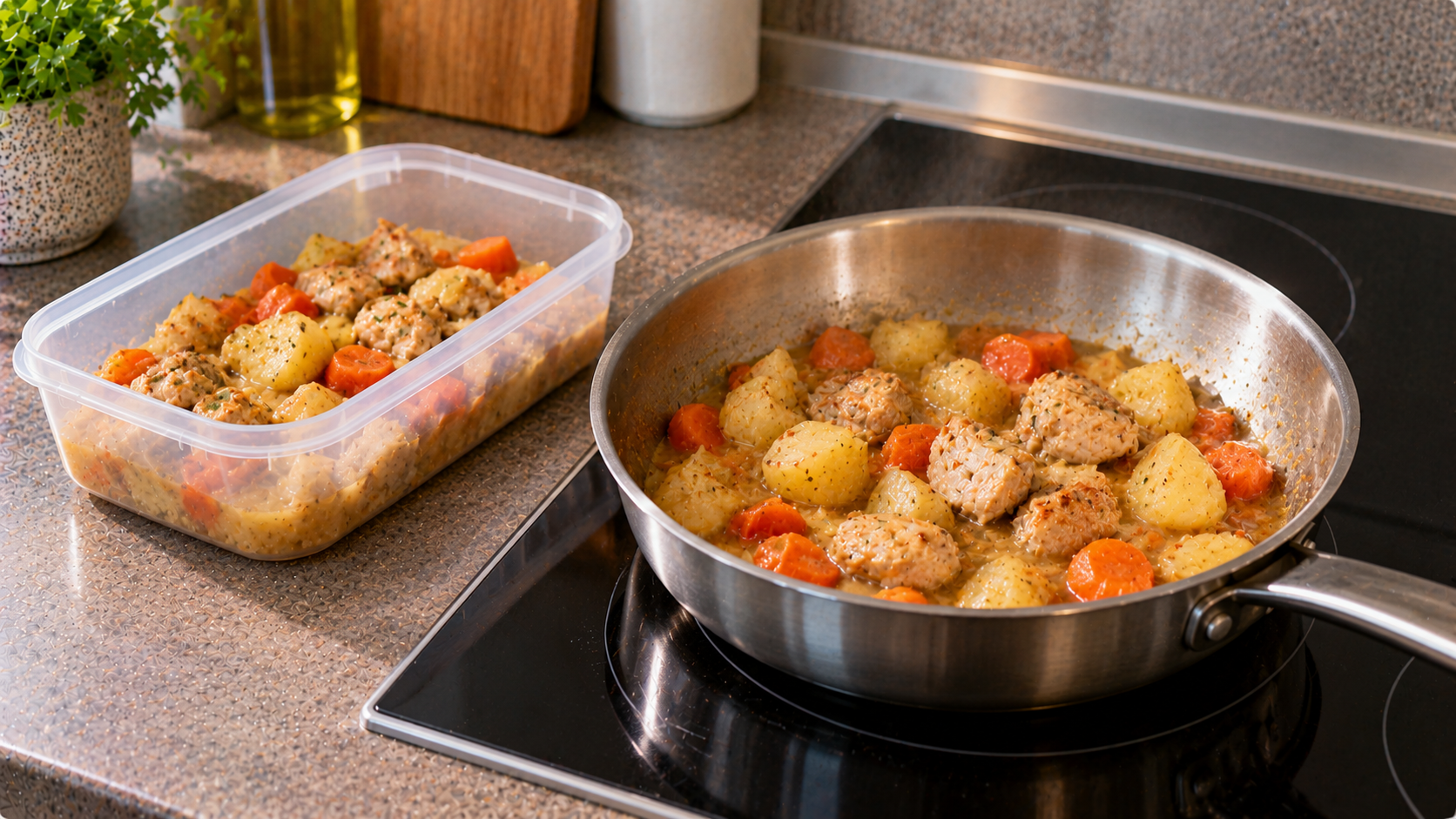
Leftovers can make a weekday meal easier, but reheating safely begins long before the microwave is switched on. A meal that was left warm for hours may not become safe simply because it is heated again. The useful sequence is: cook thoroughly, divide and cool promptly, refrigerate or freeze, keep track of the storage period, then reheat the portion you intend to eat all the way through.
There is no universal microwave time for a bowl of pasta, a container of stew or a piece of chicken. Quantity, shape, starting temperature, appliance and density all matter. A thermometer is more reliable than appearance alone. The following guidance distinguishes the US, German and UK public-health approaches rather than presenting a single number as a worldwide rule.
The decision before reheating: was the food stored safely?
First ask when was it cooked, how quickly was it chilled, and where has it been kept? Refrigeration slows the growth of many microorganisms; it does not reverse earlier time spent too warm. A meal can look and smell normal even when it is unsafe.
USDA advice is to refrigerate perishable leftovers within two hours after cooking or service, or within one hour when the surroundings are above 90°F (32°C). Divide a large batch into shallow containers so it cools more rapidly instead of leaving a stockpot on the counter for hours. For most cooked leftovers, USDA gives a refrigerated storage window of three to four days with suitable cold storage. USDA — leftovers and USDA — food safety basics.
Germany's BfR advises cooling cooked meals promptly, maintaining suitable refrigeration, and eating refrigerated cooked leftovers within two to three days. BfR identifies under 7°C as a cooling target and recommends a refrigerator setting around 5°C or colder when feasible. The UK's Food Standards Agency advises eating refrigerated leftovers within 48 hours or freezing them if they will not be eaten in time. These are different national consumer recommendations, not interchangeable scientific guarantees. BfR — household food infections; FSA — cooking and leftovers.
| Situation | Recommended action | Reason |
|---|---|---|
| Cooked dinner cooled promptly and refrigerated in shallow containers | Check the date and local storage guidance, then reheat a single portion | Cold storage and limited time reduce risk |
| Stew left on the counter overnight | Discard, do not try to rescue it by boiling | Some hazards are not reliably eliminated by later heating |
| Frozen leftovers kept frozen continuously | Reheat from frozen where the food and method allow, or thaw safely first | Frozen food needs extra time to heat throughout |
| Meal's temperature history is unknown | Discard perishable leftovers if safe handling cannot be established | Smell and appearance do not establish safety |
What temperature should leftovers reach?
The USDA recommends 165°F (74°C) throughout reheated leftovers, checked with a food thermometer. Its guidance also calls for soups, sauces and gravies to be brought to a rolling boil when reheating. USDA — leftovers. This is an internal-temperature target; setting an oven to 74°C is not the same as measuring the centre of the food.
Germany's BfR recommends at least 70°C for two minutes at every point when heating or reheating dishes, and stirring during microwave heating to distribute heat more evenly. It advises holding hot food at least 60°C if it is being kept hot. BfR — household food infections.
The UK's FSA advises reheating leftovers until steaming hot throughout, not merely warm in the middle, and recommends reheating only once. It also advises eating them within 48 hours of refrigeration or freezing them earlier. FSA — cooking your food.
| Public agency | Reheating guidance | Related storage guidance |
|---|---|---|
| USDA (United States) | 165°F / 74°C throughout | Most leftovers 3–4 refrigerated days |
| BfR (Germany) | At least 70°C for 2 minutes throughout | Cooked leftovers within 2–3 refrigerated days |
| FSA (United Kingdom) | Steaming hot throughout; reheat once | Eat within 48 hours or freeze |
A cautious kitchen practice is to reheat the amount needed once, thoroughly and evenly, using a thermometer when practical. Do not treat these national figures as a substitute for specific product instructions or special guidance for high-risk foods.
Choose portions before you apply heat
If a casserole serves six but one person needs lunch, separate one portion while the whole batch is still cold. Return the remaining container promptly to the fridge. This minimizes warming and repeated heating of the same food.
For soups and stews, consider dividing the batch into individual containers after cooking. For baked pasta, cut a slice instead of reheating the whole tray. For chicken and vegetables, arrange one plate with the desired components. If a large dish has already been reheated, avoid an automatic cycle of cooling it again and serving it repeatedly; the FSA's clear consumer advice is to reheat leftovers once.
A portion is not only a calorie decision. A deep container holds heat differently from a shallow dish: its centre may remain cool while the outside is already hot. Two smaller servings are often easier to warm evenly than one dense family-sized block. Use a clean utensil each time and prevent raw-food juices from contacting the food that is ready to eat.
For ideas on using refrigerated food before it expires, see meal planning with leftovers. Planning the next meal does not extend the safe storage life of a prepared dish.
Microwave reheating: avoid a cold centre
Microwaves commonly produce uneven heating. A steaming edge or a hot plate does not demonstrate that the middle of a thick lasagne is hot enough. USDA advises covering food with a microwave-safe vented cover, rotating or stirring for even heating, allowing standing time, and checking temperature in several locations. USDA — microwave ovens.
- Transfer food into a microwave-safe glass, ceramic or suitably labelled container; do not assume that a takeaway box is safe for heating.
- Spread the food into an even layer. Break up dense lumps and add a little liquid to foods that may dry out, where appropriate.
- Cover with a suitable lid, vented to let steam escape. Follow the appliance's instructions.
- Pause partway through to stir, turn or rotate the portion. Rearrange larger pieces so the centre is not shielded.
- Allow the manufacturer's recommended standing time. Measure temperature after standing, at more than one point; continue heating if it has not reached the applicable target.
A microwave's wattage alone does not determine a safe number of minutes. A 250 g chilled portion and 900 g of frozen casserole do not need the same heating cycle. Take particular care with thick sauces, mixed dishes, meat pieces and previously frozen meals.
Oven, hob and air fryer: match the method to the dish
On the hob, stir soup, curry, sauce or stew regularly so hot and cool regions mix. USDA recommends bringing reheated sauces, soups and gravies to a rolling boil. For solid pieces, still check the interior rather than relying on bubbling liquid around them.
In an oven, a casserole may brown on top while remaining cool at its centre. Cover as appropriate for moisture retention, use the oven temperature recommended for reheating and check the thickest middle. USDA advises an oven set no lower than 325°F / approximately 163°C for reheating cooked leftovers. USDA — reheating methods.
In an air fryer, small single portions of suitable foods may reheat evenly if they are not overcrowded. But there is no universal air-fryer duration or setting that proves safety; check the centre of any dense piece. A toaster oven or air fryer is not a workaround for unsafe storage.
A slow cooker should not be used to reheat cold leftovers: USDA cautions that such appliances may warm too slowly, leaving food at temperatures where bacteria can multiply. A slow cooker may be suitable for keeping already thoroughly heated food hot if used correctly, but that is a different task.
Particular foods require particular care
Rice and other cooked grains. Rice has specific hazards associated with Bacillus cereus. Spores can survive initial cooking, and some toxins associated with improper handling are not reliably dealt with by reheating. The FSA advises particularly prompt cooling and, for cooked rice, refrigeration for no more than 24 hours before reheating and reheating only once. This rice-specific advice should not be replaced by the general USDA three-to-four-day leftovers statement. For a detailed rice workflow, use the separate Mealisa guide on cooling and reheating rice.
Chicken, meat and fish. Break large pieces into smaller portions for even heating. Verify the middle of the thickest piece, not just the sauce or outer surface. If the initial cooking or cold storage was questionable, heating again does not validate the earlier handling.
Lasagne, baked pasta and dense dishes. Their layers can trap cooler areas. A small slice in a shallower dish is simpler to monitor than an entire baking dish. Check different positions before serving.
Cream-based sauces and soups. Stir frequently and avoid splashing when hot. Bring suitable sauces and soups thoroughly to a boil under USDA guidance, while paying attention to texture and manufacturer instructions. Cream may separate as a quality issue; it is not by itself a reliable indicator of microbial safety.
Vegetable and bean leftovers. These are not automatically shelf-stable just because they contain no meat. Cooked legumes, grains and mixed vegetable meals still require prompt cooling and safe cold storage.
From freezer to plate
Frozen leftovers can often be reheated directly from frozen, provided the heating method reaches the required temperature throughout. A solid block needs more time than thawed food, and the middle must be checked. For a quick meal, smaller frozen portions are easier to heat thoroughly than a single large container.
For advance thawing, use the refrigerator. USDA also describes cold-water and microwave methods under appropriate handling conditions; microwave-thawed leftovers should be reheated immediately to 165°F (74°C). Never leave a frozen meal on the kitchen counter for an indefinite thaw. USDA — leftovers.
Label containers with their preparation or freezing dates. Freezing does not retroactively make food safe if it was already mishandled before freezing. After reheating, serve promptly rather than creating a new extended counter-top holding period.
Practical scenarios: what would you do?
Sunday stew for Tuesday lunch. The stew was cooled quickly on Sunday and refrigerated in single portions. On Tuesday, bring the portion to a thorough simmer on the hob, stirring and checking the internal temperature as appropriate. Keep the rest refrigerated. This is the kind of planned leftover use that storage guidance supports.
Friday chicken still in the fridge on Wednesday. That is beyond the USDA's typical three-to-four-day recommendation and beyond the shorter BfR and FSA recommendations. Discard rather than assuming one more microwave cycle solves the problem.
Takeaway rice sat unrefrigerated for several hours. Heating until hot will not necessarily eliminate hazards related to incorrect storage. Discard when the safety history is doubtful; see the rice-specific advice.
A cold centre in reheated lasagne. Do not serve it because the outside is browned. Cut or separate the portion, reheat thoroughly and check the centre and other potentially cool locations.
A meal was heated once but not finished. UK FSA guidance is to avoid reheating it again. In meal-planning terms, the better solution is portioning before heating in the first place, not repeatedly cycling an entire batch between hot and cold.
A concise checklist and sources
Before serving, confirm that the original food was safely cooked and cooled; its age falls within relevant storage recommendations; it was kept cold; and the portion has been heated throughout, not just at its surface. Use an appropriate thermometer when possible. If its temperature history is unreliable, discard it. Reheating is a final safety step, not a way to repair unsafe handling.
Primary guidance used:
- USDA FSIS — Leftovers and Food Safety — cooling, storage, thawing and reheating.
- USDA FSIS — Keep Food Safe — two-hour rule, shallow containers and 74°C target.
- USDA FSIS — Cooking with Microwave Ovens — stirring, standing and checking temperature.
- BfR — Lebensmittelinfektionen im Privathaushalt — temperature/time guidance and refrigerated leftovers.
- UK Food Standards Agency — Cooking your food — steaming-hot reheating, one reheat and 48-hour guidance.