
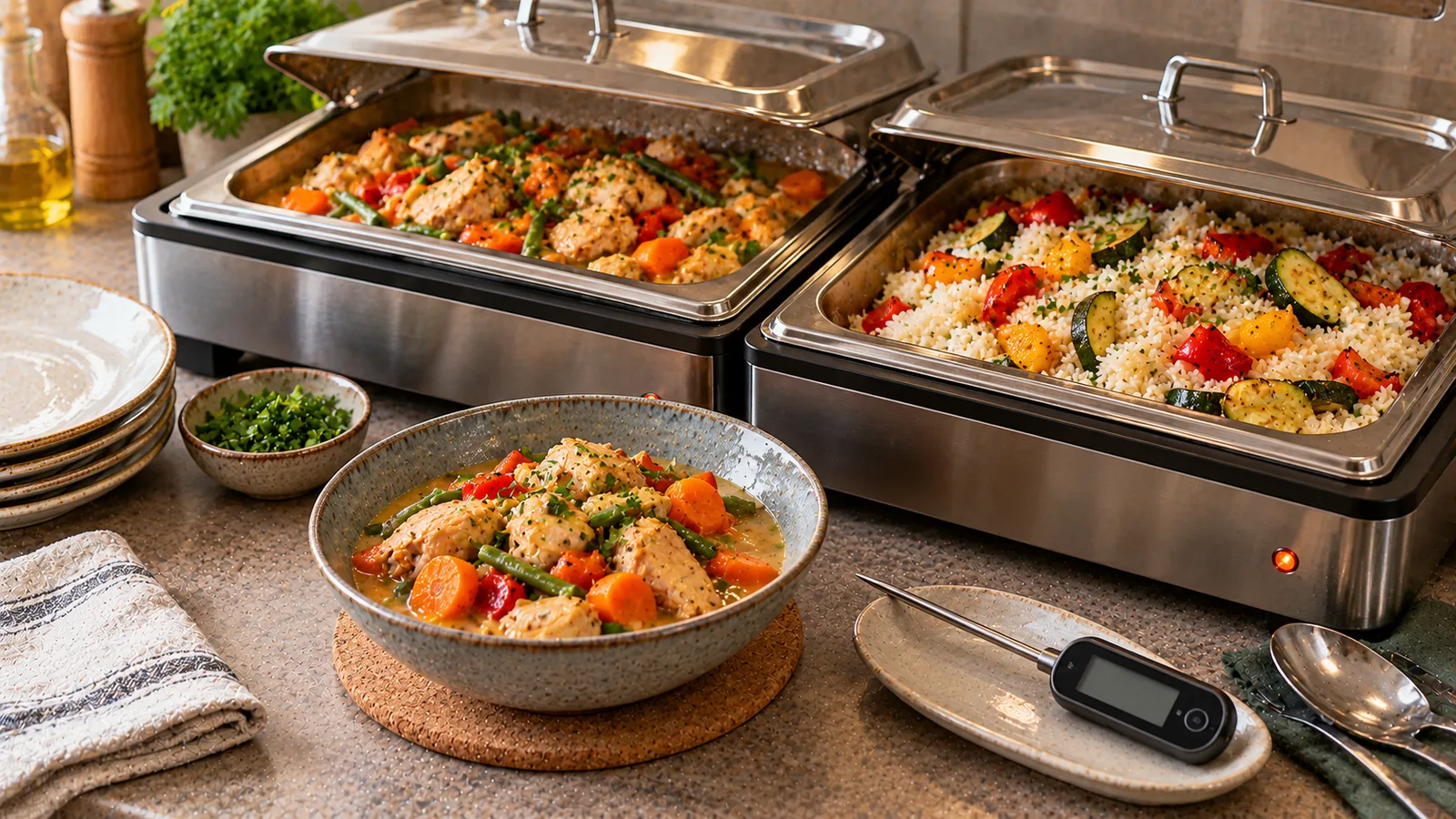
A warming tray is not a shortcut for reheating a cold casserole. The safe sequence at a home buffet is store safely → reheat thoroughly in an oven, pan or microwave → transfer to a preheated hot-holding unit → monitor the food, not merely the unit’s display. This checklist is for previously cooked, refrigerated food that will be offered hot over a period of time. It does not replace special instructions for a commercial kitchen or a manufacturer’s label.
The numbers differ by authority and setting. In US household guidance, USDA advises 74°C / 165°F for reheated leftovers and at least 60°C / 140°F for holding hot food. Germany’s BfR advises at least 70°C for two minutes throughout the food during reheating and at least 60°C throughout while holding. UK Food Standards Agency materials describe leftovers as steaming hot throughout; its hot-holding guidance for food businesses uses 63°C or above. These are not interchangeable legal thresholds for every country.
Start with the food’s history, not the serving equipment
Only start with food that was thoroughly cooked, cooled promptly and refrigerated correctly. A buffet does not restore the safety of a dish that has already spent excessive time at room temperature. USDA advises refrigeration within two hours, or within one hour when ambient temperature exceeds 32°C / 90°F, and generally using refrigerated leftovers within three to four days. UK FSA consumer advice is to eat refrigerated leftovers within 48 hours or freeze them. Follow the guidance applicable where the food is being served, rather than combining deadlines into a new universal rule.
Choose small batches over one deep container. Label each prepared dish with its cooking and cooling history. If that history is unknown, particularly after an overnight table display or an interrupted refrigeration period, do not assume that a second heating cycle makes it safe. Smell and appearance cannot reliably detect foodborne pathogens. Keep raw ingredients and serving utensils separate from ready-to-eat food.
Reheat first; hot-hold only afterward
Bring a refrigerated soup to a thorough boil in a saucepan where the recipe permits it, stirring from bottom to top. For a casserole, use a properly heated oven and check the centre and several thick spots with a clean probe thermometer. In a microwave, cover appropriately, stir or rotate, allow the specified standing time and check for cold pockets. The USDA reheating target for ordinary leftovers is 74°C / 165°F. The German BfR household recommendation is at least 70°C for two minutes everywhere. These instructions refer to reheating, not the lower temperature used to maintain already-hot food.
Do not put a cold pan into a slow cooker, chafing dish or steam table and assume the warm setting will heat it rapidly enough. USDA explicitly discourages reheating leftovers with such equipment because food may remain too long in unsafe temperatures. Heat the food in equipment designed for cooking or reheating, then move it promptly to preheated holding equipment. A kitchen thermometer is more informative than steam rising from the lid.
A practical home-buffet checklist
- Plan the menu. Select a small number of hot dishes, check fridge space and prepare clean serving utensils and a calibrated thermometer.
- Preheat the holding equipment. Follow its manufacturer’s instructions before any hot food is loaded; do not rely on a cold water bath warming eventually.
- Reheat the food separately. Stir thick mixtures, measure multiple spots and meet the applicable reheating standard.
- Transfer promptly. Use clean containers, lids where appropriate and separate spoons for each dish.
- Check the FOOD temperature. At a US home buffet, target at least 60°C / 140°F throughout. For UK catering the FSA guidance specifies 63°C or above. Check several places, particularly edges and shallow trays.
- Record service start and rechecks. A timer documents the interval but never proves the food is hot enough.
- Swap small batches. Bring out a new properly heated dish rather than mixing fresh food into a tray that has already been on display.
- Stop if temperature control fails. Do not keep guests eating from an uncertain tray while deciding whether to rescue it.
Three numbers that answer different questions
| Setting and purpose | Reference instruction | What it does not mean |
|---|---|---|
| US household: reheat leftover food | Reach 74°C / 165°F internally (USDA) | A 60°C setting is enough to reheat cold food |
| US household: hold safely reheated food hot | Maintain at least 60°C / 140°F (USDA) | Heating the water pan guarantees the food is 60°C |
| Germany: household reheating | At least 70°C for two minutes everywhere (BfR) | A single surface measurement proves every part is hot |
| Germany: household hot holding | At least 60°C throughout (BfR) | Food may be left indefinitely without monitoring |
| UK: hot holding in food-business guidance | Keep food at 63°C or above (FSA) | This is a universal legal rule for private homes worldwide |
The US FDA Food Code has additional rules for commercial establishments; those are not silently substituted for USDA home instructions. Time and temperature work together in many professional procedures. Never choose whichever single number seems easiest without knowing which authority, food and use case it covers.
What if a tray cools during service?
First measure rather than guessing. A dial on the warming unit may describe the heater, not the casserole. If the food is under the applicable holding limit, stop service from that tray, note how long it has been out of control and consult the local guidance. For a household, a cautious choice when time is unknown is discard rather than repeatedly reheat and re-display. USDA’s general room-temperature rule is at most two hours for perishables, reduced to one hour above 32°C / 90°F; this is not permission to hold all food below its hot-holding target for two hours in every commercial or national setting.
Do not pour a freshly heated batch over old lukewarm food. That destroys the timing history of both batches and may create uneven temperatures. If you want to reduce waste, keep most servings promptly chilled and heat fresh, smaller portions as needed. UK FSA consumer advice recommends reheating leftovers only once; commercial corrective-action procedures are separate and cannot simply be copied into a home buffet plan.
Example: soup and a baked rice dish for six guests
At 17:00 a chilled soup and a baked rice dish are in the refrigerator. At 17:20 the serving unit is preheated. At 17:35 the soup is reheated in a pot and the rice dish in the oven. Their thickest and coolest places are checked against the local reheating recommendation. At 17:50 two small, thoroughly hot dishes are transferred to heated serving containers. During the meal, a clean probe verifies the food, including the edges, remains at the required holding temperature. The remaining refrigerated portions stay cold until they can be reheated separately.
These clock times are an illustrative workflow, not tested heating durations, safe time exemptions or proof of safety. The actual time depends on volume, equipment and initial temperature. Rice deserves particular care because poor cooling can allow Bacillus cereus risks; reheating does not undo every consequence of unsafe storage. For rice-specific advice, consult the separate Mealisa rice-safety guide.
For the specific situations, also read cooling and reheating rice safely · safe packed hot lunches.
Avoid these buffet errors
- Cold food in a bain-marie: the appliance is meant to maintain heat, not reliably reheat a refrigerated centre.
- Thermometer in the wrong place: probe the food’s thickest or coolest point, not just its surface or surrounding water.
- One continuous deep tray: use shallow, manageable batches and stir foods that can be stirred.
- Repeatedly topping up: old and new food need separate time and temperature histories.
- A timer substituted for measurement: 20 minutes on a dial is not a verified internal temperature.
- Assuming international numbers match: household advice in the US and Germany and UK business guidance have different contexts.
A useful buffet checklist ends with a decision: the food was reheated correctly and remains above the relevant holding temperature, or service stops and the batch is evaluated conservatively. No thermometer reading can retroactively repair unsafe cooling or unknown storage.