
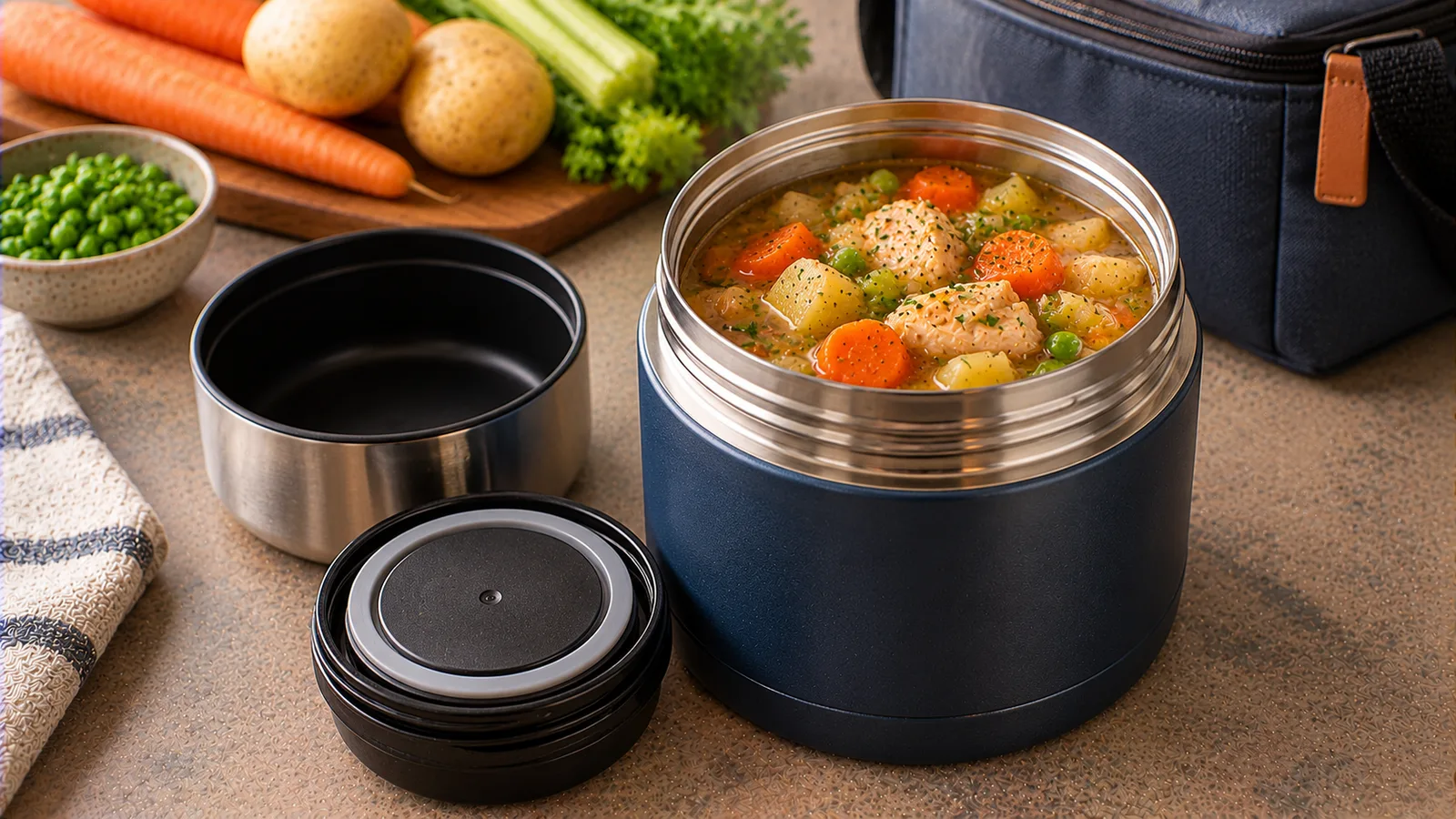
A food thermos can make a hot lunch practical when there is no microwave or refrigerator at work or school. But insulation is not refrigeration, and a warm-feeling lunch is not proof of food safety. The important question is whether the food stays hot enough from packing until eating. A trustworthy answer involves a clean insulated food jar, food heated properly before filling, careful handling and — when you need to verify performance — a food thermometer. There is no single safe holding time for every flask.
Practical target: Keep perishable hot food at or above 60 °C (140 °F) throughout holding, following the USDA guidance for packed lunches and the German Federal Institute for Risk Assessment (BfR). This is a holding temperature, not a cooking temperature. A thermos does not heat raw chicken, cook dried beans or safely reheat cold leftovers. If your own filled flask cannot reliably hold that temperature until lunch, switch to a genuinely cold lunch transported under refrigeration, as described in how to keep a packed lunch cold until eating.
What the 60 °C threshold means — and what it does not
USDA says keep hot packed food at 140 °F / 60 °C or above. BfR likewise advises holding food at at least 60 °C in every part. These are authoritative food-safety targets for keeping prepared meals hot, not a claim that food becomes instantly hazardous at 59 °C or instantly sterile at 60 °C. Temperature control reduces the opportunity for pathogens to grow. Actual risk also depends on what happened before packing, how the food was cooked, whether the container was clean and how long food spent outside safe temperatures.
The familiar 2-hour rule applies when perishable food is not being maintained safely hot or cold: USDA warns against leaving it in the danger zone for more than two hours, or one hour in ambient temperatures above 32 °C / 90 °F. It is not permission to serve a flask that might have cooled hours earlier merely because you opened it only once. Without a temperature history you cannot calculate the period spent under 60 °C. When the food is no longer safely hot and you cannot establish its time in the unsafe range, the cautious choice is to discard it. See USDA's danger-zone guidance.
The 63 °C often quoted online is a UK commercial hot-holding requirement. It is not the same thing as a Germany-specific legal mandate for a private lunch thermos. A preheated food jar that keeps food at 63 °C or above gives an extra temperature margin, but the underlying USDA/BfR consumer target cited here is 60 °C. Do not confuse either temperature with the 74 °C (165 °F) used to verify safe reheating of refrigerated leftovers.
How to pack a hot lunch, step by step
- Begin with a clean jar. Wash the lid, gasket, threads and interior according to the manufacturer. Check that the seal is intact and that the lid closes securely. A wide-mouth food jar is easier to clean and fill than a narrow bottle.
- Heat the food fully first. Prepare fresh soup, stew or chili safely on the stove. If packing previously cooked and refrigerated leftovers, reheat them to 74 °C (165 °F) in the centre, as recommended by USDA for leftovers. For soup or sauce, bring it to a boil while stirring appropriately. The flask itself does not perform this reheating.
- Preheat the empty food jar. Carefully fill it with boiling water, close it for a few minutes and discard the water. Avoid splashes and scalds. This is USDA's practical packing method, not a guarantee of a particular number of safe hours.
- Fill promptly with piping-hot food. Use a clean ladle. Fill to the manufacturer's recommended level; large empty air spaces can speed cooling. Do not dilute the meal with cold milk, yogurt or other chilled ingredients before sealing.
- Close tightly and record the time. Keep the flask closed until lunch; repeated opening loses heat. Pack a clean spoon separately. Store the flask protected from damage, out of situations where the lid can loosen.
- Check the food itself at lunch when uncertain. Use a cleaned probe in the middle of the food, mixing thicker meals first if needed. The relevant reading is the food temperature, not the warmth of the steel outer wall or the lid. If the food is not safely hot and its history cannot be verified, do not eat it.
Use clean equipment and keep cooked food away from raw-food surfaces. Do not pack a half-warm meal, assume that closing the lid will raise its temperature, or leave the lid open during the commute. A high-quality flask can perform well, but any performance statement must be tested with the foods, fill levels and timing you actually use.
A sample morning-to-lunch timeline — not a shelf-life promise
This example is a workflow, not proof that a given thermos will remain safe for a stated period. Substitute your actual schedule and verify the endpoint with a thermometer.
| Example time | Action | What to verify |
|---|---|---|
| 07:00 | Reheat previously chilled stew | 74 °C throughout before packing |
| 07:05 | Preheat clean food flask | Boiling water in empty flask for a few minutes |
| 07:10 | Empty water and immediately fill | Food is piping hot; lid sealed promptly |
| 12:00 | Open once to serve lunch | Food still measures at least 60 °C |
The 4 h 50 min between 07:10 and 12:00 is only an illustrated interval, not an approved thermos lifetime. A weak, half-filled or frequently opened flask may cool too soon. Another flask might retain heat longer. To find out, test your own setup on a non-eating day with the same food, starting quantity and conditions, taking temperature readings using a clean probe. Test only tells you about the conditions you tested — repeat when season, jar size or meal texture changes.
What works best inside a food thermos?
Soup and lentil stew fit a wide-mouth flask well, provided they start properly heated. A fairly full jar of fluid food generally makes better thermal contact than a tiny portion with a large air gap. Chili and bean casseroles may be workable if heated evenly before filling; thick dishes need stirring during reheating and a centre-temperature check. Pasta with hot tomato sauce can be packed, but its texture may soften while it sits. Rice dishes require special care: cooking and storage errors before packing cannot be fixed by keeping rice warm later. For rice that was previously refrigerated, follow the same 74 °C reheating check and safe cooling history.
Do not treat the thermos as a slow cooker for raw meat, dried legumes or uncooked grains. Do not put cold chicken salad, yogurt or soft cheese into a warm jar and expect the insulation to make it safe. These foods need a cold chain unless they are included in a meal heated fully and then held hot. For sandwiches, salads and dairy snacks that must remain cold, consult how to keep a packed lunch cold until eating instead. If you want a workplace meal without a hot-holding dependency, shelf-stable unopened foods can be simpler — subject to the package instructions after opening.
Why size, portion and opening frequency matter
A container's heat-retention claim is not the same as a measured food-core temperature. Test advertisements may use plain water at a particular starting temperature in a fully filled flask under laboratory conditions. Real lunches differ: a 350 ml serving of thick stew loses heat differently from 500 ml of broth, and a jar with a small portion of food and a large headspace is not equivalent to a full jar. Outdoor temperatures, time spent in a cold car, lid design and repeated opening all affect heat loss. For thicker food, take measurements after stirring rather than trusting a warm spot near the surface.
When choosing a flask, prioritize a food-safe, easily cleaned wide opening, dependable seal and a capacity that you can fill appropriately. Look for published heat-retention test conditions, but do not turn them into a statement such as “safe for six hours” unless the food itself has been demonstrated to remain at the safe temperature for the actual duration. A flask that retains heat brilliantly with boiling water may not maintain a small solid-food portion at the same temperature.
How to check a thermos before relying on it
Prepare a practice lunch the way you normally would. Use the same flask, preheating step, food temperature, food volume, carrying bag and planned serving time. When testing, use a clean food thermometer and take a reliable centre reading. Record the packing and checking times. One isolated reading at lunchtime shows the endpoint only; it does not establish every intermediate temperature if the lid was opened, food added or the flask tipped. Nonetheless it is much more informative than a vague manufacturer duration printed without conditions.
If the food is below 60 °C at the planned eating time, do not rely on that flask for the same schedule and meal. Shorten the interval, start with an appropriately heated larger portion, or use a different container — and retest. Do not repeatedly reheat and repack the same food as a workaround. For a child, an older adult, a pregnant person or someone immunocompromised, lean toward a well-controlled cold-chain or a freshly heated lunch rather than uncertain hot holding.
What if lunch is lukewarm when opened?
Do not use taste, smell, steam or the warmth of the lid as a safety test. If it reads below 60 °C, the target for continuous hot holding has not been met. If you know the food has been inadequately hot for too long, or cannot establish how long it has been below target, discard it. Simply reheating it later does not erase all possible previous temperature abuses; some microbes can produce toxins. Do not put a questionable meal back into the fridge and save it for tomorrow.
If your workplace has a microwave, a safer alternative is to pack pre-chilled food in a cold bag with suitable ice packs, preserve the cold chain, then heat it thoroughly at serving time. In that scenario you should not put chilled food directly in an empty thermos and assume it will stay refrigerator-cold. Choose either a verified hot chain or a verified cold chain. The method for cold lunch is detailed in how to keep a packed lunch cold until eating.
Questions people ask before packing
Can I pour boiling water into the food jar and leave pasta to cook until noon? Not as a safe universal cooking method. Heat retention is variable, and the jar is not a validated cooker. Fully cook the food first, then pack it hot.
How long does soup stay safe in a thermos? There is no universal hour figure. It remains appropriate for hot holding only while it meets the safe-temperature requirement and had a safe preparation history. Confirm your model with your food and schedule.
What if I pack freshly cooked food at 07:10 and eat at 12:00? That is a 4 h 50 min gap. It is not automatically safe; the food must still be at least 60 °C at lunch. Your test, not the clock alone, answers the question.
Do I need an expensive brand? Safety depends on verified performance, hygiene and correct use, not on price alone. Even an excellent flask cannot rescue food that was inadequately cooked or stored.
Sources and scope
- USDA FSIS — Keeping Bag Lunches Safe: preheat with boiling water and keep hot lunches at 60 °C / 140 °F or higher.
- BfR — food infections at home: sufficient heating, hot holding at 60 °C, hygiene and quick cooling.
- USDA FSIS — Leftovers and Food Safety: reheating leftovers to 74 °C / 165 °F.
- USDA FSIS — Danger Zone: time and temperature limits when food is outside safe holding.
This article concerns hot food holding in an insulated lunch container, not overnight storage, sterile canning or legal food-service equipment validation. There is no approved universal number of hours for all food thermoses.