
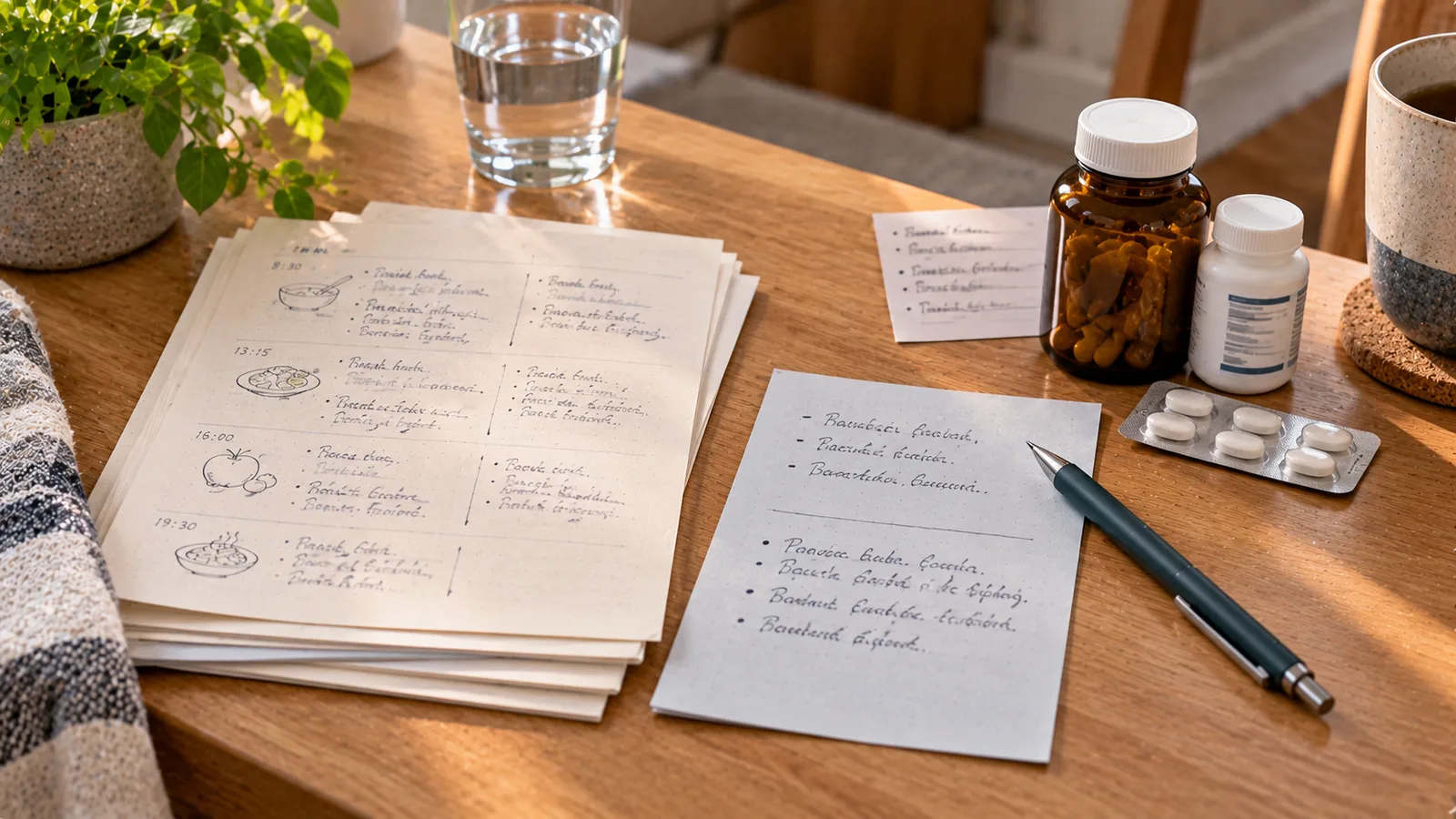
A dietitian appointment is usually more useful when the dietitian can see what your everyday eating actually looks like rather than trying to reconstruct it from memory during the consultation.
You do not need to create a perfect week before the appointment.
In fact, deliberately eating "better" for several days can make the record less representative.
A practical preparation process is to bring a short record of your normal food and drinks, clarify what you want help with, list relevant medications and supplements, and write down the questions you do not want to forget.
What to prepare before the appointment
A useful preparation checklist can include:
- 3–7 days of representative food and drink records;
- approximate portions where practical;
- meal and snack times;
- relevant product labels or brand names;
- your main nutrition goals;
- current medications and supplements;
- relevant medical information requested by the clinic;
- recent laboratory results if your clinician asked you to bring them;
- a short list of questions;
- practical constraints such as budget, schedule and cooking access.
Not every dietitian will need every item.
If the clinic sent specific instructions, follow those first.
Do not try to create a "perfect" food diary
One of the most useful things you can bring is an ordinary picture of how you normally eat.
If you usually:
- drink coffee with milk and sugar;
- skip breakfast on some days;
- eat takeaway once or twice a week;
- snack while working;
- have different meals on weekends;
record those patterns rather than changing them for the diary.
The purpose is not to receive a score.
The purpose is to give the dietitian useful information.
How many days should you record?
For general appointment preparation, 3–7 representative days can provide a useful practical snapshot.
The record becomes more informative when it includes different types of days.
For example:
- two or three normal workdays;
- one particularly busy day;
- one weekend day.
A seven-day record may show more variation, but it also requires more effort.
If detailed tracking makes you stressed or changes the way you eat, tell the dietitian rather than forcing yourself to produce a perfect log.
The clinic may also have its own preferred recording period.
What should a basic food record contain?
For a general nutrition consultation, a simple record can include:
| Information | Example |
|---|---|
| Time | 08:10 |
| Food or drink | Oatmeal with milk, banana, coffee |
| Approximate amount | 60 g oats, 200 ml milk, 1 banana |
| Relevant details | Coffee with milk and 1 tsp sugar |
| Context if useful | Breakfast before work |
You do not necessarily need to calculate calories or macros unless the dietitian specifically requested them.
A record of the foods, drinks and approximate quantities may be enough to start a useful conversation.
Record drinks too
Drinks are easy to forget when reconstructing a day from memory.
Include drinks such as:
- coffee;
- tea;
- milk;
- juice;
- soft drinks;
- energy drinks;
- smoothies;
- alcohol;
- water if hydration is relevant to your consultation.
Also include additions that meaningfully change the drink, such as milk, cream, sugar or syrup.
Include snacks and small extras
A representative record should not contain only formal meals.
Include:
- snacks;
- sweets;
- nuts;
- fruit;
- bites while cooking;
- sauces and dressings when relevant;
- drinks between meals.
You do not need to become obsessive about tiny amounts.
The goal is to capture the overall pattern accurately enough for discussion.
Use realistic portion estimates
If you already weigh food as part of your normal routine, you can record gram amounts.
If you do not normally weigh food, you do not need to turn the week before your appointment into a laboratory experiment.
Useful descriptions can include:
- 2 eggs;
- 1 medium apple;
- 1 bowl of soup;
- 2 slices of bread;
- 1 yogurt cup;
- approximately 1 cup of rice;
- half a restaurant pizza.
For packaged foods, the package size or serving weight can be useful.
For homemade dishes, list the main ingredients if that is easy to do.
Photos can complement written records
A quick meal photo can help when:
- the portion is difficult to describe;
- the meal contains several components;
- you are eating at a restaurant;
- you do not have time to record everything immediately.
Photos do not automatically provide exact quantities or nutrition values.
They work best as an additional memory aid rather than a replacement for all context.
For example, a photo plus a note saying:
13:20 — chicken curry with rice, restaurant lunch
is usually more informative than an unlabeled image alone.
Keep the record representative
Suppose your appointment is on Monday.
A useful record might look like:
Tuesday
Normal workday.
Wednesday
Normal workday.
Friday
Busy day with takeaway dinner.
Saturday
Weekend eating pattern.
This can be more informative than selecting four unusually disciplined days.
The dietitian is trying to understand your real routine and the places where recommendations need to fit.
Bring your goals—but make them concrete
"I want to eat healthier" is understandable, but it is broad.
Before the appointment, try to identify what you actually want help with.
Examples include:
- building more balanced meals;
- getting enough protein;
- increasing fiber;
- improving meal planning;
- eating regularly during shift work;
- understanding nutrition labels;
- managing food choices within a budget;
- adjusting food intake around exercise;
- planning meals for a specific medically diagnosed condition under professional guidance.
You do not need to know the solution.
That is part of the reason for the consultation.
You only need to describe the problem as clearly as you can.
Prioritize your goals
If you have ten nutrition concerns, identify the two or three that matter most right now.
For example:
- I want breakfasts that keep me comfortable until lunch.
- I need dinners that take less than 30 minutes.
- I want to understand whether my current protein intake is appropriate.
This helps the appointment focus on decisions you can actually use.
Bring information about your normal schedule
Nutrition advice has to work within your day.
Useful information may include:
- typical wake and sleep times;
- work hours;
- shift patterns;
- commute;
- usual meal times;
- exercise schedule;
- access to a kitchen at work;
- days when cooking is difficult;
- who else you cook for.
A technically good meal plan that does not fit your schedule is unlikely to be practical.
Budget is relevant information
If food cost matters, say so directly.
You can bring an approximate weekly or monthly grocery budget.
You can also mention:
- supermarkets you normally use;
- whether you eat at restaurants regularly;
- whether you rely on workplace meals;
- whether freezer space is limited;
- whether you shop once a week or several times.
This helps the dietitian suggest changes that fit your actual circumstances.
Bring a medication and supplement list
Write down medications and supplements you currently take.
For each supplement, useful information can include:
- product name;
- dose shown on the label;
- how often you take it.
If practical, bring the package, a photo of the label or the exact product name.
Do not stop prescribed medication or change its dose because of general nutrition information online.
Medication changes should be discussed with the appropriate healthcare professional.
Include vitamins, minerals and sports supplements
People sometimes remember prescription medicines but forget products such as:
- multivitamins;
- vitamin D;
- iron;
- magnesium;
- omega-3 supplements;
- protein powders;
- creatine;
- electrolyte products;
- herbal supplements.
These may be relevant to the overall nutrition assessment.
The dietitian needs the real list, not only the products you consider "medication."
Bring relevant medical information when requested
Depending on the reason for the consultation, the dietitian may need information about:
- diagnosed medical conditions;
- allergies;
- intolerances;
- recent blood tests;
- previous nutrition recommendations;
- relevant procedures or surgeries;
- weight history.
Only bring information that is relevant and that you are comfortable sharing in the healthcare context.
If another clinician referred you, some information may already have been provided.
Do not diagnose yourself before the appointment
Preparation should help the consultation, not replace it.
Avoid turning the week before the appointment into an experiment where you:
- eliminate several food groups;
- diagnose an intolerance yourself;
- start a highly restrictive diet;
- deliberately provoke symptoms;
- make major supplement changes.
These changes can make your normal eating pattern harder to assess and may be inappropriate for your situation.
If you suspect a food-related medical problem, discuss it with the appropriate healthcare professional.
General preparation is different from a symptom diary
A standard pre-appointment food record is designed to show your normal eating pattern.
A food-and-symptom diary has a different purpose.
It may include details such as:
- exact symptom timing;
- symptom type;
- intensity;
- duration;
- bowel symptoms;
- possible triggers.
If your clinician specifically asked for symptom tracking, follow those instructions.
For a general dietitian appointment, do not assume that you need to monitor every physical sensation or use your diary to identify a diagnosis.
Prepare a short health and nutrition history
You do not need to write an autobiography.
A short timeline can be useful.
For example:
- what prompted you to book the appointment;
- previous diets or major nutrition changes;
- recent changes in appetite or routine;
- previous advice that worked;
- advice that was difficult to follow.
This gives context without using most of the appointment to reconstruct your history.
Think about what has already been tried
Before the consultation, write down:
- what you have tried;
- how long you tried it;
- what was easy;
- what was difficult;
- why you stopped.
For example:
Tried meal prepping every Sunday for one month. It helped with lunches but took too long to prepare five different dinners.
That information is useful.
It shows that the problem may not be a lack of motivation—the system itself may need to be simpler.
Prepare questions in advance
Appointments move quickly.
A written question list reduces the chance of remembering your most important question after you leave.
Useful questions may include:
- What should I focus on first?
- Which changes would make the biggest practical difference?
- Is my current meal pattern reasonable for my goals?
- Do I need to track calories or macros?
- How can I make this work with my schedule?
- What should I look for on food labels?
- Are any of my supplements unnecessary or worth discussing with my doctor?
- How should we measure progress?
- When should we review the plan?
- Which recommendations are priorities and which are optional?
Choose questions relevant to your situation rather than trying to ask everything.
Ask how progress should be measured
Progress does not always mean body weight.
Depending on your goal, useful measures might include:
- consistency of meals;
- vegetable or fruit intake;
- fiber intake;
- protein distribution;
- cooking frequency;
- grocery spending;
- energy during training;
- laboratory markers interpreted by the relevant clinician.
Ask which measures actually matter for your goal.
This prevents you from tracking numbers that do not help with decision-making.
Write down practical barriers
Nutrition recommendations often fail because a practical barrier was never discussed.
Examples include:
- no kitchen at work;
- only 15 minutes for lunch;
- irregular shifts;
- limited fridge space;
- cooking for children with different preferences;
- limited food budget;
- frequent travel;
- little confidence with cooking;
- difficulty shopping frequently.
These are not side issues.
They directly affect which nutrition strategy is realistic.
Mention cultural and food preferences
Tell the dietitian about foods and eating patterns that are important to you.
That can include:
- cultural dishes;
- religious dietary practices;
- vegetarian or vegan eating;
- foods you strongly dislike;
- foods you want to keep in your diet;
- family meal traditions.
A useful plan should adapt to your eating context rather than unnecessarily replacing it.
Allergies and diagnosed intolerances
If you have diagnosed food allergies or intolerances, bring accurate information about them.
If you only suspect a problem, describe what you have noticed without presenting it as a confirmed diagnosis.
For example:
I have noticed that I sometimes feel uncomfortable after certain meals and want to discuss whether this needs further assessment.
That is more useful than arriving with several self-diagnosed intolerances after eliminating foods without professional guidance.
If you already use a nutrition app
You do not necessarily need to print hundreds of entries.
A concise summary is more useful.
Consider bringing:
- several representative days;
- average intake if the app calculates it reliably;
- commonly eaten foods;
- meal timing;
- questions raised by your data.
If your app contains inaccurate entries or incomplete days, mention that.
App data is only as useful as the information recorded.
Do you need calorie and macro numbers?
Not necessarily.
Some consultations benefit from quantitative records.
Others do not require detailed calorie tracking at all.
If you already track calories and macros, you can bring that information.
If you do not, do not assume you must start simply because you are seeing a dietitian.
A dietitian can tell you whether detailed tracking is useful for your particular goal.
What not to do the day before
Avoid trying to "improve" your record at the last minute.
You generally do not need to:
- eat unusually lightly;
- avoid foods you normally eat;
- skip a restaurant meal because it looks difficult to record;
- start weighing every ingredient;
- buy special health foods;
- fast before a routine nutrition appointment unless specifically instructed.
If blood testing or another procedure requires fasting, follow the instructions from the healthcare provider.
A simple 7-day preparation timeline
7 days before
Check any instructions from the clinic.
Start a representative food record if requested or useful.
5–6 days before
Continue normal eating and record a mix of typical days.
Take photos of labels or meals when they help you remember details.
3–4 days before
Write down your main goals and practical barriers.
Prepare your medication and supplement list.
2 days before
Collect relevant documents requested by the clinic.
Choose the most representative food-record days if you recorded more than needed.
1 day before
Write your priority questions.
Check the appointment time, location or video-call details.
Appointment day
Bring or have access to:
- food records;
- medication and supplement list;
- relevant documents;
- questions;
- notes about goals and constraints.
A one-page preparation template
You can summarize the essentials like this:
My main goals
- ____________________
- ____________________
- ____________________
My normal schedule
Wake time: __________
Work hours: __________
Typical breakfast: __________
Typical lunch: __________
Typical dinner: __________
Exercise: __________
Main practical constraints
- ____________________
- ____________________
- ____________________
Medications and supplements
- ____________________
- ____________________
- ____________________
Questions
- ____________________
- ____________________
- ____________________
- ____________________
Attach or bring several representative food-record days separately.
During the appointment
You do not need to defend your food choices.
Answer questions as accurately as you can.
If a recommendation sounds unrealistic, say so.
For example:
- "I cannot cook at lunchtime."
- "That ingredient is too expensive for my weekly budget."
- "I do not think I can prepare seven different dinners."
- "I would prefer to keep this traditional meal."
- "Tracking every gram makes me anxious."
That information allows the recommendation to be adjusted.
After the appointment
Before leaving, make sure you understand:
- the first one or two actions to take;
- which recommendations are most important;
- what you are expected to track, if anything;
- how progress will be evaluated;
- when follow-up is appropriate.
If you leave with ten changes and no priorities, ask which two should come first.
When detailed professional assessment matters
General preparation guides cannot determine what nutrition treatment is appropriate for an individual.
Professional assessment is especially important when nutrition concerns involve issues such as:
- diagnosed medical conditions;
- significant unexplained weight change;
- persistent gastrointestinal symptoms;
- food allergies;
- pregnancy;
- eating disorders or suspected disordered eating;
- major dietary restriction;
- complex medication or supplement use.
The appropriate healthcare professional can determine what information and testing are actually needed.
The practical takeaway
You do not need to impress your dietitian with a perfect week.
A useful appointment is more likely when you bring an honest, representative picture of your normal eating and enough context to understand it.
A practical preparation process is:
- record 3–7 representative days if appropriate;
- include normal food, drinks, snacks and approximate portions;
- identify your two or three main goals;
- write down practical constraints;
- prepare your medication and supplement list;
- bring relevant information requested by the clinic;
- write your priority questions.
Keep a general appointment record focused on your normal diet and goals.
If symptom-specific tracking is needed, use a dedicated symptom diary according to professional guidance rather than trying to diagnose the cause yourself.
Sources
- Academy of Nutrition and Dietetics, information on working with registered dietitian nutritionists.
- NHS, guidance on preparing for healthcare appointments and bringing medication information.
- National Institute of Diabetes and Digestive and Kidney Diseases (NIDDK), nutrition and digestive-health patient information.
- Deutsche Gesellschaft für Ernährung (DGE), evidence-based nutrition guidance.
- Bundeszentrum für Ernährung (BZfE), practical nutrition and food-record guidance.