
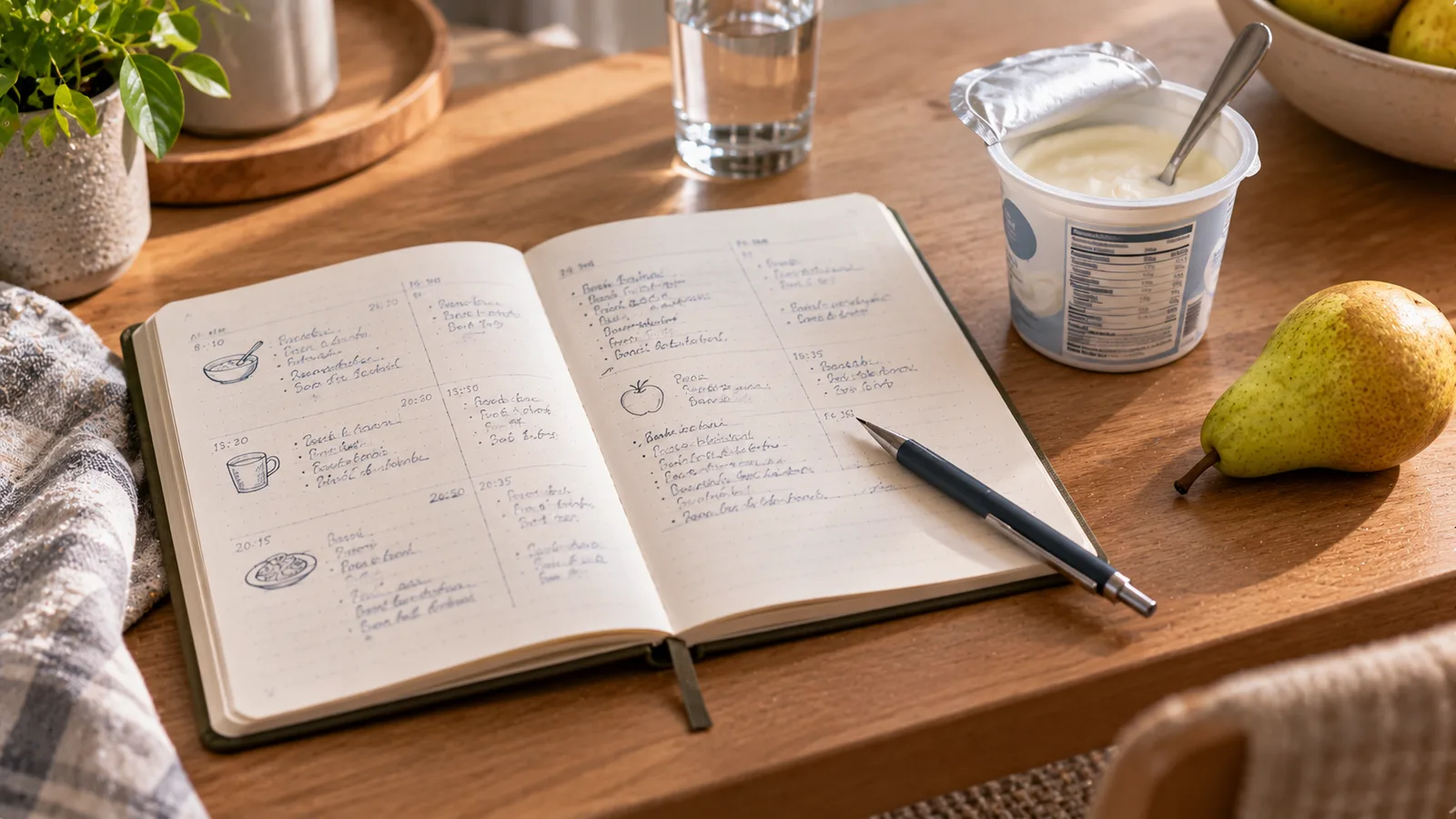
A food and symptom diary can help a dietitian understand what happens around your meals more clearly than memory alone.
The purpose is not to diagnose an intolerance, allergy or digestive disorder yourself.
Instead, the diary creates a factual record of:
- what you ate and drank;
- approximately how much;
- when you consumed it;
- when symptoms occurred;
- what the symptoms were like;
- other circumstances that may have been relevant.
A useful diary records observations without immediately deciding what caused them.
What a food and symptom diary can show
When several days are recorded consistently, a dietitian can look for patterns involving:
- particular foods or ingredients;
- portion sizes;
- meal timing;
- long gaps between meals;
- repeated symptoms after similar meals;
- caffeine or alcohol;
- changes between workdays and weekends;
- medication or supplement timing;
- stress, sleep or activity;
- bowel patterns when relevant.
A pattern can provide a reason to investigate further.
It is not automatically proof that a particular food caused the symptom.
What the diary cannot diagnose
Symptoms such as bloating, abdominal discomfort, diarrhea, constipation, nausea or fatigue can have many possible explanations.
A diary alone cannot reliably diagnose conditions such as:
- food allergy;
- lactose intolerance;
- coeliac disease;
- irritable bowel syndrome;
- inflammatory bowel disease;
- histamine intolerance;
- other gastrointestinal or medical conditions.
Avoid turning every repeated observation into a diagnosis.
The diary is evidence to discuss with an appropriately qualified healthcare professional.
Record the time
Timing is one of the most useful pieces of information.
Instead of writing:
> Breakfast — yogurt and cereal
record:
> 07:40 — yogurt, oats, banana and coffee
If symptoms appear later, add their own time:
> 10:15 — abdominal bloating started
This makes the sequence visible.
Without times, it can be difficult to distinguish a symptom that appeared 20 minutes after eating from one that appeared six hours later.
Record the complete meal
Do not record only the ingredient you currently suspect.
If lunch contained:
- pasta;
- tomato sauce;
- minced meat;
- onion;
- cheese;
- olive oil;
- sparkling water,
record the whole meal.
If you write only "pasta," potentially useful information disappears.
Mixed dishes are especially important because they may contain several ingredients that are easy to forget.
Include drinks
Drinks are part of the diary.
Record items such as:
- coffee;
- tea;
- milk;
- juice;
- soft drinks;
- energy drinks;
- alcohol;
- smoothies;
- protein drinks;
- sparkling water.
Also note additions when relevant.
"Coffee" and "large coffee with 150 ml milk and syrup" are not the same intake.
Estimate portions without chasing perfect precision
You do not necessarily need laboratory-level measurements.
Useful descriptions might be:
- 200 g yogurt;
- 2 slices of bread;
- 1 medium apple;
- approximately 1 cup of rice;
- 1 tablespoon of sauce;
- half a restaurant portion.
If you already weigh foods, you can record grams.
If you do not, consistent household measures are often more useful than skipping the entry because you cannot determine the exact weight.
Packaged foods: record enough detail to identify the product
For packaged foods, useful details can include:
- product name;
- brand;
- flavor or variety;
- approximate amount;
- relevant label information.
A photograph of the ingredient list may also be useful if your dietitian wants to examine the product later.
This can matter because two foods with similar names may have different formulations.
Homemade recipes need more than a dish name
"Homemade soup" provides limited information.
A better entry might be:
> Lentil soup — lentils, carrots, onion, tomatoes, potatoes, vegetable stock and olive oil; approximately 450 g.
You do not need to recreate a full recipe every time if you eat leftovers.
Give the recipe a short name and refer back to the original ingredient list.
Restaurant meals require reasonable estimates
You may not know every ingredient in restaurant food.
Record what you reasonably know.
For example:
> 19:30 — chicken curry with basmati rice, restaurant portion; coconut-based sauce, exact ingredients unknown.
Do not invent precision that you do not have.
The uncertainty itself is useful information.
Describe the symptom specifically
"Felt bad" is difficult to interpret.
More useful descriptions include:
- bloating;
- abdominal pain;
- nausea;
- reflux or heartburn;
- loose stool;
- constipation;
- headache;
- itching;
- unusual fatigue.
Use ordinary language if you do not know a medical term.
The goal is to describe what happened, not to diagnose it.
Record when the symptom started and ended
Whenever practical, note:
- start time;
- approximate duration;
- whether it was continuous or intermittent.
Example:
> 14:20 — cramping started. Moderate. Came and went for about 45 minutes.
This gives much more context than simply writing "stomach pain today."
A simple symptom intensity scale can help
You can use a consistent scale such as:
- 0 — none;
- 1 — very mild;
- 2 — mild;
- 3 — moderate;
- 4 — strong;
- 5 — severe.
The exact scale matters less than using it consistently.
For example:
> Bloating: 3/5, started at 18:10, lasted approximately two hours.
Do not use the score to decide whether a food is dangerous. It is simply a way to describe your experience consistently.
For bowel symptoms, use a consistent description
If bowel habits are relevant to the reason for your consultation, your dietitian may find information about:
- frequency;
- urgency;
- stool consistency;
- pain;
- unusual changes
helpful.
The Bristol Stool Form Scale is sometimes used clinically to describe stool form consistently.
You do not need to include bowel information if it is unrelated to your symptoms or consultation.
Record relevant medications and supplements
Some medications and supplements can affect gastrointestinal symptoms, appetite or bowel habits.
If relevant, record:
- medication or supplement name;
- dose if known;
- approximate time taken.
Do not stop prescribed medication simply to make the diary "cleaner."
Medication changes should be discussed with the clinician responsible for your treatment.
Sleep can provide useful context
Poor or unusual sleep may coincide with changes in:
- appetite;
- meal timing;
- caffeine intake;
- stress;
- gastrointestinal symptoms.
A simple entry is enough:
> Sleep: about 5.5 hours, poor quality.
You do not need detailed sleep tracking unless your healthcare professional specifically requests it.
Stress and unusual events can be recorded neutrally
Stress can coincide with changes in eating behavior and gastrointestinal symptoms.
Instead of trying to quantify your entire psychological state, a short note may be enough:
> High-workload day.
or:
> Important exam in the afternoon.
The purpose is context, not deciding that stress caused the symptom.
Physical activity may matter
If symptoms appear around exercise, note:
- activity type;
- approximate duration;
- unusual intensity;
- whether it occurred before or after eating.
Example:
> 17:30 — 60-minute run, harder than usual.
This can help separate food-related hypotheses from other possible patterns.
Menstrual-cycle context may sometimes be relevant
For people who menstruate, gastrointestinal symptoms, appetite and fluid retention can vary across the menstrual cycle.
If this is relevant and you are comfortable recording it, a brief note may help provide context.
It is optional unless your healthcare professional specifically asks for it.
A practical diary format
A simple table is often enough.
| Time | Food/drink | Approximate amount | Symptoms | Context |
|---|---|---|---|---|
| 07:30 | Oats, milk, banana, coffee | 60 g oats, 200 ml milk, 1 banana | None | Slept 7 h |
| 10:20 | — | — | Bloating 2/5 | Sitting at work |
| 12:45 | Chicken sandwich, apple, water | 1 sandwich, 1 apple | None | — |
| 15:30 | Coffee with milk | 1 large cup | Mild cramps 1/5 at 16:10 | Busy afternoon |
| 19:15 | Rice, salmon, broccoli, sauce | Approx. 1 plate | None initially | 45-min walk earlier |
This format keeps food and symptoms on the same timeline without claiming that one caused the other.
Do not record only symptomatic meals
This is an important mistake to avoid.
If you record only meals followed by symptoms, the diary loses comparison data.
Meals without symptoms are useful too.
For example, if you eat yogurt five times and symptoms occur after only one of those occasions, that context matters.
Record the ordinary days as well as the difficult ones.
Avoid changing your entire diet before the appointment
If it is medically safe for you to continue your usual diet and you have not been instructed otherwise, radically changing what you eat before keeping the diary can make the record less representative of your normal routine.
Do not begin multiple restrictive elimination diets simply to test hypotheses on your own.
Unnecessary restriction can:
- make nutritional adequacy harder;
- create confusing results;
- make normal eating more difficult;
- interfere with appropriate diagnostic testing in some conditions.
For example, removing gluten before testing for coeliac disease can affect the diagnostic process.
If you suspect a medical condition, discuss dietary changes with a healthcare professional before starting a restrictive elimination plan.
Food allergy symptoms need appropriate medical assessment
A food diary should not be used to deliberately re-expose yourself to a food that has previously caused a serious or potentially allergic reaction.
Symptoms such as difficulty breathing, swelling of the tongue or throat, collapse or other signs of a severe allergic reaction require urgent medical attention.
A diary is a record-keeping tool, not a substitute for emergency or allergy care.
How many days should you record?
There is no universal perfect duration.
The useful period depends on:
- how often symptoms occur;
- how varied your diet is;
- the reason for the consultation;
- instructions from your dietitian or clinician.
Several representative days can be more informative than one unusually detailed day.
If symptoms are infrequent, a longer record may be necessary.
If your dietitian has given you a specific duration, follow that instruction.
Include weekdays and weekends when they differ
Eating patterns often change between:
- workdays;
- weekends;
- travel days;
- night shifts;
- training days.
If your symptoms vary too, including different types of days can make the diary more informative.
For example, a pattern that appears only on office days may involve meal timing, coffee, stress or food availability rather than one specific ingredient.
Do not try to make the diary look "healthy"
Record what you actually eat.
A dietitian gains little from a diary that has been edited to look ideal.
Include:
- snacks;
- sweets;
- alcohol;
- takeaway meals;
- sauces;
- second servings;
- foods eaten late at night.
These are not failures.
They are data.
Photos can support written entries
A quick meal photo can help you remember:
- what was on the plate;
- relative portion sizes;
- sauces and sides;
- packaged products.
But photos should complement rather than replace useful written information.
A photo usually cannot show:
- hidden ingredients;
- exact recipe;
- symptoms;
- timing;
- medication;
- how much of the meal you actually finished.
Avoid searching for a culprit after every entry
If you experience bloating after dinner, it can be tempting to immediately label one ingredient as the cause.
Instead, record:
> Bloating began 90 minutes after dinner.
Then continue collecting observations.
Repeated patterns across multiple exposures are more informative than a single event, but even repeated patterns may require professional interpretation.
Prepare a short summary before the appointment
You do not need to diagnose yourself.
A useful summary might say:
> I recorded 10 days. Bloating occurred on six days, usually in the afternoon or evening. I noticed it several times after large meals, but I could not identify one food that was present every time.
Or:
> Symptoms appeared on four occasions. Three followed restaurant meals, while similar foods eaten at home did not always cause symptoms.
This helps the dietitian understand what you noticed while leaving room for a broader assessment.
Questions your diary may help a dietitian explore
A structured record may help guide questions such as:
- Are symptoms associated with meal size?
- Is timing consistent?
- Are there repeated ingredient patterns?
- Are symptoms more common after restaurant meals?
- Is caffeine intake unusually high on symptomatic days?
- Are bowel changes associated with particular routines?
- Is the diet already unnecessarily restricted?
- Is further medical evaluation needed?
These are questions for assessment, not conclusions the diary should answer by itself.
When not to wait for a dietitian appointment
Some symptoms require prompt medical attention rather than prolonged self-tracking.
Seek appropriate medical care if you have concerning symptoms such as:
- signs of a severe allergic reaction;
- blood in stool or vomit;
- persistent vomiting;
- severe or worsening abdominal pain;
- unexplained significant weight loss;
- difficulty swallowing;
- persistent fever;
- signs of significant dehydration;
- symptoms that are severe, rapidly worsening or otherwise concerning.
This list is not exhaustive.
If you are unsure whether a symptom requires urgent assessment, contact an appropriate healthcare service.
A compact daily checklist
For each day, try to capture:
- time of meals and drinks;
- complete foods and ingredients where known;
- approximate portions;
- symptom type;
- symptom start time;
- approximate severity and duration;
- relevant medications or supplements;
- unusual sleep, stress or exercise context;
- bowel information if relevant.
You do not need a perfect record.
Consistency is usually more useful than excessive detail for one day followed by no tracking at all.
The main takeaway
A food and symptom diary is most useful when it stays descriptive.
Record:
what happened, when it happened and what else was happening around it.
Do not use the diary to diagnose yourself or to justify increasingly restrictive diets.
A well-kept record can give a dietitian a clearer picture of your usual eating pattern and symptoms, helping the consultation start with better information rather than relying entirely on memory.
Sources
- National Institute of Diabetes and Digestive and Kidney Diseases (NIDDK), patient information on digestive symptoms and coeliac disease.
- National Institute of Allergy and Infectious Diseases (NIAID), guidance and evidence on food allergy.
- National Health Service (NHS), patient guidance on food intolerance, food allergy and digestive symptoms.
- British Dietetic Association (BDA), dietetic information on gastrointestinal symptoms and elimination diets.
- Deutsche Gesellschaft für Ernährung (DGE), evidence-based nutrition information.