
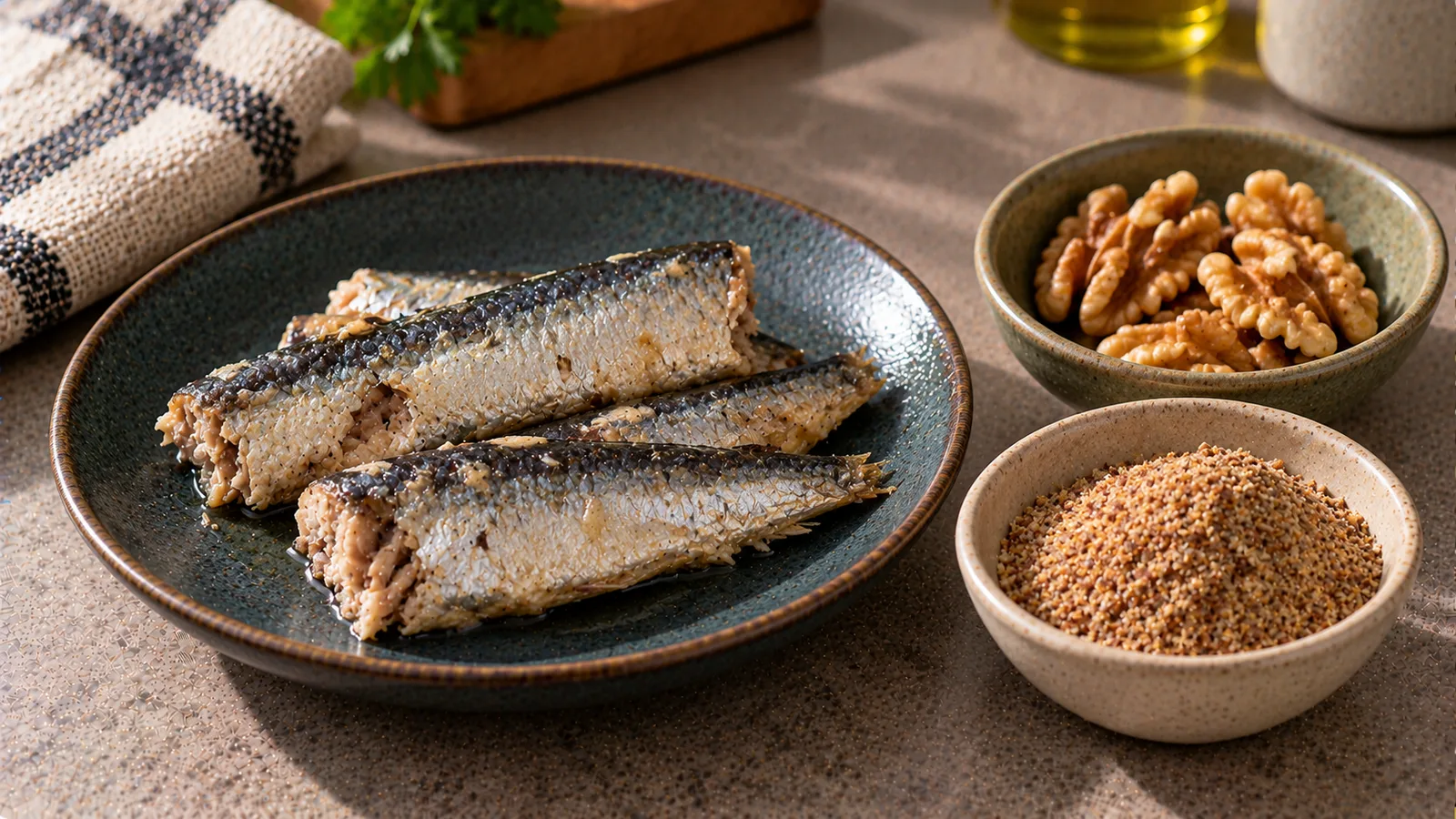
Affordable omega-3 foods do not have to mean expensive fresh salmon or a bottle of capsules. Canned sardines, some other oily fish, flaxseed, chia and walnuts can all contribute omega-3 fatty acids. But a shopping comparison is only useful if it distinguishes the type of omega-3, the edible portion and the money actually spent. A spoonful of flaxseed is not a cheaper version of a portion of sardines: the former mainly supplies alpha-linolenic acid (ALA), while the latter supplies the long-chain fatty acids EPA and DHA.
This guide compares six precisely identified food forms using the NIH Office of Dietary Supplements food-composition table. The quantities come from that reference, while every euro price is a deliberately hypothetical shopping example to teach cost calculations, not a verified offer from a German retailer in October 2026. Use the numbers to understand the method, then substitute the drained weights and prices of products available to you.
First distinguish ALA from EPA and DHA
Omega-3 is a family, not one interchangeable nutrient. ALA is an essential fatty acid found mainly in flax, chia, walnuts and certain plant oils. EPA and DHA are long-chain omega-3 fatty acids supplied directly by fatty fish, seafood and some algae-derived foods. The body can convert some ALA to EPA and DHA, but conversion is limited and variable. The NIH explicitly cautions against treating a large ALA number as the same amount of EPA and DHA.
For that reason, comparing €0.09 of flaxseed with €1.29 of sardines by simply dividing each price by its total grams of “omega-3” would answer the wrong question. It is legitimate to ask which item supplies ALA economically, and separately which item supplies EPA plus DHA economically. It is not legitimate to rank those two figures together as though a gram of ALA and a gram of EPA plus DHA delivered equivalent physiological exposure.
The European Food Safety Authority's assessment discusses an adult reference intake of about 250 mg of EPA plus DHA per day in the context of general cardiovascular health. That is not a shopping prescription, a medical treatment target or an instruction to eat fish every day. The NIH omega-3 fact sheet separately sets out ALA adequate intakes and explains why EPA/DHA recommendations differ among organizations. A person avoiding fish has a different purchasing question from someone simply trying to make two inexpensive fish meals each week.
Six foods and the portions actually being compared
The following nutrient values match the named forms and quantities in NIH Table 2. An asterisk in the source denotes a food whose particular database preparation matters; do not transfer the numbers to all brands, different sauces or uncooked products. Where the table says three ounces, that is approximately 85 g of the specified edible food, not the weight of the entire tin and packing liquid. A tablespoon of whole flaxseed is the source's own unit, and its mass is not assumed to equal a spoonful of ground flaxseed.
| Food and reference form | Edible portion | Omega-3 from NIH | Illustrative portion cost | Cost per g of that omega-3 type |
|---|---|---|---|---|
| Sardines, canned in tomato sauce, drained | 85 g | 1.19 g EPA+DHA | €1.29 | €1.08 / g EPA+DHA |
| Atlantic mackerel, cooked | 85 g | 1.02 g EPA+DHA | €1.59 | €1.56 / g EPA+DHA |
| Pink salmon, canned, drained | 85 g | 0.91 g EPA+DHA | €2.19 | €2.41 / g EPA+DHA |
| Flaxseed, whole | 1 tbsp | 2.35 g ALA | €0.09 | €0.04 / g ALA |
| Chia seeds | 28 g (1 oz) | 5.06 g ALA | €0.32 | €0.06 / g ALA |
| English walnuts | 28 g (1 oz) | 2.57 g ALA | €0.45 | €0.18 / g ALA |
Each fish figure adds the separate EPA and DHA values in the NIH table: sardines 0.45 + 0.74 = 1.19 g, mackerel 0.43 + 0.59 = 1.02 g, and drained pink salmon 0.28 + 0.63 = 0.91 g. Prices above are six independent assumptions for the stated edible portions. They have not been extracted from retailer labels, extrapolated from a photograph or presented as current German shelf prices. The last column is rounded from portion cost divided by the relevant grams. It is a budget tool, not a nutritional equivalence claim.
For the three plant foods, the NIH table lists ALA only in these rows. Their blank EPA/DHA cells must not be read as proof that every tested product contains literally zero trace amounts; the practical message is that these foods are not direct substitutes for marine EPA/DHA. The figures are reference composition values, not promises that each seed or walnut package has precisely the same content. If you use a larger or smaller portion, scale the figure rather than copying the reference portion unaltered.
What does “cheap” mean: receipt, edible weight or nutrient?
There are three different prices. Checkout cost is what you pay for the whole tin or bag. Portion cost is the part allocated to the quantity you use. Cost per gram of the relevant fatty acid divides that allocated amount by estimated ALA or EPA+DHA. These are useful for different decisions. A family might care most about its weekly checkout total; a person comparing edible fish might need drained cost; an article comparing omega-3 sources must also preserve the fatty-acid category.
For example, imagine a sardine tin costing €1.52 and containing 100 g drained fish. Using 85 g means 85/100 × €1.52 = €1.29 of the contents at rounded precision. If the tin states 125 g net weight but only 90 g drained, dividing by 125 g undervalues the cost per edible fish portion. Oil or tomato sauce can be part of a recipe, but it should not silently count as 125 g of fish or inherit the fish's EPA/DHA composition.
A bag of chia costing an assumed €3.20 for 280 g gives €3.20 × 28/280 = €0.32 for 28 g. This does not mean a 28 g portion is the best amount for every meal. Chia supplies additional energy and fibre; a heaped tablespoon may be substantially smaller than the one-ounce reference. For a guide to recognizing the difference between serving declarations and what is on your plate, see portion size versus serving size.
The receipt and the food consumed are not the same calculation. If you buy a €3.20 bag, the cash outlay today is €3.20 even though this recipe uses only €0.32. The unused seeds are pantry inventory, not automatically waste and not free. For planning prices around repeated meals rather than a single ingredient, a budget grocery list is more informative than an isolated cost-per-gram figure.
A worked weekly basket that combines fish and seeds
Here is a calculation scenario, not a recommended medical dose or an assertion about real German prices. Suppose you plan two meals containing the reference 85 g portions of drained sardines, three small uses of whole flaxseed measured as NIH tablespoons, and one 28 g serving of walnuts during a week. Other meals, vegetables and energy needs are outside this omega-3-only example.
| Ingredient in the example week | Portions | Subtype and reference amount | Allocated ingredient cost |
|---|---|---|---|
| Drained sardines in tomato sauce | 2 × 85 g | 2 × 1.19 = 2.38 g EPA+DHA | €2.58 |
| Whole flaxseed | 3 × 1 tbsp | 3 × 2.35 = 7.05 g ALA | €0.27 |
| Walnuts | 1 × 28 g | 2.57 g ALA | €0.45 |
| Total for the listed ingredients | — | 2.38 g EPA+DHA + 9.62 g ALA (separate) | €3.30 |
Do not add 2.38 and 9.62 to make a supposed 12 g of interchangeable omega-3 protection. They remain different subtypes. The €3.30 is an allocated ingredient cost; your actual checkout might be higher because you need to buy a complete tin, pack of seeds and bag of walnuts. It also excludes side dishes, refrigeration energy and any leftovers. A sardine dish with beans, potatoes or salad still needs the cost and nutrition of those other ingredients counted.
An alternate low-effort week might use one fish meal and daily smaller portions of seeds. That can be affordable, but it would lower the marine EPA/DHA supplied directly unless another food source supplies it. More frequent flaxseed cannot be converted into an exact equivalent number of sardine meals by a fixed multiplier because the ALA conversion rate varies. A vegan household might specifically compare algae-derived DHA/EPA foods or supplements, checking labels and prices separately, rather than claiming walnuts alone replace those fatty acids.
Canned sardines: the strongest budget case depends on the tin
Sardines are often practical because they are ready to eat, keep unopened for a long time under labeled storage conditions and offer EPA and DHA without a premium fresh-fish purchase. Their nutritional identity matters: the reference in the first table is canned in tomato sauce, drained. A different tin in olive oil, brine or a different sauce can have a different drained mass, salt content, energy value and omega-3 profile. Do not transfer a canned-fish number directly to a cooked raw fillet.
Check the label for fish species, fish weight or drained weight where given, salt per 100 g, and the list of added ingredients. A heavily salted sauce can change whether the product suits a particular meal. If you eat soft edible bones, calcium may be another consideration, but it is not part of this omega-3 cost calculation. Sardines often make sense with inexpensive potatoes, legumes or bread; they are not inherently a complete balanced meal by themselves. The balanced meal guide can help fill in vegetables and other food groups.
The lowest tin price can be a misleading comparison: a cheap 125 g container with much less edible fish may cost more per 85 g drained portion than a seemingly expensive tin. A bulk promotion helps only if you will actually use the product before its stated date and store it correctly. A reasonable budget decision considers palatability, salt, portion yield and whether the tin prevents another more expensive purchase.
Mackerel and canned salmon: check the form, not just the fish name
The reference mackerel in NIH Table 2 is Atlantic mackerel, cooked, not smoked mackerel in oil and not king mackerel. These distinctions affect both nutrient figures and contaminant advice. The sample €1.59 cost assumes an 85 g ready-to-eat portion. If you purchase raw whole fish, you cannot take 85 g of raw product as 85 g cooked edible flesh: bones, trimming and cooking losses change the yield. Calculate what the cooked portion actually cost before comparing it with canned sardines.
For salmon, the example is canned pink salmon, drained, not farmed Atlantic salmon or smoked salmon. It has a different EPA/DHA profile from fresh fatty salmon. The €2.19 example is therefore a deliberately invented cost for the reference drained edible quantity; it should not be generalized to all salmon. Bones and skin may be included or removed depending on the product, so compare edible portions consistently. If the shop has a genuine discount, replace the placeholder with the local price and recalculate; no food wins universally across every store and country.
Food safety belongs in the comparison too. The FDA/EPA fish advice identifies sardines, Atlantic mackerel and salmon among lower-mercury “Best Choices”; king mackerel is not the same species and should not be silently included. Advice is especially important for pregnancy, breastfeeding and children. Buying a fish because it looks cheap should not bypass those distinctions or local food advisories.
Flaxseed, chia and walnuts: inexpensive ALA with different uses
Flaxseed can be affordable per gram of ALA in a pantry, but measurement matters. The NIH table gives whole flaxseed, one tablespoon, not a guarantee for a random tablespoon of ground meal. Grinding or chewing affects access to its nutrients; storing ground flaxseed protected from heat and light helps manage rancidity. A small weighed amount mixed into porridge or yogurt can be easier to use consistently than pouring an undefined spoonful. Flax also contains fibre; if you are changing your intake quickly, increase gradually and use adequate fluid.
Chia is useful in porridge, yogurt or a hydrated pudding. The 28 g comparison is a full ounce, larger than the amount some people use as a topping. Seeds absorb liquid and change texture, so dry-weight figures should remain dry-weight figures. A 10 g portion calculated proportionally from the NIH ounce would provide roughly 1.79 g ALA, not the 5.06 g shown for the full 28 g reference. Individual products may differ; hydration does not create new grams of fatty acids. For other economical fibre-bearing pantry foods, see high-fibre foods.
Walnuts contribute ALA while also providing energy and other nutrients. Their cost per gram of ALA in the hypothetical example is higher than that of flax or chia, but the comparison omits taste, convenience and whether you would eat the nuts anyway. The one-ounce NIH reference is approximately 28 g; if you eat half, count about half its stated ALA and half its allocated price. Raw, roasted, salted and flavoured products are not interchangeable in every nutritional respect.
These plant foods should not be reduced to a contest over the biggest ALA number. A tablespoon of flaxseed fits one kind of meal; 28 g of walnuts is a snack-sized ingredient; an entire ounce of chia may be more than someone wants in one sitting. Useful shopping means buying the food and portion you will actually eat, not maximizing an abstract metric while ignoring calories, salt, allergies or preference.
How to check supermarket labels without overinterpreting them
First identify exact species and processing form. “Mackerel” could refer to a different species; “salmon” could be raw, smoked or canned; sardines in sauce may have a smaller drained weight than the gross tin mass. Next record the net purchase price and the edible weight. For a seed bag, the edible package weight is normally straightforward; for fish, drained weight, bones and cooking yield deserve attention.
Then record omega-3 information carefully. Standard nutrition panels generally list energy, fat and other mandatory nutrients; EPA/DHA or ALA values may not be declared. When they are absent, a composition database is a reference estimate rather than proof of a brand-specific content. Use the NIH numbers as comparisons for the named foods, not a fabricated precision that the retail package does not support. If a manufacturer offers an analytical fatty-acid declaration, check which fatty acid and per-portion unit it describes.
Finally decide whether your objective is direct EPA/DHA, dietary ALA, lower checkout spending, or a practical meal. Write separate price-per-gram columns for ALA and EPA/DHA; never merge them into one winner. Think about food allergies, vegetarian eating, salt-sensitive diets, added sauces, dietary fibre and the rest of the plate. Keep a transparent note of assumptions so you can update the comparison when offers and products change.
What the evidence establishes and what it cannot guarantee
The NIH table supports the approximate fatty-acid quantities of the specified food forms and serving sizes. EFSA provides useful context for adult EPA+DHA intake, while FDA/EPA guidance distinguishes fish species and lower-mercury choices. None of these authorities verifies our illustrative euros, determines which supermarket is cheapest this week or promises that one serving will treat a health condition. Any apparent savings in this article comes from arithmetic applied to hypothetical prices, not a live price survey.
There is no single perfect omega-3 bargain. A ready-to-eat tin can deliver long-chain omega-3s with almost no preparation; a small amount of flax can cheaply add ALA to a meal you already enjoy; walnuts may be worth buying despite a higher hypothetical ALA unit cost because you actually eat them. Recheck real prices and amounts, separate ALA from EPA+DHA, and make the final purchase decision on the edible portion and your whole dietary pattern—not a marketing label.
Sources
- NIH Office of Dietary Supplements — Omega-3 Fatty Acids, Health Professional Fact Sheet — Table 2 supplies the exact reference food forms and ALA, EPA and DHA amounts used above; also covers ALA conversion and intake context.
- NIH Office of Dietary Supplements — Omega-3 Fatty Acids, Consumer Fact Sheet — explanation of the different fatty acids and food sources.
- European Food Safety Authority — EFSA assesses safety of long-chain omega-3 fatty acids — adult EPA/DHA reference context; not an individual medical instruction.
- FDA — Questions and answers on FDA/EPA advice about eating fish — species distinctions, lower-mercury choices and serving advice.
- US EPA — FDA/EPA advice about eating fish and shellfish — additional context on species choice and consumption advice.