
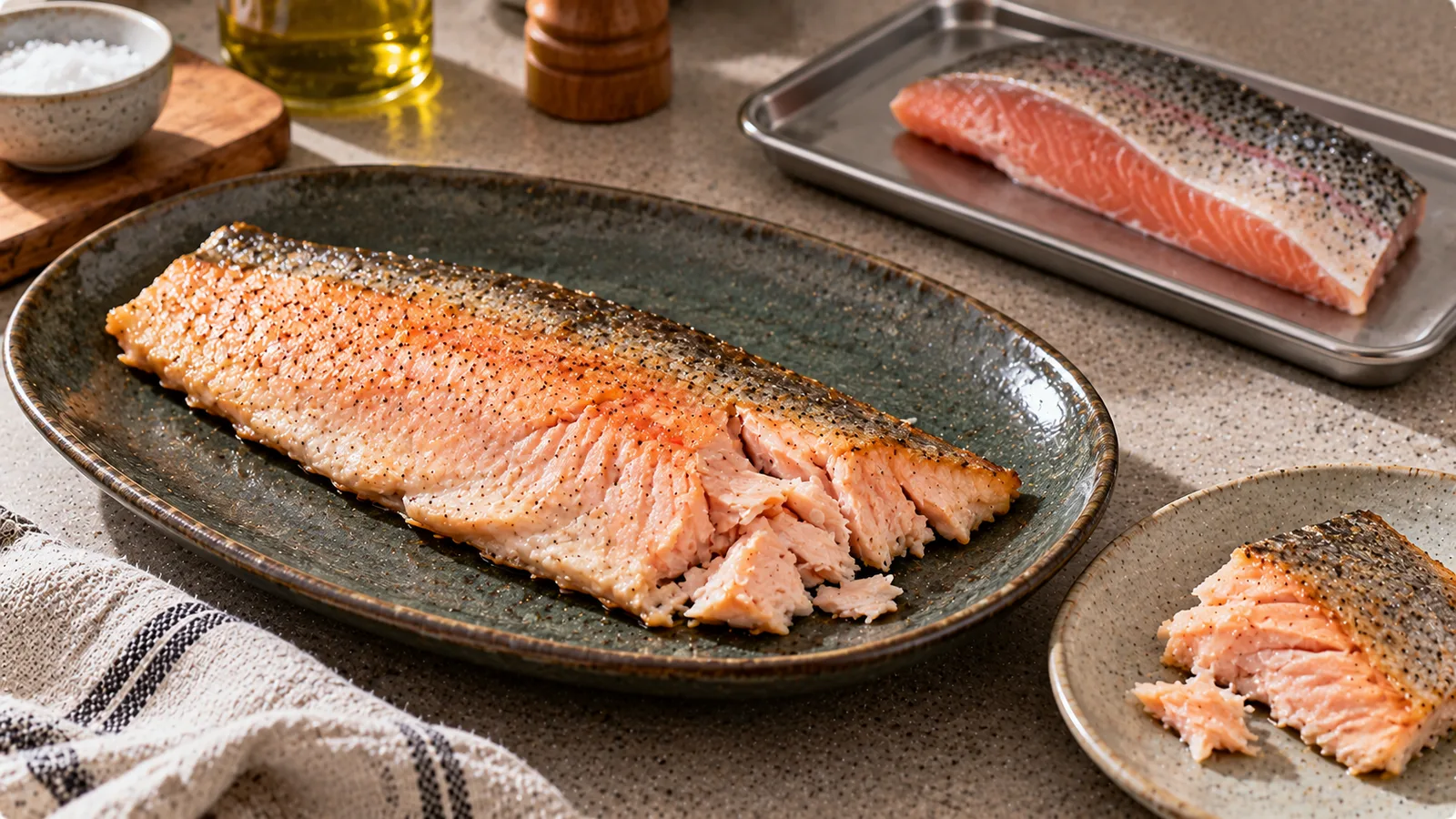
Trout is a freshwater fish valued for its mild flavour, protein and beneficial fats. It can be baked, grilled, pan-fried or smoked, but its calorie content changes depending on the species, cooking method and ingredients added.
For accurate nutrition tracking, it is important to distinguish raw trout from cooked trout, weigh the edible portion and account for oil, butter or sauces.
How many calories are in trout?
Rainbow trout is one of the most commonly eaten trout species.
As a practical reference:
- Raw rainbow trout: approximately 120–150 kcal per 100 g.
- Baked or grilled rainbow trout: approximately 150–190 kcal per 100 g cooked fish.
- Pan-fried trout: approximately 160–230 kcal per 100 g, depending on added fat.
- Smoked trout: approximately 150–220 kcal per 100 g, depending on the product.
These are approximate ranges rather than exact values for every fish.
Different trout species and farming conditions can produce different fat contents. Cooking also changes water content, which affects calories per 100 g.
For a packaged product, use its nutrition label whenever possible.
Trout calories by preparation
| Trout preparation | Approximate calories per 100 g |
|---|---|
| Rainbow trout, raw | 120–150 kcal |
| Rainbow trout, baked | 150–190 kcal |
| Rainbow trout, grilled | 150–190 kcal |
| Trout, pan-fried | 160–230 kcal |
| Trout, smoked | 150–220 kcal |
These values are broad estimates.
A trout fillet cooked without additional fat may contain fewer calories than one fried in butter.
The amount of oil retained during cooking is often more important than the difference between baking and grilling.
Calories in a trout fillet
Trout fillets vary in size.
A small fillet might weigh 100–120 g, while a larger one can weigh 150–200 g or more.
For an example calculation, assume cooked trout provides 170 kcal per 100 g.
| Cooked edible portion | Estimated calories |
|---|---|
| 80 g | 136 kcal |
| 100 g | 170 kcal |
| 120 g | 204 kcal |
| 150 g | 255 kcal |
| 180 g | 306 kcal |
| 200 g | 340 kcal |
| 250 g | 425 kcal |
These figures describe the fish alone, without added oil, butter, breading or sauce.
Example: a 160 g trout fillet
If your cooked fillet weighs 160 g and the food entry lists 170 kcal per 100 g:
160 × 170 ÷ 100 = 272 kcal
If you also consume 10 g olive oil used in cooking, add approximately 90 kcal.
The estimated total becomes:
272 + 90 = 362 kcal
The actual amount of oil consumed may be lower than the amount placed in the pan, especially if some remains behind.
Trout nutrition per 100 g
Trout is a protein-rich fish that also supplies fat, vitamins and minerals.
The following values illustrate a typical cooked rainbow trout portion.
| Nutrient | Approximate amount per 100 g cooked |
|---|---|
| Calories | 150–190 kcal |
| Protein | 22–26 g |
| Fat | 6–10 g |
| Carbohydrates | Usually 0 g |
| Omega-3 fatty acids | Varies by species and production |
| Vitamin B12 | Present |
| Vitamin D | Present in variable amounts |
For food-specific nutrient records, consult USDA FoodData Central.
Nutrition varies between rainbow trout, other trout species and different products.
How much protein is in trout?
Cooked trout commonly provides approximately 22–26 g protein per 100 g.
If you use a reference value of 24 g protein per 100 g, the calculations are:
| Cooked trout | Estimated protein |
|---|---|
| 100 g | 24 g |
| 120 g | 28.8 g |
| 150 g | 36 g |
| 180 g | 43.2 g |
| 200 g | 48 g |
These are examples based on one reference value.
For a specific fish product, use its label or a matching food composition entry.
Is trout a good protein source?
Yes. Trout provides substantial protein without carbohydrates in its plain form.
It can be part of meals built around vegetables, potatoes, rice, beans or whole grains.
The amount of protein you need depends on factors such as body size, age, activity and overall dietary goals.
Why raw and cooked trout have different calories
Raw trout contains water that is partly lost during cooking.
Suppose you start with 200 g raw trout and finish with 160 g cooked fish.
If no fat is added and no substantial edible material is discarded, the total energy remains broadly similar, but it is concentrated into a smaller weight.
Therefore, calories per 100 g cooked trout may be higher than calories per 100 g raw trout.
Cooking does not create calories. Water loss changes the calorie density.
This distinction matters when logging food.
If you weigh trout raw, choose a raw trout entry.
If you weigh it after cooking, use an appropriate cooked entry.
Do not use a cooked value with raw weight or the reverse.
Rainbow trout versus other trout
The word trout can describe several fish species.
Rainbow trout is common in supermarkets and restaurants, but brown trout, lake trout and sea trout may also be sold.
Their fat content can differ.
For example, a relatively lean trout may contain fewer calories per 100 g than a fattier fish sold under the same general name.
Farmed and wild fish can also differ in composition, although the direction and size of the difference depend on species, feed and environment.
For accurate tracking:
- Identify the species if possible.
- Check whether the fish is farmed or wild when the database distinguishes them.
- Select the correct raw or cooked preparation.
- Prefer the package label when available.
Baked trout calories
Baking trout is a convenient cooking method because you can control the added fat.
A simple baked trout may contain:
- Trout.
- Lemon.
- Garlic.
- Herbs.
- Salt and pepper.
- A measured amount of olive oil.
Lemon, herbs and spices usually contribute relatively few calories in typical cooking amounts.
Oil contributes more.
For example, 5 g olive oil adds approximately 45 kcal.
If you bake two portions using 10 g olive oil and divide it equally, that is approximately 45 additional calories per serving, assuming all the oil is consumed.
Grilled trout calories
Grilling can produce a flavourful fish with little added fat.
However, grilled trout is not automatically lower in calories than baked trout.
The result depends on the natural fat content of the fish and any oil or marinade used.
If you brush a fillet with olive oil, include the amount consumed in your estimate.
Avoid counting an entire marinade if most of it is discarded.
Pan-fried trout calories
Pan-fried trout can be higher in calories when butter or oil is added.
Consider a cooked portion of trout estimated at 255 kcal.
If it absorbs or is served with approximately 10 g butter, that adds roughly 70–75 kcal.
The meal would then contain approximately 325–330 kcal, before side dishes.
The exact amount of butter consumed can be difficult to determine.
For more consistent tracking, measure the cooking fat and use a reasonable estimate of what remains in the finished meal.
Smoked trout calories
Smoked trout is commonly sold ready to eat.
Its calories vary by species, fat content and processing.
A typical smoked trout product may provide approximately 150–220 kcal per 100 g, but the package label should take priority.
Smoked trout can also contain more salt than plain fresh trout.
If you monitor sodium or salt intake, compare brands.
In the EU, nutrition labels generally display salt directly.
Does trout contain omega-3 fatty acids?
Yes. Trout can provide marine omega-3 fatty acids, including EPA and DHA.
The amount depends on the species, its diet and production conditions.
Omega-3 content should not be estimated from calorie content alone.
Two trout products with similar calories can have different fatty acid profiles.
Trout can be one way to include fish in a varied eating pattern.
For general fish-consumption guidance, see the FDA and EPA advice about eating fish.
Trout and vitamin D
Trout can provide vitamin D, although amounts vary between products.
Vitamin D contributes to normal calcium metabolism and bone health.
The amount in a specific portion should be checked in a reliable nutrition database rather than assumed from a generic trout entry.
The same principle applies to vitamin B12 and other micronutrients.
Is trout good for weight loss?
Trout can fit into a calorie-controlled eating pattern.
Its protein content makes it a useful ingredient for a satisfying meal.
However, trout does not cause weight loss by itself.
Long-term weight change depends on overall energy balance.
A practical meal could include:
- 150 g baked trout.
- A generous portion of vegetables.
- A moderate serving of potatoes.
- A measured amount of oil or dressing.
This combination provides protein, vegetables and carbohydrates while making portions easier to track.
Trout versus salmon: which has more calories?
Trout and salmon are both fish that can provide protein and omega-3 fatty acids.
Their calorie contents overlap considerably.
Some salmon species and preparations contain more fat and calories than typical rainbow trout, but not every salmon product is higher in calories.
The correct comparison requires matching:
- Species.
- Raw or cooked state.
- Edible portion.
- Added cooking fat.
A generic comparison between trout and salmon is less reliable than comparing two specific products.
Trout versus cod
Cod is generally a leaner fish than rainbow trout.
As a result, plain cod often contains fewer calories per 100 g.
Trout typically contains more fat, including omega-3 fatty acids.
Both can provide substantial protein.
The better choice depends on the meal, taste preferences and overall dietary needs rather than calories alone.
How much trout should you eat per serving?
There is no single ideal portion for everyone.
Useful reference amounts include:
- 100–120 g cooked trout: a smaller serving.
- 150 g cooked trout: a common main-meal portion.
- 180–200 g cooked trout: a larger protein-focused serving.
For a whole trout, remember that the head, bones and other inedible parts can make the purchase weight substantially greater than the edible amount.
A 300 g whole fish does not necessarily provide 300 g edible flesh.
If you are tracking calories, weigh the cooked flesh you actually eat or use a reliable edible-yield estimate.
Mercury and trout
Mercury levels vary among fish species.
Freshwater trout and commercially sold rainbow trout are generally considered lower-mercury choices in FDA and EPA consumer guidance.
However, fish caught in local lakes and rivers may be subject to local contamination advisories.
If you eat self-caught fish, check local recommendations.
Pregnant or breastfeeding people and children should follow current advice relevant to their situation.
See FDA/EPA Advice About Eating Fish.
How to log trout in a nutrition app
For accurate tracking:
- Identify the trout species if possible.
- Determine whether you weighed it raw or cooked.
- Weigh the edible fish, excluding bones and other discarded parts.
- Select a matching food database entry.
- Add oil, butter, breading and sauces separately.
- Record side dishes according to their own weights.
- Save the preparation as a reusable recipe if you cook it frequently.
Example: baked trout with potatoes and broccoli
Suppose your meal contains:
| Ingredient | Example calories |
|---|---|
| 150 g cooked trout at 170 kcal/100 g | 255 kcal |
| 200 g boiled potatoes at 85 kcal/100 g | 170 kcal |
| 150 g broccoli at 35 kcal/100 g | 53 kcal |
| 10 g olive oil | 90 kcal |
| Total | 568 kcal |
These values are illustrative calculations, not exact measurements.
Actual nutrition depends on the specific foods, preparation and quantities.
Common mistakes when counting trout calories
Counting the whole fish as edible meat
A whole trout includes bones, head and sometimes other parts that are not eaten.
Mixing raw and cooked weights
Cooking changes water content and calorie density.
Forgetting oil or butter
Added fats can contribute a substantial number of calories.
Assuming all trout species have identical nutrition
Species and fat content matter.
Using smoked trout values for fresh trout
Smoking and processing can change moisture, salt and nutrition per 100 g.
Estimating a fillet by appearance alone
Fillets can vary significantly in thickness and weight.
A kitchen scale is more reliable.
Sources
- USDA FoodData Central — nutrient composition data for rainbow trout and other fish.
- FDA and EPA: Advice About Eating Fish — fish selection and mercury guidance.
- European Commission: Food Information to Consumers Legislation — EU nutrition labelling rules.
Summary
Rainbow trout typically provides approximately 120–150 kcal per 100 g raw or 150–190 kcal per 100 g baked or grilled, although exact values vary.
It supplies protein and can contribute omega-3 fatty acids, vitamin B12 and vitamin D.
For the most accurate calorie estimate, match the fish species and preparation, weigh the edible portion and include any added oil, butter or sauce.