
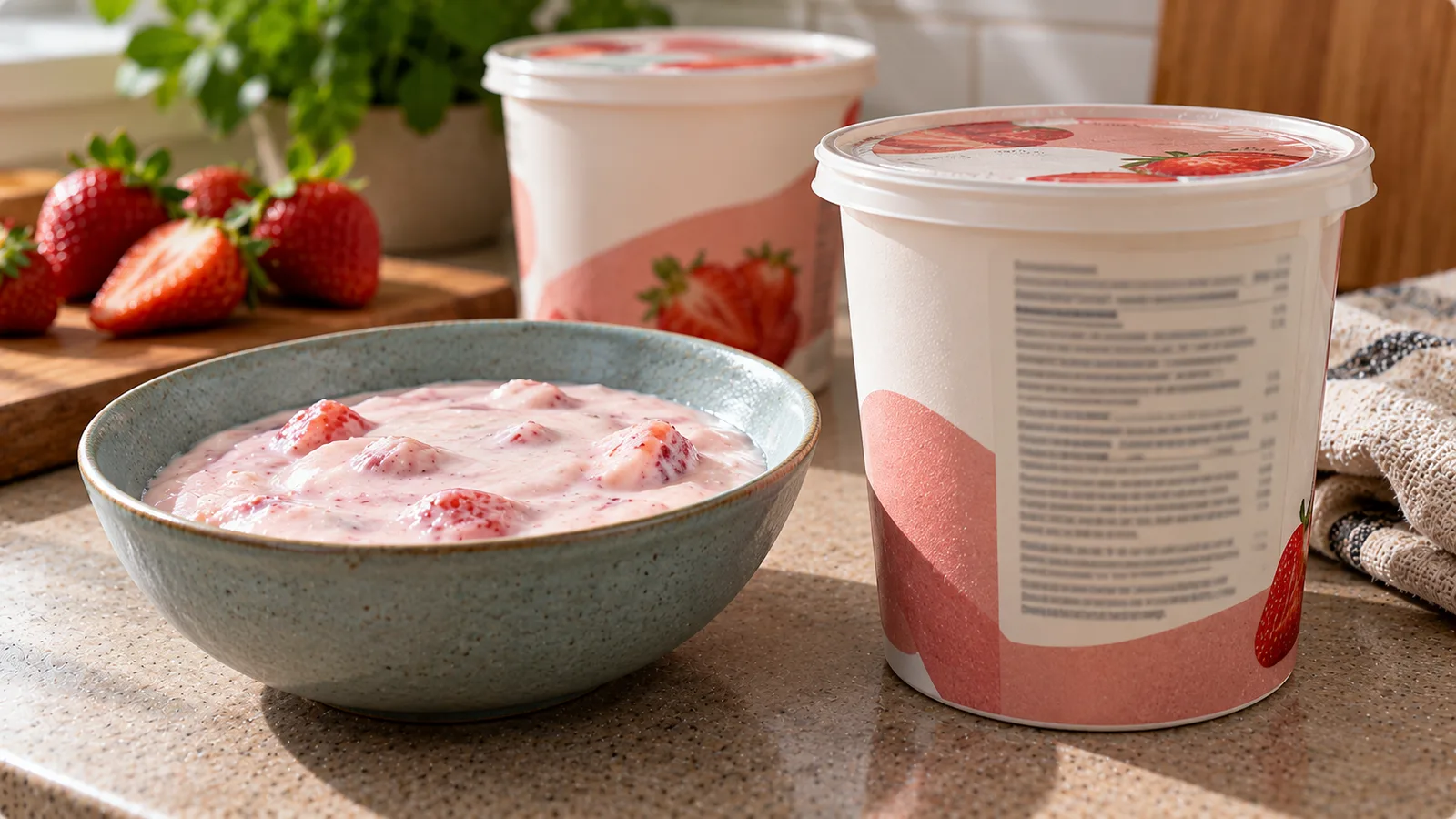
An ingredient list tells you what a packaged food contains. Sometimes it also tells you how much of a particular ingredient was used.
On European Union food labels, this information is called QUID, short for Quantitative Ingredient Declaration.
For example, a strawberry yogurt might list:
Ingredients: Yogurt, strawberries (12%), sugar, modified starch.
The 12% figure is a QUID declaration. It gives you information about the quantity of strawberries used, but it does not mean that strawberries supply 12% of the product's calories, sugar or nutritional value.
Understanding that distinction makes QUID useful when comparing products.
What is QUID?
QUID is the declaration of the quantity of an ingredient or category of ingredients used in a food.
Under Regulation (EU) No 1169/2011, the quantity must generally be expressed as a percentage.
QUID is particularly relevant when an ingredient is important to how a food is named, described or presented.
The legal basis is primarily Article 22 and Annex VIII of Regulation (EU) No 1169/2011.
The rules apply within the EU food-information framework, subject to the regulation's scope and exemptions.
When is an ingredient percentage required?
Article 22 identifies three main situations.
| Trigger | Example | Why QUID may apply |
|---|---|---|
| Ingredient appears in the food's name | Strawberry yogurt | Strawberries are named |
| Ingredient is emphasized in words, pictures or graphics | A product prominently featuring raspberries | Raspberries are highlighted |
| Ingredient is essential to characterize the food and distinguish it from products with which it could be confused | A characteristic ingredient in a specific prepared food | The ingredient defines the product |
These are general rules, not a guarantee that every pictured or named ingredient must carry a percentage.
Annex VIII includes exceptions, and some foods are subject to specific compositional or labeling rules.
For example, ingredients used in small quantities for flavoring and certain cases involving quantities already governed by other requirements can be treated differently.
Where can you find the percentage?
The QUID declaration normally appears:
- In the name of the food; or
- In the list of ingredients, in connection with the ingredient or category concerned.
You might see:
Strawberry yogurt (strawberries 12%)
or:
Ingredients: Yogurt, strawberries (12%), sugar.
The percentage is not necessarily displayed in a separate nutrition table.
It is ingredient-composition information, not the same as energy or macronutrient information.
What does “strawberries 12%” actually mean?
In the ordinary case, QUID indicates the quantity of the ingredient used at the time of manufacture.
A declaration of strawberries (12%) generally means that strawberries accounted for 12% of the ingredients used according to the applicable QUID calculation rules.
It does not automatically mean that exactly 12 g of intact strawberry pieces will be present in every 100 g of the finished food.
Processing can change water content, texture and final weight.
Special calculation rules apply to foods that lose moisture during heating or other treatment.
This is why the wording and type of food matter.
How QUID percentages are calculated
As a general rule under Annex VIII, the declared quantity corresponds to the amount of the ingredient or ingredient category at the time of its use.
Consider a simplified recipe before processing:
| Ingredient | Weight |
|---|---|
| Strawberries | 120 g |
| Yogurt base | 780 g |
| Sugar | 80 g |
| Other ingredients | 20 g |
| Total | 1,000 g |
The strawberries represent:
120 ÷ 1,000 × 100 = 12%.
For a food without relevant moisture-loss adjustments, that illustrates the basic principle.
However, actual commercial formulations may require additional legal calculations.
You should not reverse-engineer a manufacturer's full recipe from one percentage alone.
What happens when food loses water during cooking?
A major complication is that some foods lose moisture during heating.
Annex VIII provides a special approach for ingredients used in foods that lose moisture after heat treatment or other processing.
The quantity can be expressed in relation to the finished product, with additional presentation rules where calculated percentages exceed 100%.
Imagine a simplified product:
- 120 g meat used.
- Other ingredients added.
- Final cooked product weighs 100 g.
The amount of meat originally used may be greater than the final product's weight.
A percentage above 100% can therefore be possible under the applicable rules.
That does not mean the package contains more than its own weight in meat at the time of purchase.
It reflects the quantity used before moisture loss.
Always interpret such declarations within the product and regulatory context.
Why some labels say “made with X g per 100 g”
Certain processed foods may use wording such as:
Prepared with 120 g of fruit per 100 g of finished product.
This can occur when the ingredient quantity is expressed relative to the finished food.
It is particularly important not to confuse the amount of fruit used with the amount of fresh fruit physically remaining after cooking.
A jam may lose water during processing.
The statement is about the manufacturing formulation under the applicable rules, not a direct measure of its vitamin content or fruit pieces.
QUID versus the order of ingredients
EU ingredient lists generally present ingredients in descending order of weight as recorded at the time of use, subject to specific exceptions.
That gives you a relative ranking.
For example:
Ingredients: Water, tomatoes (28%), onions, olive oil, salt.
You can see that water is listed before tomatoes and that tomatoes have a declared percentage.
But the list does not tell you the exact percentages of onion or olive oil.
An ingredient's position does not allow you to calculate its precise quantity.
QUID provides a specific number only for the ingredients or categories for which it is declared.
QUID versus nutrition information
These two label elements answer different questions.
| Label information | What it tells you |
|---|---|
| Strawberries 12% | Quantity of strawberries used under QUID rules |
| Sugars 9 g per 100 g | Sugar content in the nutrition declaration |
| Protein 4 g per 100 g | Protein content |
| Fat 3 g per 100 g | Fat content |
| 85 kcal per 100 g | Energy content |
A product containing 20% fruit is not necessarily lower in sugar than one containing 10% fruit.
Fruit naturally contains sugars, and manufacturers may add other sweetening ingredients.
The nutritional outcome depends on the full formulation.
Use QUID to understand ingredient composition and the nutrition table to compare energy and nutrients.
Does a higher percentage always mean a better product?
Not necessarily.
A higher percentage of a named ingredient may be valuable if you specifically want more of that ingredient.
For example, a tomato sauce containing 70% tomatoes may suit someone looking for a tomato-forward product.
But quality and nutritional suitability also depend on:
- Other ingredients.
- Added sugar and salt.
- Fat content.
- Processing method.
- Taste and texture.
- Price per usable portion.
- Individual dietary needs.
A higher QUID percentage is one piece of information, not a universal quality score.
How to compare two products using QUID
Suppose you are choosing between two strawberry yogurts.
| Feature | Product A | Product B |
|---|---|---|
| Strawberries | 8% | 15% |
| Sugars per 100 g | 7 g | 11 g |
| Protein per 100 g | 5 g | 4 g |
| Calories per 100 g | 80 kcal | 105 kcal |
These numbers are hypothetical.
Product B uses a higher proportion of strawberries.
Product A has less sugar and more protein in this example.
Neither product is automatically the better choice for everyone.
If your priority is fruit quantity, B may appeal more.
If your priority is lower sugar, A may be preferable.
The comparison works because QUID and the nutrition table are considered together.
What about highlighted ingredients on the front of the pack?
A product might feature a prominent picture of blueberries, almonds or chicken.
That presentation can trigger QUID requirements if the ingredient is emphasized within the meaning of Article 22.
However, the rules contain exceptions, and the overall presentation matters.
Do not assume that a large picture proves that the ingredient makes up most of the product.
Find the ingredient list and any declared percentage.
If the presentation appears misleading, the broader EU prohibition on misleading food information may also be relevant.
Does QUID apply to compound ingredients?
A compound ingredient is an ingredient made from more than one ingredient.
For example, a prepared filling or chocolate component may contain several subingredients.
Depending on the food and labeling requirements, the percentage may concern the compound ingredient or a relevant ingredient within it.
The ingredient list may also need to disclose the compound ingredient's constituents.
The applicable exemptions and rules are important.
A percentage for a chocolate filling does not automatically tell you how much cocoa the entire product contains.
Read both the quantity declaration and the detailed ingredient list.
Why isn't every ingredient given a percentage?
EU rules do not generally require manufacturers to print a percentage for every ingredient.
QUID applies when the legal triggers are met, unless an exception applies.
The remaining ingredients are usually listed by name and in the legally required order, without exact percentages.
Therefore, a label with only one declared percentage is not necessarily incomplete.
It may be fully compliant.
What QUID cannot tell you
Even a correct QUID declaration cannot independently reveal:
- The complete recipe.
- The precise percentage of every undeclared ingredient.
- The calorie contribution of the named ingredient.
- The amount of added sugar.
- The freshness or grade of an ingredient.
- The bioavailability of nutrients.
- Whether a food is appropriate for a specific medical condition.
- The full environmental impact of the product.
For those questions, you need additional information.
Practical shopping examples
Fruit yogurt
Look at the percentage of fruit and then the sugars and protein per 100 g.
A larger fruit percentage does not guarantee a lower sugar content.
Tomato sauce
Compare the tomato percentage, salt content and any added oil or sugar.
A concentrated tomato ingredient may require careful interpretation of the formulation.
Nut bars
Check the declared nut percentage and the ingredient list.
A bar marketed with almonds may also contain syrups, chocolate or other calorie-dense ingredients.
Prepared meat dishes
A meat percentage can help compare formulations.
For cooked products, pay attention to moisture-loss rules and the exact wording.
Fruit preserves
Statements about fruit used per 100 g finished product can reflect the amount used before cooking.
Do not read them as a direct measurement of intact fruit in the jar.
A five-step EU label check
- Read the legal or descriptive name of the food.
- Identify the ingredients emphasized in the name or packaging.
- Find their declared percentages, where required.
- Compare the full ingredient list and the nutrition table per 100 g or 100 ml.
- Consider serving size, price and your actual reason for choosing the product.
This method is more informative than relying only on front-of-pack claims.
Common questions
What does QUID stand for?
Quantitative Ingredient Declaration.
Is QUID the same as a nutrition percentage?
No. It describes the quantity of an ingredient used under the applicable rules, not the percentage of calories or nutrients.
Does 20% fruit mean 20 g of fruit in 100 g finished food?
Not always. The ordinary calculation is based on ingredients used, and processing-related exceptions can change how the declaration is expressed.
Are percentages required for every ingredient?
No. Only when the legal conditions apply, subject to exceptions.
Can a QUID percentage exceed 100%?
In certain foods affected by moisture loss, the relevant ingredient quantity may exceed the weight of the finished product, with special declaration rules.
Is the first ingredient always the largest?
Ingredients are generally listed in descending order by weight at the time of use, but specific rules and exceptions apply.
Official sources
- Regulation (EU) No 1169/2011, Article 22 and Annex VIII — quantitative indication of ingredients.
- European Commission: Food Information to Consumers — EU food labeling framework.
- European Commission: QUID guidance — guidance and implementation context.
The key takeaway
QUID helps you understand how much of a highlighted or defining ingredient was used in a packaged food.
It is useful for comparing products, but it is not a measure of overall nutritional quality.
Read ingredient percentages alongside the ingredient list, nutrition declaration and actual serving size.
That gives you a much more complete picture of what you are buying.