
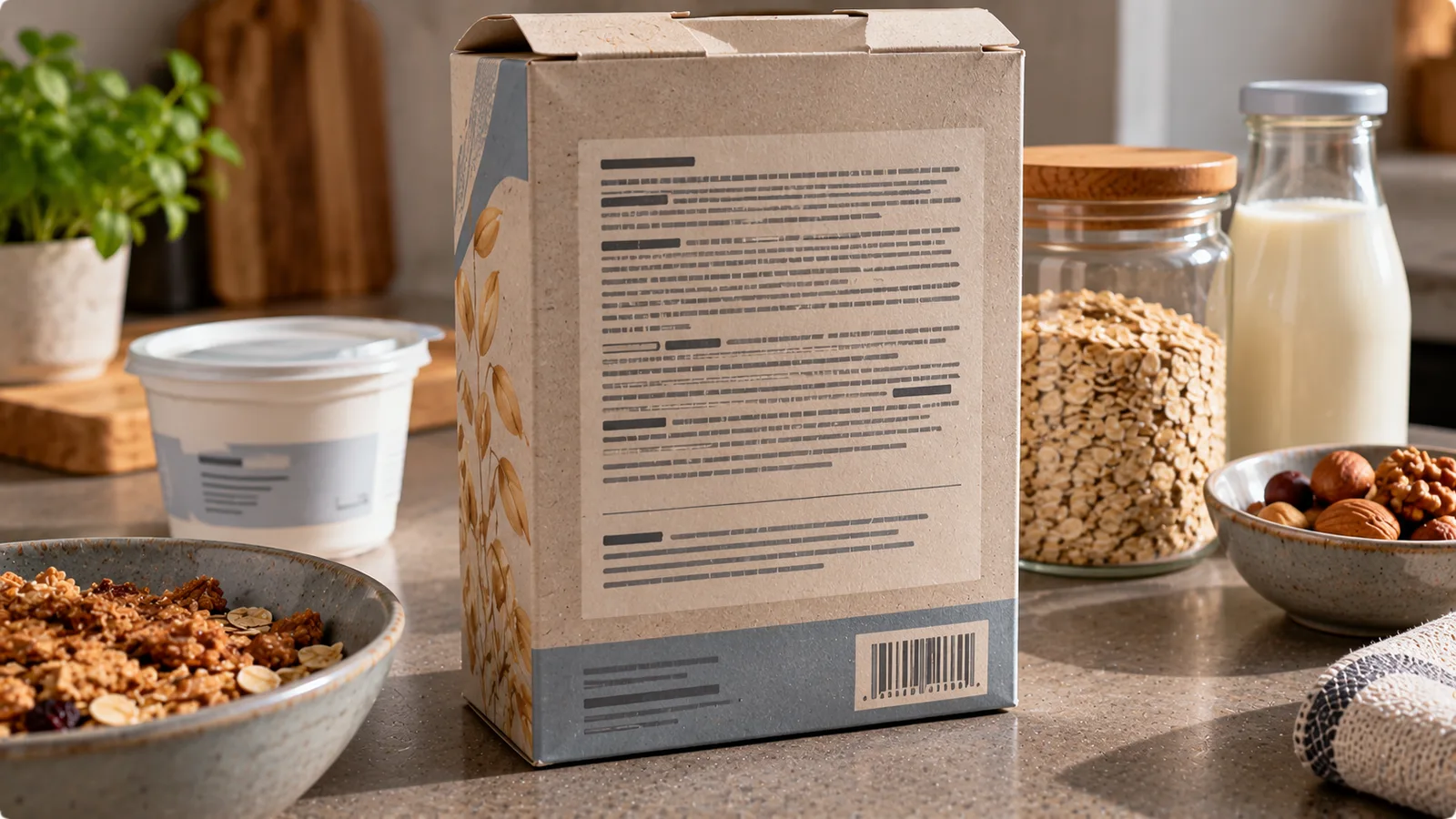
Food labels in the European Union follow specific rules for identifying ingredients that can cause allergies or intolerances.
For most prepacked foods, the key information appears in the ingredient list, where certain allergenic ingredients must be clearly distinguished from the surrounding text.
Understanding that system can make supermarket shopping easier, particularly when you need to avoid a specific ingredient.
However, a label is only useful when you know what it is required to tell you, what it may not tell you and when additional checks are necessary.
Where to find allergen information on an EU food package
Start with the ingredient list.
Under Regulation (EU) No 1169/2011, substances or products listed in Annex II that are used in manufacturing or preparation and remain present in the finished food must generally be identified in the ingredients information.
For prepacked foods with an ingredient list, the relevant name must be emphasised using a typesetting style that clearly distinguishes it from other ingredients.
Manufacturers may use:
- Bold type.
- A different typeface.
- A different background colour.
- Another clearly distinguishing style.
Bold lettering is common, but it is not the only legally permitted method.
Example of an ingredient list
Consider a fictional cereal bar:
Ingredients: oat flakes, WHEAT flour, sugar, sunflower oil, MILK powder, cocoa, ALMONDS, salt.
The highlighted ingredients identify regulated allergen sources.
In this example, wheat, milk and almonds are clearly indicated.
This does not mean that every other ingredient is suitable for every person with a food allergy.
It means that the regulated allergens present as ingredients have been identified according to the applicable labelling requirements.
The 14 allergen categories covered by EU rules
Annex II of Regulation (EU) No 1169/2011 identifies 14 categories of substances or products causing allergies or intolerances.
| Category | Examples to recognise |
|---|---|
| 1. Cereals containing gluten | Wheat, rye, barley, oats, spelt, khorasan wheat and hybridised strains |
| 2. Crustaceans | Prawns, shrimp, crab, lobster |
| 3. Eggs | Egg, egg powder, egg-derived ingredients |
| 4. Fish | Fish and certain fish-derived ingredients |
| 5. Peanuts | Peanuts, groundnuts |
| 6. Soybeans | Soy, soya, soybean ingredients |
| 7. Milk | Milk and milk-derived ingredients, including lactose |
| 8. Nuts | Almonds, hazelnuts, walnuts, cashews, pecans, Brazil nuts, pistachios, macadamia or Queensland nuts |
| 9. Celery | Celery root, celery stalks and relevant celery ingredients |
| 10. Mustard | Mustard seeds and mustard-derived ingredients |
| 11. Sesame seeds | Sesame seeds and relevant sesame ingredients |
| 12. Sulphur dioxide and sulphites | At concentrations above 10 mg/kg or 10 mg/litre expressed as total SO₂ |
| 13. Lupin | Lupin flour, lupin protein and other lupin ingredients |
| 14. Molluscs | Mussels, oysters, squid, snails and other molluscs |
The regulation contains specific exceptions for certain derived products.
Therefore, this table is a practical guide, not a substitute for the complete legal wording in Annex II.
The category of cereals containing gluten also requires attention to the specific cereal. A label should identify the relevant cereal, such as wheat or barley, rather than relying only on a generic reference to gluten.
Why the actual ingredient name matters
A product can contain an allergen even when the familiar everyday name is not the most prominent part of the description.
For example:
- Whey is derived from milk.
- Casein is a milk protein.
- Semolina is commonly derived from wheat.
- Tahini is made from sesame seeds.
- Marzipan commonly contains almonds.
- Tofu is generally made from soybeans.
EU allergen rules are designed to make the relevant allergen source identifiable.
For instance, a milk-derived ingredient should be labelled in a way that clearly references milk when required.
A person avoiding milk should not rely only on spotting the word "milk" in the product name.
Read the entire ingredient list and look for highlighted allergen sources.
What if the ingredient list contains several layers?
Some products use compound ingredients.
A biscuit might contain a chocolate filling, which itself contains several ingredients.
An illustrative label could read:
Ingredients: biscuit base (WHEAT flour, sugar, EGG), chocolate filling (sugar, cocoa butter, MILK powder, SOY lecithin).
Here, allergens appear within the components of the recipe.
The important point is that the ingredient list may contain nested descriptions.
Do not stop reading after the first highlighted allergen.
Review the entire list, including ingredients in fillings, coatings, seasonings and sauces.
Is a separate "Contains" statement required?
A separate statement such as "Contains milk and wheat" may be useful, but it does not replace the legal rules for highlighting allergens in an ingredient list.
For prepacked foods that have an ingredient list, the mandatory allergen declaration is generally integrated into that list.
When a food does not require an ingredient list, allergen information may instead use wording such as "contains" followed by the relevant allergen name, subject to the applicable rules.
The absence of a separate "Contains" box does not automatically mean the label is non-compliant.
The ingredient list remains the primary place to check on most prepacked products.
Does an allergen always appear in bold?
No.
EU rules require clear emphasis, but manufacturers may use a different typeface, style or background colour.
Some packages use uppercase lettering.
Others use bold type or a combination of methods.
A practical approach is to look for any visibly distinguished ingredient rather than expecting exactly one format.
On multilingual packages, check the ingredient list in the language you understand best.
If the print is difficult to read, do not rely on an uncertain interpretation when an allergy could cause a serious reaction.
Are allergens in additives and processing ingredients covered?
Allergen labelling is not limited to obvious whole-food ingredients.
The relevant requirements can also apply to allergenic substances used as ingredients, processing aids or substances derived from Annex II sources when they remain present in the finished food, even in an altered form.
For example, an ingredient derived from milk or soy may require the source to be identified.
However, Annex II includes specific exemptions for certain products and processes.
This is why a blanket rule such as "every ingredient ever made from an allergen must always be highlighted" would be inaccurate.
The exact legal requirements depend on the ingredient and the applicable exemption.
What about food sold without packaging?
EU allergen-information requirements also apply to non-prepacked foods, including many foods sold in restaurants, bakeries, cafés and at food counters.
However, the way information is provided can differ under national rules.
Depending on the country and setting, allergen information may be available through written materials or another permitted method.
For example, a bakery may provide an allergen chart or information through trained staff.
Do not assume that the absence of bold text on a menu means the food contains no regulated allergens.
If you have a food allergy, ask for ingredient and preparation information before ordering.
For severe allergies, it is also important to discuss possible cross-contact during preparation.
Ingredient allergens versus possible cross-contact
Two different questions need to be separated:
- Is an allergenic ingredient deliberately used in the recipe?
- Could an allergen enter the product unintentionally through shared equipment or handling?
The EU ingredient-list emphasis rules primarily address regulated allergens present as ingredients or relevant substances used in preparation.
Statements such as "may contain nuts" concern possible unintended allergen presence.
These precautionary statements are a different issue from mandatory ingredient allergen declarations.
They should not be interpreted as proof that the allergen is a deliberate ingredient.
Equally, the absence of a precautionary statement is not a universal guarantee that cross-contact is impossible.
For a detailed explanation of precautionary wording, see the separate topic What Does May Contain Mean on a Food Label?
Does "gluten-free" mean wheat-free?
Not necessarily.
The EU regulates the use of the claim "gluten-free" separately under Commission Implementing Regulation (EU) No 828/2014.
A food labelled gluten-free must meet the applicable gluten threshold.
However, some specially processed wheat-derived ingredients may be used in foods that meet that threshold.
This means that a gluten-free claim does not automatically establish suitability for a person with a wheat allergy.
A person with coeliac disease and a person with an IgE-mediated wheat allergy may need to check different aspects of the label.
If you need to avoid wheat itself, examine the ingredient information rather than relying solely on a gluten-free claim.
Is lactose-free the same as milk-free?
No.
Lactose is a sugar naturally present in milk.
Milk allergy concerns an immune reaction to milk proteins.
A lactose-free dairy product can still contain milk proteins.
Therefore, a product described as lactose-free should not automatically be considered suitable for someone with a milk allergy.
Check whether milk is identified as an ingredient and follow the advice relevant to the diagnosed condition.
A practical five-step label-reading routine
When shopping for someone with a food allergy or intolerance:
Step 1: Identify the exact ingredient to avoid
Know whether the restriction concerns milk, lactose, wheat, gluten, peanuts, a specific tree nut or another substance.
These categories are not interchangeable.
Step 2: Find the ingredient list
Locate the complete ingredients information on the packaging.
Do not rely only on the product name or front-of-pack marketing.
Step 3: Scan every highlighted ingredient
Check all allergens that are distinguished by bold type, uppercase lettering or another style.
Step 4: Read the surrounding ingredients
Look at compound ingredients, seasonings, coatings, fillings and relevant derived ingredients.
Step 5: Check for additional safety information
Review precautionary statements, preparation instructions and any relevant information about cross-contact.
If the information remains unclear and the allergy is clinically significant, contact the manufacturer or choose a product with clearer information.
Why you should check the label every time
Manufacturers can reformulate foods.
A familiar product may change ingredients, suppliers or manufacturing processes.
Packaging can also change without the front design looking dramatically different.
For that reason, previously safe purchases should not be treated as permanently unchanged.
A practical routine is to read the label each time you buy the product, especially if you have a serious allergy.
Do not rely solely on an old photograph, saved food-diary entry or previous ingredient list.
What a food-scanning app can and cannot tell you
A barcode scanner or food-photo app can help organise product information, but it should not replace the current physical label when allergen safety matters.
Databases may contain:
- Outdated ingredient lists.
- Information from a different country.
- A previous product formulation.
- Missing precautionary statements.
- Incomplete information about preparation or cross-contact.
For nutritional tracking, these issues can cause inaccurate records.
For food allergies, they can be more consequential.
Use the current product label as the primary reference, and contact the manufacturer when clarification is necessary.