
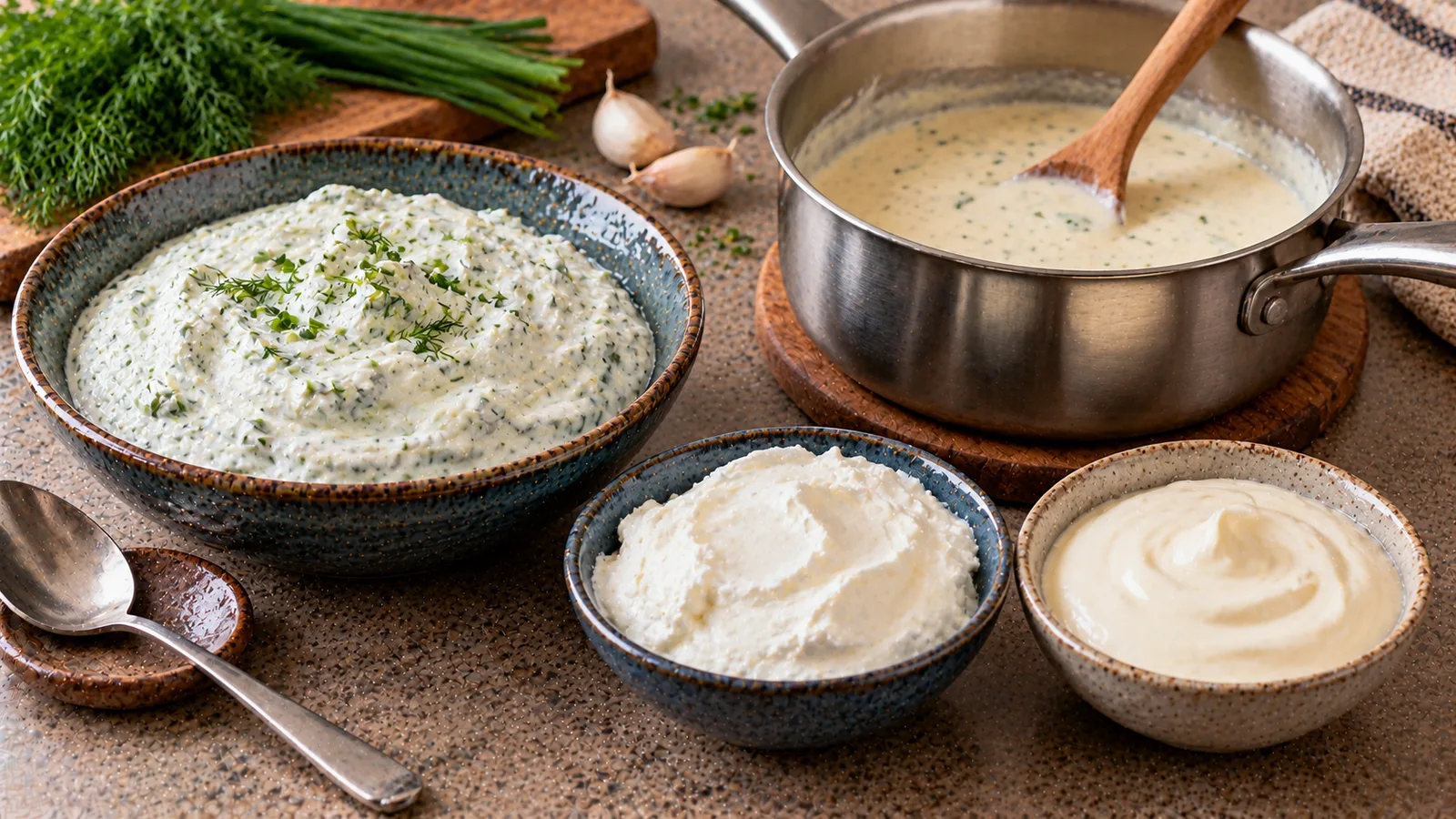
Plain Greek yogurt can replace sour cream in a dip almost directly, but a bubbling sauce is another matter. The right decision depends on fat content, acidity, temperature and what the ingredient is meant to do. This guide separates cold uses from cooked dishes, weighs the replacement instead of assuming that every tablespoon is identical, and shows a reliable way to stir yogurt into an already-hot sauce. It is a technique comparison, not a promise that every yogurt produces the taste of sour cream.
The practical decision
For a refrigerated dip, begin with an equal weight of plain, unsweetened Greek yogurt. Taste before adding extra lemon: yogurt may already be tangier. A 60 g topping on potatoes can be exchanged by weight without changing the rest of the recipe. For a sauce that will be served hot, use yogurt as a finishing ingredient: finish cooking the base, take it off the heat, temper the yogurt with some warm sauce and stir it back gently. If the dish must boil hard for a long time, sour cream or a different base may be more forgiving. Both ingredients contain milk; neither is a suitable substitute for someone with a milk allergy.
What the nutrition labels really compare
A comparison works only when the products are precisely identified. USDA SR Legacy entries provide an illustrative plain nonfat Greek yogurt at 59 kcal and 10.2 g protein per 100 g, and cultured regular sour cream at 198 kcal and 2.4 g protein per 100 g. Their fat contents also differ sharply, approximately 0.4 g versus 19.4 g per 100 g. Full-fat Greek yogurt, low-fat sour cream and sweetened yogurt do not share these numbers. European products labelled Greek-style, crème fraîche, smetana or soured cream may have different fat percentages. For a real meal, use the nutritional declaration on the actual tub rather than transplanting the figures below.
| Portion / reference | Greek yogurt, nonfat | Sour cream, regular |
|---|---|---|
| 100 g | 59 kcal | 198 kcal |
| 30 g | 18 kcal | 59 kcal |
| 60 g | 35 kcal | 119 kcal |
| 120 g | 71 kcal | 238 kcal |
| 200 g | 118 kcal | 396 kcal |
A cold dip with weighed ingredients
For a small savory dip, weigh 200 g plain Greek yogurt, add 10 g lemon juice, 10 g finely chopped cucumber or herbs, and a pinch of salt. Stir with a spoon and leave chilled for 10 minutes before tasting. Use the same 200 g of sour cream as a control only if you want to compare the two versions; the added vegetables, lemon and salt stay unchanged. The yogurt base supplies about 118 kcal using the stated USDA entry, while the sour-cream base supplies about 396 kcal. The extra ingredients have their own energy, so those are base-only values, not calorie counts for the finished dip. If yogurt is too thick, add water a teaspoon at a time rather than sweetened milk.
A thinner dressing is a different job
For a pourable salad dressing, start with 60 g yogurt, 15 g water, 5 g mustard and herbs; stir and adjust the water after the mustard has dispersed. A thick dip and a dressing need different consistency, so a cup-for-cup replacement is not always the best working measurement. Mustard, citrus and pickle brine can change acidity as much as the dairy does. Taste after combining rather than trying to correct the yogurt before it meets the other ingredients. If a recipe already contains lemon juice or vinegar, begin with less and add only what the finished dressing needs.
How to finish a hot sauce
For hot sauces, turn off the burner after the vegetables, pasta or meat have finished cooking to their required safe temperature. In a separate bowl, whisk 120 g of plain Greek yogurt until smooth. Stir in two or three spoonfuls of warm, not boiling sauce, one at a time; this is tempering, which reduces the immediate temperature shock. Pour the loosened mixture into the pan while stirring. Warm it gently if necessary but do not return it to a rolling boil. A starch-thickened sauce often tolerates the swap better than a thin, strongly acidic liquid. It is still possible to see small grains, especially with low-fat yogurt: the method lowers risk, not guarantees a restaurant-smooth finish.
Milk Street — Cooking guidance
If the yogurt begins to split
Visible curds are a texture problem caused when milk proteins aggregate as heat and acidity increase. It is not evidence that the yogurt suddenly gained calories or that all separated sauce is unsafe. If it begins to split, stop heating, whisk gently and add a small amount of warm cooking liquid; aggressive boiling will usually make it worse. Salt and acidic ingredients can accentuate the problem, so add lemon at the end. If a recipe relies on a lengthy high-temperature reduction, reduce the base before stirring in yogurt. A richer plain yogurt can give a rounder texture, though it will change the nutrition figures.
A worked calorie comparison for one pan
Suppose a finished mushroom sauce calls for 120 g sour cream after the mushrooms are cooked. With the illustrative USDA values, its dairy contributes about 238 kcal. Replacing it with 120 g of the specified nonfat Greek yogurt contributes around 71 kcal, a difference of approximately 167 kcal for the whole sauce. Divide that difference across the actual number of servings, rather than claiming each plate saves 167 kcal. Oil used to sauté mushrooms, starch, pasta, butter or cheese still belong in the recipe calculation. If you swap to full-fat yogurt, recalculate with its own label. The weight, not the apparent volume of a dollop, is the reliable denominator.
Taste, reheating and texture
Flavor, mouthfeel and stability are three separate tests. Sour cream offers a richer coating sensation; Greek yogurt is often firmer and sharper. On baked potatoes or alongside chili, the substitution is normally noticeable but workable. On a warm stroganoff-style sauce, heating becomes a bigger issue than the raw ingredient's tang. A sauce that contains mustard, wine or tomato may demand more care because it is already acidic. A sauce intended for reheating tomorrow should be tested in a small portion first: rewarming can reveal splitting that was absent on the first serving.
For related ingredient details, see sour cream calories · Greek yogurt and quark in dips.
Choosing the product in the shop
Choose plain and unsweetened, then check fat, protein, sugar and allergens on the package. “Greek” is not a universal nutrition specification, and thicker is not automatically more protein-rich. Compare amounts per 100 g for the brands available where you shop. For cold dips, a strained yogurt is often practical because it starts thick. For heated food, some cooks prefer a full-fat variant, not because it has fewer calories, but because a richer emulsion may be more forgiving. Do not confuse sour cream with crème fraîche: the latter typically has a different fat level and cooking behaviour.
Refrigeration, allergy and leftovers
Treat both products as perishable dairy. Keep the containers and prepared dips refrigerated at 4 °C or below when possible. FoodSafety.gov advises refrigerating perishables within two hours, or within one hour if the surroundings are above 32 °C. Divide a large hot batch into shallow containers so it cools promptly. Do not rely on lemon juice as a preservation step. For leftovers, check ingredient-specific guidance and whether the original cooked food was cooled safely. Milk-allergic diners need an explicitly dairy-free alternative, not Greek yogurt; lactose content also varies and cannot be inferred solely from the word “Greek”.
Use weight-for-weight yogurt in a cold dip, taste acidity, and change the water to control thickness. In a hot dish, cook the base first and introduce yogurt at the end, off the boil. The nutritional comparison is useful only with correctly matched products and the complete dish recipe. A smaller number on the yogurt label is not a substitute for a measured portion or a safe cooling process.