
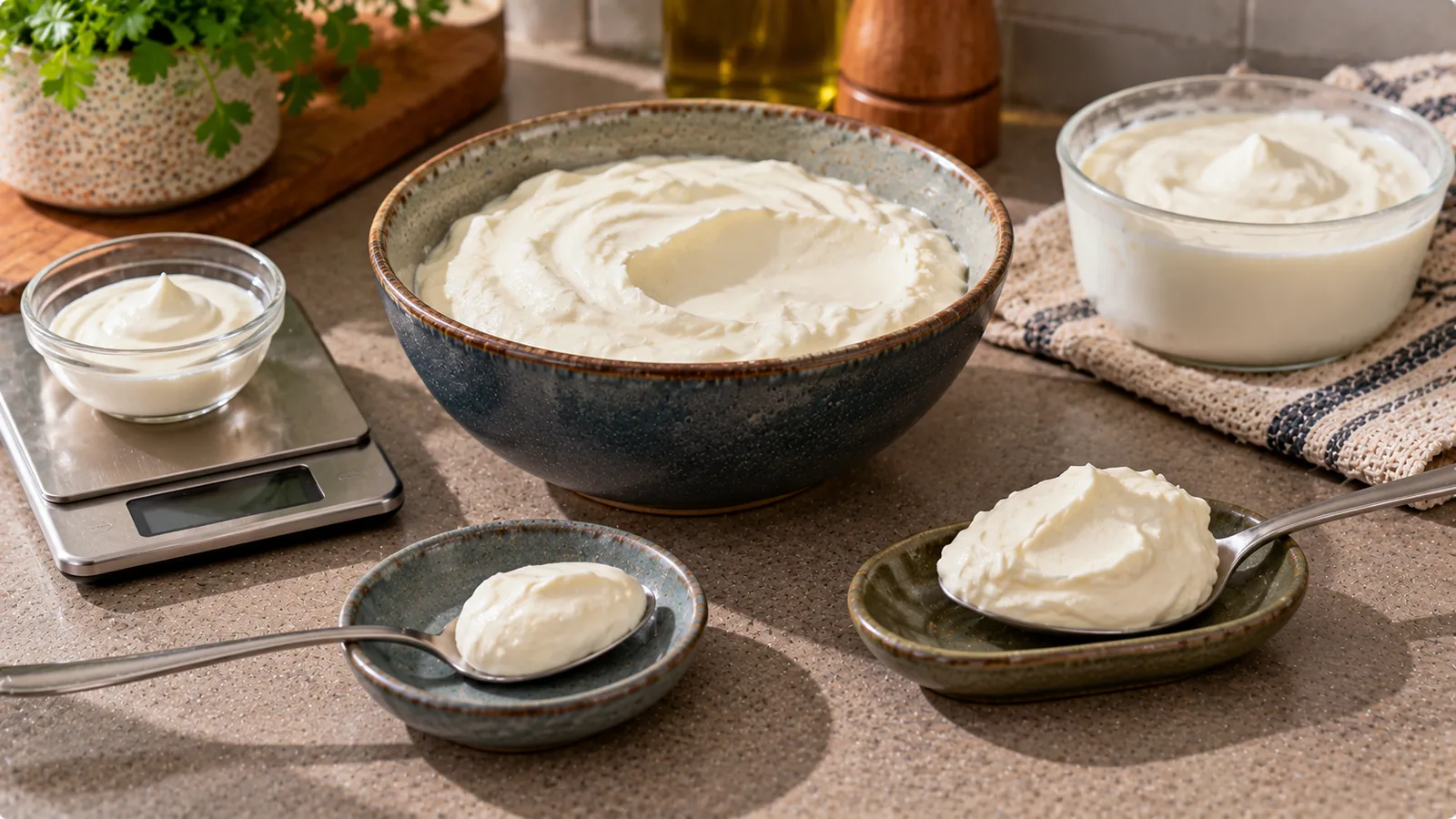
Sour cream is a cultured dairy product whose calorie content depends heavily on its fat percentage.
Regular full-fat sour cream can provide around 190–210 kcal per 100 g, while lower-fat products can contain substantially less. Because sour cream is often eaten by the spoonful rather than in 100 g portions, the amount actually used can make a large difference.
How many calories are in sour cream?
A useful representative value for regular sour cream is approximately:
200 kcal per 100 g
Using that value, common portions provide approximately:
| Sour cream amount | Approximate calories |
|---|---|
| 10 g | 20 kcal |
| 15 g | 30 kcal |
| 20 g | 40 kcal |
| 30 g | 60 kcal |
| 50 g | 100 kcal |
| 100 g | 200 kcal |
These are representative calculations, not universal values.
The nutrition label on your specific product is the best source for precise tracking.
Calories in one tablespoon of sour cream
A tablespoon of sour cream is commonly around 15 g, although an actual spoonful can be larger or smaller.
If the sour cream contains 200 kcal per 100 g:
200 ÷ 100 × 15 = 30 kcal
So a level 15 g tablespoon contains approximately 30 kcal.
A larger 25 g spoonful would contain:
200 ÷ 100 × 25 = 50 kcal
This is why “one spoon” is not always a reliable serving measurement.
Nutrition in sour cream
A representative regular sour cream might provide approximately the following per 100 g:
| Nutrient | Approximate amount |
|---|---|
| Calories | 190–210 kcal |
| Protein | 2–3 g |
| Carbohydrate | 3–5 g |
| Fat | 18–21 g |
The exact composition varies by product.
Most of the calories in regular sour cream come from fat.
Protein content is relatively modest compared with higher-protein cultured dairy products.
Fat percentage makes a major difference
Sour cream is sold at different fat levels.
A simplified comparison might look like this:
| Type | Typical calorie pattern |
|---|---|
| Lower-fat sour cream | roughly 110–160 kcal per 100 g |
| Medium-fat sour cream | roughly 160–190 kcal per 100 g |
| Full-fat sour cream | roughly 190–220+ kcal per 100 g |
These ranges are intentionally broad.
Products differ between countries and manufacturers, and the terminology used for sour cream is not identical everywhere.
Always use the package value when available.
Why fat changes the calories so much
Fat provides approximately 9 kcal per gram, while protein and carbohydrate provide approximately 4 kcal per gram each.
Because sour cream can contain a substantial amount of milk fat, relatively small changes in fat percentage can noticeably change its energy density.
For example, compare two hypothetical products.
Product A
Per 100 g:
- 10 g fat;
- 4 g carbohydrate;
- 3 g protein.
Estimated energy from the macronutrients:
10 × 9 + 4 × 4 + 3 × 4 = 118 kcal
Product B
Per 100 g:
- 20 g fat;
- 4 g carbohydrate;
- 3 g protein.
Estimated energy:
20 × 9 + 4 × 4 + 3 × 4 = 208 kcal
The additional fat produces a large calorie difference even though the portion weight is unchanged.
Actual label values can differ slightly because of rounding and product composition.
Sour cream serving sizes
Sour cream is commonly used in relatively small portions.
Typical practical amounts include:
- 10–15 g as a small topping;
- 20–30 g on potatoes, tacos or soup;
- 30–50 g as part of a dip or sauce;
- larger quantities when sour cream is an ingredient in a recipe.
Because the food is energy-dense compared with many vegetables or low-fat dairy foods, increasing the portion from 15 g to 50 g can noticeably change the meal total.
Using a representative 200 kcal per 100 g:
15 g = 30 kcal
while:
50 g = 100 kcal
The difference is approximately 70 kcal.
Is a tablespoon always 15 g?
No.
A tablespoon is a volume measure, while grams measure weight.
A standard tablespoon is approximately 15 ml, but a spoon used at home may hold a different volume, and a heaped spoon can contain substantially more than a level spoon.
The density of sour cream can also vary.
If accurate tracking matters, weighing the portion in grams is usually more reliable than estimating “one spoon.”
An easy way to weigh sour cream
Place the meal on a kitchen scale and zero the scale.
Add the sour cream.
The increase in weight is the amount added.
For example, if you add 27 g and the product contains 198 kcal per 100 g:
198 ÷ 100 × 27 = 53.46 kcal
That portion contains approximately 53 kcal.
There is no need to round the food itself to a standard 15 g serving if you know the actual weight.
Calories in 30 g of sour cream
Thirty grams is a common moderate topping.
If your sour cream contains:
- 120 kcal per 100 g → 30 g provides 36 kcal;
- 160 kcal per 100 g → 30 g provides 48 kcal;
- 200 kcal per 100 g → 30 g provides 60 kcal;
- 220 kcal per 100 g → 30 g provides 66 kcal.
This illustrates why the product's fat level matters.
Calories in 50 g of sour cream
For a 50 g serving, the calculation is particularly simple because it is half of 100 g.
A product with:
- 120 kcal per 100 g → 60 kcal per 50 g;
- 160 kcal per 100 g → 80 kcal per 50 g;
- 200 kcal per 100 g → 100 kcal per 50 g;
- 220 kcal per 100 g → 110 kcal per 50 g.
Carbohydrates in sour cream
Plain sour cream generally contains a relatively small amount of carbohydrate from the dairy ingredients.
A typical product might contain roughly 3–5 g of carbohydrate per 100 g.
A 30 g portion at 4 g carbohydrate per 100 g would contain:
4 ÷ 100 × 30 = 1.2 g carbohydrate
Sweetened sour-cream-based products or prepared dips can be different.
Check the label rather than assuming every product has the same carbohydrate content.
Protein in sour cream
Sour cream is not usually a concentrated protein source.
Many regular products contain approximately 2–3 g of protein per 100 g.
At 2.5 g per 100 g, a 30 g serving provides:
2.5 ÷ 100 × 30 = 0.75 g protein
If your goal is to estimate the protein contribution of a meal, sour cream will usually contribute much less than meat, fish, eggs, legumes or higher-protein dairy products.
Sour cream in sauces and recipes
When sour cream is mixed into a recipe, calculate the amount used in the whole batch.
Suppose a sauce contains 200 g of sour cream at 200 kcal per 100 g.
The sour cream contributes:
200 × 2 = 400 kcal
If the finished sauce is divided into four equal servings, the sour cream contributes approximately:
400 ÷ 4 = 100 kcal per serving
Other ingredients must then be added separately.
Example: sour cream in soup
Suppose you stir 100 g of sour cream containing 190 kcal per 100 g into a pot of soup.
The sour cream adds 190 kcal to the entire pot.
If the finished soup contains five equal portions:
190 ÷ 5 = 38 kcal
The sour cream therefore contributes approximately 38 kcal to each portion.
This is different from assuming that every bowl contains a full tablespoon added separately.
Prepared sour cream dips can be different
A sour cream dip may contain:
- sour cream;
- mayonnaise;
- oil;
- cheese;
- herbs;
- vegetables;
- seasonings.
A dip made primarily from sour cream may have a similar calorie density to the original product.
Adding mayonnaise, cheese or oil can increase it substantially.
Do not automatically use plain sour cream nutrition for a prepared dip unless its ingredients justify that assumption.
Light sour cream
Products marketed as light or reduced-fat sour cream generally contain less fat than the manufacturer's regular version.
That usually lowers calories per 100 g.
However, “light” does not identify one universal calorie value.
The exact definition and formulation can vary by market and product.
For food logging, use the nutrition label rather than assigning a generic light-sour-cream value.
Sour cream versus yogurt
Sour cream and yogurt can both be cultured dairy products, but they are not nutritionally interchangeable.
Regular sour cream is generally higher in fat and calories than many plain yogurts.
However, yogurt ranges from very low-fat products to full-fat and concentrated varieties, so there is no single comparison that applies to every product.
If yogurt replaces sour cream in a recipe, track the yogurt actually used rather than keeping the original sour cream entry.
Does cooking sour cream change its calories?
Heating sour cream does not create or remove a meaningful amount of energy by itself.
However, cooking can change water content.
If water evaporates from a sauce containing sour cream, the finished sauce may weigh less and become more calorie-dense per gram even though the total calories of the ingredients remain essentially unchanged.
For recipes tracked by cooked weight, final yield therefore matters.
Why brand values differ
Two containers labeled sour cream can have different nutrition values because of differences in:
- milk-fat percentage;
- added milk solids;
- thickeners;
- formulation;
- serving-size conventions;
- label rounding.
A generic database entry is useful when the package information is unavailable.
When you have the actual label, that label is generally the better choice for logging that product.
How to calculate calories from the label
If the package lists calories per 100 g, use:
calories per 100 g × grams eaten ÷ 100
For example:
Product: 204 kcal per 100 g
Portion: 35 g
Calculation:
204 × 35 ÷ 100 = 71.4 kcal
The portion contains approximately 71 kcal.
How to calculate macros for any portion
The same formula works for protein, carbohydrate and fat.
Suppose the label states per 100 g:
- protein: 2.7 g;
- carbohydrate: 3.6 g;
- fat: 20 g.
For a 35 g serving:
Protein:
2.7 × 35 ÷ 100 = 0.95 g
Carbohydrate:
3.6 × 35 ÷ 100 = 1.26 g
Fat:
20 × 35 ÷ 100 = 7 g
This gives a more accurate entry than assuming every spoonful is identical.
What should you log when the exact product is unknown?
If you ate sour cream away from home and do not know the brand or fat percentage, use a reasonable generic entry.
Consider:
- whether it appeared full-fat or light;
- approximate amount;
- whether it was plain sour cream or a prepared sauce.
Avoid creating false precision.
If you estimate that you ate about two tablespoons, an approximate 30 g entry using a representative regular sour cream value may be more defensible than pretending you know the exact manufacturer and fat percentage.
Sour cream added at the table
If sour cream is added separately to a finished meal, it is usually easiest to log it separately.
For example:
- baked potato;
- 30 g sour cream;
- cheese;
- vegetables.
This makes portion changes easier to represent.
If sour cream is mixed throughout a casserole, soup or sauce, it usually makes more sense to include it as an ingredient in the saved recipe.
A practical reference
For regular sour cream around 200 kcal per 100 g:
- 1 small 10 g amount → about 20 kcal;
- 15 g → about 30 kcal;
- 20 g → about 40 kcal;
- 30 g → about 60 kcal;
- 50 g → about 100 kcal.
The actual package may differ substantially, especially for reduced-fat products.
For the most accurate food log, use the product's calories per 100 g and multiply them by the grams you actually eat.
Nutrition data sources
The portion examples use a rounded 200 kcal per 100 g.
The USDA references below describe the particular foods and preparation states named in their records; they do not establish every rounded example or product variation in this article. Check the label of a specific product when available.
- USDA FoodData Central — Cream, sour, cultured (FDC 171257; 198 kcal/100 g).