
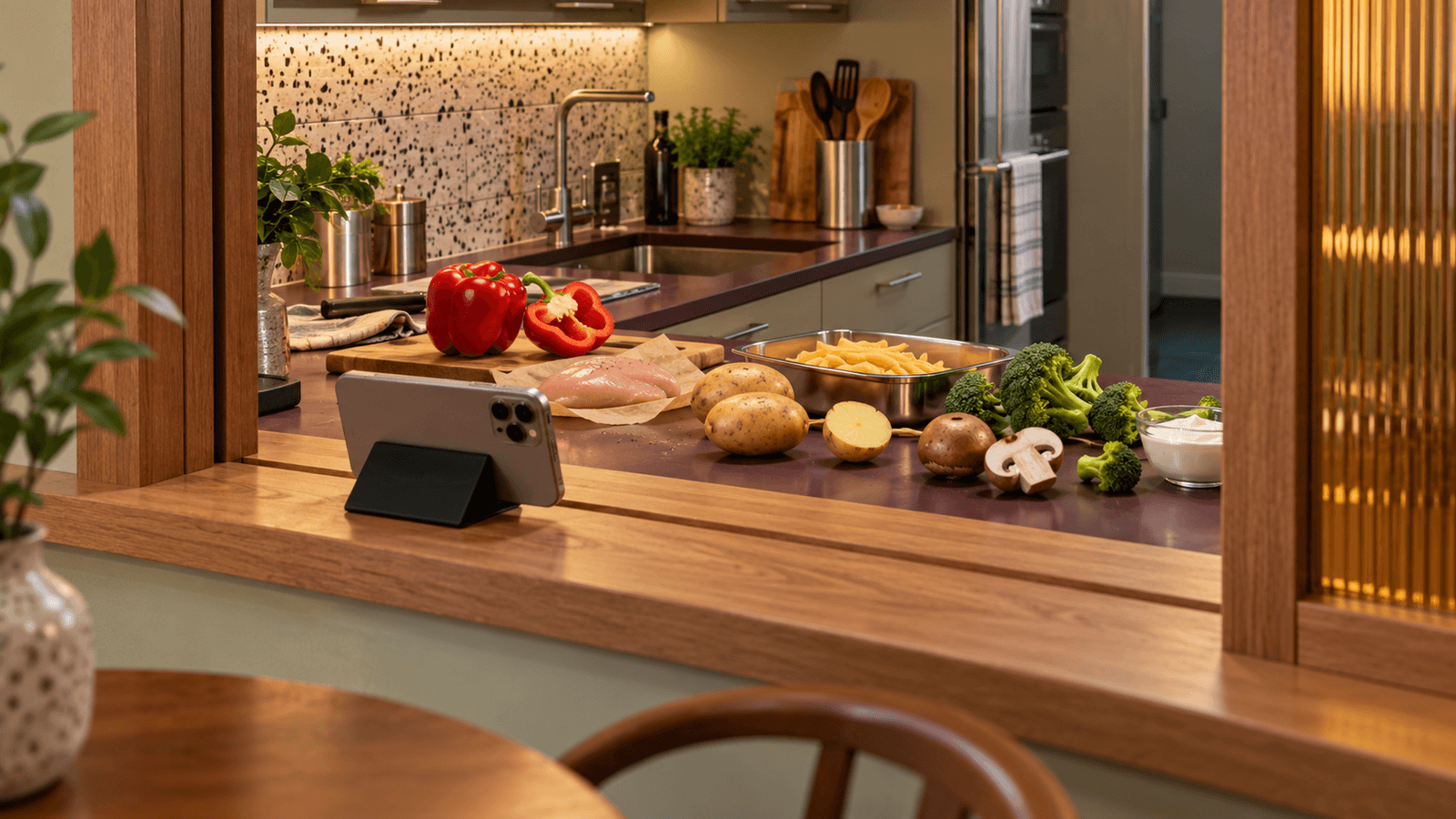
Food recognition AI allows nutrition apps to extract useful information from a photograph of a meal.
Instead of manually searching for every ingredient, a user can take a photo and let the system analyze what appears in the image.
The process can feel simple:
take a photo → identify the food → estimate nutrition.
Behind that simple interaction, however, several different tasks may be happening.
An AI system may need to:
- detect where food appears in the image
- distinguish separate foods
- identify likely food categories
- recognize ingredients or dishes
- estimate portion size
- interpret cooking context
- match recognized foods with nutrition data
- handle uncertainty when the image is ambiguous
Understanding these steps helps explain both why photo-based food tracking can be convenient and why the result should usually be treated as an estimate rather than a perfect measurement.
What is food recognition AI?
Food recognition AI is a broad term for computer systems that analyze images and attempt to identify foods, ingredients or dishes.
A nutrition app might receive a photograph containing:
- chicken
- rice
- vegetables
- sauce
and attempt to recognize these components automatically.
A more difficult photograph might contain a mixed dish such as:
- curry
- casserole
- pasta with sauce
- soup
- burrito
- stir-fry
In these cases, individual ingredients may be partly or completely hidden.
The system therefore has to interpret the whole visual context rather than simply identify isolated objects.
Food recognition is not one single task
When an app appears to “recognize a meal,” several AI tasks can be involved.
These may include:
- image classification
- object detection
- image segmentation
- ingredient recognition
- dish recognition
- portion estimation
- nutrition matching
Different applications may use different combinations of these methods.
Step 1: the image enters the system
The process begins with the photograph.
Image quality matters because the model can only analyze visual information that is available.
Useful visual information can include:
- shape
- color
- texture
- surface detail
- boundaries between foods
- relative size
- cooking appearance
- context around the food
A dark, blurry or heavily obstructed image removes some of these clues.
For practical photo tips, see How to Take Better Food Photos for AI Calorie Estimates.
Step 2: finding the food
Before identifying a food, the system may first need to determine which parts of the image contain food.
A photograph can also contain:
- plate
- bowl
- table
- fork
- napkin
- glass
- packaging
- background objects
The model needs to separate relevant visual information from the environment.
This is one reason a clear photograph with the meal occupying a useful portion of the frame can be easier to interpret.
Step 3: separating multiple foods
Many meals contain several components.
For example:
- chicken breast
- potatoes
- broccoli
- sauce
The system may attempt to identify these as separate regions.
This can be easier when foods have visible boundaries.
It becomes harder when foods:
- overlap
- are covered with sauce
- are mixed together
- have similar colors
- are partially hidden
- are inside another food
A sandwich, burrito or casserole can therefore present a different challenge from several clearly separated ingredients.
Classification and detection are different
Image classification asks a broad question:
“What does this image most likely contain?”
Object detection asks:
“Which objects are present, and where are they?”
For food tracking, location can matter because a single image may contain several foods.
A system that only recognizes “pasta” may provide less useful information than one that distinguishes pasta, sauce, cheese and vegetables.
What is image segmentation?
Segmentation attempts to divide an image into meaningful regions.
Instead of simply placing a box around a food, the system can attempt to determine which pixels belong to that food.
For nutrition estimation, this can be useful because foods rarely form perfect rectangles.
A portion of rice, for example, may have an irregular shape.
Segmentation can help estimate its visible area more precisely.
Step 4: identifying the food
Once the system has found a food region, it can attempt to classify it.
The model compares visual patterns with patterns learned during training.
It may use clues such as:
- shape
- texture
- color
- browning
- internal structure
- surrounding foods
- serving context
For example, a golden irregular food could potentially be:
- roasted potato
- fried potato
- bread
- chicken
- another cooked ingredient
Context helps narrow the possibilities.
Context can improve recognition
Foods are not usually photographed in isolation.
Other items in the image can provide clues.
For example:
pasta + red sauce + grated cheese
suggests a different interpretation from:
rice + vegetables + curry sauce.
The shape of the container can also provide information about scale and serving style.
Context is useful, but it can also mislead the system when visual clues are ambiguous.
Recognizing ingredients is harder in mixed dishes
Some foods are visually straightforward.
An apple may be relatively easy to recognize.
A mixed casserole is much harder.
The photograph may show the surface while hiding ingredients underneath.
AI cannot directly see through food.
If oil, cheese, sauce or other ingredients are not visually apparent, the system may need to infer their presence from the likely recipe or dish type.
That introduces uncertainty.
Dish recognition versus ingredient recognition
Recognizing “lasagna” is not the same as identifying every ingredient in the lasagna.
A dish label may imply typical ingredients.
But recipes vary.
Two visually similar servings of lasagna can contain different amounts of:
- meat
- cheese
- oil
- pasta
- vegetables
- sauce
For nutrition tracking, this difference matters.
A useful system should therefore distinguish between what is directly visible and what is inferred.
How AI learns to recognize food
Food recognition models are generally trained using large collections of examples.
During training, the system learns visual patterns associated with different food categories.
The model does not memorize food in the way a person memorizes a recipe.
Instead, it learns statistical relationships between image features and labels or other training signals.
The quality and diversity of training data can affect how well the system handles:
- different cuisines
- homemade meals
- restaurant food
- unusual ingredients
- different lighting
- different camera angles
- regional dishes
Why visually similar foods are difficult
Many foods look similar.
Examples include:
- yogurt and sour cream
- mashed potato and some purees
- chicken and some white fish
- different types of rice
- different creamy sauces
- sugar-free and sugar-sweetened drinks
A photograph may not contain enough information to distinguish them reliably.
This is not always a failure of image quality.
Sometimes the visual information simply does not reveal the nutritional difference.
Portion size is a separate problem
Recognizing the food does not automatically tell the system how much is present.
The AI may correctly identify rice but still need to estimate whether the portion is:
- 100 g
- 180 g
- 250 g
From a single two-dimensional photograph, physical volume can be difficult to determine.
The system may use visual reference information such as:
- known container dimensions
- plate size
- other objects
- perspective
- depth cues
- typical portion sizes
But uncertainty remains.
Why camera angle matters
Perspective changes how large food appears.
A shallow camera angle can hide food behind other ingredients.
A very close photograph may remove useful context.
A distant photograph may make individual foods too small.
For photo-based tracking, a clear view of the entire meal is generally more useful than an artistic composition.
Hidden ingredients are a major challenge
A photo can show what food looks like.
It cannot always show how the food was prepared.
For example, vegetables may have been cooked with:
- no oil
- one teaspoon of oil
- several tablespoons of oil
The finished appearance may be similar.
Likewise, a sauce can contain ingredients that are impossible to identify visually.
This is why photo-based calorie estimates should not be interpreted as laboratory measurements.
Sauces and dressings can be difficult
Sauces can be challenging because they may:
- cover other foods
- contain hidden fats or sugars
- look visually similar despite different recipes
- spread across multiple ingredients
A small visible amount can also represent different actual quantities depending on thickness and distribution.
When accuracy matters, allowing the user to correct or add information can improve the estimate.
Cooking method can change the estimate
The same basic ingredient can have different nutritional characteristics depending on preparation.
Examples include:
- boiled potato
- roasted potato with oil
- fried potato
or:
- grilled chicken
- breaded fried chicken
The visual system may attempt to recognize preparation style, but some differences remain difficult to determine from appearance alone.
Step 5: matching food with nutrition data
Recognition itself does not provide calories or macronutrients.
Once a food is identified, the app needs nutrition information.
That information may come from:
- a food composition database
- packaged-product data
- restaurant data
- recipe data
- a structured internal database
The recognized food must be mapped to an appropriate nutrition entry.
If the mapping is too generic, the nutrition estimate may be less useful.
Recognition confidence matters
A responsible system should account for uncertainty.
If the image could plausibly contain several foods, the app may:
- choose the most likely option
- offer alternatives
- ask the user for clarification
- allow manual correction
For example, the system might recognize a white creamy food but be uncertain whether it is yogurt, cream cheese or sauce.
User confirmation can be more useful than pretending the system knows with certainty.
Why user correction is valuable
AI recognition can reduce manual work without eliminating the user from the process.
A useful workflow is:
- take a photo
- receive an initial interpretation
- review the result
- correct obvious mistakes
- save the meal
This can be much faster than entering every food manually while still allowing the user to improve the record.
Recognition and calorie estimation are different
It is useful to separate two questions:
- What food is this?
- How many calories are in this amount?
The first is a recognition problem.
The second depends on:
- portion size
- recipe
- cooking method
- hidden ingredients
- nutrition database selection
A system can recognize the food correctly and still produce an imperfect calorie estimate.
For a broader explanation of photo-based tracking, see AI Calorie Trackers: How Photo-Based Food Tracking Works.
What makes food recognition easier?
Recognition is generally easier when:
- the food is clearly visible
- lighting is adequate
- the image is sharp
- the whole meal is visible
- foods are not heavily obstructed
- the camera angle provides useful depth information
- the photo is not dominated by unrelated objects
This does not mean every meal needs to be photographed perfectly.
The goal is simply to provide enough useful visual information.
What makes recognition harder?
Common challenges include:
- dark images
- motion blur
- heavy shadows
- highly reflective surfaces
- foods hidden under sauces
- mixed dishes
- unusual presentation
- multiple overlapping foods
- very small portions in the frame
- visually similar ingredients
Some difficulties can be reduced through better photography.
Others are inherent to the meal itself.
Homemade food versus packaged food
Homemade meals often require visual interpretation because there may be no exact product identifier.
Packaged food can sometimes be identified more reliably using additional information such as:
- barcode
- product name
- nutrition label
This is why nutrition apps may combine several input methods rather than relying entirely on photographs.
Mealisa, for example, can use photo-based analysis alongside other ways of entering food.
Restaurant meals are especially uncertain
Restaurant meals can be difficult because the diner usually does not know the exact recipe.
A photograph may show:
- steak
- potatoes
- vegetables
- sauce
but not reveal exactly how much butter, oil or sugar was used.
The AI can estimate what is visually plausible.
It cannot recover information that is absent from the photograph.
Regional foods matter
Food recognition systems need to handle more than a small collection of globally common dishes.
A useful system may encounter:
- German dishes
- French dishes
- Indian food
- Middle Eastern food
- East Asian food
- Eastern European food
- African cuisines
- Latin American dishes
Training diversity and model knowledge therefore matter.
A model that performs well on one cuisine may face more uncertainty with unfamiliar regional dishes.
Visual recognition can be combined with language models
Modern nutrition systems do not necessarily rely on a single image classifier.
Visual information can be combined with language-based reasoning.
For example, the system may use:
- visual recognition
- user description
- meal context
- recipe knowledge
- nutrition database information
Together, these signals can create a more useful interpretation than image classification alone.
Multiple photos can provide more information
One photograph shows only one perspective.
Additional views can potentially reveal:
- hidden ingredients
- food depth
- container size
- portion structure
However, requiring several photographs also increases user effort.
Nutrition apps therefore need to balance convenience with the amount of information collected.
Why a single photo is attractive
Manual food tracking can require many actions:
- search for food
- choose database entry
- enter quantity
- repeat for each ingredient
A photo can reduce this friction.
Even when the result requires correction, starting from an AI-generated interpretation may be faster than starting from an empty form.
This is one of the main practical benefits of food recognition AI.
What AI should not pretend to know
A photograph cannot reliably reveal every detail.
Depending on the meal, AI may not know:
- exact weight
- exact recipe
- exact amount of cooking oil
- exact brand
- exact sauce composition
- ingredients hidden inside the food
A useful system should treat these as sources of uncertainty rather than invisible facts.
Can food recognition identify calories directly?
Not exactly.
Calories are not visually visible.
The system recognizes or infers food information and then combines it with estimated quantity and nutrition data.
The calorie result is therefore derived from several steps.
Errors at any step can affect the final estimate.
Is food recognition AI accurate?
There is no single accuracy number that applies to every food, photograph, model and nutrition app.
Performance can vary according to:
- image quality
- food type
- portion visibility
- cuisine
- model
- database
- user corrections
This is why a single headline percentage can be misleading.
For a dedicated discussion, see How Accurate Are AI Calorie Trackers?.
Food recognition works best as an assistant
For everyday nutrition tracking, AI does not need to replace every manual action to be useful.
Its value can come from reducing friction.
Instead of manually building a meal entry from zero, the user can start with a plausible interpretation.
The user then remains able to:
- change the food
- change the amount
- add missing ingredients
- remove incorrect items
This combination of automation and correction is often more practical than expecting perfect recognition.
How Mealisa approaches the problem
Mealisa is designed around minimal-input nutrition tracking.
Photo analysis can help identify what appears in a meal and generate an initial nutrition estimate.
The broader workflow can also use other information when available, such as:
- product data
- nutrition labels
- recipes
- user corrections
The purpose is not to claim that a photograph reveals every nutritional detail.
The purpose is to reduce the amount of manual input needed for everyday tracking.
A practical photo workflow
For a useful food-recognition photo:
1. Show the entire meal
Avoid cutting off important foods.
2. Use adequate light
The food should be clearly visible.
3. Keep the camera reasonably steady
Sharp detail helps recognition.
4. Avoid hiding foods unnecessarily
If possible, make major meal components visible.
5. Review the result
Check whether the recognized foods make sense.
6. Correct important errors
Change foods or quantities when necessary.
7. Add hidden information when it matters
If a sauce or ingredient is nutritionally important but visually invisible, add or correct it.
Common misconceptions
“AI can see the exact calories in a photo”
Calories are not directly visible. They are estimated from recognized foods, quantities and nutrition data.
“If the food name is correct, the calorie estimate must be correct”
Recognition and portion estimation are separate problems.
“AI can identify every ingredient inside a mixed dish”
Hidden ingredients may not be visually available.
“A better camera solves every problem”
Image quality helps, but it cannot reveal information that is physically hidden.
“Photo tracking removes the need for corrections”
Corrections can still be valuable when the image is ambiguous.
“AI needs perfect food photography”
No. Clear, ordinary photos are generally more useful than artistic images.
Frequently asked questions
Can AI recognize homemade meals?
Yes, it can attempt to identify homemade foods and dishes, but exact recipes and hidden ingredients may remain uncertain.
Can AI recognize several foods in one photo?
Modern systems can attempt to detect and classify multiple foods in the same image.
Can AI identify portion size from a photo?
It can estimate portion size using visual information and contextual clues, but a single photo does not provide perfect physical measurement.
Why does AI sometimes confuse similar foods?
Some foods share similar colors, textures and shapes. The image may not contain enough information to distinguish them reliably.
Does food recognition automatically provide nutrition information?
No. The recognized food must be matched with nutrition data and an estimated amount.
Can AI recognize restaurant meals?
It can identify visible foods and make estimates, but restaurant recipes often contain hidden ingredients and unknown preparation quantities.
Is manual food logging more accurate?
It depends on the quality of the manual information. Manually entering an incorrect portion or selecting the wrong database item can also create errors.
Should I trust a food photo estimate exactly?
It is generally better to treat it as an estimate and review important details when precision matters.
The bottom line
Food recognition AI turns a meal photograph into structured information through several stages.
The system may first locate food, separate meal components, identify likely foods, estimate portions and then connect those foods with nutrition data.
Some foods are easier to interpret than others.
Clear, visible ingredients provide more information than mixed dishes with hidden components.
Recognition also does not solve every part of nutrition tracking.
Portion size, cooking method, recipes and invisible ingredients can still introduce uncertainty.
The practical value of food recognition AI is therefore not perfect visual measurement.
It is reducing the amount of manual work required to create a useful food record.
When automation is combined with user review and correction, photo-based tracking can become a fast and practical part of everyday nutrition management.
This article provides general information about nutrition technology and is not a substitute for individualized medical or dietetic advice.