
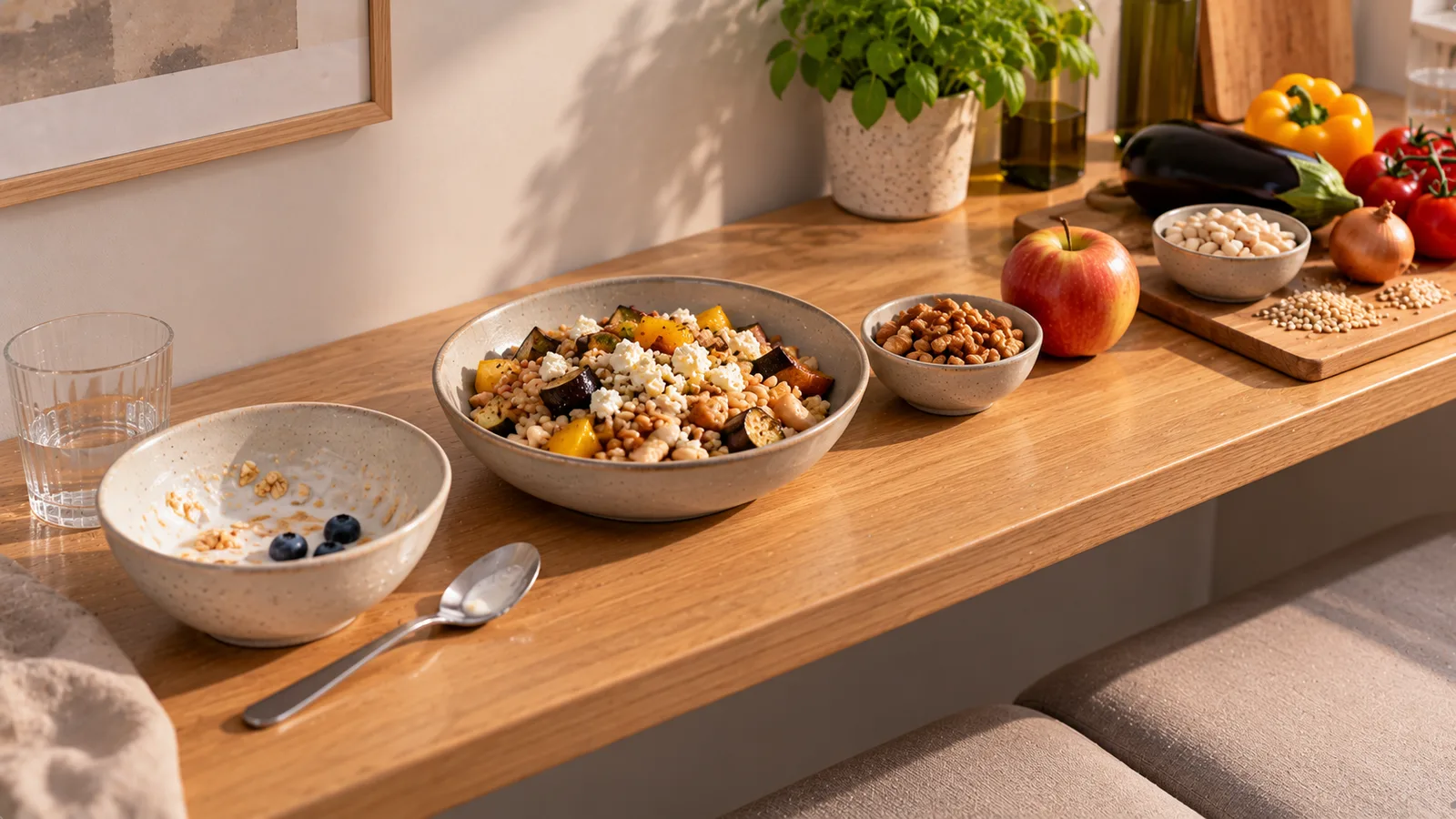
A balanced day of eating does not require every meal to be nutritionally perfect.
A more practical approach is to look at the whole day.
One meal may contain more vegetables. Another may provide more protein. Breakfast may be carbohydrate-heavy, while dinner includes more fats. What matters is whether the overall pattern gives you enough variety, nutrients and energy for your needs.
This makes balanced eating more flexible and easier to maintain.
Start with the whole day, not one perfect plate
A common mistake is trying to make every meal contain exactly the same nutritional components in exactly the same proportions.
Real eating rarely works that way.
Instead, think of the day as several opportunities to include:
- protein-rich foods;
- vegetables and fruit;
- whole grains or other carbohydrate sources;
- sources of dietary fat;
- fiber-rich foods;
- fluids.
The exact amounts depend on your energy needs, preferences, activity, goals and individual circumstances.
A simple structure for the day
A balanced day might contain three main meals, or three meals plus one or more snacks.
There is no universal number of meals that everyone needs.
For example:
| Eating occasion | Practical focus |
|---|---|
| Breakfast | Protein + carbohydrate/fiber source + fruit or vegetables |
| Lunch | Protein + vegetables + carbohydrate source + some fat |
| Snack | Fill a genuine gap: hunger, protein, fruit, fiber or energy |
| Dinner | Protein + vegetables + carbohydrate source + some fat |
This is a framework rather than a rule.
If you prefer two larger meals, the same components can be distributed differently.
Step 1: Give protein a place in your main meals
Protein is useful for maintaining body tissues and supporting many normal physiological functions.
Instead of leaving most of your protein for one meal, it can be practical to include a meaningful protein source at several eating occasions.
Examples include:
- eggs;
- yogurt, skyr or cottage cheese;
- fish;
- chicken or other meat;
- tofu or tempeh;
- beans;
- lentils;
- chickpeas.
A breakfast might use yogurt and oats.
Lunch could include lentils or chicken.
Dinner might use fish, tofu or beans.
You do not need to eat the same protein repeatedly.
Variety can make the day easier to enjoy and can broaden the nutrient mix.
Step 2: Spread vegetables and fruit across the day
Trying to fit all your vegetables into dinner can make balanced eating unnecessarily difficult.
Instead, look for several smaller opportunities.
For example:
Breakfast: berries with yogurt or tomatoes with eggs.
Lunch: salad, soup or cooked vegetables.
Snack: fruit.
Dinner: one or more vegetables as part of the meal.
Fresh, frozen and canned options can all be useful depending on the product and how they are prepared.
The goal is not to force vegetables into every possible eating occasion. It is to create enough opportunities across the day.
Step 3: Include carbohydrate sources according to your needs
Carbohydrates do not need to be removed to make a day balanced.
Common options include:
- oats;
- bread;
- rice;
- potatoes;
- pasta;
- other grains;
- beans and lentils;
- fruit.
Whole-grain and other fiber-rich choices can be particularly useful when they fit the meal.
The appropriate portion depends on factors such as total energy needs, activity and what else is included.
Someone with a physically active day may prefer more carbohydrate than someone with a lower-energy day.
Step 4: Remember dietary fats
Dietary fat is part of a balanced diet.
Sources can include:
- nuts;
- seeds;
- olive or other vegetable oils;
- avocado;
- oily fish;
- nut and seed butters.
Because many fat-rich foods are energy-dense, relatively small portions can contribute substantial energy.
That does not make them unhealthy. It simply means portion size can matter when total energy intake is relevant to your goal.
Step 5: Use fiber-rich foods throughout the day
Fiber does not need to come from a special product.
It can accumulate naturally when the day includes foods such as:
- vegetables;
- fruit;
- whole grains;
- beans;
- lentils;
- chickpeas;
- nuts;
- seeds.
For example, oats and berries at breakfast, lentils and vegetables at lunch, fruit as a snack and vegetables with whole grains at dinner create several opportunities for fiber.
What can a balanced day actually look like?
Here is one example.
Breakfast
Plain yogurt or skyr with oats, berries and a small portion of nuts.
This provides a protein source, carbohydrate, fruit, fiber and fat.
Lunch
A lentil bowl with vegetables, whole-grain bread and a dressing made with a moderate amount of oil.
This adds legumes, vegetables, carbohydrate and fat.
Snack
An apple with cottage cheese.
The snack adds fruit and protein.
Dinner
Salmon, potatoes and a generous portion of mixed vegetables.
This provides protein, carbohydrate, vegetables and dietary fat.
The point is not that everyone should eat these exact foods.
The example shows how nutritional roles can be distributed across the day.
Another balanced day can look completely different
Balanced eating does not require a fixed menu.
For example:
Breakfast
Eggs, whole-grain toast and tomatoes.
Lunch
Chicken, rice and mixed vegetables.
Snack
Fruit and yogurt.
Dinner
Tofu stir-fry with vegetables and noodles.
Both days can follow the same broad nutritional structure while using different foods.
Use meals to compensate for gaps, not to chase perfection
Suppose breakfast contains little protein.
You do not need to declare the day “unbalanced.”
You can simply make protein more prominent at lunch, a snack or dinner.
If lunch contains few vegetables, add more later.
If dinner is low in carbohydrate but you have an active evening, a carbohydrate-containing snack or a different dinner portion may fit better.
This is one advantage of evaluating the whole day rather than individual meals in isolation.
How to think about snacks
A snack does not automatically make a diet more or less balanced.
Its usefulness depends on why it is there.
A snack may help when:
- there is a long gap between meals;
- you are genuinely hungry;
- your main meals leave a nutritional gap;
- you need convenient energy around activity;
- your schedule makes a full meal difficult.
Instead of choosing snacks randomly, ask what the day is missing.
If protein is low, yogurt or cottage cheese may fit.
If fruit intake is low, fruit may fit.
If you need something more substantial, fruit with yogurt or nuts may be more satisfying than fruit alone.
If you are not hungry and your meals already cover your needs, a snack is not mandatory.
Balance does not mean equal calories at every meal
Breakfast, lunch and dinner do not need to contain one-third of your daily calories each.
Some people naturally prefer a larger lunch.
Others prefer a larger dinner.
Some eat a small breakfast and more later.
The important question is whether the distribution works for:
- your hunger;
- your schedule;
- your activity;
- your overall intake.
A balanced day is not defined by mathematical symmetry.
Use portion size to adapt the same meal
The same meal structure can work for people with different energy needs.
Consider:
- chicken;
- rice;
- vegetables;
- olive oil.
A person needing more energy might use:
- a larger rice portion;
- more chicken;
- somewhat more oil;
- an additional side or fruit.
Someone needing less energy might use:
- a smaller rice portion;
- a suitable protein portion;
- plenty of vegetables;
- a smaller amount of added oil.
The meal does not need to become an entirely different recipe.
Often, adjusting portions is enough.
For a visual approach to portions, see Hand Portion Method: How to Estimate Portions Without a Scale.
A busy-day version
Balanced eating does not require cooking several meals from scratch.
A practical busy day could use:
Breakfast: plain yogurt, oats and a banana.
Lunch: whole-grain sandwich with a protein filling plus vegetables and fruit.
Snack: nuts and fruit.
Dinner: frozen vegetables, microwavable grains and canned beans with a simple sauce.
Convenience and nutritional balance are not opposites.
The useful question is whether convenient foods help you assemble the components you need.
A vegetarian example
A balanced vegetarian day might look like:
Breakfast: oats with milk or fortified plant drink, fruit and seeds.
Lunch: chickpea salad with bread.
Snack: yogurt or a suitable alternative with fruit.
Dinner: tofu with rice and vegetables.
Plant-based meals can use legumes, soy foods, nuts, seeds and other foods to build variety.
People following restrictive diets may need additional attention to particular nutrients depending on what they exclude.
What if one meal is much larger?
That can still fit into a balanced day.
Suppose you know you are having a large dinner.
You do not necessarily need to skip breakfast and lunch.
A more practical approach may be to keep earlier meals satisfying but relatively simple.
For example:
- protein-rich breakfast with fruit;
- lunch with protein and vegetables plus an appropriate carbohydrate portion;
- larger social dinner.
This can be easier than arriving at dinner extremely hungry.
What if breakfast is not your thing?
A balanced day does not require breakfast simply because it is morning.
If you prefer your first meal later, focus on the quality and overall distribution of the foods you do eat.
The same principle applies to snacks.
Meal timing and frequency can be adapted to your routine unless you have a medical or other individual reason to follow a particular schedule.
A five-minute planning method
You can plan a balanced day quickly.
1. Choose your main protein sources
Decide what will provide protein at your main meals.
2. Place vegetables and fruit
Identify several realistic opportunities to include them.
3. Add carbohydrate sources
Choose bread, grains, potatoes, fruit, legumes or other foods that fit your meals and activity.
4. Check fat sources
Look at oils, nuts, seeds, avocado, fish or other sources already present.
5. Decide whether snacks are useful
Add them for hunger, convenience or nutritional gaps rather than automatically.
6. Check the day as a whole
Ask whether the plan contains enough variety and whether the portions are realistic for you.
This takes much less time than trying to optimize every nutrient in every meal.
A practical daily checklist
Before considering the day planned, you can ask:
- Do I have protein sources across my main meals?
- Do I have several opportunities for vegetables and fruit?
- Are there fiber-rich foods?
- Have I included suitable carbohydrate sources?
- Are dietary fats represented?
- Do my portions make sense for my appetite and energy needs?
- Do I actually like these foods?
- Can I realistically prepare or obtain them today?
The last two questions matter.
A nutritionally impressive plan that you cannot or do not want to follow is not a useful plan.
Balance across several days also matters
Your diet does not reset at midnight.
Some days naturally contain more of one food group and less of another.
Travel, restaurants, celebrations, work schedules and appetite can all change individual days.
Rather than trying to compensate aggressively for every deviation, return to your usual balanced pattern at the next realistic opportunity.
Longer-term consistency matters more than making every individual day look identical.
When calorie or macro targets are part of the plan
Some people also track calories or macronutrients.
In that case, nutritional balance and numerical targets can be considered together.
A meal may fit your calorie target while providing little protein, fiber or variety.
Another meal may be nutrient-rich but larger than your current energy needs.
Neither calories nor food quality alone describes the entire diet.
If you use targets, treat them as another planning layer rather than replacing basic meal quality.
The simplest principle
A balanced day of eating is not a rigid menu.
Build your day from several useful food groups, distribute them in a way that works with your appetite and schedule, adjust portions to your needs and use later meals to fill reasonable gaps from earlier ones.
That creates flexibility without abandoning structure.