
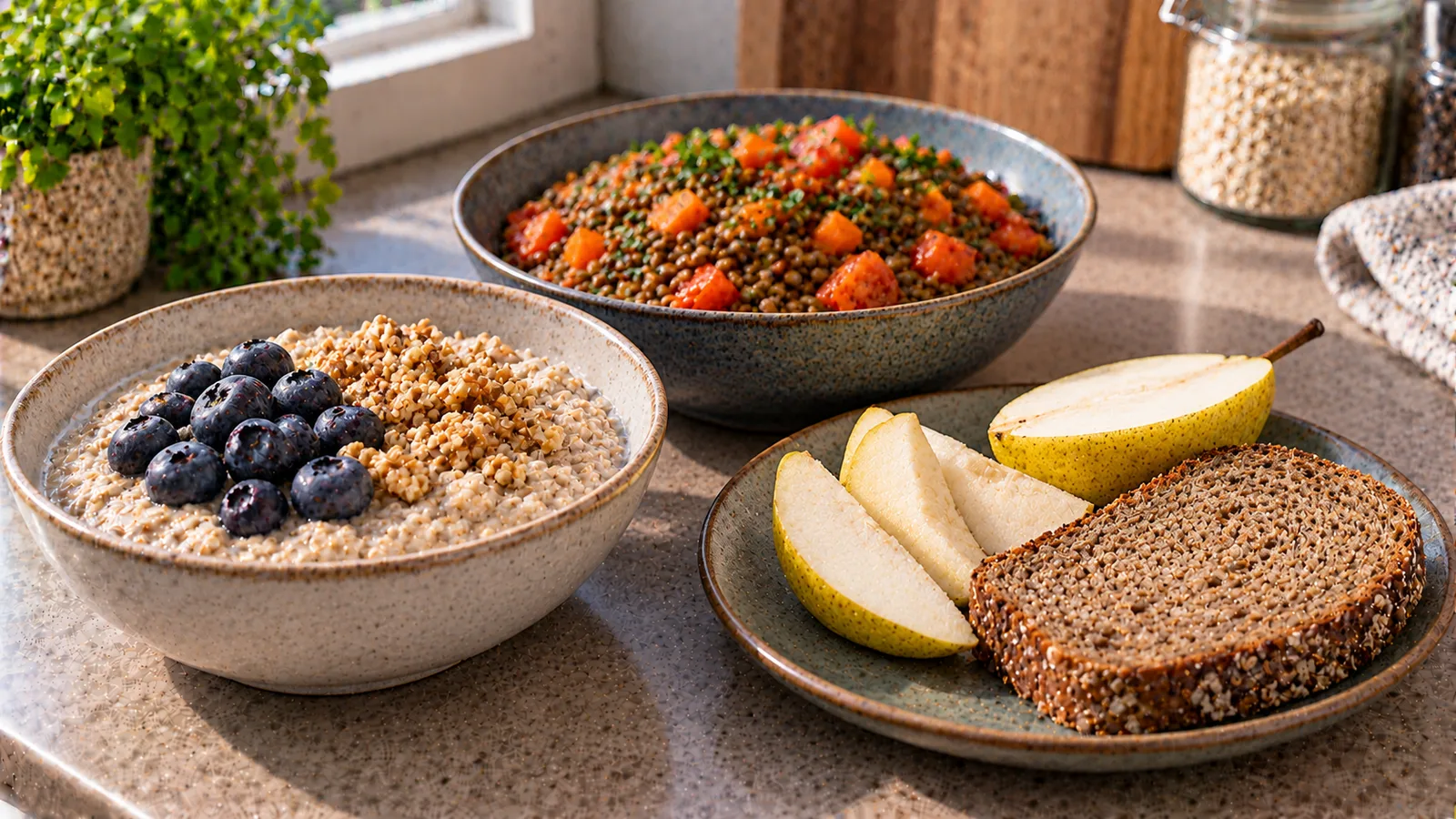
An adult can reach about 30 g of dietary fibre in one day without supplements or a shelf of expensive speciality products. This worked example uses oats, fruit, lentils, potatoes, vegetables and almonds, alongside ordinary protein foods. It provides 31.3 g of estimated fibre, 1,762 illustrative kcal and €5.17 in model ingredient costs. Those numbers belong to this exact set of weighed ingredients and assumptions, not a promise about every supermarket product or an individually suitable calorie target.
The key is to see the whole day, not a disconnected list of high-fibre foods. Breakfast contributes 9.7 g, lunch 13.3 g, dinner 5.4 g and a small snack 2.9 g. You can see precisely which foods deliver that amount and which contribute calories without much fibre. This is a one-day calculation, not a seven-day diet, a personalised medical prescription or a general article on how to raise fibre intake.
Why 30 g is a useful example, but not one universal rule
Germany's DGE fibre guidance gives adults a benchmark of at least 30 g per day. The UK NHS guide also uses 30 g for adults. The European Food Safety Authority considers 25 g per day adequate for normal bowel function in adults, while recognising evidence associated with larger intakes. These reference values have different derivations and are not interchangeable medical prescriptions. Fibre needs and tolerance also vary with age, overall intake and individual health circumstances.
There is no single nutrient that turns a meal into a healthy diet. Fibre sits alongside adequate energy, protein, essential fats, micronutrients and fluid. A day that reaches 30 g from a few unusually large portions but fails to meet someone's energy needs is not automatically balanced. This example makes the arithmetic transparent so it can be adapted rather than copied mechanically.
The food-by-food calculation: 12 ingredient entries
The amounts below are edible weights, using cooked and drained weights where explicitly stated. For oats, the 60 g is the dry weight. Cooked rice is 150 g, modelled as approximately 50 g dry rice after water absorption; the exact cooking yield will vary. The fibre values for pear, oats, potatoes, carrots, drained lentils, broccoli and almonds follow the portion examples in the DGE table linked above. The model's 0.6 g fibre for white rice and all energy numbers are illustrative product-value assumptions, not additional DGE lab measurements. Plain yogurt, oil and salmon are treated as zero-fibre here.
| Meal | Food | Edible amount | Fibre | Illustrative energy | Illustrative cost |
|---|---|---|---|---|---|
| Breakfast | Rolled oats (dry) | 60 g | 5.8 g | 233 kcal | 0.09 € |
| Breakfast | Pear, edible portion | 140 g | 3.9 g | 80 kcal | 0.35 € |
| Breakfast | Plain yogurt | 200 g | 0.0 g | 126 kcal | 0.40 € |
| Lunch | Boiled potatoes | 250 g | 2.8 g | 215 kcal | 0.38 € |
| Lunch | Cooked carrots | 150 g | 4.7 g | 53 kcal | 0.21 € |
| Lunch | Canned lentils, drained | 125 g | 5.8 g | 125 kcal | 0.38 € |
| Lunch | Olive oil in lunch | 15 g | 0.0 g | 135 kcal | 0.14 € |
| Dinner | Salmon, cooked | 150 g | 0.0 g | 312 kcal | 2.40 € |
| Dinner | Steamed broccoli | 150 g | 4.8 g | 53 kcal | 0.38 € |
| Dinner | White rice, cooked | 150 g | 0.6 g | 195 kcal | 0.10 € |
| Dinner | Olive oil in dinner | 10 g | 0.0 g | 90 kcal | 0.09 € |
| Snack | Almonds | 25 g | 2.9 g | 145 kcal | 0.25 € |
A few details prevent significant errors. The lentils are 125 g after draining: 125 g including brine is not the same amount of pulses. The 150 g of broccoli is a cooked, edible portion, not the frozen bag plus discarded water. Salmon and yogurt provide protein and energy but effectively no fibre. Their inclusion matters to the example as a meal, not to inflate its fibre total.
The model counts 15 g olive oil with lunch and 10 g with dinner, assuming all of it is consumed. If oil remains in the pan, the true energy and cost eaten may be lower. Prices are allocated to the amount used, not the price of buying the whole container. You would still need to purchase a full bag, bottle or tin when starting from an empty kitchen.
Does this really total around 30 g?
Yes, on the listed assumptions. Here is the aggregation of the twelve displayed ingredient rows, with intermediate fibre figures shown to one decimal place. Euros are summed from the individually rounded line costs; using unrounded shelf-price multiplication first can differ by a few cents.
| Meal | Dietary fibre | Model calories | Model ingredient cost |
|---|---|---|---|
| Breakfast | 9.7 g | 439 kcal | 0.84 € |
| Lunch | 13.3 g | 528 kcal | 1.11 € |
| Dinner | 5.4 g | 650 kcal | 2.97 € |
| Snack | 2.9 g | 145 kcal | 0.25 € |
| Whole example day | 31.3 g | 1762 kcal | 5.17 € |
To reproduce the fibre math without a calculator: 9.7 + 13.3 + 5.4 + 2.9 = 31.3 g. The meal energy estimates give 439 + 528 + 650 + 145 = 1,762 kcal. Ingredient costs give €0.84 + €1.11 + €2.97 + €0.25 = €5.17. A nutrition tracker using a different brand of oats, canned lentils, yogurt or bread will not necessarily reproduce these totals exactly. That is normal: real product labels and actual weights take precedence.
These energy figures are supplied so the day is not presented as a fibre-only shopping list. They do not make the menu a suitable 1,762-kcal plan for everyone. The meal pattern can be expanded with food to match an individual's energy and protein needs, while keeping the fibre calculation explicit. Fibre is also not a substitute for checking total calories or overall dietary quality.
A realistic way to prepare the four eating occasions
Breakfast: Cook 60 g oats with water, add 200 g unsweetened plain yogurt and serve with 140 g sliced pear. The 9.7 g of fibre comes from the oats and pear; the yogurt supplies additional energy and protein. If you weigh oats after cooking and then use the dry-oat label on that heavier weight, you will overstate their contribution.
Lunch: Assemble 125 g drained cooked lentils with 250 g boiled potatoes and 150 g cooked carrots. Add herbs, lemon or vinegar, and assume up to 15 g olive oil is actually eaten. This is the fibre-heavy meal at 13.3 g. The lentil portion is deliberately modest compared with the quantity used in some large salads; however, anyone unaccustomed to pulses may prefer to begin with less.
Dinner: Serve 150 g cooked salmon, 150 g steamed broccoli and 150 g cooked white rice with 10 g eaten olive oil. Broccoli provides 4.8 g fibre and the rice an assumed 0.6 g. The salmon contributes none, but changes the meal's protein and price. This is a dinner illustration, not advice to eat salmon every day.
Snack: Eat 25 g almonds, preferably weighed rather than estimated by a handful. Their 2.9 g of fibre moves the day over the 30 g mark. A small packet purchased separately could have a higher unit price than the bulk-kilo assumption used here.
Where the €5.17 comes from
This is a deliberately explicit illustrative German-market price model, not a live price check, advertised offer or cross-country price comparison. Assume oats at €1.50/kg, pears €2.50/kg, plain yogurt €2.00/kg, potatoes €1.50/kg, carrots €1.40/kg, canned lentils €0.75 per 250 g drained contents, broccoli €2.50/kg, salmon €16.00/kg, dry rice €2.00/kg, almonds €10.00/kg and olive oil €9.00/kg. For the rice, allocate 50 g dry product to the 150 g cooked portion. Applying those assumptions to the edible amounts in the table and rounding each displayed line to cents creates the €5.17 sum.
That total leaves out seasoning, tap water, electricity, transport, delivery fees and unused food or spoilage. Whole-pack checkout cash will be higher: a buyer cannot purchase just 15 g of oil or 60 g from a sealed bag of oats. Furthermore, drained weight is vital when costing canned lentils; the label's total can weight may include water.
For a separate method to compare entire baskets and reduce shopping waste, see Mealisa's low-cost high-fibre grocery basket. That resource covers broader weekly purchasing; the calculation here answers the narrower question of what one actual day of portions may cost when foods are allocated by quantity used.
How much does a simple swap change the budget?
Price and fibre are not the same metric. To isolate a cost decision, imagine replacing the €2.40 salmon portion with two eggs costed at €0.60, while keeping every other item unchanged. Egg also has essentially no fibre, so this swap affects the model cost but not its fibre sum. It does alter energy, protein and other nutrients, which need a new calculation before treating it as an equivalent meal. Removing the rice is a different change: it saves just €0.10 in the model but removes its assumed 0.6 g of fibre and substantial energy.
| Situation | Main-protein assumption | Day cost | Day fibre |
|---|---|---|---|
| Original salmon version | 150 g salmon at €2.40 | 5.17 € | 31.3 g |
| Two eggs instead of salmon | Two eggs at €0.60 | 3.37 € | 31.3 g |
| Omit rice, keep salmon | Rice removed (€0.10) | 5.07 € | 30.7 g |
The egg version is approximately €3.37 for the day under the same assumptions. This is not a recommendation to replace fish with eggs routinely. Different proteins offer different nutrient profiles. Similarly, the rice-free day would have 30.7 g fibre but less food energy. A basket or shopping-list price can be much lower or higher depending on discounts, seasonality and whether foods are bought frozen, dried or canned.
A frequent trap is ranking foods solely by fibre per euro. A cheap fibre-rich ingredient may be less convenient, require cooking, or be poorly tolerated in large amounts. Another food may cost more yet help supply protein, calcium or essential fats. The day works because several ordinary ingredients contribute different nutrients, rather than because one food has the highest possible fibre number.
Adapt it without accidentally doubling the numbers
If fresh pears are expensive, swap to another seasonal fruit and read its fibre value rather than retaining the pear's 3.9 g. If you replace drained canned lentils with dry lentils, compare them on the correct dry-to-cooked weight basis and include the cooking yield; do not multiply 125 g of cooked lentils by values for 125 g dry lentils. Likewise, when swapping white rice for wholegrain rice, recalculate both fibre and cooking yield using the product label.
Oats can be replaced by wholegrain bread, but the gram-for-gram fibre and total calories will differ. The related Mealisa guide on portion size versus serving size is relevant here: what you actually put in the bowl matters more than the generic serving printed on a packet. Our seven-day high-fibre meal plan is a different resource for readers who want multiple days instead of one audited example.
For household planning, prepare a pot of lentils or potatoes in advance, but record the edible portion when serving. Cooking a larger batch does not automatically mean one person ate the entire pack. Refrigerate cooked food promptly, use appropriate storage times and reheat safely. A scale and the real product label provide a more useful audit than a supposed universal portion size.
If 30 g is a big jump, change the pace
Someone currently eating much less fibre may experience gas, bloating or discomfort when suddenly adding legumes and large quantities of whole grains. Both the DGE guidance and the NHS information advise raising fibre gradually and maintaining adequate fluid intake. Start with smaller lentil and oat portions if necessary, monitor tolerance and work toward an appropriate pattern over time. Severe, persistent digestive symptoms or a condition requiring a modified-fibre diet warrant individual clinical advice.
This one-day model is most useful as a checkable worksheet: weigh the portion, choose the correct food state, take the fibre value from the actual product or a credible database, multiply, and total the day. To learn strategies rather than follow a fixed menu, read how to eat more fibre. A realistic, repeatable pattern is more valuable than hitting 30.0 g to the decimal on one day.
Method and sources: fibre inputs are principally drawn from the DGE's published worked portion examples; the adult target comparisons are from EFSA and NHS. The other numerical inputs are explicitly illustrative assumptions, not published laboratory totals or live retail quotes.