
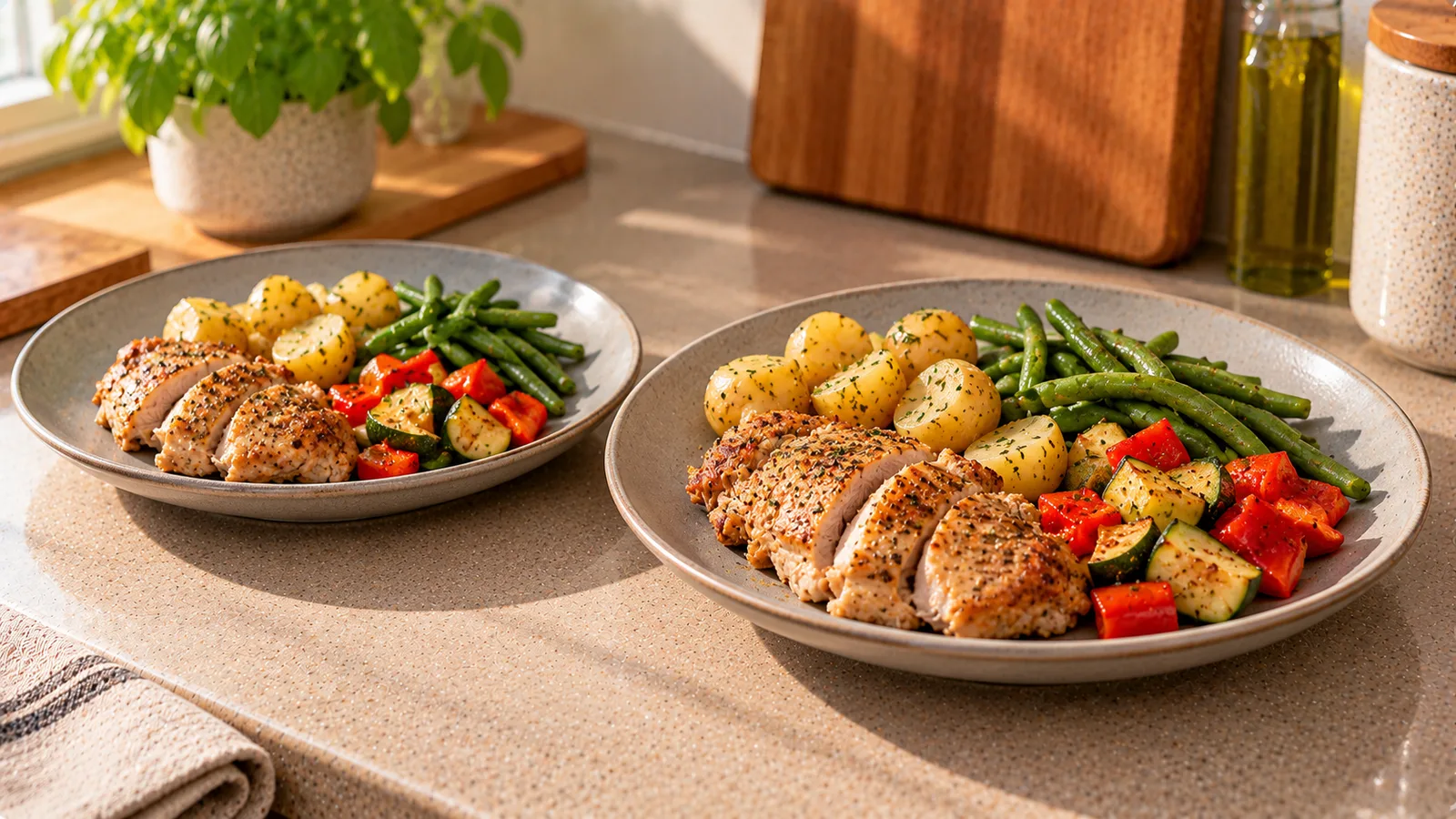
Two adults can share the same dinner even when their calorie needs are different.
You usually do not need two separate recipes, two pans or two completely different meal plans. A more practical approach is to prepare one common meal and adjust the portions of its components.
The key is to separate the idea of what you eat from how much of each component you eat.
Start with one common meal
Suppose dinner consists of:
- chicken;
- rice;
- roasted vegetables;
- olive oil;
- yogurt sauce.
Both people can eat all five components.
The difference can come from the quantities.
For example:
| Component | Adult A | Adult B |
|---|---|---|
| Cooked chicken | 130 g | 180 g |
| Cooked rice | 120 g | 220 g |
| Vegetables | 250 g | 300 g |
| Olive oil | 8 g | 15 g |
| Yogurt sauce | 40 g | 60 g |
The meal remains recognizably the same. Only the portions change.
Why this works better than cooking two dinners
Preparing separate meals every day creates extra work:
- more planning;
- more ingredients;
- more cooking;
- more dishes;
- more leftovers to manage.
A shared base meal simplifies the process while still allowing different energy intakes.
This can be especially useful for couples or housemates when one person:
- is smaller or larger;
- is more physically active;
- is maintaining weight while the other is reducing intake;
- has a different daily energy target;
- simply needs a larger or smaller meal.
Calorie requirements are individual, so the examples below are planning examples rather than personal prescriptions.
Build the meal from adjustable components
Meals are easiest to scale when their main components remain somewhat separate.
A useful structure is:
protein + carbohydrate source + vegetables + added fat + optional extras
For example:
- salmon + potatoes + green beans + olive oil;
- chicken + rice + vegetables + sauce;
- tofu + noodles + stir-fried vegetables + sesame oil;
- beans + couscous + roasted vegetables + dressing.
You can cook everything together where appropriate, but knowing the quantities of the main components makes portioning easier.
Which parts should change first?
You do not need to scale every ingredient by exactly the same percentage.
The most practical adjustments often come from:
- carbohydrate portion;
- added fats;
- sauces and toppings;
- protein portion when appropriate;
- snacks or side items outside the shared meal.
Vegetables can often remain generous for both people rather than being reduced simply to lower calories.
Example: one chicken-and-rice dinner
Imagine the available cooked foods have approximately these energy values:
- chicken breast: 165 kcal per 100 g;
- cooked rice: 130 kcal per 100 g;
- vegetables: 40 kcal per 100 g;
- olive oil: 9 kcal per gram;
- yogurt sauce: 80 kcal per 100 g.
These are example values. Actual products and recipes should be calculated from their own labels or database entries.
Adult A
- 130 g chicken = about 215 kcal;
- 120 g rice = about 156 kcal;
- 250 g vegetables = about 100 kcal;
- 8 g olive oil = about 72 kcal;
- 40 g sauce = about 32 kcal.
Approximate meal total:
575 kcal
Adult B
- 180 g chicken = about 297 kcal;
- 220 g rice = about 286 kcal;
- 300 g vegetables = about 120 kcal;
- 15 g olive oil = about 135 kcal;
- 60 g sauce = about 48 kcal.
Approximate meal total:
886 kcal
Both adults eat the same foods.
The difference is about 311 kcal, created mainly by larger portions of rice, chicken, oil and sauce.
No second recipe is required.
Do not simply make one plate twice as large
If one person needs more energy, doubling every component is rarely necessary.
Suppose the smaller meal already contains a useful amount of vegetables and protein.
The larger meal may only need:
- more rice;
- slightly more protein;
- more cooking oil or dressing;
- bread or another side;
- dessert or fruit;
- a larger snack elsewhere in the day.
This is often easier than scaling the entire plate.
Use calorie-dense ingredients strategically
Small amounts of energy-dense foods can create a meaningful difference between portions.
Examples include:
- olive oil;
- nuts;
- seeds;
- cheese;
- avocado;
- nut butter;
- pesto;
- creamy sauces.
For example, adding 10 g of oil adds roughly 90 kcal.
That can make a larger-energy meal substantially different without requiring a huge increase in food volume.
The same principle works in reverse: reducing an added fat can lower meal calories without dramatically shrinking the visible amount of food.
Carbohydrate portions are easy to scale
Rice, pasta, potatoes, bread, couscous and similar foods are convenient components for creating different meal sizes.
For example:
Person A:
120 g cooked rice
Person B:
220 g cooked rice
Both plates still contain the same recipe components, but the larger serving provides more energy.
When tracking, use the cooked or uncooked database entry that matches how you measured the food.
Protein does not have to scale exactly with calories
If one person's calorie target is 30% higher, that does not automatically mean every nutrient should also increase by exactly 30%.
Protein needs depend on factors such as body size, activity and individual goals.
Therefore, avoid creating the larger plate by mechanically multiplying every ingredient.
Instead, set appropriate portions for each person and use carbohydrates, fats and extras to create the remaining energy difference.
Mixed dishes require a slightly different method
Separate components are easy to portion.
Lasagna, curry, chili, casserole and similar mixed dishes cannot always be divided ingredient by ingredient after cooking.
For these meals, calculate the recipe as a batch.
Example
A homemade chili contains 2,400 kcal in total after all ingredients are entered.
The finished chili weighs 2,000 g.
Energy per gram:
2,400 ÷ 2,000 = 1.2 kcal/g
Adult A eats 400 g:
400 × 1.2 = 480 kcal
Adult B eats 600 g:
600 × 1.2 = 720 kcal
Again, one recipe can support two different meal sizes.
Add sides when the main dish should stay identical
Sometimes dividing the main dish into noticeably different portions is inconvenient.
For example, you make two equal pieces of homemade lasagna.
Instead of changing the lasagna itself, increase the larger meal with:
- bread;
- extra dressing;
- cheese;
- fruit;
- yogurt;
- nuts;
- another side dish.
This keeps the shared recipe simple.
Example: tacos for two adults
Prepare one set of ingredients:
- tortillas;
- seasoned beans or meat;
- vegetables;
- salsa;
- cheese;
- avocado.
Adult A might have:
- 2 tortillas;
- 100 g filling;
- vegetables and salsa;
- 20 g cheese;
- 30 g avocado.
Adult B might have:
- 3 tortillas;
- 150 g filling;
- vegetables and salsa;
- 30 g cheese;
- 60 g avocado.
The cooking process is almost identical.
Portion assembly creates the difference.
Example: pasta night
Prepare:
- pasta;
- tomato-meat sauce;
- vegetables;
- Parmesan.
Adult A:
- 150 g cooked pasta;
- 180 g sauce;
- 200 g vegetables;
- 10 g Parmesan.
Adult B:
- 250 g cooked pasta;
- 230 g sauce;
- 200–250 g vegetables;
- 20 g Parmesan.
The vegetables do not have to differ much. Most of the additional energy can come from pasta, sauce and cheese.
Example: breakfast for two
The same principle works outside dinner.
Prepare:
- plain yogurt;
- oats;
- berries;
- nuts.
Adult A:
- 170 g yogurt;
- 30 g oats;
- 100 g berries;
- 10 g nuts.
Adult B:
- 250 g yogurt;
- 60 g oats;
- 150 g berries;
- 20 g nuts.
There is still only one breakfast concept and one set of ingredients.
Plan the grocery list around total quantities
If two people share meals, grocery planning should be based on the combined amount needed.
Suppose one dinner requires:
Adult A:
- 130 g cooked chicken;
- 120 g cooked rice.
Adult B:
- 180 g cooked chicken;
- 220 g cooked rice.
Together, you need:
- 310 g cooked chicken;
- 340 g cooked rice.
For several meals, multiply the combined quantities rather than building two independent grocery lists.
Remember that raw and cooked weights differ, so purchase quantities should be based on the form in which you buy the ingredient.
Batch cooking becomes easier
Shared meals with different portions work well with batch cooking.
For example, cook:
- a large tray of vegetables;
- one batch of chicken;
- one pot of rice.
After cooking, portion each component according to each person's needs.
You can label containers or simply record the usual portions.
This avoids preparing separate recipes while keeping portions predictable.
A simple two-person portion table
A reusable table can make planning faster:
| Component | Person 1 | Person 2 |
|---|---|---|
| Protein | ___ g | ___ g |
| Starch/grain | ___ g | ___ g |
| Vegetables | ___ g | ___ g |
| Added fat | ___ g | ___ g |
| Sauce | ___ g | ___ g |
| Extras | ___ | ___ |
You do not need to fill this out forever.
After several repeated meals, common portion differences often become easy to remember.
What if only one person tracks calories?
That is still compatible with shared meals.
The person who tracks can weigh or estimate their own portion.
The other person can eat an appropriate portion without recording every ingredient.
There is no requirement that both people use the same tracking method simply because they share dinner.
What if both people track?
Save the common recipe once when possible.
Then each person logs their own serving size.
For a mixed recipe:
- save the full ingredients;
- record final cooked weight if your tracking system supports it;
- weigh each serving;
- log the corresponding amount.
For separate components, each person can log their own amounts directly.
Avoid assigning foods to one person as “diet food”
Shared meal planning tends to work better when the base meal is neutral.
Instead of:
- one person eating “diet food”;
- the other eating the “normal meal”;
use one meal and adjust portions.
For example, both people can eat:
- chicken;
- potatoes;
- vegetables;
- sauce.
One plate simply contains different quantities.
This can also simplify shopping and cooking.
When calorie differences are large
If two adults have substantially different energy needs, dinner portions alone may not need to carry the entire difference.
Suppose one person needs several hundred additional calories over the day.
Those calories can also come from:
- a larger breakfast;
- additional snacks;
- larger lunch portions;
- milk or other drinks;
- dessert;
- extra bread, nuts or yogurt.
Trying to create the entire daily difference at one shared dinner may result in an unnecessarily large plate.
When dietary requirements differ too
Different calorie needs are relatively easy to handle with portion changes.
Different medical diets, allergies, intolerances or ethical food choices may require additional changes.
For example, if one person cannot eat an ingredient, simply changing portion size does not solve the problem.
In those situations, design the shared base around ingredients both people can eat, then add individual components separately when appropriate.
Do not treat calorie targets as exact daily limits
Estimated calorie needs are not perfectly precise numbers.
Actual energy requirements vary between people and can change with:
- body size;
- activity;
- training;
- routine;
- goals.
A portion plan is therefore a practical framework rather than a requirement to make every meal match an exact number.
Looking at the broader eating pattern is usually more useful than trying to engineer every shared dinner to the last calorie.
A practical weekly system
For several shared dinners, choose meals that can be scaled easily.
For example:
Monday: chicken, rice and vegetables
Tuesday: tacos
Wednesday: salmon, potatoes and salad
Thursday: chili with bread
Friday: pasta with tomato-meat sauce
Saturday: curry with rice
Sunday: tray-bake vegetables with protein and couscous
For each meal, identify one or two components that can create most of the portion difference.
Usually that will be:
- rice, pasta, potatoes or bread;
- added fat;
- sauce;
- cheese;
- another side.
This is easier than designing seven pairs of separate meals.
The simplest rule
When two adults need different amounts of energy, keep the meal structure shared and make the portion sizes individual.
A practical sequence is:
- choose one meal both people want to eat;
- prepare a common protein, carbohydrate and vegetable base;
- set suitable portions for each person;
- use starches, fats, sauces and extras to create additional energy differences;
- track each serving separately when tracking is needed.
Different calorie needs do not automatically require different food.
In many households, one recipe plus flexible portions is enough.