
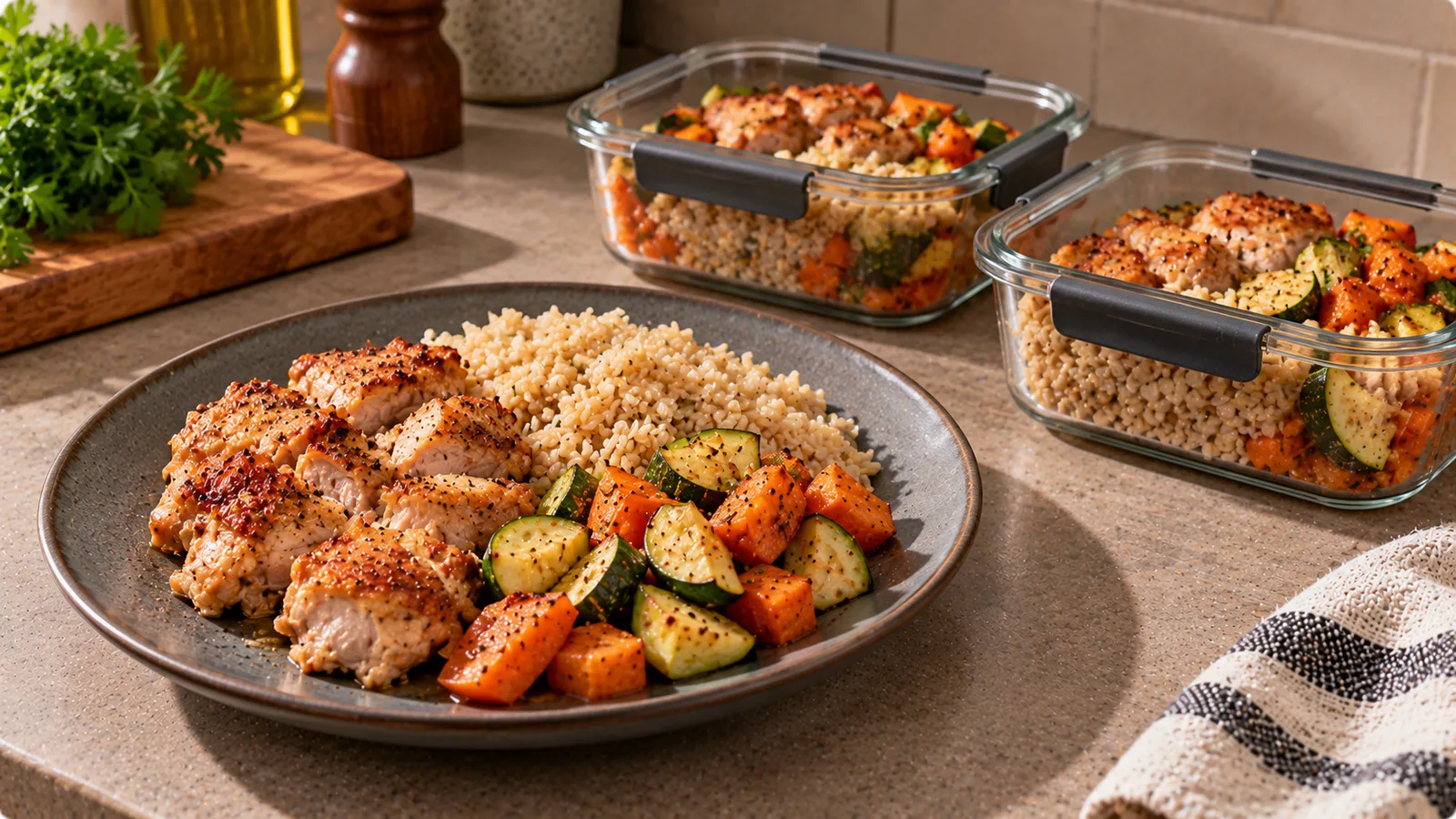
A household does not need to eat every meal at the same time to benefit from a shared meal plan.
Shift work, school activities, commuting, training and different sleep schedules can make a traditional family dinner difficult. Cooking a separate meal for every person, however, increases preparation time, dishes and food waste.
A more practical approach is to plan shared ingredients and flexible serving times, rather than requiring everyone to sit down together.
The core system: one meal, several serving times
Start with dishes that can be prepared once and divided into individual portions.
Good examples include:
- Chili with beans and vegetables.
- Lentil or vegetable soup.
- Pasta sauce served with freshly cooked pasta.
- Chicken and roasted vegetables.
- Rice bowls with separately stored toppings.
- Baked potatoes with different fillings.
The aim is not to cook an entire dinner repeatedly. It is to separate the main cooking session from each person's serving time.
This works best when meals tolerate refrigeration and reheating, or when their components can be assembled quickly.
Map the household's actual schedule
Before choosing recipes, write down when each person is realistically available to eat.
For example:
| Person | Typical dinner time | Practical requirement |
|---|---|---|
| Adult A | 17:30 | Meal ready before an evening shift |
| Child | 18:30 | Simple serving with familiar ingredients |
| Adult B | 21:00 | Refrigerated portion that reheats well |
In this example, there is no need for three separate dinners.
One prepared meal can serve all three people if portions are handled and stored safely.
Schedules may change from day to day, so identify the most difficult evenings first.
Choose meals by how well they hold
Not every recipe is equally suitable for staggered mealtimes.
| Meal type | Suitability | Best approach |
|---|---|---|
| Soups and stews | High | Refrigerate individual portions |
| Chili and bean dishes | High | Reheat each serving separately |
| Pasta with sauce | Good | Store sauce separately where practical |
| Grain bowls | Good | Store grains, protein and fresh toppings separately |
| Fried fish | Limited | Prefer cooking near serving time |
| Crisp salads | Limited | Keep dressing and wet ingredients separate |
| Crispy roasted foods | Variable | Reheat in oven or air fryer if appropriate |
A dish that loses its texture after several hours may still work if you prepare the components ahead and finish cooking when needed.
Build a shared base with individual adjustments
People living together often have different appetites, dietary needs or food preferences.
Instead of making entirely different meals, create a common base.
For example, prepare:
- A pot of tomato and vegetable sauce.
- Cooked beans or another protein source.
- Rice, potatoes or pasta.
- Fresh vegetables or toppings.
Each person can assemble a suitable portion.
One person may want more vegetables, another more carbohydrates, and another a different protein source.
Keep genuine food allergies and medically necessary dietary restrictions separate from simple preferences. Shared equipment and ingredients may require additional precautions when allergens are involved.
A practical three-day example
The following plan assumes three people with different dinner times.
| Day | Shared preparation | How it is served later |
|---|---|---|
| Monday | Turkey and bean chili | Refrigerated portions reheated individually |
| Tuesday | Roasted vegetables, chicken and rice | Components stored separately and assembled as needed |
| Wednesday | Lentil soup with bread | Soup reheated per serving; bread added fresh |
This arrangement reduces the number of separate cooking sessions without requiring identical plates.
The quantities should reflect the actual household, not a fixed recipe serving count.
Calculate portions before cooking
Suppose a recipe makes six portions and the household needs:
- Three portions for dinner.
- Two portions for lunches the following day.
- One extra portion for freezing.
All six portions have a purpose.
This is more useful than cooking an arbitrary large batch and hoping it will be eaten.
For mixed dishes, weigh the final cooked batch and divide it according to each person's needs.
A 450 g portion and a 300 g portion can come from the same recipe.
When tracking nutrition, use the actual serving weight rather than assuming all plates contain identical amounts.
The two-stage cooking method
Some households find it easier to separate meal preparation into two stages.
Stage 1: Prepare the shared components
Earlier in the day, cook ingredients that take the longest:
- Beans and lentils.
- Sauces.
- Roasted vegetables.
- Grains.
- Proteins suitable for safe storage.
Cool and refrigerate anything that will not be eaten promptly.
Stage 2: Finish individual servings
At mealtime, each person can:
- Reheat a portion.
- Add fresh herbs or salad.
- Cook a quick side.
- Adjust portion size.
- Assemble the components in a bowl or wrap.
This keeps individual serving time short without sacrificing flexibility.
Food safety when dinner is spread over several hours
Do not leave a cooked meal sitting at room temperature from the first dinner until the last.
Perishable cooked foods should be refrigerated promptly.
As a general US food-safety reference, refrigerate perishable food within two hours, or within one hour when the ambient temperature exceeds 32°C / 90°F.
Use shallow containers to help larger quantities cool quickly.
Keep refrigerated food at 4°C / 40°F or below.
When reheating leftovers, US guidance recommends reaching 74°C / 165°F throughout.
Avoid repeatedly reheating the entire pot. Divide the meal into portions and reheat only what is needed.
Follow applicable local guidance and any stricter instructions for particular foods.
Organize the refrigerator for different schedules
A simple labeling system can prevent confusion.
Each container can show:
- Meal name.
- Preparation date.
- Intended person or portion size, if useful.
- Any important allergen information.
Place meals intended for the next day where they are easy to see.
Freeze portions that will not be used within an appropriate refrigerated storage period.
For many cooked leftovers, US guidance uses three to four days in the refrigerator as a general reference, although some foods require more specific handling.
Reduce the mental load with a weekly planning routine
Once a week, identify:
- Evenings when everyone eats at different times.
- Evenings when one person can cook.
- Meals that can safely be made ahead.
- Ingredients that can be reused across two recipes.
- Portions that should be frozen rather than refrigerated.
A useful plan does not have to specify a unique recipe for every person and every time slot.
It needs to answer who will eat, what they will eat, and when each portion will be prepared or reheated.
What if one person regularly eats much later?
If one person eats several hours after everyone else, prepare their portion at the original cooking time and refrigerate it promptly.
Do not keep it warm on the counter.
If the person prefers freshly cooked food, prepare a shared sauce or vegetable base in advance and let them cook a quick protein or starch when they arrive.
The best option depends on available time, equipment and the dish itself.
When separate meals are actually easier
Shared-base planning is not always appropriate.
Separate meals may be necessary when:
- Someone has a medically required diet.
- A serious food allergy makes shared preparation unsafe without additional controls.
- Household members have fundamentally incompatible food preferences.
- A dish cannot be stored or reheated acceptably.
- Different schedules also mean different access to cooking equipment.
The goal is to reduce unnecessary duplication, not force everyone to eat the same food.
Sources
- USDA Food Safety and Inspection Service — safe storage, cooling and reheating.
- FDA: Safe Food Handling — food handling principles.
- USDA MyPlate — practical meal-planning and food-group guidance.
A sustainable approach
For households with different mealtimes, the most reliable system is usually a combination of shared recipes, individual portions and safe refrigerated storage.
Plan around the schedule you actually have.
Cook once where practical, finish individual meals quickly, and avoid keeping perishable food unrefrigerated while waiting for the last person to eat.