
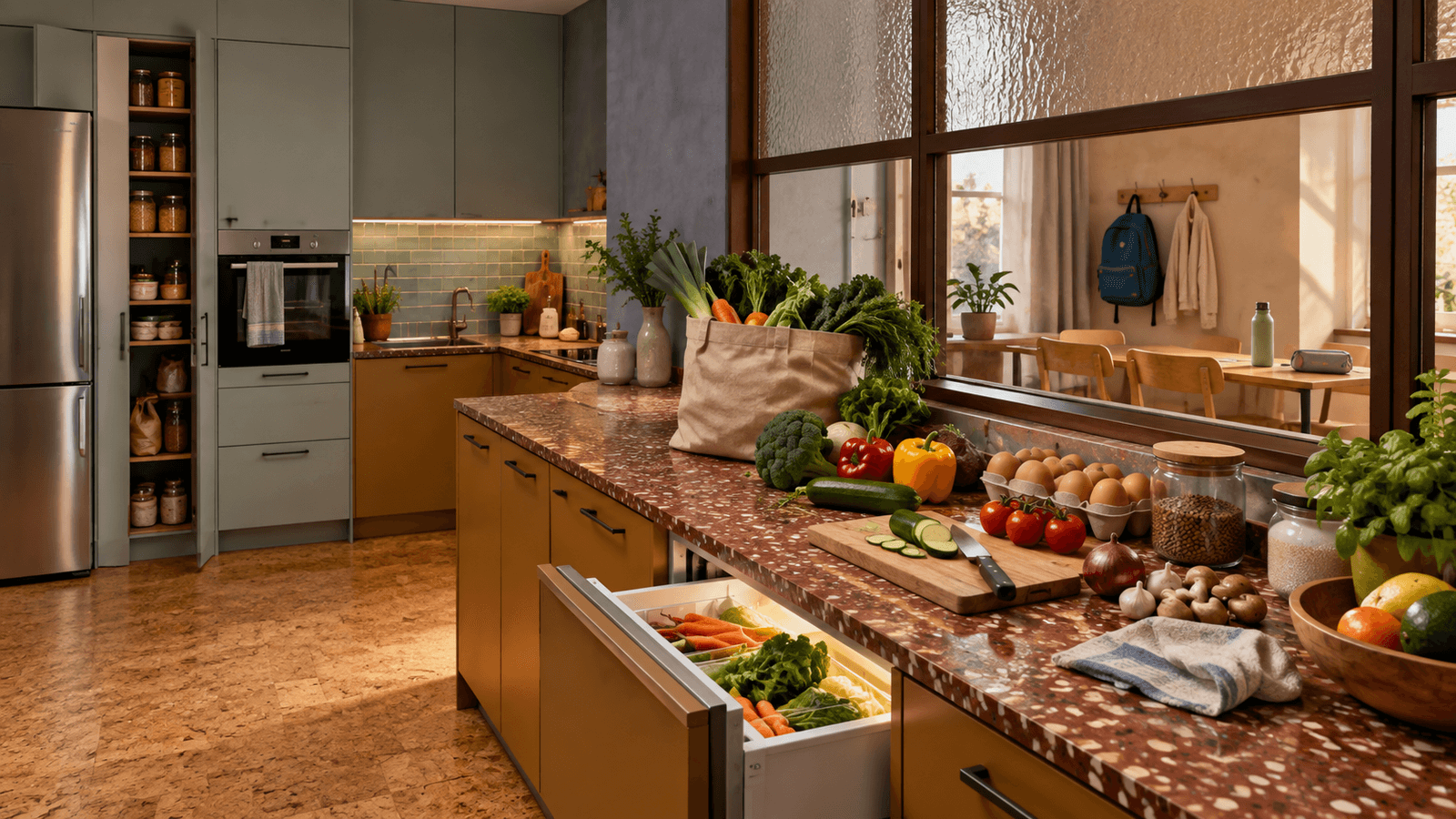
Family meal planning can make the week easier, but only if the system is realistic enough to survive busy days, changing schedules and different appetites.
A useful family plan is not a rigid calendar where every person must eat an identical meal at an exact time.
It is a simple structure that helps answer a few recurring questions:
- What can we eat this week?
- What groceries do we actually need?
- Which meals need to be quick?
- What can be prepared ahead?
- Which ingredients can be used more than once?
- What happens when plans change?
The goal is to reduce repeated decisions without removing flexibility.
What is family meal planning?
Family meal planning means deciding enough of the household's meals in advance to make shopping and cooking easier.
Depending on your household, that may include:
- dinners only
- breakfasts and dinners
- lunches for school or work
- snacks
- weekend meals
- leftovers
- emergency backup meals
You do not need to plan every bite.
For many families, planning the meals that cause the most stress provides most of the benefit.
Why family meal planning can help
Without a plan, the same decisions return every day.
What should we cook?
Do we have the ingredients?
Will everyone eat it?
Is there enough time?
Should we order something instead?
A weekly system moves some of these decisions to one short planning session.
That can help with:
- grocery organization
- reducing duplicate purchases
- using ingredients before they spoil
- managing busy evenings
- creating more variety
- keeping convenient backup meals available
- coordinating different schedules
The system does not need to be perfect to be useful.
Start with the family's real schedule
Before choosing meals, look at the week itself.
Identify days with:
- late work
- school activities
- sports
- appointments
- travel
- guests
- unusually early mornings
- evenings when nobody wants to cook
These are not minor details.
They determine which meals are realistic.
A recipe that takes an hour may be perfectly reasonable on Sunday and completely impractical on Wednesday.
Plan around the week you actually have rather than the week you wish you had.
Decide which meals actually need planning
Many households do not need seven different breakfasts, seven different lunches and seven different dinners.
Some meals already work well through routine.
For example:
Breakfast might rotate between:
- oats
- eggs and toast
- yogurt with fruit
- cereal
- sandwiches
Lunch may often consist of:
- leftovers
- sandwiches
- soup
- school or workplace meals
In that case, dinner may be the main meal worth planning in detail.
Start with the area that creates the most daily friction.
Use a weekly framework instead of seven isolated meals
A practical family plan works better when meals share ingredients.
Instead of selecting seven completely unrelated recipes, build a connected week.
For example:
- one chicken meal
- one fish meal
- one legume-based meal
- one pasta meal
- one flexible leftovers meal
- one quick freezer or pantry meal
- one meal chosen according to the weekend schedule
This is a framework, not a rule.
The exact pattern can change according to preferences, budget and dietary needs.
Plan the busiest days first
Start with the days where cooking time is most limited.
If Tuesday and Thursday are especially busy, assign the simplest meals there.
Examples include:
- soup with bread
- eggs with potatoes and vegetables
- pasta with a quick sauce
- rice with frozen vegetables and a protein source
- leftovers from the previous day
- a pre-prepared component combined with fresh ingredients
Then use less busy days for meals requiring more preparation.
This is usually easier than choosing meals in chronological order from Monday to Sunday.
Build meals from reusable components
One ingredient can often support several different meals.
For example, cooked rice might be used with:
- chicken and vegetables
- beans and tomato sauce
- eggs and vegetables
- fish and a side salad
Roasted vegetables might appear:
- beside a protein source
- in a wrap
- mixed into pasta
- with eggs
- in a grain bowl
A family plan becomes more efficient when ingredients have more than one possible destination.
Avoid planning seven complicated recipes
A weekly plan does not need seven recipes that each require a separate shopping list.
That can create:
- too many ingredients
- partially used packages
- more preparation
- more dishes
- higher food waste
- less flexibility
Instead, combine a few structured meals with simple meals and leftovers.
For example:
- 3 planned cooked dinners
- 2 quick assembly meals
- 1 leftovers meal
- 1 flexible meal
The exact balance can change from week to week.
Keep one flexible evening
Unexpected changes are normal.
Someone may work late.
A child may eat elsewhere.
There may be more leftovers than expected.
Plans may simply change.
Leaving one evening flexible gives the week room to absorb these changes.
That evening can use:
- leftovers
- pantry staples
- freezer food
- sandwiches
- eggs
- soup
- another simple household favorite
Flexibility is part of planning, not a failure of planning.
Use leftovers deliberately
Leftovers are easier to use when they have a planned destination.
If you cook extra rice on Monday, decide whether it may become Tuesday's lunch.
If you make a large pot of soup, consider whether part of it is for another meal.
If roasted vegetables remain, they can be reused in:
- wraps
- pasta
- eggs
- grain dishes
This is more reliable than putting leftovers in the refrigerator and hoping somebody remembers them.
Separate “cook once” from “eat once”
Not every cooking session has to produce only one meal.
You can prepare useful components in larger amounts.
Examples:
- cooked grains
- roasted potatoes
- washed vegetables
- cooked lentils
- soup
- tomato sauce
- cooked chicken
- boiled eggs
This does not mean preparing identical meal boxes for the entire week.
It simply means some future cooking steps are already completed.
Keep a few reliable family meals
Variety is useful, but every week does not need to be completely new.
Most households benefit from having a group of reliable meals that:
- most people accept
- use familiar ingredients
- fit the budget
- are reasonably quick
- can be adjusted easily
Examples might include:
- pasta with tomato sauce and a protein source
- soup with bread
- chicken with potatoes and vegetables
- rice with vegetables and eggs
- lentil stew
- fish with potatoes
- wraps with several filling options
Your family's reliable meals will depend on your preferences.
Allow components to be customized
Family members do not always want exactly the same food.
Instead of cooking completely separate meals, use meals that can be adjusted at the table or during assembly.
Examples include:
- wraps
- grain bowls
- pasta with optional toppings
- baked potatoes with different fillings
- sandwiches
- soups with optional additions
One person might add more vegetables.
Another might prefer a different protein source.
Someone else may want sauce on the side.
The base meal can remain shared.
Planning for children
Children's appetites and preferences can change quickly.
A rigid plan may therefore be frustrating.
A practical approach is to include at least one familiar component alongside less familiar foods.
For example, a meal might contain:
- a familiar carbohydrate
- a protein source
- vegetables
- optional sauce or toppings
The goal is not to create a separate menu for every person.
It is to make the shared meal adaptable enough to work for the household.
Planning breakfasts
Breakfast often benefits from repetition.
You might keep three or four regular options available rather than assigning a unique breakfast to every day.
For example:
- oats with fruit
- yogurt or skyr with fruit
- eggs with whole-grain bread
- cereal with milk
- toast with a protein-rich topping
This reduces planning while maintaining choice.
Planning lunches
Lunch planning depends heavily on where family members spend the day.
Useful categories include:
- packed lunches
- leftovers
- sandwiches
- soup
- salads with a protein source
- workplace or school meals
If leftovers are commonly used for lunch, account for this when deciding dinner quantities.
Planning snacks
Snacks do not necessarily need a detailed daily schedule.
It may be enough to keep a small selection of reliable options available.
Examples:
- fruit
- yogurt
- vegetables with hummus
- whole-grain bread
- nuts where appropriate
- cheese
- boiled eggs
Choose options according to age, dietary needs, allergies and individual preferences.
Build the grocery list from the plan
Once the meal structure is clear, translate it into groceries.
First check what is already available.
Look at:
- refrigerator
- freezer
- pantry
- bread storage
- fruit and vegetable storage
Then list only what is missing.
This helps reduce duplicate purchases.
For more detail, see How to Build a Budget Grocery List.
Organize the grocery list by use
You can organize the list according to store sections:
- vegetables and fruit
- dairy
- meat and fish
- grains and bread
- canned and dry goods
- frozen foods
Or organize it according to meals.
The best method is the one that makes shopping easier for your household.
Use ingredients across multiple meals
Before adding an ingredient to the shopping list, ask:
“Will we use the rest of this?”
If a recipe requires half a cabbage, plan another use for the remaining cabbage.
If you buy a large container of yogurt, it might be used for:
- breakfast
- sauces
- snacks
If you buy carrots, they might appear in:
- soup
- lunch boxes
- roasted vegetables
- snacks
This simple habit can reduce waste.
Keep emergency meals available
A weekly plan should have a fallback.
Useful pantry or freezer combinations might include:
- pasta + tomato sauce + frozen vegetables
- rice + eggs + frozen peas
- lentils + canned tomatoes
- soup + bread
- frozen fish + potatoes + vegetables
- beans + rice + vegetables
Choose backups your household will actually eat.
An emergency meal is useful only if it is genuinely convenient.
Do not schedule highly perishable foods too late
If you buy delicate fresh foods, consider using them earlier in the week.
More durable foods can be scheduled later.
For example, depending on storage conditions:
Earlier:
- delicate leafy vegetables
- fresh berries
- fresh fish
Later:
- cabbage
- carrots
- potatoes
- frozen vegetables
- dry legumes
- pasta
This can help reduce food waste.
Use the freezer strategically
The freezer can make family meal planning much more flexible.
It can hold:
- bread
- frozen vegetables
- berries
- fish
- cooked sauces
- soup
- individual portions of leftovers
Labeling and dating frozen foods can make them easier to use before they are forgotten.
Plan quantities realistically
A family meal plan should account for how much your household actually eats.
Consider:
- number of adults
- number and ages of children
- whether anyone eats elsewhere
- whether leftovers are wanted
- individual appetites
- activity levels
There is no universal portion size that works for every family member.
Do not force identical portions
A shared family meal does not mean everybody needs the same amount.
Energy needs and hunger vary.
The meal can be shared while portions remain individual.
This is particularly important in households with both adults and children.
Budget and family meal planning
Meal planning can support a food budget by helping you buy with a purpose.
Useful strategies include:
- checking existing food first
- using affordable staples
- repeating versatile ingredients
- using leftovers intentionally
- keeping freezer options
- choosing seasonal produce when practical
- reducing last-minute purchases
For a broader approach, see How to Meal Plan on a Budget.
Nutrition without making planning complicated
A family plan can support balanced eating without turning every meal into a nutrition calculation.
A simple meal structure might include:
- a protein source
- vegetables or fruit
- a carbohydrate source
- an appropriate source of fat
Not every meal needs to look identical.
Some meals naturally combine these components.
For example, lentil soup with bread already contains several nutritional elements in one dish.
Include fiber-rich foods
Useful everyday sources include:
- beans
- lentils
- oats
- whole-grain bread
- whole-grain pasta
- potatoes with skin
- vegetables
- fruit
- nuts and seeds
For more examples, see High-Fiber Foods: Practical Everyday Choices.
Make the system visible
A meal plan is only useful if household members can access it.
Depending on your routine, that might mean:
- a shared digital plan
- a simple note
- a calendar
- a meal-planning app
The system does not need to be decorative.
It only needs to answer what is planned and what ingredients are available.
A practical 15-minute weekly planning routine
A simple planning session might look like this:
Minutes 1–3: Check the schedule
Identify busy evenings, appointments and days when people will eat elsewhere.
Minutes 4–6: Check existing food
Look through the refrigerator, freezer and pantry.
Identify ingredients that should be used soon.
Minutes 7–10: Choose main meals
Select meals for the week, starting with the busiest days.
Minutes 11–13: Assign leftovers and flexible meals
Decide where extra portions can be used.
Leave room for schedule changes.
Minutes 14–15: Finish the grocery list
Add only the missing ingredients.
The process may take longer initially, but repetition usually makes it faster.
Example of a flexible family week
Monday
Chicken, potatoes and vegetables.
Cook extra potatoes.
Tuesday
Quick egg and vegetable meal using the extra potatoes.
Wednesday
Lentil and tomato soup with bread.
Make enough soup for lunch.
Thursday
Pasta with vegetables and a protein source.
Friday
Flexible leftovers or freezer meal.
Saturday
Fish, rice and vegetables.
Cook extra rice if useful.
Sunday
A household favorite or a meal that takes more preparation.
This is not a required template.
It simply shows how ingredients, leftovers and cooking time can connect across the week.
When the week changes
If a planned meal does not happen, do not assume the entire plan has failed.
Move the meal.
Freeze an ingredient.
Use leftovers first.
Swap two days.
Choose the emergency meal.
A useful system should tolerate disruption.
Common family meal-planning mistakes
Planning too many recipes
Seven complex recipes can create unnecessary work and a long grocery list.
Ignoring the schedule
Meal difficulty should match the time available.
Buying before checking existing food
This can create duplicates and waste.
Planning every meal with no flexibility
Unexpected changes then disrupt the whole system.
Forgetting leftovers
Leftovers work better when their next use is intentional.
Expecting everyone to eat identical portions
Different people have different appetites and needs.
Trying to create a completely new menu every week
Reliable repeated meals can make the system much easier.
Choosing aspirational meals instead of realistic meals
A meal plan should reflect what the household will actually cook and eat.
Frequently asked questions
How many family meals should I plan each week?
There is no required number. Some households benefit from planning all dinners, while others only need four or five planned meals plus leftovers and flexible options.
Should every day have a different meal?
No. Repeating meals, using leftovers and reusing ingredients can make planning easier and reduce waste.
How do I meal plan for picky eaters?
Use adaptable meals with familiar components and optional additions rather than automatically preparing entirely separate meals.
How can family meal planning save money?
It can help reduce duplicate purchases, make better use of ingredients, increase intentional leftover use and reduce last-minute food decisions.
What should I do when plans change?
Move meals to another day, freeze suitable ingredients, use leftovers or choose a backup meal.
Do I need to meal prep everything in advance?
No. Meal planning and meal prep are different. You can plan meals without cooking them ahead.
How can I make meal planning faster?
Keep a list of reliable meals, reuse ingredients, check your schedule first and repeat a simple weekly process.
How Mealisa can help
Mealisa is designed to reduce the amount of manual work involved in everyday food planning.
A household planning system can take into account factors such as:
- calorie targets
- protein and other macronutrients
- food preferences
- allergies and intolerances
- budget
- cooking time
- available ingredients
- number of meals
- household routines
Instead of treating each day as an isolated problem, a weekly plan can connect meals, ingredients and leftovers.
Mealisa can also help identify foods from photos and use available ingredients as part of meal planning.
The goal is not to make family eating rigid.
It is to reduce unnecessary decisions while keeping enough flexibility for real life.
The bottom line
Family meal planning works best as a flexible weekly system rather than a perfect calendar.
Start with the family's real schedule.
Plan the busiest days first.
Reuse ingredients.
Give leftovers a purpose.
Keep a backup meal.
Leave some flexibility.
And build the grocery list from what the household actually plans to eat.
A simple system that is repeated every week is usually more useful than an ambitious plan that is difficult to maintain.
This article provides general nutrition and meal-planning information and is not a substitute for individualized medical or dietetic advice.