
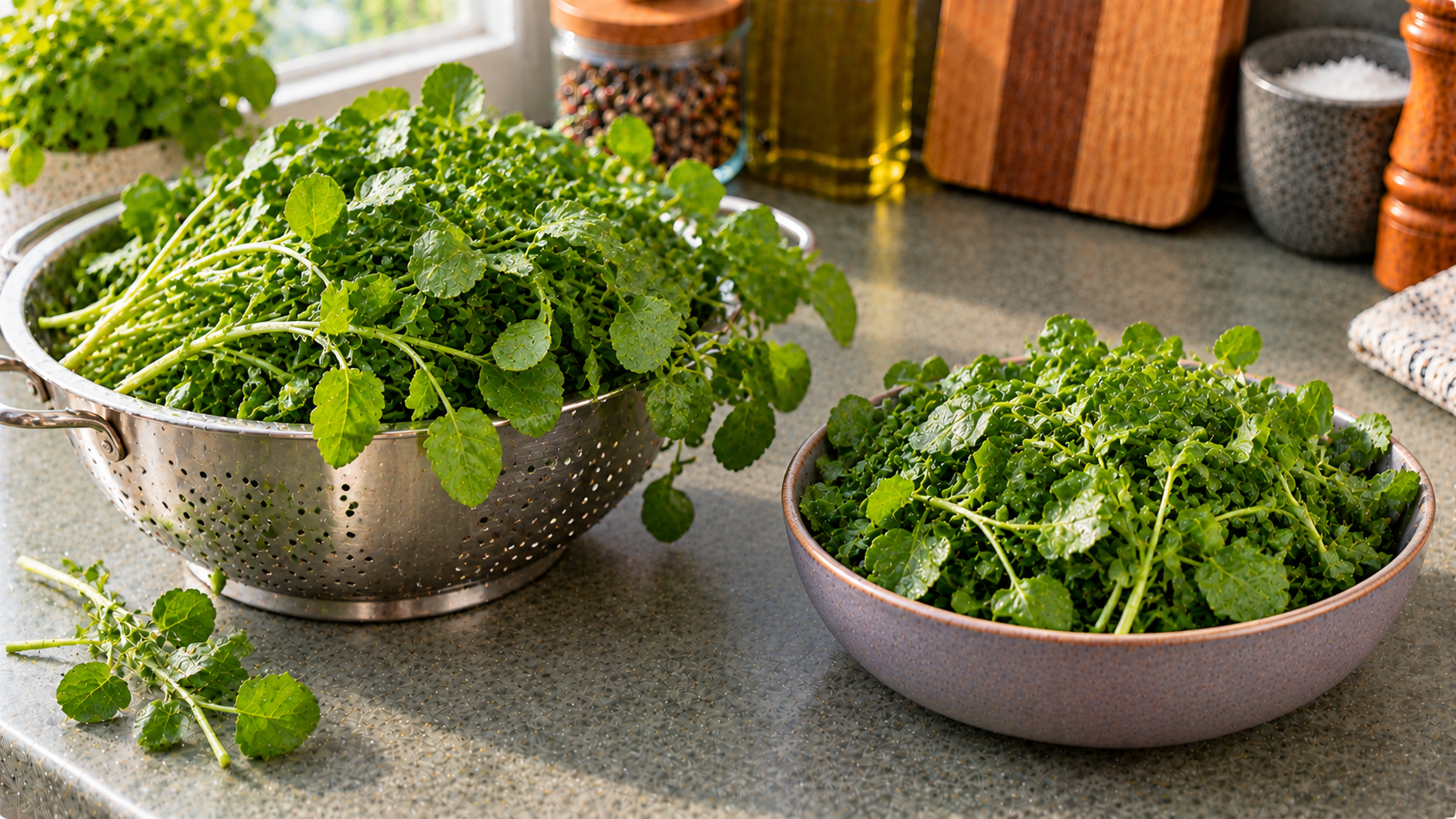
Watercress is an exceptionally light leafy vegetable: 11 kcal per 100 g raw, according to USDA FoodData Central. A standard 34 g chopped cup contains about 4 kcal. Watercress has a peppery taste and is commonly added to salads, sandwiches, soups and sauces.
The low number applies to raw watercress alone, not a dressed salad or cooked dish containing butter, cream or oil. If you are counting calories, weigh the edible leaves and tender stems, then account for the rest of the recipe separately.
Watercress nutrition per 100 g
The USDA SR Legacy entry Watercress, raw (FDC 170068) reports the following composition. Numbers reflect the edible part, without dressing.
| Nutrient | Amount per 100 g raw |
|---|---|
| Energy | 11 kcal |
| Protein | 2.30 g |
| Carbohydrate, by difference | 1.29 g |
| Total sugars | 0.20 g |
| Dietary fibre | 0.50 g |
| Total fat | 0.10 g |
| Water | 95.11 g |
| Calcium | 120 mg |
| Potassium | 330 mg |
| Vitamin C | 43 mg |
Source: USDA FoodData Central: watercress, raw, FDC 170068.
Watercress is largely water. Although protein accounts for a relatively high share of its tiny calorie total, 100 g supplies only 2.3 g of protein in absolute terms. It should not replace substantial protein foods in a meal.
Calories by serving size
The table scales the USDA value of 11 kcal per 100 g. The figures are rounded calculations, not separate tests of every serving.
| Raw edible weight | Calories | Protein | Carbohydrate |
|---|---|---|---|
| 10 g | 1 kcal | 0.2 g | 0.1 g |
| 25 g | 3 kcal | 0.6 g | 0.3 g |
| 34 g — 1 chopped cup | 4 kcal | 0.8 g | 0.4 g |
| 50 g | 6 kcal | 1.2 g | 0.6 g |
| 75 g | 8 kcal | 1.7 g | 1.0 g |
| 100 g | 11 kcal | 2.3 g | 1.3 g |
| 150 g | 17 kcal | 3.5 g | 1.9 g |
Calories = grams of edible raw watercress × 11 ÷ 100. For instance, a 60 g portion is roughly 7 kcal. When a calculated serving is below one calorie, rounding to whole calories can display zero without implying that the food has absolutely no energy.
How much does a cup or handful weigh?
USDA uses 34 g per cup of chopped raw watercress in the cited entry. This is a particular household measure, not a universal weight for every cup of greens. Loose, unchopped leaves occupy more space, and a packed cup holds more than a lightly filled one.
A few sprigs used in a sandwich may weigh only a few grams. A large salad bowl may contain several times as much. For practical tracking, weigh the leaves and tender stems once to learn what your usual handful represents rather than assuming that an entire packet equals one serving.
Watercress versus garden cress and arugula
Watercress refers to the aquatic leafy plant commonly called Nasturtium officinale. Garden cress is a different plant, and arugula or rocket is another distinct leafy vegetable. Similar peppery flavours do not mean their food-composition records are interchangeable.
Watercress and arugula have different flavour and composition; for the latter, see the calorie and portion guide to arugula.
For German shopping, watercress is Brunnenkresse, while garden cress is Gartenkresse. In French, watercress is usually cresson de fontaine. Use the actual product name when choosing a nutrition database entry, particularly for mixed salad bags.
Raw watercress, soup and cooked preparations
The 11-kcal figure describes raw watercress. Heating changes its weight, texture and possibly nutrient content, especially if water evaporates or the leaves are drained. It would be misleading to assign raw-food data to 100 g of finished soup without considering its water and other ingredients.
For a soup, record the quantity of watercress before cooking, then add potatoes, stock, onion, cream, butter and any oil. Calculate the calories in the complete pot and divide them among the portions actually served.
Example: 100 g watercress contributes only about 11 kcal. Adding 20 g olive oil contributes roughly 180 kcal, making the two-ingredient subtotal approximately 191 kcal before anything else. If four equal servings are made, each receives about 48 kcal from those two ingredients. This is a calculation example, not an average watercress soup recipe.
Salad dressings change the picture
A plain 34 g cup has approximately 4 kcal. A dressing with 10 g olive oil adds about 90 kcal if all of that oil is eaten. Nuts, cheese, avocado, mayonnaise and sugary sauces can also have substantial effects on the total.
This does not make a dressed watercress salad unhealthy. It simply means that the calorie content of the complete meal cannot be described by the leaves alone. For accurate tracking, record the dressing and other ingredients separately.
Vitamins and minerals: useful, but portion size matters
The USDA entry reports vitamin C, calcium, potassium and vitamin K in raw watercress. These can help diversify vegetable intake. However, nutrient values quoted per 100 g may look impressive compared with the much smaller 10–35 g amounts often eaten as a garnish.
Vitamin C contributes to normal collagen formation; vitamin K plays a role in normal blood clotting. People taking vitamin-K-sensitive anticoagulants should keep their intake of vitamin-K-rich greens consistent and follow clinical advice, rather than avoiding all such vegetables without guidance.
Washing fresh leaves appropriately and following food-safety advice is also important, especially for produce eaten raw. Wild watercress collected from uncertain waterways should not be assumed safe to eat; contaminated freshwater can pose infection risks.
Is watercress useful for managing weight?
Watercress adds flavour, colour and some micronutrients with very little energy. It works as a salad base, sandwich filling or topping, but its small amounts of fibre and protein per typical serving mean it is not a complete meal by itself.
A balanced plate can combine watercress with legumes, eggs, tofu, fish or another suitable protein source, plus other vegetables and an appropriate carbohydrate source. Weight management depends on overall dietary habits and energy intake, not on one low-calorie ingredient.
How to log watercress accurately
Select a raw watercress entry if the leaves were weighed raw. Remove any discarded roots or damaged portions from the recorded weight. When the leaves go into a recipe, calculate the full recipe rather than applying the raw value per 100 g to the finished dish. For packaged prepared foods, use the label.
Data source and limitations
Portion figures are derived from the USDA per-100-g entry and rounded. Product differences, edible yield and added ingredients can change the actual energy of a meal.