
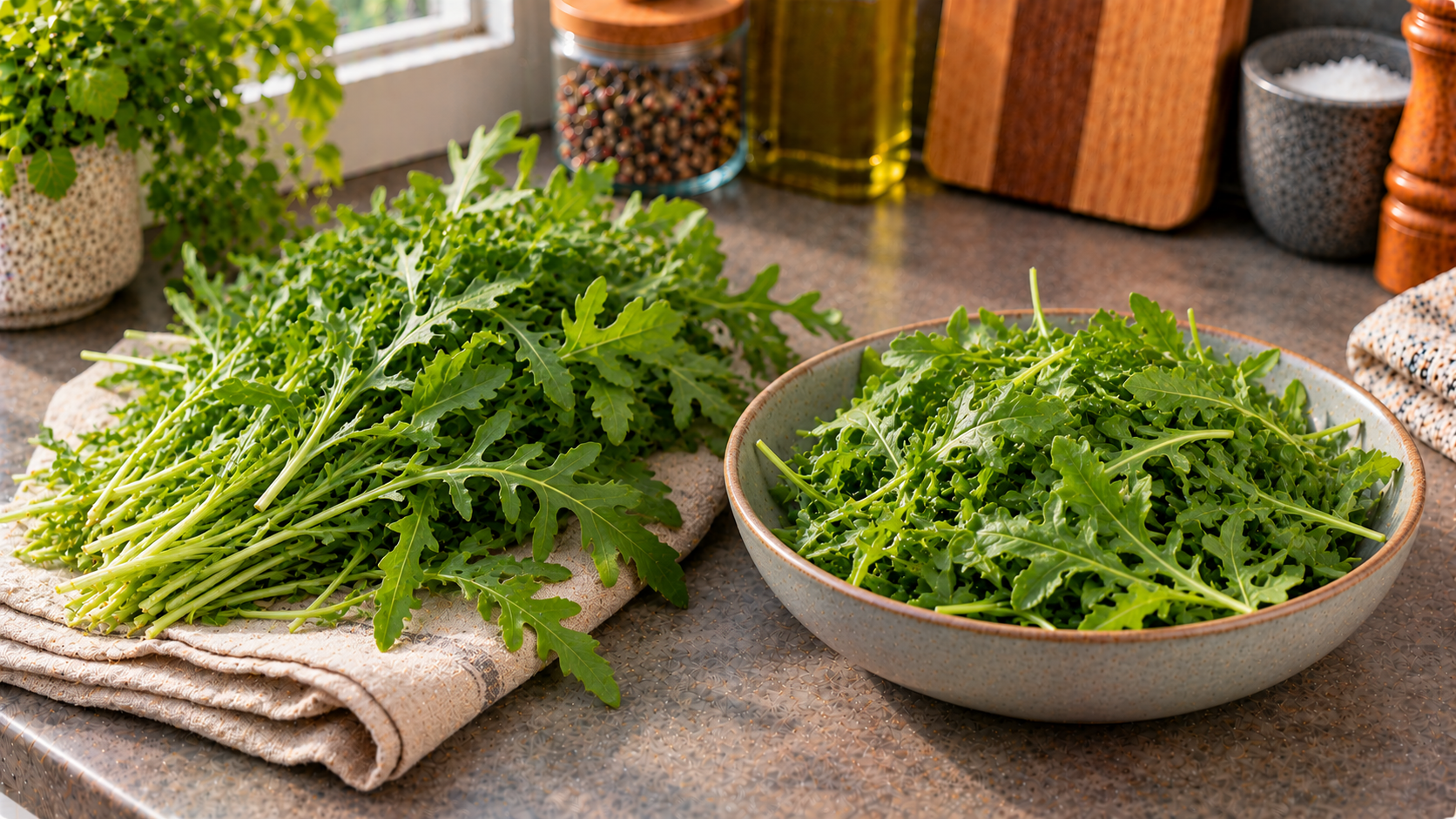
Arugula, also called rocket, contains approximately 25 calories per 100 g raw, according to USDA FoodData Central. A small handful can add a distinctive peppery taste to a salad or sandwich for only a few calories. The final calorie count, however, depends much more on the oil, cheese, nuts or dressing served with the leaves than on the arugula itself.
Arugula calories and nutrition per 100 g
The reference below is specifically arugula, raw, USDA FoodData Central SR Legacy FDC 169387. It describes the edible leaves without dressing or added ingredients.
| Nutrient | Per 100 g raw |
|---|---|
| Energy | 25 kcal |
| Protein | 2.58 g |
| Carbohydrate, total by difference | 3.65 g |
| Total sugars | 2.05 g |
| Dietary fibre | 1.60 g |
| Fat | 0.66 g |
| Water | 91.70 g |
| Calcium | 160 mg |
| Potassium | 369 mg |
| Folate | 97 µg |
| Vitamin K | 109 µg |
Source: USDA FoodData Central: Arugula, raw, FDC 169387. These figures are reference values, not a guaranteed analysis of every supermarket packet. Variety, freshness and the actual edible weight can affect a meal's nutrition.
The USDA total-carbohydrate field includes fibre under its reporting convention. European nutrition labels generally present available carbohydrates separately from fibre, so the two conventions should not be directly equated.
Calories in a handful, salad portion or large serving
Because rocket leaves are light, a typical salad garnish may weigh far less than 100 g. These examples use the 25 kcal per 100 g raw reference.
| Raw edible arugula | Calories | Protein | Fibre |
|---|---|---|---|
| 10 g | 3 kcal | 0.3 g | 0.2 g |
| 20 g | 5 kcal | 0.5 g | 0.3 g |
| 30 g | 8 kcal | 0.8 g | 0.5 g |
| 50 g | 13 kcal | 1.3 g | 0.8 g |
| 75 g | 19 kcal | 1.9 g | 1.2 g |
| 100 g | 25 kcal | 2.6 g | 1.6 g |
| 150 g | 38 kcal | 3.9 g | 2.4 g |
All amounts are calculated from the same food-composition entry and rounded. They are not separate laboratory analyses of these serving sizes.
Calories = edible raw grams × 25 ÷ 100. For instance, 40 g raw arugula is about 10 kcal before additional ingredients.
A handful is not a standard measurement: large leaves, tightly packed leaves and different hand sizes make it unreliable. Weigh the portion if you need accurate food logging.
How much does a cup of arugula weigh?
Cup measurements depend on how finely the leaves are cut and whether they are packed down. A cup of loosely filled whole leaves can weigh much less than a cup of chopped, compressed greens. Do not use a generic cup-to-gram conversion for every arugula preparation.
For practical tracking, place an empty bowl on the scale, tare it and add the leaves. Count the weight you will actually eat, excluding discarded stems or damaged leaves. Most of the time, weighing a salad garnish takes less effort than guessing a volume-based portion.
Does cooking arugula change its calories?
Arugula is usually eaten raw, but it can be folded into warm pasta, wilted in a pan or added to soup. Heat reduces volume and may change water content, which means 100 g cooked leaves cannot automatically be treated as equivalent to 100 g raw leaves.
If you start with 100 g raw arugula and wilt it without adding ingredients, the starting plant material still contributes approximately 25 kcal; a different finished weight does not mean calories appeared. Nutrient losses and cooking water may slightly change what remains in the dish.
For home recipes, it is often simpler to log the original raw weight and add oil, butter or other ingredients separately. Avoid inventing a cooked-arugula value when the database has only a raw record matching your ingredient.
Salad dressing can outweigh the leaves in calories
A salad of 50 g raw arugula contains roughly 13 kcal before dressing. Add 10 g olive oil and the oil contributes about 90 kcal, resulting in approximately 103 kcal before tomatoes, parmesan or other ingredients.
The practical lesson is not to avoid olive oil. It is to record what actually goes into the salad. Lemon juice, vinegar, cheese, seeds, avocado and nuts change both calories and the nutritional balance. A prepared salad should be tracked as a recipe, not as plain arugula.
If dressing is mixed in a communal bowl, calculate the entire dressing quantity and allocate it according to the portions eaten rather than assuming every plate received the same amount.
Arugula pesto is not nutritionally equivalent to fresh arugula
Arugula pesto commonly contains oil, nuts or seeds and hard cheese. These ingredients are energy-dense even though the leaves themselves contain few calories. There is no universal calorie value for pesto because recipes vary widely.
To estimate an arugula pesto rather than the leaves alone, count the oil, nuts and cheese using the pesto calorie guide.
For homemade pesto, weigh each ingredient and calculate the entire batch. For supermarket pesto, use the label per 100 g and the quantity actually served. Do not apply the raw arugula figure of 25 kcal per 100 g to a finished pesto sauce.
Vitamins, minerals and what a normal serving contributes
The USDA entry lists calcium, potassium, folate and vitamin K in arugula. These values look substantial when expressed per 100 g, but an ordinary 20 g garnish supplies only one fifth of the listed amounts. For example, a 20 g portion provides roughly 32 mg calcium and 19 µg folate based on the same reference.
Vitamin K supports normal blood clotting. If you take a vitamin-K-sensitive anticoagulant, maintain a consistent dietary pattern and follow professional advice rather than abruptly excluding leafy greens.
Arugula is useful as one component of a varied diet, not a stand-alone source of every nutrient. A larger salad needs other foods if it is intended to serve as a complete meal.
Arugula and weight management
Arugula can add volume, flavour and vegetables to meals with little energy from the leaves themselves. It does not independently cause weight loss. Total food intake and the energy supplied by toppings, bread, proteins and dressings matter more.
A practical lunch might pair arugula with beans or eggs, tomatoes, whole-grain bread and a measured dressing. This supplies a more complete meal than leaves alone and lets each ingredient be logged accurately.
Fresh, bagged and mixed salad leaves
Plain bagged arugula is generally similar in purpose to loose fresh leaves, but an arugula-spinach mix or pre-dressed salad is a different product. Use the packaging label when the product includes other leaves or additions. Wash and store according to product instructions, observing use-by information and refrigeration requirements.
For a recipe, use the raw entry only for the measured arugula itself. Do not assign its nutrition to an entire mixed-leaf packet without checking the ingredients.
Sources and method
- USDA FoodData Central, Arugula, raw, FDC 169387 — composition per 100 g edible raw leaves.
- Portion figures are derived from the cited per-100-g values; dressing and pesto examples use ingredient-level arithmetic, not brand averages.
The most reliable answer is 25 kcal per 100 g of plain raw arugula, scaled to the real edible weight. For a finished dish, calculate every meaningful added ingredient.