
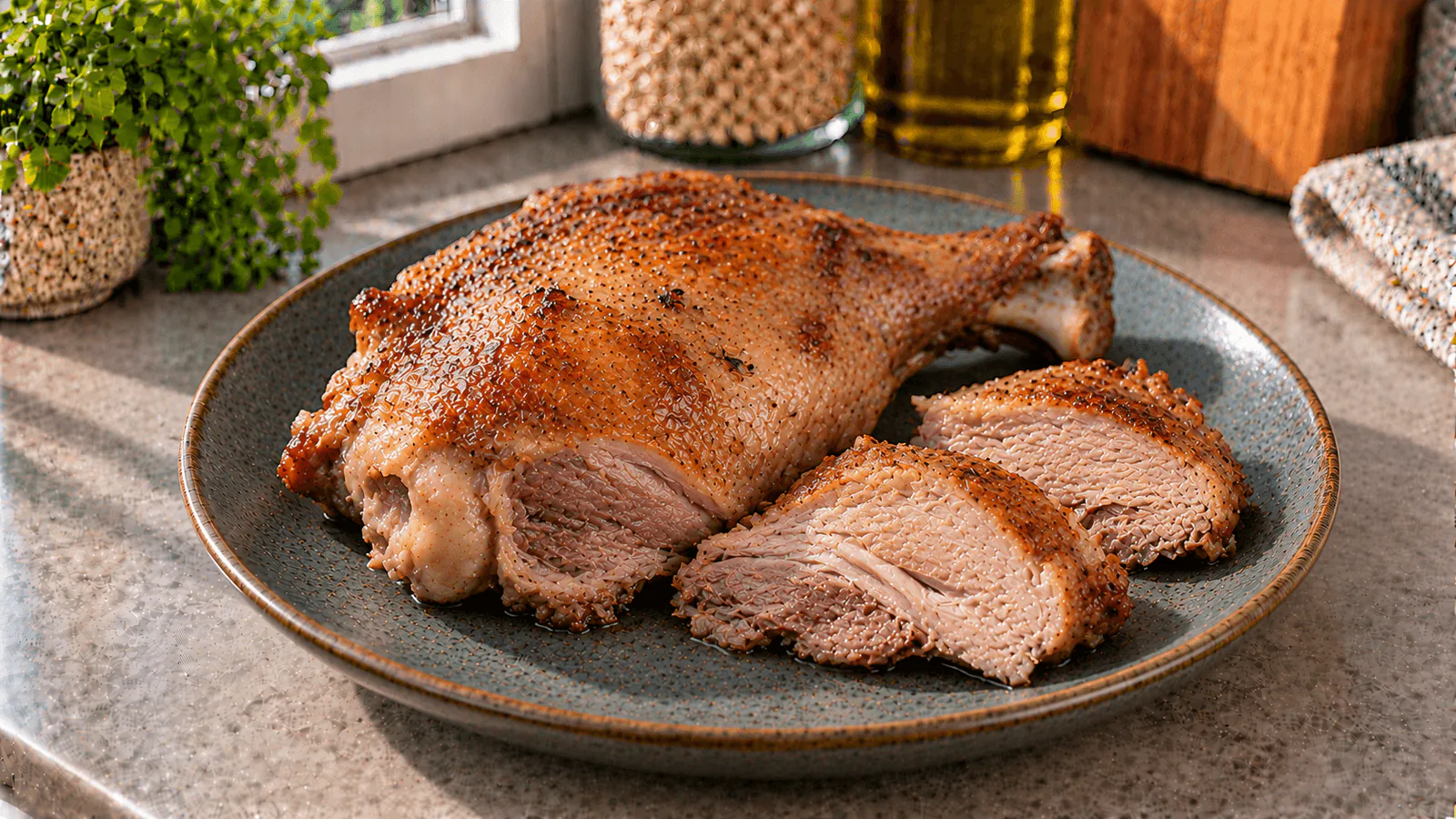
Roasted turkey thigh is a source of protein, but its calories depend on which part of the thigh you eat and how you weigh it. For 100 g of roasted turkey thigh meat without skin, the USDA reference is 165 kcal, 27.71 g of protein and 6.04 g of fat. Including the roasted skin changes the reference to 183 kcal per 100 g. Raw skinless thigh has another value, 108 kcal per 100 g. These are not contradictory figures: they describe different products and different amounts of water.
To estimate your plate, identify whether the thigh is raw or cooked, whether you eat the skin, and how much edible meat remains after removing the bone. This guide explains the three reference foods, useful portions, oven cooking, packaged thighs and the common mistakes that can change a food diary by hundreds of calories.
Turkey thigh calories per 100 g: the three relevant states
USDA FoodData Central has separate SR Legacy records for turkey thigh from a whole bird, meat only, raw (FDC 171531); meat only, roasted (FDC 171532); and retail turkey thigh, meat and skin, roasted (FDC 171137). The values below are per 100 g of the specific edible product described. They are not averages for a whole bone-in thigh.
| Turkey thigh reference | Calories | Protein | Fat | Carbohydrate | Sodium |
|---|---|---|---|---|---|
| Raw thigh, meat only | 108 kcal | 21.28 g | 2.50 g | 0.15 g | 124 mg |
| Roasted thigh, meat only | 165 kcal | 27.71 g | 6.04 g | 0.00 g | 104 mg |
| Roasted thigh, meat and skin | 183 kcal | 24.00 g | 9.50 g | 0.41 g | 101 mg |
Sources: USDA raw turkey thigh, FDC 171531, USDA roasted thigh without skin, FDC 171532 and USDA roasted thigh with skin, FDC 171137. The last line comes from a retail-parts reference rather than precisely the same whole-bird specimen. These records describe representative foods; a particular breed, trimming method or branded preparation may differ.
Turkey thigh is dark meat and generally contains more fat than a very lean breast preparation. That does not make it an inherently poor choice. It simply means that the cut, skin and recipe must match the entry used for tracking. Protein is present in all three descriptions, while carbohydrates are negligible in plain, unseasoned meat.
Calories in typical cooked portions
The following estimates use 165 kcal/100 g for cooked skinless meat and 183 kcal/100 g for cooked meat with skin. They assume you have already removed bones and that no oil, glaze or sauce is included.
| Cooked edible weight | Roasted meat only | Roasted meat with skin |
|---|---|---|
| 50 g | 83 kcal | 92 kcal |
| 75 g | 124 kcal | 137 kcal |
| 85 g | 140 kcal | 156 kcal |
| 100 g | 165 kcal | 183 kcal |
| 125 g | 206 kcal | 229 kcal |
| 150 g | 248 kcal | 275 kcal |
| 200 g | 330 kcal | 366 kcal |
| 250 g | 413 kcal | 458 kcal |
All numbers are rounded from the 100 g reference. Calculate your own portion as cooked edible grams × calories per 100 g ÷ 100. For example, 180 g of roasted skinless turkey thigh contributes about 297 kcal; 180 g of the meat-and-skin reference contributes about 329 kcal. A restaurant leg or a large holiday serving can be much heavier than a 100 g entry.
An 85 g cooked meat-only serving gives approximately 140 kcal and 23.6 g protein, calculated from the corresponding USDA nutrient profile. A 150 g serving gives about 248 kcal and 41.6 g protein. Those protein amounts are useful for comparing portions, but they should not be interpreted as the protein in an entire bone-in thigh of unknown weight.
Does the bone count in the weight?
No. Most nutrition databases express turkey thigh values per 100 g edible portion. Bone, hard cartilage and other discarded parts are not food. If your whole cooked leg and thigh weighs 450 g with the bones, multiplying 450 g by 165 kcal/100 g would be incorrect. You have to estimate or weigh the edible meat you actually consume.
A practical method is to weigh the cooked piece before eating, collect the bones and untouched scraps, and subtract their weight afterward. For example, a 350 g cooked bone-in piece with 120 g of bone and discarded parts yields 230 g eaten. If those 230 g are skinless roast meat, the estimated energy is about 380 kcal. If skin was consumed, use the appropriate mixed meat-and-skin entry or separately weigh the skin where practical. The 120 g discard in this illustration is not a universal bone percentage.
Buying boneless, skinless turkey thigh makes logging simpler. Check whether a package's nutrition panel applies to raw boneless meat, to a prepared product, or to a cooked portion. The weight shown on the front of a package may include a solution, marinade, skin or other ingredients. Read the full label rather than assuming it exactly matches USDA's plain meat.
Why are raw and roasted calories different?
Cooking usually changes moisture content. When raw turkey thigh loses water in the oven, a smaller mass of cooked food can have a higher concentration of calories and protein per 100 g. The USDA raw skinless reference is 108 kcal/100 g, while the roasted skinless entry is 165 kcal/100 g. That difference does not mean the oven created energy in the turkey.
Use the entry that matches the point at which you weighed your food. If you measured 300 g of raw edible meat, the raw reference gives 324 kcal before oil or other ingredients. If you later weigh the resulting roast and eat the entire cooked batch, its total turkey calories are still broadly represented by that original raw calculation, subject to drippings and discarded fat. Do not apply 165 kcal to the original 300 g raw weight merely because you will roast it.
Conversely, if someone hands you 150 g of cooked roasted meat, the appropriate cooked skinless reference gives 248 kcal. Comparing those two weights directly is misleading because one was measured before cooking and the other afterward. Cooked yield depends on temperature, cooking time, cut thickness and retained juices, so there is no precise universal raw-to-cooked conversion factor.
Skin-on versus skinless: what changes?
Skin adds fat to the portion and can also carry seasonings or cooking oil. In the USDA records shown here, 100 g roasted meat plus skin is 183 kcal, versus 165 kcal for skinless roasted meat. The difference for a 150 g serving is 27 kcal using those reference mixtures. For a larger portion, the difference increases, though individual skin proportions vary.
Do not interpret this comparison to mean that removing one small patch of skin always removes exactly 18 kcal per 100 g of the remaining food. The datasets refer to different mixtures by weight. Crispy skin brushed with oil can have a different profile, and poultry skin rendered during cooking may leave some fat in the pan. For a consistent diary, note whether you actually ate the skin and avoid counting the same rendered fat twice.
If you're deciding between cuts, compare the nutrition and calories of turkey breast on the same cooked-weight basis. Turkey breast tends to be leaner, but the recipe may matter more than the name of the cut. A skinless thigh with vegetables and a moderate amount of oil can fit many eating plans without needing to be replaced by breast every time.
How much do oil, butter and sauces add?
An oven-roasted thigh with no added fat is not nutritionally identical to one basted with butter or cooked in a sugary glaze. A useful recipe calculation starts with the weight of plain cooked meat, adds oils and other ingredients actually consumed, then divides the total by the number of portions.
Suppose you eat 150 g of roasted skinless thigh and the food retains the equivalent of 10 g cooking oil. Using about 9 kcal per gram of oil, the arithmetic is:
| Component | Weight or calculation | Calories |
|---|---|---|
| Roasted skinless turkey thigh | 150 g at 165 kcal/100 g | 248 kcal |
| Oil consumed with the portion | 10 g at 9 kcal/g | 90 kcal |
| Combined turkey and oil | Without sides or sauces | 338 kcal |
This is a worked example, not a standard serving label. If most of the oil remains in the roasting tray and is discarded, counting every gram as eaten overstates the meal. If you eat pan juices, oily skin or a rich sauce, leaving these out understates the meal. Include potatoes, stuffing, gravy and other sides individually.
A sweet bottled glaze may add sugar; salty brines and seasoned turkey products may have much more sodium than the unseasoned USDA reference. For store-bought cooked slices, smoked turkey thighs or ready-made meals, the package label is a more appropriate source than the plain roasted entry.
Turkey thigh compared with chicken thigh and ground turkey
When comparing similar poultry portions, keep the measurement basis consistent: edible grams, raw or cooked state, skin and any added fat. Our chicken thigh calorie guide uses chicken-specific references, so do not assume chicken and turkey thighs have interchangeable numbers. The darker colour of meat alone cannot tell you the exact calorie content.
Ground turkey is a different product again. Manufacturers can grind variable combinations of cuts and fat, and the fat percentage strongly affects calories. Use our ground turkey nutrition guide rather than substituting turkey-thigh data for mince or meatballs. Similarly, deli turkey that has been cured, smoked or injected with brine is not the same as plain roasted thigh.
You can use thigh in soups, grain bowls, wraps or leftovers. A soup may contain a relatively small amount of turkey but substantial noodles or potatoes; a wrap may add dressing, tortilla and cheese. In each case, the right question is how much thigh meat you ate and what else went into the dish, not simply whether its name includes turkey.
Cooking and storage safety
Raw turkey should be handled as raw poultry. FoodSafety.gov recommends cooking all turkey, including thighs, to a safe minimum internal temperature of 74 °C (165 °F), measured with a food thermometer. Place the probe in the thickest part of the meat, avoiding the bone, since a bone contact can distort the reading. Colour and clear juices alone cannot reliably prove that a thick piece is safe. See the safe minimum internal temperature chart and USDA advice on checking turkey temperature.
Refrigerate perishable leftovers promptly, use clean utensils for cooked meat and do not place cooked turkey back on a plate that held raw poultry unless it has been washed. Frozen products should be thawed safely. Cooking temperatures are a food-safety condition, not a promise about final calorie density, which still depends on moisture and ingredients.
A simple method for accurate tracking
First decide which nutritional state fits your food: raw meat without skin, roasted meat without skin or roasted meat with skin. Next determine the edible weight rather than the weight of a bone-in piece. Finally add any oil, stuffing, gravy and other ingredients you ate. If a particular package supplies its own complete nutrition panel, prefer that product-specific information.
If you log 150 g of roasted skinless thigh today and 150 g next week, the same reference lets you compare your portions reasonably consistently. But if one portion includes skin and gravy and the other is plain, their calories will differ even at the same weight. The difference between portion size and serving size may also help when a food label uses a smaller example serving than you normally eat.
Reference data: USDA SR Legacy raw thigh, meat only, FDC 171531; USDA SR Legacy roasted thigh, meat only, FDC 171532; USDA SR Legacy roasted thigh, meat and skin, FDC 171137. All serving calculations are rounded and represent edible weight.