
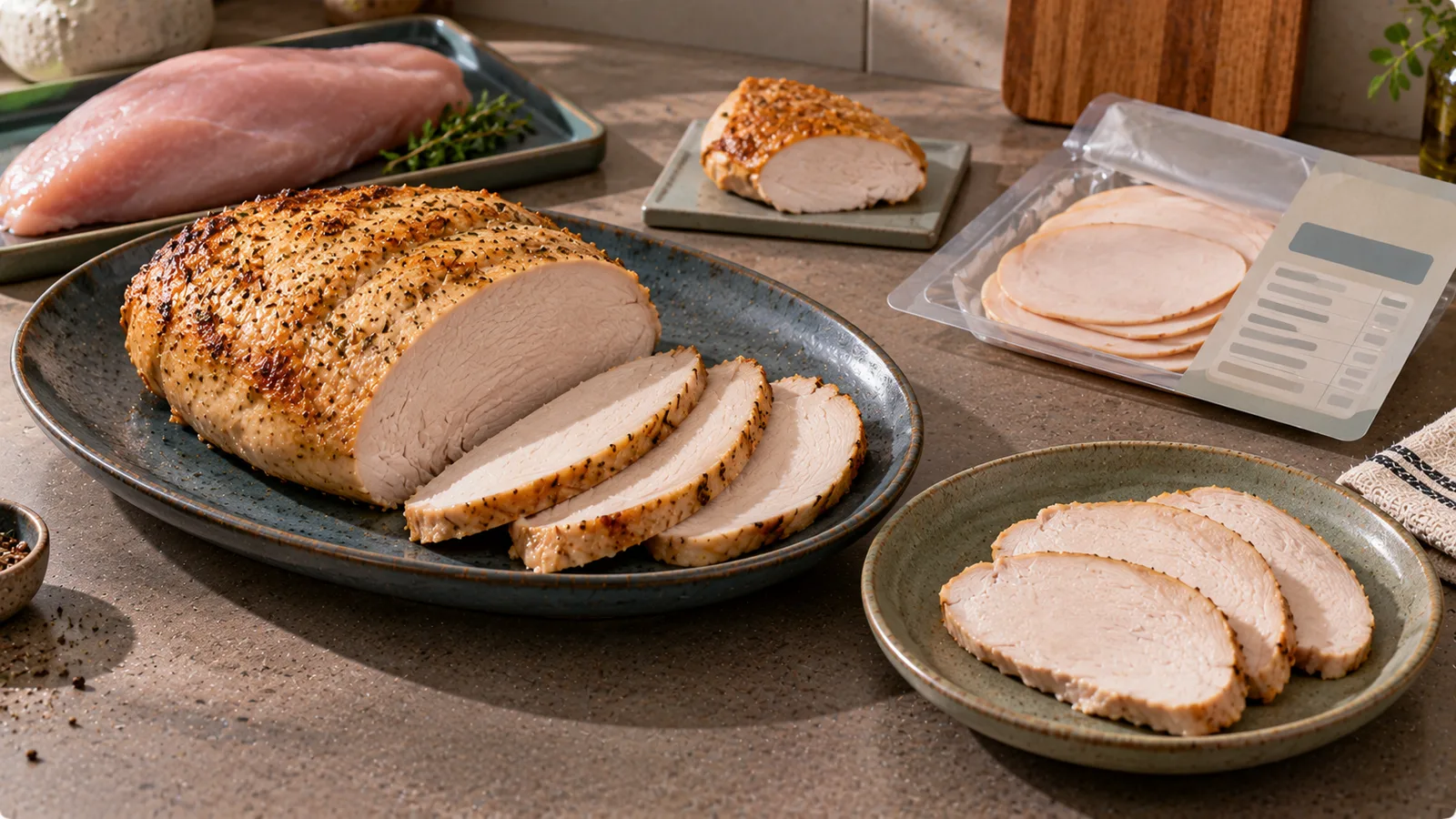
Turkey breast is a protein-rich poultry food, but its calorie content depends on whether you weigh it raw or cooked, whether the skin is included, and how it was prepared.
For a practical starting point, 100 g of plain, roasted, skinless turkey breast contains approximately 135 kcal and 29 g of protein. Raw skinless turkey breast generally has fewer calories and less protein per 100 g because it contains more water.
These are rounded reference estimates, not values that apply to every turkey product. The most accurate figure for a packaged product is its own nutrition label.
Turkey breast calories at a glance
| Turkey breast | Calories per 100 g | Protein per 100 g | What the value represents |
|---|---|---|---|
| Raw, skinless | About 110 kcal | About 24 g | Uncooked lean breast meat |
| Roasted, skinless | About 135 kcal | About 29 g | Plain cooked breast meat |
| Roasted with skin | Usually higher | Varies | Breast meat plus edible skin |
| Packaged deli turkey | Varies by product | Varies | Processed, sliced ready-to-eat turkey |
The first two rows are rounded illustrative values broadly consistent with entries in USDA FoodData Central. Actual values differ by sample, cut, moisture, preparation and database entry. USDA FoodData Central.
Skin-on turkey and deli turkey do not have a reliable universal calorie number. Added fat, brine, starch, sugar, water and other ingredients can change the nutrition profile.
How many calories are in a serving?
Using the reference value of 135 kcal per 100 g of cooked, skinless turkey breast:
| Cooked turkey breast | Estimated calories | Estimated protein |
|---|---|---|
| 50 g | 68 kcal | 14.5 g |
| 75 g | 101 kcal | 21.8 g |
| 100 g | 135 kcal | 29 g |
| 120 g | 162 kcal | 34.8 g |
| 150 g | 203 kcal | 43.5 g |
| 200 g | 270 kcal | 58 g |
| 250 g | 338 kcal | 72.5 g |
Values are calculated from the rounded 100 g reference, so small differences may arise from rounding.
To calculate your own serving:
Calories = calories per 100 g × portion weight in grams ÷ 100
For example, 180 g of cooked turkey breast at 135 kcal per 100 g contains:
135 × 180 ÷ 100 = 243 kcal.
The same calculation works for protein, fat and other nutrients.
Raw versus cooked turkey breast
One of the most common food-tracking mistakes is combining a raw weight with nutrition values for cooked meat.
Turkey loses water during roasting or pan-cooking. The cooked portion therefore weighs less, even though the original meat still contributes its nutrients, apart from losses into cooking juices and other preparation-related changes.
Consider an illustrative example:
- You start with 200 g of raw, skinless turkey breast.
- The raw meat contains approximately 110 kcal per 100 g.
- Its starting energy is approximately 220 kcal.
- After cooking, the meat weighs 160 g.
If you recorded 160 g using a raw-food entry, you would underestimate the amount of raw meat used.
Instead, choose one consistent method:
- Weigh before cooking: log the raw weight using a raw turkey-breast database entry.
- Weigh after cooking: log the cooked weight using a cooked turkey-breast entry.
Do not assume every turkey breast loses exactly 20% of its weight. Cooking method, temperature, duration and thickness affect moisture loss.
The example is a simplified illustration; fat or juices discarded during cooking and added ingredients can affect the final energy calculation.
Does turkey skin change the calories?
Yes. Turkey skin contains more fat than lean breast muscle, so including edible skin generally increases the calorie and fat content of the portion.
When comparing values, check whether the database entry says:
- meat only;
- meat and skin;
- skin removed before eating;
- roasted or otherwise cooked.
A nutrition value for skinless breast should not be used for a serving that includes a substantial amount of skin.
If the turkey was roasted with skin but you removed the skin before eating, choose an entry representing the edible meat rather than the whole skin-on portion.
What about turkey breast cooked with oil?
Plain roasted turkey breast and turkey cooked with added oil are not nutritionally identical.
For example, if a pan-cooked portion absorbs an estimated 5 g of oil, that oil adds approximately 45 kcal.
The actual absorbed amount depends on the cooking method and how much oil remains in the pan.
For a home-cooked recipe, a practical approach is to log the turkey and the oil or other ingredients separately, then divide the recipe into the portions actually eaten.
Sauces, breading, butter and marinades can also change the final calorie content.
Deli turkey is a different product
Packaged sliced turkey breast is often sold as deli meat or sandwich meat.
Its nutrition can differ from plain roasted turkey because manufacturers may add:
- water or brine;
- salt;
- starches or other binders;
- sugar or flavourings;
- preservatives, depending on the product.
Some products contain less protein per 100 g than plain cooked breast because of their water content. Sodium can also be substantially different.
Use the package label for the exact deli turkey you buy. Avoid assigning plain roasted turkey values to all packaged turkey slices.
In the EU, nutrition labels generally provide values per 100 g or 100 ml, which makes comparisons between products easier. European Commission — Nutrition labelling.
Is turkey breast a good protein source?
Turkey breast provides substantial protein relative to its calorie content, especially when it is skinless and cooked without large amounts of added fat.
Protein is needed for normal tissue maintenance and many physiological functions. However, a single food does not determine whether a person's total protein intake is adequate.
The amount you need depends on factors such as body size, activity and health circumstances.
For a general reference, the European Food Safety Authority established a population reference intake of 0.83 g of protein per kilogram of body weight per day for healthy adults. Individual requirements may differ. EFSA — Dietary Reference Values for protein.
For example, 150 g of cooked skinless turkey breast at the rounded reference value supplies about 43.5 g of protein. This is a food composition calculation, not a suggested daily target or required serving.
Turkey breast versus turkey thigh
Breast and thigh are different cuts, and their nutrition values should not be treated as interchangeable.
Turkey breast is generally leaner than thigh meat, especially when the breast is skinless. However, the exact comparison depends on whether the meat is raw or cooked, whether skin is included and which database entries are used.
If you eat a mixed portion of turkey, such as meat from several parts of a roasted bird, a breast-only entry may not accurately represent the meal.
How to log turkey breast accurately
Use this quick process:
- Identify the cut: turkey breast rather than thigh or mixed turkey.
- Check whether the skin was eaten.
- Record whether the meat was weighed raw or cooked.
- Select a matching database entry or the packaged product's label.
- Weigh only the edible portion, excluding bones and discarded parts.
- Include added oil, sauces, breading and other ingredients.
- Scale the values to the actual amount eaten.
For a restaurant meal or an unweighed serving, any estimate is less precise. A reasonable estimate is still more useful than treating every turkey portion as exactly 100 g.
Common questions
How many calories are in 100 g of turkey breast?
A useful estimate for plain, roasted, skinless turkey breast is about 135 kcal per 100 g. Raw skinless breast is approximately 110 kcal per 100 g in the illustrative reference used here. Exact values depend on the product and preparation.
How much protein is in 100 g of turkey breast?
Plain cooked, skinless turkey breast provides approximately 29 g of protein per 100 g in the rounded reference used in this article.
How many calories are in 200 g of cooked turkey breast?
At 135 kcal per 100 g, 200 g contains approximately 270 kcal, before any added oil, sauces or other ingredients.
Should I weigh turkey before or after cooking?
Either method works. The important point is to use a nutrition entry that matches the state in which you weighed the meat.
Are turkey breast slices the same as roasted turkey breast?
Not necessarily. Deli turkey may contain added water, salt and other ingredients. Check the nutrition label for the specific product.