
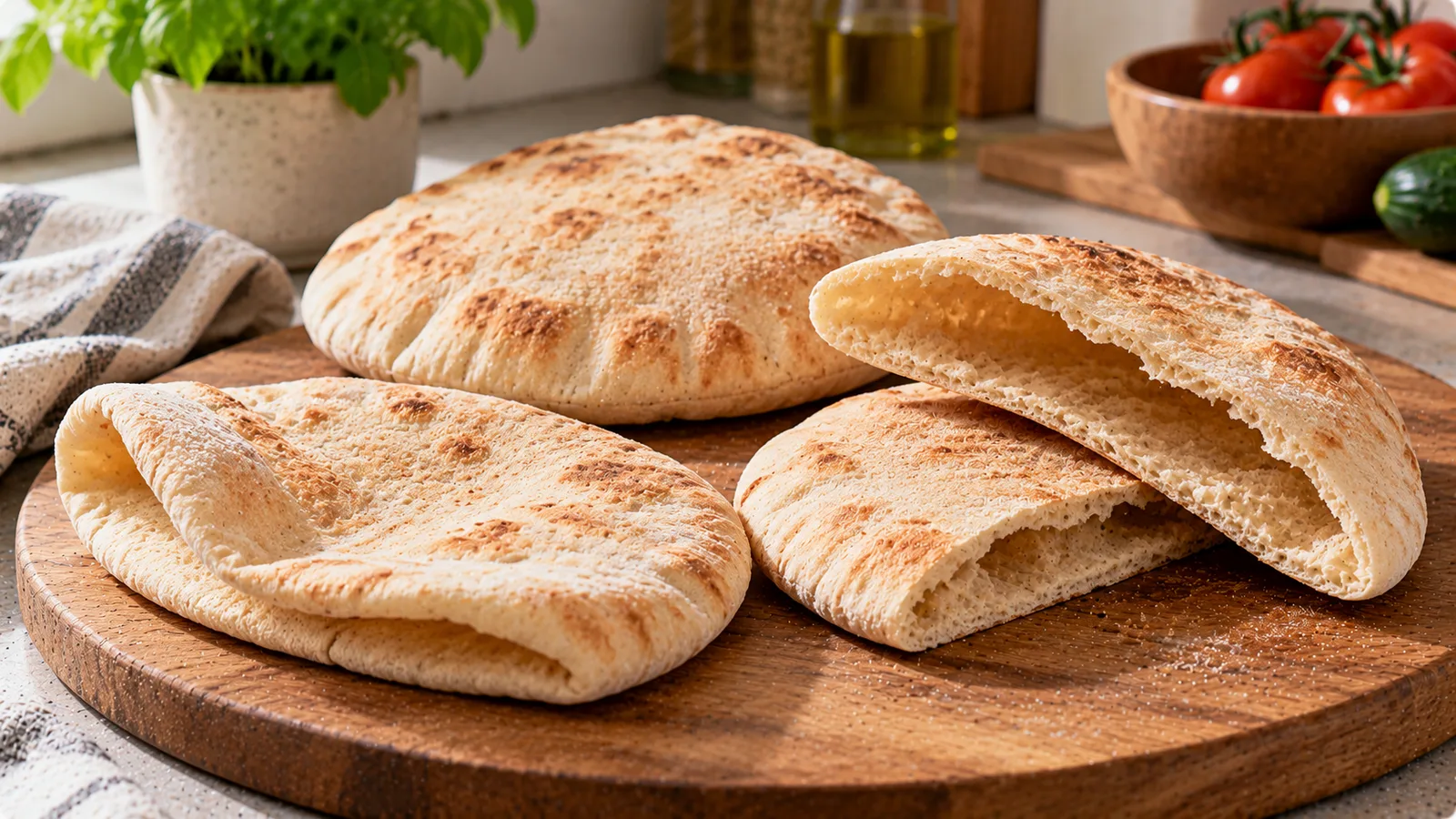
Pita bread is a popular flatbread used for sandwiches, wraps, dips and Mediterranean-style meals.
But how many calories does one pita contain?
The answer depends mainly on the weight of the bread, rather than whether it is round, folded or filled.
As a practical starting point, plain pita bread often provides approximately 250–290 calories per 100 g.
A small pita weighing 40 g might therefore contain about 100–116 calories, while a large pita weighing 90 g could contain 225–261 calories.
These are general estimates. The exact values depend on the recipe, moisture content and product.
Pita bread calories at a glance
The following calculations use an illustrative range of 250–290 kcal per 100 g.
| Pita portion | Estimated calories |
|---|---|
| 25 g, half a small pita | 63–73 kcal |
| 40 g, small pita | 100–116 kcal |
| 50 g, medium pita | 125–145 kcal |
| 60 g, medium-large pita | 150–174 kcal |
| 75 g, large pita | 188–218 kcal |
| 90 g, large thick pita | 225–261 kcal |
| 100 g | 250–290 kcal |
| 150 g | 375–435 kcal |
The ranges are calculated from the stated per-100-g values, not taken from one specific branded product.
A large, thick pita can contain more than twice as many calories as a small, thin one.
For accurate tracking, check the package and weigh the bread.
How many calories are in one pita?
There is no universal weight for one pita bread.
Some mini pitas weigh around 30–40 g.
A common medium pita may weigh approximately 50–65 g.
Large bakery pitas can weigh 80–100 g or more.
Using a representative value of 270 kcal per 100 g, the calorie calculation looks like this:
| Weight of one pita | Calories |
|---|---|
| 30 g | 81 kcal |
| 40 g | 108 kcal |
| 50 g | 135 kcal |
| 60 g | 162 kcal |
| 70 g | 189 kcal |
| 80 g | 216 kcal |
| 90 g | 243 kcal |
| 100 g | 270 kcal |
A pita sold as one serving is not necessarily the same size as a pita from another brand.
That is why the weight printed on the package is more useful than the number of pieces.
Pita bread nutrition per 100 g
Plain wheat pita is usually made from flour, water, yeast or another leavening method, and salt.
Some recipes also contain oil or sugar.
The following are broad illustrative ranges for plain wheat pita bread.
| Nutrient | Approximate amount per 100 g |
|---|---|
| Energy | 250–290 kcal |
| Protein | 8–11 g |
| Fat | 1–4 g |
| Total carbohydrate, including fiber in US-style databases | 50–58 g |
| Fiber | 2–5 g |
| Sodium | Varies with added salt |
These ranges describe different possible products.
Do not combine every upper value into one supposedly exact nutritional profile.
Whole-wheat pita may contain more fiber, while pita made with added oil can have more fat.
Why carbohydrate numbers may differ
US nutrition databases generally include fiber in total carbohydrate.
EU nutrition labels list carbohydrate and fiber separately.
For that reason, carbohydrate figures may look different across international food databases.
Check which definition is being used before comparing values.
White pita versus whole-wheat pita
Whole-wheat pita is made with whole-grain flour, while white pita usually uses refined wheat flour.
The calorie difference is often smaller than people expect.
| Feature | White pita | Whole-wheat pita |
|---|---|---|
| Main flour | Refined wheat | Whole wheat |
| Calories per 100 g | Often similar | Often similar |
| Fiber | Usually lower | Usually higher |
| Texture | Often softer and lighter | Sometimes denser |
| Flavor | Mild | More grain-forward |
| Portion calories | Depend on weight | Depend on weight |
Whole-wheat pita can be a useful way to increase dietary fiber.
However, it is not automatically lower in calories.
A 75 g whole-wheat pita may contain more calories than a 45 g white pita simply because it is larger.
For calorie comparisons, use the actual product values and portion weights.
Does pita bread have fewer calories than regular bread?
Not necessarily.
Pita and ordinary sliced bread often use similar basic ingredients.
The energy content per 100 g can therefore overlap.
The difference often comes from serving size.
For example:
- One 50 g pita at 270 kcal per 100 g contains 135 kcal.
- Two slices of bread weighing 70 g total at 250 kcal per 100 g contain 175 kcal.
In this example, the pita has fewer calories because the portion is smaller.
That does not mean pita bread is inherently lower in calories.
If the pita weighs 90 g, the result changes.
Pita bread versus tortillas
Pita bread and tortillas are both used for wraps and filled meals, but their recipes and sizes vary.
A plain wheat pita typically contains flour, water, yeast and salt.
A flour tortilla may contain added fat to achieve a flexible texture.
However, product-specific differences are large.
A small tortilla can have fewer calories than a large pita.
A large flour tortilla can contain more calories than a medium pita.
The correct comparison is:
- Check calories per 100 g.
- Check the weight of one piece.
- Calculate calories for the portion you actually eat.
Do not compare one pita with one tortilla without considering their sizes.
How many calories are in half a pita?
Half a pita contains approximately half the calories of the full bread, provided it is divided into two equal-weight pieces.
At 270 kcal per 100 g:
| Full pita weight | Half pita weight | Calories in half |
|---|---|---|
| 40 g | 20 g | 54 kcal |
| 60 g | 30 g | 81 kcal |
| 80 g | 40 g | 108 kcal |
| 100 g | 50 g | 135 kcal |
If you cut the pita unevenly, weigh the piece for a more accurate result.
How many calories are in two pita breads?
Using 270 kcal per 100 g:
| Weight of each pita | Calories in two |
|---|---|
| 40 g | 216 kcal |
| 50 g | 270 kcal |
| 60 g | 324 kcal |
| 75 g | 405 kcal |
| 90 g | 486 kcal |
Two large pitas can contribute a substantial amount of energy before fillings are added.
The number of pieces alone does not tell you enough.
How much pita bread is 100 calories?
Use this formula:
Weight for 100 calories = 100 ÷ calories per 100 g × 100
At 250 kcal per 100 g:
100 ÷ 250 × 100 = 40 g.
At 270 kcal per 100 g:
100 ÷ 270 × 100 = approximately 37 g.
At 290 kcal per 100 g:
100 ÷ 290 × 100 = approximately 34 g.
A practical estimate is therefore 34–40 g of plain pita bread for about 100 calories.
Calories in pita bread with fillings
The bread is only one part of a filled pita.
Meat, falafel, hummus, cheese, sauces and vegetables all affect the final calorie total.
The following are illustrative ingredient estimates.
| Filling | Example quantity | Approximate calories |
|---|---|---|
| Hummus | 40 g | 65–110 kcal |
| Cooked chicken breast | 100 g | 150–170 kcal |
| Falafel | 80 g | 200–270 kcal |
| Feta cheese | 40 g | 100–115 kcal |
| Tzatziki | 50 g | 30–70 kcal |
| Lettuce and tomato | 80 g | 15–25 kcal |
| Olive oil | 10 g | 88–90 kcal |
Actual values depend on preparation and brands.
Example: chicken pita
Suppose you make a pita sandwich using:
- 60 g pita bread at 270 kcal per 100 g: 162 kcal.
- 100 g cooked chicken breast: approximately 165 kcal.
- 80 g lettuce and tomato: approximately 20 kcal.
- 50 g tzatziki: approximately 50 kcal.
Estimated total: 397 kcal.
If you add 10 g olive oil, the meal increases by approximately 90 kcal.
Example: falafel pita
A pita with:
- 60 g bread: approximately 162 kcal.
- 80 g falafel: approximately 230 kcal.
- 40 g hummus: approximately 90 kcal.
- 80 g vegetables: approximately 20 kcal.
Estimated total: 502 kcal.
These are examples, not fixed values for every restaurant or homemade sandwich.
Is pita bread good for weight loss?
Pita bread can fit into a weight-loss diet.
Weight management depends primarily on total energy intake and expenditure over time.
No bread type automatically causes weight gain or weight loss.
Pita can be convenient for portion planning because each piece forms a defined sandwich pocket.
However, large pitas and generous fillings can make a meal more calorie-dense than expected.
Useful approaches include:
- Choosing a pita size that matches your appetite.
- Adding vegetables for volume.
- Including a suitable protein source.
- Measuring energy-dense sauces and spreads.
- Using whole-wheat pita when you want more fiber.
You do not need to eliminate pita bread to manage calorie intake.
Is pita bread healthy?
Pita can be part of a balanced diet.
Its nutritional value depends on the flour, added ingredients and what you eat with it.
Whole-wheat pita usually provides more fiber than white pita.
A pita filled with vegetables, beans and a protein source can make a balanced meal.
A pita filled mainly with fried foods and large quantities of sauce may have a very different nutritional profile.
Consider the complete meal rather than judging the bread in isolation.
Is pita bread gluten-free?
Traditional wheat pita is not gluten-free.
People with celiac disease or another medically necessary gluten restriction should choose appropriately labeled gluten-free pita made from suitable ingredients.
Check for cross-contact risks when buying from bakeries or restaurants.
Does warming or toasting pita change its calories?
Warming or toasting pita can remove some moisture.
It does not meaningfully remove the energy contained in the bread.
A pita weighed before heating generally contains approximately the same calories afterward, assuming nothing is added or significantly burned.
Because moisture loss reduces weight, the calories per 100 g of toasted pita can appear higher.
For nutrition tracking, weigh the pita before heating and use the original product label.
How to track pita bread accurately
The most reliable method is to use grams.
- Check the package for calories per 100 g.
- Weigh one pita or the portion you plan to eat.
- Multiply its weight by the calorie value.
- Divide by 100.
- Record fillings, spreads and cooking oils separately.
For example:
Pita weight: 68 g.
Label: 264 kcal per 100 g.
68 × 264 ÷ 100 = 179.52 kcal.
Log approximately 180 kcal for the bread.
What if there is no nutrition label?
For bakery pita without a label, select a generic entry that closely matches the bread type.
Use white wheat pita for a plain white pita, and whole-wheat pita for a whole-grain product.
Weigh the bread.
Remember that a generic entry is an estimate, not a laboratory measurement of the exact loaf.
Frequently asked questions
How many calories are in one pita bread?
A 50–60 g pita may contain approximately 125–174 calories, using a general range of 250–290 kcal per 100 g.
How many calories are in 100 g of pita bread?
Plain pita bread often contains approximately 250–290 kcal per 100 g, depending on the recipe.
Is whole-wheat pita lower in calories?
Not necessarily. Its main nutritional difference is often a higher fiber content.
Is pita lower in calories than sliced bread?
Not inherently. Portion weight and the actual recipe determine the comparison.
How many calories are in half a pita?
Half of a 60 g pita at 270 kcal per 100 g contains approximately 81 calories.
Does pita bread contain protein?
Yes. Plain wheat pita may provide roughly 8–11 g protein per 100 g, although actual values vary.
Does toasting pita reduce calories?
No meaningful reduction occurs simply from toasting.
Sources and references
- USDA FoodData Central — nutritional composition of pita bread and common fillings.
- Dietary Guidelines for Americans — general recommendations on grains and dietary patterns.
- European Commission: Food Information to Consumers — EU nutrition-labeling requirements.
- Celiac Disease Foundation — information about gluten and celiac disease.
The bottom line
Plain pita bread often provides approximately 250–290 calories per 100 g.
The calories in one pita depend mainly on its weight.
A small 40 g pita may contain around 100–116 calories, while a large 90 g pita may contain 225–261 calories.
For the best estimate, weigh the bread, use the actual nutrition label and count fillings separately.