
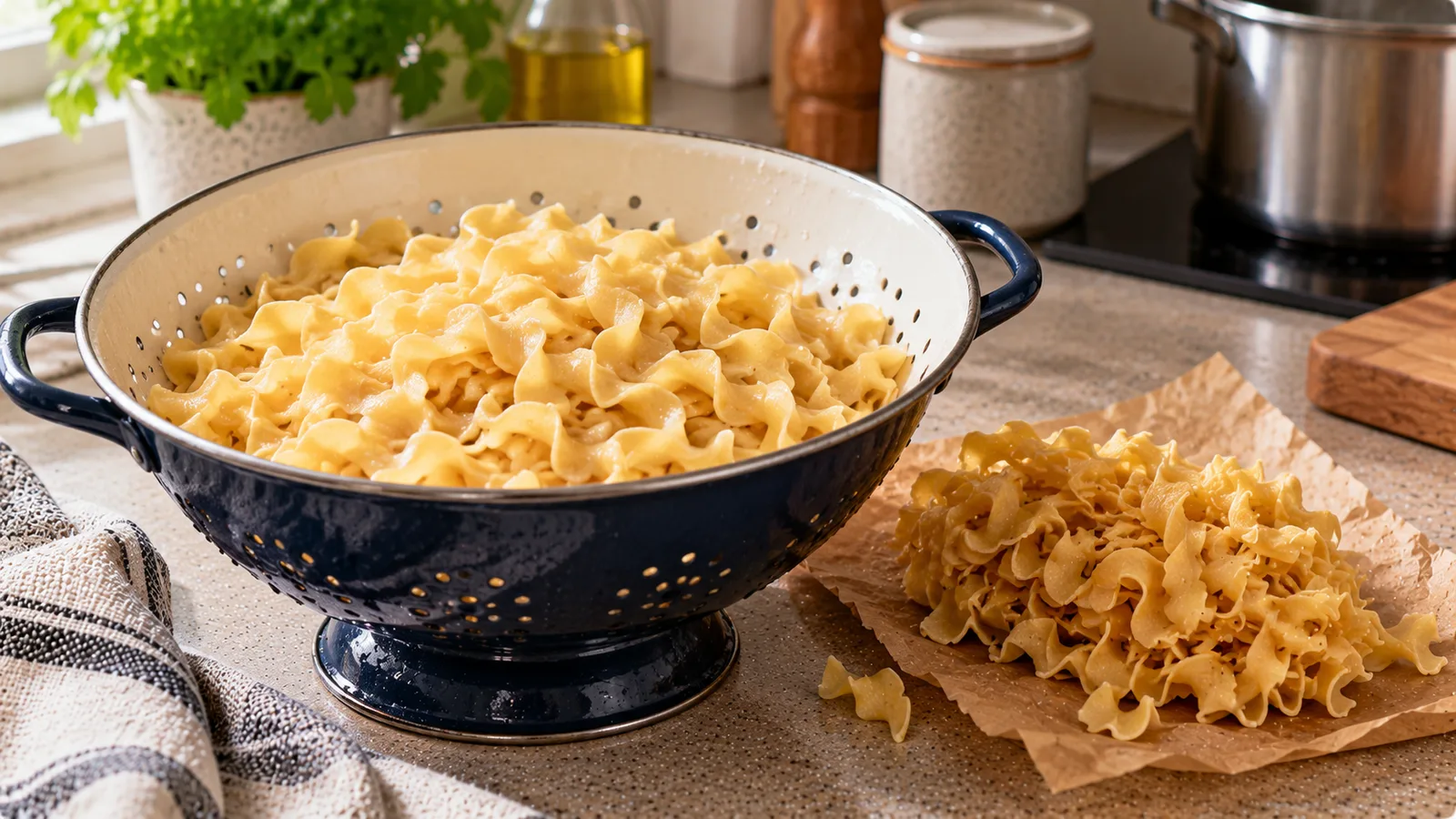
Egg noodles are used in soups, casseroles, stir-fries and many traditional noodle dishes. They are commonly made from wheat flour and eggs, although the amount of egg and the exact recipe vary by product.
If you are counting calories, the most important distinction is whether you weigh the noodles before or after cooking.
Dried egg noodles commonly contain approximately 350–390 kcal per 100 g. Cooked egg noodles often contain around 130–160 kcal per 100 g, depending on their composition and water absorption.
The lower value for cooked noodles does not mean that cooking removes most of their calories. The noodles absorb water, which increases their weight without adding energy.
Egg noodle calories at a glance
| Portion | Estimated calories |
|---|---|
| Dry egg noodles, 25 g | 88–98 kcal |
| Dry egg noodles, 50 g | 175–195 kcal |
| Dry egg noodles, 75 g | 263–293 kcal |
| Dry egg noodles, 100 g | 350–390 kcal |
| Cooked egg noodles, 100 g | 130–160 kcal |
| Cooked egg noodles, 150 g | 195–240 kcal |
| Cooked egg noodles, 200 g | 260–320 kcal |
| Cooked egg noodles, 250 g | 325–400 kcal |
These figures are useful estimates rather than values for every brand.
Check whether the nutrition declaration refers to dry noodles, cooked noodles or a prepared product.
Fresh egg noodles contain moisture before cooking and require their own nutrition values.
Why dry and cooked egg noodles have different calories per 100 g
Dried noodles absorb water during cooking.
Water contributes weight but no calories.
Imagine that 75 g of dried egg noodles contain 370 kcal per 100 g.
The uncooked portion contains:
75 × 370 ÷ 100 = 277.5 kcal.
After boiling and draining, suppose the noodles weigh 195 g.
The total remains approximately 277.5 kcal, assuming no meaningful loss of energy-containing material.
The cooked calorie density becomes:
277.5 ÷ 195 × 100 = 142.3 kcal per 100 g.
The noodles have not lost 228 calories. Their weight has increased through hydration.
This is why choosing the wrong database entry can substantially distort a food diary.
Dry versus cooked egg noodles
The following example uses a dry energy value of 370 kcal per 100 g and a cooked yield factor of 2.6.
| Dry weight | Cooked weight | Total calories |
|---|---|---|
| 40 g | 104 g | 148 kcal |
| 50 g | 130 g | 185 kcal |
| 75 g | 195 g | 278 kcal |
| 100 g | 260 g | 370 kcal |
| 125 g | 325 g | 463 kcal |
The cooked weights are illustrative.
Different noodle shapes, cooking times and draining methods produce different yields.
Do not assume that every product increases in weight by exactly the same factor.
How much do egg noodles weigh after cooking?
Many dried noodle products gain substantial weight as they hydrate. A cooked yield of roughly two to three times the dry weight can be a starting estimate, but it is not a universal conversion.
Water absorption depends on:
- Noodle thickness and shape.
- Wheat flour and egg content.
- Cooking time.
- Whether the noodles are boiled or soaked.
- How thoroughly they are drained.
- Whether they are rinsed.
- Whether they are later mixed with sauce.
For accurate calorie tracking, measure the yield of your actual batch.
Example: calculate calories from a cooked batch
You cook 200 g of dried egg noodles.
The package lists 370 kcal per 100 g dry.
Total calories:
200 × 370 ÷ 100 = 740 kcal.
After cooking and draining, the noodles weigh 510 g.
Calories per 100 g cooked:
740 ÷ 510 × 100 = 145.1 kcal.
If your cooked serving weighs 180 g:
180 × 145.1 ÷ 100 = 261 kcal, approximately.
This calculation is more reliable than applying an unrelated generic cooked-noodle entry.
Nutrition in egg noodles
Egg noodles provide carbohydrates, some protein and usually a modest amount of fat.
The precise nutrient profile depends on the quantity of egg, the flour and any additional ingredients.
Typical nutrition per 100 g dry
| Nutrient | Approximate amount |
|---|---|
| Energy | 350–390 kcal |
| Protein | 11–15 g |
| Carbohydrates | 68–75 g |
| Fat | 3–6 g |
| Fiber | 2–4 g |
These are broad ranges for typical dried wheat-and-egg noodles.
Some products fall outside them.
Typical nutrition per 100 g cooked
| Nutrient | Approximate amount |
|---|---|
| Energy | 130–160 kcal |
| Protein | 4–6 g |
| Carbohydrates | 25–31 g |
| Fat | 1–3 g |
| Fiber | Around 1–2 g |
Cooked values vary with hydration.
The values in the two tables should not be treated as an exact matched pair for every product.
Do eggs make noodles higher in calories?
Eggs contribute protein and fat to noodle dough.
However, the effect on total calories depends on how much egg is used and which ingredients it replaces.
A dried egg noodle product is not automatically dramatically higher in calories than ordinary dried wheat pasta.
The difference between brands may be smaller than the difference caused by portion size or added sauce.
For a meaningful comparison, use the same basis: 100 g dry versus 100 g dry, or equivalent cooked portions with known preparation methods.
Egg noodles versus regular pasta
Egg noodles and conventional wheat pasta are often similar in calorie density when dry.
| Food | Approximate calories per 100 g dry |
|---|---|
| Dried egg noodles | 350–390 kcal |
| Regular dried wheat pasta | 350–375 kcal |
| Whole-wheat dried pasta | 340–370 kcal |
These ranges overlap.
Egg noodles may contain more fat because of the egg ingredients.
Whole-wheat pasta often provides more fiber.
Protein content depends on the recipe and flour used.
There is no universal winner based on calories alone.
Egg noodles versus rice noodles
Rice noodles are typically made from rice flour and water, while egg noodles commonly contain wheat flour and egg.
| Feature | Egg noodles | Rice noodles |
|---|---|---|
| Main ingredients | Wheat flour and egg | Usually rice flour and water |
| Dry calories per 100 g | Approximately 350–390 kcal | Approximately 350–370 kcal |
| Protein | Often somewhat higher | Often lower |
| Fat | Usually somewhat higher | Usually lower |
| Gluten | Typically contains wheat | Depends on ingredients and manufacturing |
The comparison is general.
Rice noodles are not automatically lower-calorie, and egg noodles are not automatically more nutritious for everyone.
People with wheat or egg allergies must check ingredients carefully.
Fresh egg noodles versus dried egg noodles
Fresh egg noodles contain more water before cooking.
Their energy density per 100 g can therefore be lower than that of dried noodles.
However, fresh products differ considerably.
Some contain substantial egg, oil or additional ingredients.
Never log 100 g of fresh egg noodles using a generic dry-noodle entry.
Read the package to determine whether its values apply to the product as sold.
How many calories are in one serving?
The following examples use 370 kcal per 100 g dry.
| Dry portion | Calories |
|---|---|
| 40 g | 148 kcal |
| 50 g | 185 kcal |
| 60 g | 222 kcal |
| 75 g | 278 kcal |
| 90 g | 333 kcal |
| 100 g | 370 kcal |
The appropriate amount depends on the complete meal and individual energy needs.
A noodle soup with vegetables and chicken may use a smaller dry noodle portion.
A noodle-centered main dish may contain more.
These are examples, not mandatory serving recommendations.
Calories in popular egg noodle dishes
Plain noodles are only one part of a prepared meal.
Oil, butter, meat, vegetables, cream and sauces can substantially change the total.
Egg noodles with chicken and vegetables
| Ingredient | Amount | Estimated calories |
|---|---|---|
| Dry egg noodles | 75 g | 278 kcal |
| Cooked chicken breast | 100 g | 165 kcal |
| Mixed vegetables | 150 g | 55 kcal |
| Cooking oil | 10 g | 90 kcal |
| Sauce | 40 g | 40 kcal |
| Total | 628 kcal |
These values are illustrative.
Actual results depend on the ingredients and their labels.
Buttered egg noodles
Suppose a serving contains:
- Dry egg noodles, 75 g: approximately 278 kcal.
- Butter, 15 g: approximately 108 kcal.
- Fresh herbs: approximately 2 kcal.
Estimated total: 388 kcal.
The butter adds a meaningful amount of energy even though the noodle portion has not changed.
Egg noodle soup
An example serving might contain:
- Dry egg noodles, 50 g: 185 kcal.
- Broth, 350 ml: 25 kcal.
- Cooked chicken, 80 g: 132 kcal.
- Vegetables, 150 g: 45 kcal.
Estimated total: 387 kcal.
Broth, toppings and the actual chicken cut may change the value.
Creamy egg noodles
Cream, cheese and butter can raise the calorie total substantially.
For this type of dish, calculate the complete recipe rather than relying on the calories of plain noodles.
Are egg noodles good for weight loss?
Egg noodles can fit into a calorie-controlled eating pattern.
Their suitability depends on the amount consumed and the ingredients served with them.
A meal combining noodles, vegetables and a protein source can provide variety and satisfaction.
Large portions with butter or creamy sauces can be much more energy-dense.
Egg noodles are neither inherently fattening nor inherently slimming.
The overall meal and long-term eating pattern matter more than the noodle name.
Are egg noodles high in protein?
Egg noodles provide some protein from wheat flour and eggs.
They are not usually as protein-dense as chicken, fish, tofu or legumes.
For example, a 75 g dry portion containing 13 g protein per 100 g supplies:
75 × 13 ÷ 100 = 9.75 g protein.
That can contribute to a meal, but adding another protein source may be useful depending on the person's needs.
Do egg noodles contain gluten?
Most traditional egg noodles contain wheat flour and therefore gluten.
They also contain egg, a relevant allergen.
Some specialty products are made without wheat, but their ingredient lists and allergen declarations must be checked.
For people with celiac disease, a product specifically suitable for a gluten-free diet is necessary.
How to track egg noodles accurately
When weighing dry noodles
- Check the package's dry nutrition values.
- Weigh the uncooked portion.
- Multiply the calories per 100 g by the portion weight divided by 100.
- Record butter, oil, sauce and other ingredients separately.
Example:
80 g dry noodles at 370 kcal per 100 g:
80 × 370 ÷ 100 = 296 kcal.
When weighing cooked noodles
The most accurate practical method is to weigh the full batch before and after cooking.
Calculate total calories from the dry weight.
Then divide those calories by the cooked weight.
For example:
- Dry noodles: 250 g.
- Energy: 370 kcal per 100 g.
- Cooked batch: 625 g.
Total noodle calories:
250 × 370 ÷ 100 = 925 kcal.
Calories per 100 g cooked:
925 ÷ 625 × 100 = 148 kcal.
A 200 g cooked portion contains:
200 × 148 ÷ 100 = 296 kcal.
When noodles are already mixed with sauce
Calculate the recipe from all ingredients before dividing it into servings.
Weigh the complete finished dish if possible.
Do not use a plain cooked-noodle entry for a creamy or oily prepared meal.
Common mistakes
Confusing dry and cooked weights
This can more than double the apparent calorie total.
Using a fresh-noodle entry for dried noodles
Fresh and dried products have different moisture contents.
Forgetting butter or oil
Added fat can significantly increase the meal's calories.
Assuming every egg noodle has identical nutrition
Egg content, flour and processing vary.
Comparing cooked noodles from different sources without checking water absorption
The cooked weight depends on hydration, so values per 100 g can differ even when dry calories are similar.
Frequently asked questions
How many calories are in 100 g of cooked egg noodles?
Often approximately 130–160 kcal, depending on the product and cooking method.
How many calories are in 100 g of dry egg noodles?
Commonly around 350–390 kcal.
How many calories are in 200 g of cooked egg noodles?
Approximately 260–320 kcal for many products.
Are egg noodles more caloric than pasta?
Not necessarily. Their dry calorie ranges overlap considerably.
Do egg noodles have more protein than rice noodles?
Often yes, but the actual difference depends on the products.
Do egg noodles lose calories when cooked?
Their calories per 100 g decrease mainly because they absorb water, not because the calories disappear.
Can egg noodles be part of a balanced diet?
Yes. Consider portion size and combine them with vegetables and suitable protein sources.
Sources
- USDA FoodData Central — food composition data for egg noodles and other ingredients.
- European Commission: Food Information to Consumers — EU nutrition labeling requirements.
- USDA MyPlate — general guidance on grains and balanced meals.
Key takeaway
Dry egg noodles commonly contain around 350–390 kcal per 100 g, while cooked egg noodles often provide approximately 130–160 kcal per 100 g.
The difference is mainly due to water absorption.
For reliable calorie tracking, weigh the noodles dry when possible, check the actual product label and include all sauces, oils and toppings in the final meal calculation.