
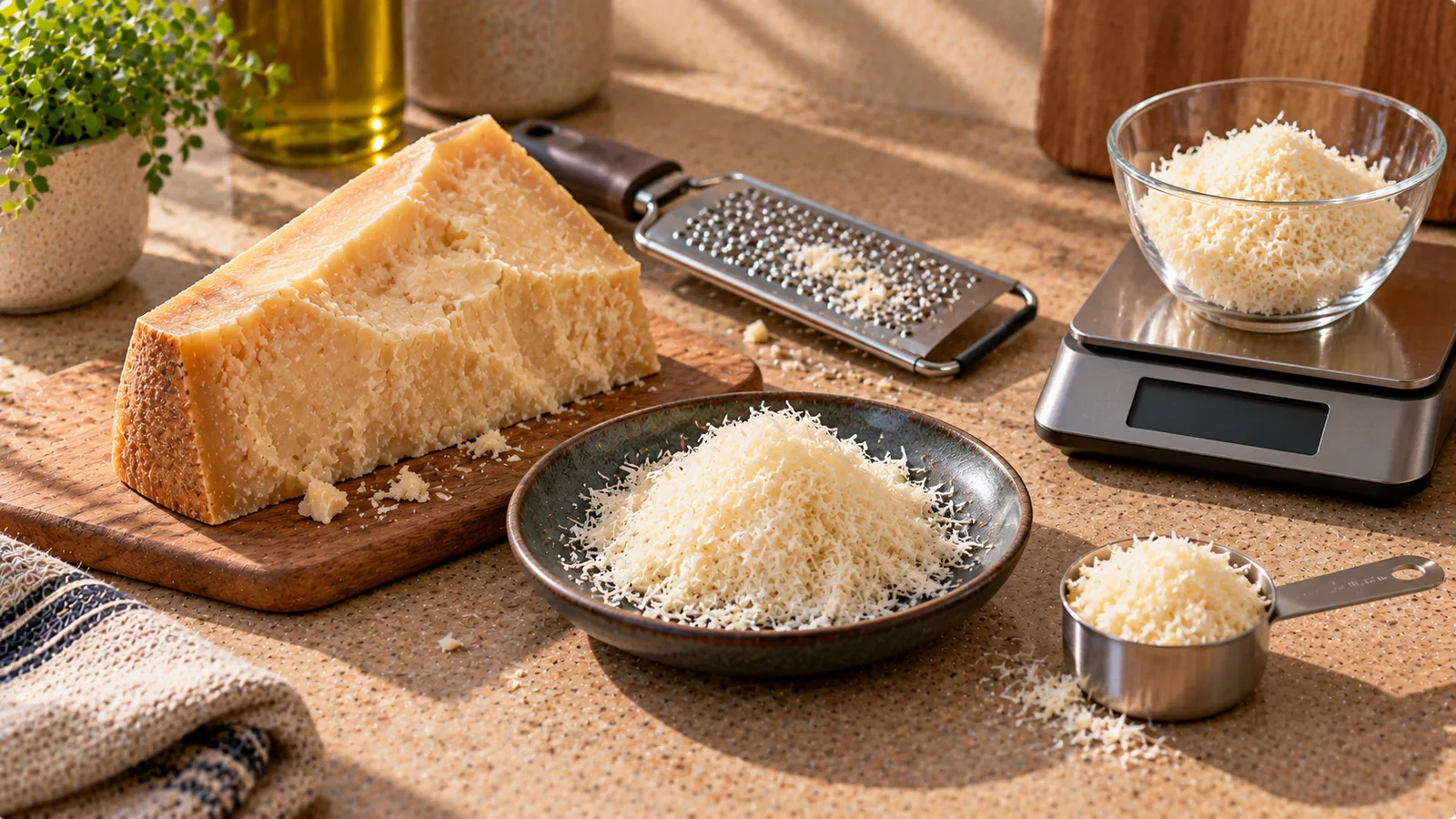
Parmesan is a hard, aged cheese with relatively little water, so its calories and nutrients are concentrated into a small amount of food.
A useful reference for Parmesan is roughly 390–430 kcal per 100 g, although the exact value depends on the specific cheese and product.
For everyday tracking, the amount you actually use matters much more than the 100 g figure. A light sprinkle of grated Parmesan may weigh only a few grams, while a generous addition to pasta can easily be several times larger.
Parmesan nutrition per 100 g
Typical Parmesan-style hard cheese provides approximately:
| Nutrient | Per 100 g |
|---|---|
| Calories | 390–430 kcal |
| Protein | 33–38 g |
| Fat | 27–30 g |
| Carbohydrates | 0–4 g |
These values are a practical range rather than a universal specification.
Traditional Parmigiano Reggiano, other Parmesan cheeses, pre-grated products and similar hard cheeses can have somewhat different nutrition values.
For precise tracking, use the label on the cheese you actually eat.
Calories in common Parmesan portions
Using about 410 kcal per 100 g as a practical example:
| Parmesan amount | Approximate calories |
|---|---|
| 5 g | 21 kcal |
| 10 g | 41 kcal |
| 15 g | 62 kcal |
| 20 g | 82 kcal |
| 25 g | 103 kcal |
| 30 g | 123 kcal |
| 40 g | 164 kcal |
| 50 g | 205 kcal |
| 100 g | 410 kcal |
The calculation is:
calories = grams × calories per 100 g ÷ 100
For 20 g:
20 × 410 ÷ 100 = 82 kcal
If your Parmesan contains 398 kcal per 100 g, use 398 rather than the example value.
How many calories are in 10 g of Parmesan?
At 410 kcal per 100 g:
10 × 410 ÷ 100 = 41 kcal
Ten grams can be enough for a noticeable topping when Parmesan is finely grated.
However, visual volume is not a reliable way to determine weight because grated cheese can be packed loosely or densely.
How many calories are in 20 g?
A 20 g portion at the same reference value contains about:
82 kcal
This can represent a more generous topping for pasta, risotto, soup or vegetables.
How many calories are in 30 g?
Thirty grams provides approximately:
123 kcal
At this portion size, Parmesan also contributes a meaningful amount of protein and fat.
Grated Parmesan vs a solid piece
If both come from the same cheese, 20 g grated and 20 g from a solid wedge contain essentially the same calories.
Grating changes the shape and volume, not the amount of energy contained in the same mass of cheese.
The confusion usually comes from measuring by volume.
A spoonful or cup of grated Parmesan can vary in weight depending on:
- how finely it is grated;
- how tightly it is packed;
- moisture;
- whether the product is freshly grated or commercially prepared.
For this reason, grams are more reliable than visual volume when accurate tracking matters.
How many calories are in a tablespoon of grated Parmesan?
There is no single exact gram weight for every tablespoon of Parmesan.
Finely grated cheese can settle differently from coarse shavings, and spoon measurements can be level or heaped.
If your tablespoon contains about 5 g and the cheese provides 410 kcal per 100 g:
5 × 410 ÷ 100 = about 21 kcal
If the same spoon actually contains 8 g:
8 × 410 ÷ 100 = about 33 kcal
That difference is why weighing Parmesan once can be useful if you use it frequently.
What about a quarter cup?
Volume measurements become even more variable with larger portions.
Instead of assuming that every quarter cup has the same weight, check whether your package provides a gram equivalent.
If it does not, weigh your usual quarter-cup portion once.
You can then use that gram amount for similar future servings.
Protein in Parmesan
Parmesan is relatively protein-dense.
If a cheese contains 36 g protein per 100 g, then:
| Portion | Approximate protein |
|---|---|
| 10 g | 3.6 g |
| 20 g | 7.2 g |
| 30 g | 10.8 g |
| 50 g | 18 g |
The exact amount depends on the product.
Parmesan can contribute protein to a meal, but normal topping portions are much smaller than 100 g.
This is why it is useful to distinguish nutrient density per 100 g from the amount actually consumed.
Fat in Parmesan
A typical Parmesan may contain around 28–30 g fat per 100 g.
At 29 g per 100 g:
- 10 g provides about 2.9 g fat;
- 20 g provides about 5.8 g;
- 30 g provides about 8.7 g.
Fat is one reason hard cheese has a relatively high calorie density.
Protein also contributes calories, while carbohydrate content is generally low.
Are there carbs in Parmesan?
Parmesan usually contains relatively little carbohydrate.
Exact values vary with the cheese and labeling method, so use the package value when tracking closely.
A small carbohydrate number on a label does not materially change the fact that most of Parmesan's calories come from fat and protein.
Why Parmesan is calorie-dense
Hard aged cheeses contain less water than many fresh cheeses.
As moisture decreases during cheesemaking and aging, nutrients become concentrated into a smaller mass.
That is why 100 g of Parmesan can contain substantially more calories than 100 g of many high-moisture dairy foods.
Calorie density does not mean Parmesan must be avoided. It means portion size has a noticeable effect on the final calorie total.
Parmesan vs feta
Feta generally contains more water and is usually less calorie-dense per 100 g than Parmesan.
For example, if feta contains around 260–280 kcal per 100 g while Parmesan contains around 410 kcal, equal weights will not provide equal calories.
But typical serving sizes may also differ.
Comparisons are most useful when both the calorie density and the amount actually eaten are considered.
Parmesan vs Gouda
Gouda is also an energy-dense cheese, but Parmesan is typically harder, drier and often more concentrated.
The exact comparison depends on the specific products.
If you are choosing between cheeses for calorie tracking, compare the nutrition labels on the same basis, ideally per 100 g.
Freshly grated vs pre-grated Parmesan
Pre-grated Parmesan can differ from a block or wedge.
Depending on the product, it may contain:
- a different moisture level;
- anti-caking ingredients;
- a blend of cheeses;
- different nutrition values.
Do not automatically copy the nutrition data from a wedge of Parmigiano Reggiano to a packaged grated cheese.
Use the label from the actual product whenever possible.
Parmigiano Reggiano and generic Parmesan
“Parmesan” can refer to different products depending on the market.
Authentic Parmigiano Reggiano follows a specific production standard, while products labeled Parmesan elsewhere may differ in ingredients, moisture and composition.
For calorie tracking, the practical rule is simple:
Use the nutrition values for the exact cheese you consumed.
The name alone is not precise enough to guarantee identical calories.
How to track Parmesan on pasta
Suppose you prepare a bowl of pasta and add Parmesan.
The pasta entry should account for the pasta itself and any sauce or oil.
Then add the cheese separately.
If you use 18 g Parmesan with 410 kcal per 100 g:
18 × 410 ÷ 100 = 73.8 kcal
Rounded reasonably, that is about 74 kcal.
Do not assume Parmesan is already included in the nutrition value of a pasta entry unless the entry explicitly represents the complete prepared dish.
Parmesan in a homemade recipe
For a recipe, weigh the total Parmesan added to the whole batch.
Suppose a four-serving recipe contains 80 g Parmesan.
At 410 kcal per 100 g:
80 × 410 ÷ 100 = 328 kcal
If the dish is divided equally into four servings:
328 ÷ 4 = 82 kcal of Parmesan per serving
The rest of the recipe's calories must still be calculated from the other ingredients.
Parmesan added during cooking and at the table
It is easy to count one addition and forget another.
For example:
- 40 g Parmesan stirred into a sauce;
- another 20 g sprinkled over the finished dish.
Total Parmesan used:
40 + 20 = 60 g
If the recipe makes three equal portions, the average Parmesan amount is:
60 ÷ 3 = 20 g per serving
provided the cheese is distributed approximately evenly.
Estimating Parmesan without a scale
If weighing is not practical, use the serving information on the package when available.
For example, a label might state a serving in tablespoons together with its gram weight.
That gram weight is more useful than a generic internet conversion because it relates to the specific product.
Another practical option is to weigh your normal serving once.
If your usual sprinkle turns out to be about 12 g, that gives you a more realistic reference for future estimates.
Why a “sprinkle” is not a standard serving
Terms such as:
- sprinkle;
- handful;
- spoonful;
- shaving;
- topping
do not define a fixed amount.
Two people can describe very different quantities using the same word.
For calorie tracking, translate these descriptions into grams whenever the difference matters.
Does Parmesan fit a lower-calorie meal?
It can.
A food does not need to have a low calorie value per 100 g to fit into a lower-calorie meal.
For example, 10 g Parmesan may add around 40 kcal while providing a strong flavor.
A larger 40 g portion could add around 160 kcal.
The relevant question is therefore not simply whether Parmesan is “high calorie,” but how much is being used in the complete meal.
Does Parmesan fit a high-protein meal?
Parmesan provides substantial protein relative to its weight, but it also contains fat and therefore significant calories.
A small topping can contribute some protein, while larger portions contribute more of both protein and calories.
Whether it makes sense as a protein source depends on the entire meal rather than a single nutrient.
Sodium and Parmesan
Parmesan is a salted aged cheese and can contribute a meaningful amount of sodium.
Values vary between products.
If sodium intake is relevant to you, use the package nutrition information rather than estimating from calories or from another cheese.
Calories cannot tell you how much sodium a food contains.
Calcium and other nutrients
Hard cheeses such as Parmesan can also provide calcium and other nutrients.
However, this article focuses on calories, macronutrients and practical serving sizes.
For micronutrients, use the nutrition information available for the specific product or a reliable food-composition source.
How to calculate calories from your own package
Suppose your Parmesan label says:
402 kcal per 100 g
and you use 17 g.
Calculation:
402 × 17 ÷ 100 = 68.34 kcal
You can log approximately 68 kcal.
For 27 g:
402 × 27 ÷ 100 = 108.54 kcal
Approximately 109 kcal.
This method works for any Parmesan when you know its calories per 100 g.
If the label gives calories per serving
Suppose the package says:
- serving size: 15 g;
- calories per serving: 62 kcal.
You use 24 g.
First determine how many servings that represents:
24 ÷ 15 = 1.6 servings
Then:
62 × 1.6 = 99.2 kcal
So the 24 g portion contains approximately 99 kcal according to that label.
What serving size should you use?
There is no single ideal Parmesan serving for everyone.
The appropriate amount depends on:
- the meal;
- your energy needs;
- how much cheese you enjoy;
- what other ingredients are present;
- whether Parmesan is a garnish or a major ingredient.
For tracking, the most useful serving is simply the amount you actually ate.
Quick reference
Using 410 kcal per 100 g as an example:
- 5 g Parmesan: about 21 kcal
- 10 g: about 41 kcal
- 15 g: about 62 kcal
- 20 g: about 82 kcal
- 30 g: about 123 kcal
- 50 g: about 205 kcal
- 100 g: about 410 kcal
Actual Parmesan can differ, so the package label should take priority when available.
The biggest practical tracking issue is usually not whether the cheese is grated or solid. It is knowing how many grams were actually used.
Nutrition data sources
The portion examples use 410 kcal per 100 g as an illustration.
The USDA references below describe the particular foods and preparation states named in their records; they do not establish every rounded example or product variation in this article. Check the label of a specific product when available.
- USDA FoodData Central — Cheese, parmesan, hard (FDC 170848; 392 kcal/100 g).
- USDA FoodData Central — Cheese, parmesan, grated, refrigerated (FDC 2259795; 404.76 kcal/100 g).