
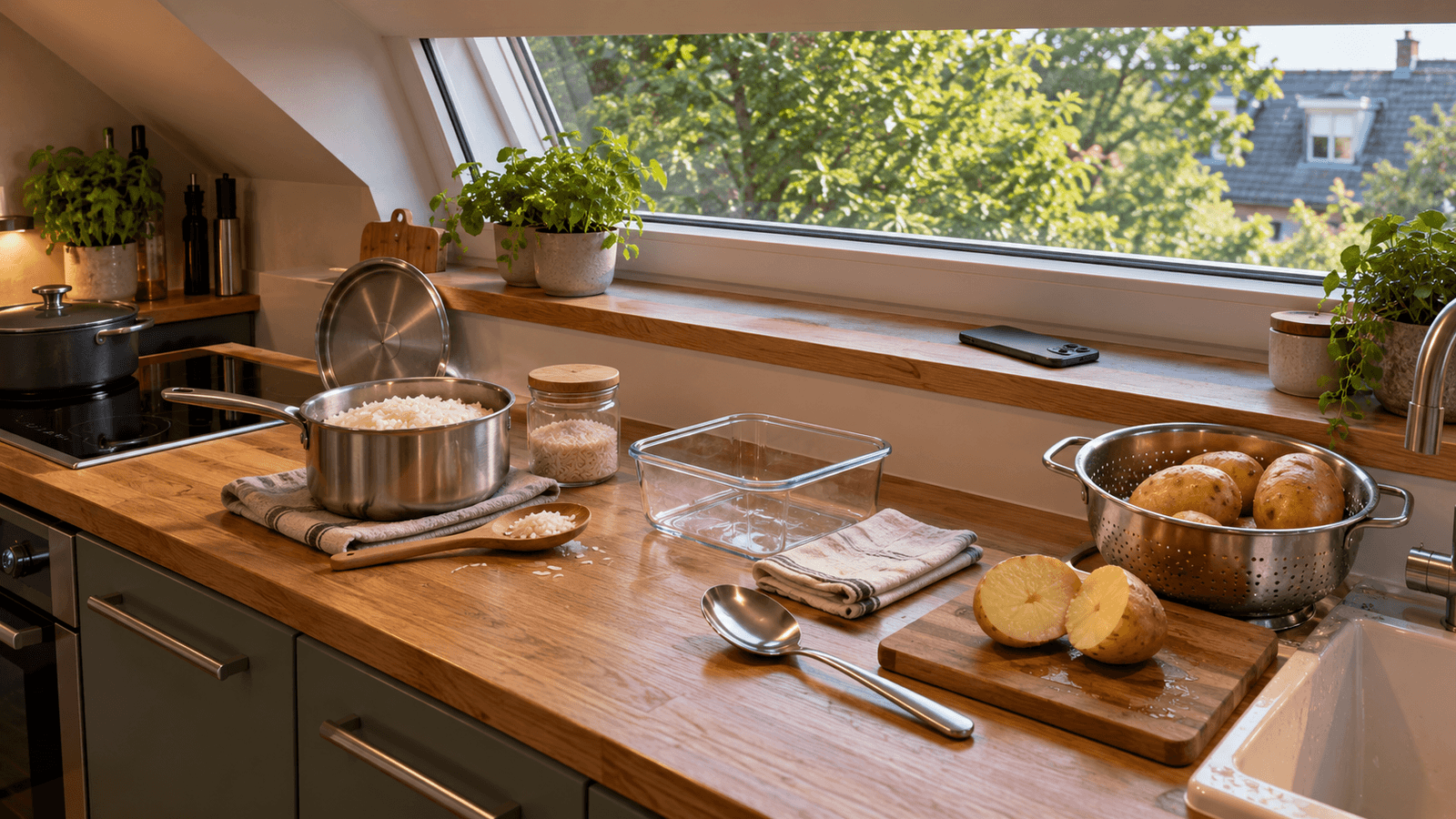
Rice and potatoes are two common carbohydrate-rich foods used in meals around the world.
Both can fit into a balanced diet, but they differ in calorie density, water content, fiber, micronutrients, texture and the way they are usually prepared.
The most useful comparison is not simply asking which food is "better." It is understanding how the type, portion and cooking method change what ends up in your meal.
Rice vs potatoes at a glance
For a fair comparison, it is important to compare foods in the same state.
Dry rice should not be compared directly with cooked potatoes because rice absorbs a substantial amount of water during cooking.
In everyday meals, comparing cooked rice with cooked potatoes is usually more useful.
| Factor | Cooked rice | Cooked potatoes |
|---|---|---|
| Main macronutrient | Carbohydrate | Carbohydrate |
| Water content | Moderate to high after cooking | Naturally high |
| Calorie density | Usually higher per 100 g | Usually lower per 100 g when boiled or baked without much added fat |
| Protein | Modest | Modest |
| Fat | Naturally very low | Naturally very low |
| Fiber | Depends on type | Depends on preparation and whether skin is eaten |
| Portion volume | More compact | Often larger volume for similar calories |
| Major variable | Rice type and cooking | Cooking method and added fat |
Exact values vary by variety, preparation and food database.
Calories: rice vs potatoes
Plain cooked potatoes are generally less calorie-dense per 100 g than plain cooked rice.
One major reason is water.
Potatoes naturally contain a large amount of water.
Rice is dry before cooking and absorbs water during cooking, but cooked rice usually remains more energy-dense by weight than boiled potatoes.
This does not mean rice is inherently fattening or potatoes automatically cause weight loss.
Your total portion and the rest of the meal matter more than a single food in isolation.
Why dry rice looks much higher in calories
Nutrition labels for rice may list values for the dry product.
Dry rice contains relatively little water, so its calories are concentrated into a smaller weight.
During cooking, rice absorbs water and becomes heavier.
The total calories originally present in the dry rice do not disappear, but they become distributed across a larger cooked weight.
This is why it is important to know whether a nutrition value refers to dry or cooked rice.
What about potatoes?
Potatoes also change weight during cooking.
Boiling can maintain or increase water content.
Baking and roasting can remove water.
Frying removes some water while adding fat.
As a result, boiled potatoes, baked potatoes, roasted potatoes and French fries can have very different calorie densities even though they all begin as potatoes.
Carbohydrates
Both rice and potatoes are primarily carbohydrate foods.
Rice generally provides more carbohydrate per 100 g of cooked food because it contains less water than boiled potatoes.
Potatoes provide carbohydrate largely as starch.
Rice also provides carbohydrate primarily as starch.
Neither food needs to be avoided simply because it contains carbohydrates.
Carbohydrate needs vary according to total energy needs, activity and individual eating patterns.
Protein
Neither rice nor potatoes is usually the main protein source in a meal.
Both contribute some protein, but most people will obtain a larger amount by pairing them with foods such as:
- fish
- poultry
- eggs
- dairy foods
- tofu
- beans
- lentils
- other protein-rich foods
Think of rice or potatoes as one component of the meal rather than expecting them to provide all major nutrients by themselves.
Fat
Plain rice and plain potatoes are naturally very low in fat.
The difference often comes from preparation.
Rice dishes may include:
- oil
- butter
- coconut milk
- creamy sauces
Potato dishes may include:
- frying oil
- butter
- cheese
- cream
- mayonnaise
These additions can contribute more calories than the difference between plain rice and plain potatoes.
Fiber
Fiber content depends on the specific product and preparation.
Brown rice generally contains more fiber than white rice because more of the grain remains intact.
Potatoes can provide fiber, particularly when the skin is eaten where appropriate.
However, fiber intake should be considered across the entire diet.
Vegetables, fruit, legumes, whole grains, nuts and seeds can all contribute.
Micronutrients
Rice and potatoes have different micronutrient profiles.
Potatoes can contribute nutrients such as potassium and vitamin C, although amounts vary with variety, storage and cooking.
Rice can contribute nutrients including manganese and B vitamins, with the exact profile depending on whether it is white, brown or enriched rice.
Neither food needs to "win" every nutrient comparison.
A varied diet can use both.
Which is more filling?
Fullness is influenced by more than calories.
Factors include:
- food volume
- water content
- fiber
- protein in the whole meal
- texture
- eating speed
- portion size
- personal preference
Plain potatoes often provide a larger physical volume for a given number of calories than cooked rice because of their higher water content and lower calorie density.
That can be useful for people who prefer larger meals.
But fullness is individual.
Some people may find a rice-based meal equally or more satisfying depending on what it is served with.
The rest of the meal matters
Consider two examples.
A modest portion of rice served with vegetables and a protein-rich food can be a balanced and satisfying meal.
A potato served with vegetables and protein can also be a balanced and satisfying meal.
Conversely, either food can become much more calorie-dense when prepared with large amounts of oil or served with energy-dense sauces.
The carbohydrate source is only one part of the meal.
Rice vs potatoes for weight loss
Both rice and potatoes can fit into a weight-loss diet.
Weight loss requires an energy deficit over time.
Potatoes may be useful when you want a larger food volume for fewer calories, particularly when boiled or baked with limited added fat.
Rice may be convenient when you want:
- a compact carbohydrate source
- easy batch cooking
- predictable portions
- a food that pairs with many dishes
You do not need to eliminate either one.
Portion size and preparation usually matter more.
Portion size changes the comparison
Comparing only 100 g can be useful for standardized nutrition data, but people do not always eat identical weights of different foods.
A typical portion of rice may weigh less than a large serving of potatoes.
Therefore, compare the amount you actually eat rather than assuming a per-100-g difference automatically equals the difference in your meal.
White rice vs potatoes
White rice is lower in fiber than many whole-grain options, but it can still be part of a balanced diet.
It is easy to digest for many people and works with a wide variety of foods.
Plain boiled or baked potatoes are typically lower in calorie density by weight.
The more useful choice depends on the rest of the meal and your preferences.
Brown rice vs potatoes
Brown rice retains more of the grain and generally provides more fiber than white rice.
It also has a different texture and cooking time.
Potatoes provide a different nutrient profile and usually more water per 100 g.
Both can be useful carbohydrate sources.
Sweet potatoes vs rice
Sweet potatoes are nutritionally different from regular potatoes, but the broad comparison is similar.
They contain substantial water and are generally less calorie-dense by weight than cooked rice when prepared without much added fat.
They also provide carotenoids, especially orange varieties.
This does not make them automatically superior to either rice or regular potatoes.
Boiled potatoes vs rice
Boiled potatoes are one of the simplest comparisons with plain cooked rice.
They contain no added cooking fat unless it is added after cooking.
Because boiled potatoes contain substantial water, they generally provide fewer calories per 100 g than cooked rice.
This can allow a larger portion by weight for a similar calorie amount.
Baked potatoes vs rice
A plain baked potato can still be relatively low in fat.
However, baking removes some water, which can make the potato somewhat more calorie-dense by weight than a boiled potato.
Toppings can change the meal substantially.
Butter, cheese, sour cream and oil should be considered as part of the total.
Roasted potatoes vs rice
Roasted potatoes often contain added oil.
The amount of oil can have a large effect on total calories.
A small amount of oil spread across a tray is different from potatoes heavily coated in oil.
If you are comparing calories, include the cooking fat rather than comparing only the underlying potato.
French fries vs rice
French fries are not nutritionally equivalent to plain potatoes.
Frying adds fat and changes water content.
As a result, fries are typically much more calorie-dense than boiled potatoes.
When comparing rice and potatoes, specify the preparation method.
"Rice vs potatoes" is not the same comparison as "plain rice vs French fries."
Fried rice vs potatoes
The same principle applies to rice.
Plain cooked rice and fried rice are different foods from a calorie perspective.
Fried rice may contain:
- oil
- eggs
- meat
- sauces
- vegetables
Those ingredients can make it a complete mixed dish rather than simply a serving of rice.
Glycemic response
The blood glucose response to rice or potatoes varies considerably.
It can depend on:
- variety
- cooking method
- cooking time
- cooling and reheating
- portion size
- foods eaten alongside them
- individual physiology
For people managing diabetes or another condition requiring individualized carbohydrate guidance, personal medical or dietetic advice may be appropriate.
Does cooling rice or potatoes matter?
Cooking and cooling starch-containing foods can change some of the starch structure and increase resistant starch.
However, this does not make the calories disappear or transform the food into a fundamentally different category.
For everyday meal planning, portion size, overall meal composition and preparation remain important.
Rice or potatoes before exercise?
Both can provide carbohydrate.
The better option depends on factors such as:
- timing
- portion
- digestion
- exercise duration
- personal tolerance
Some people prefer rice because it can be easy to combine with lean protein and relatively low-fat foods.
Others prefer potatoes.
There is no universal requirement to choose one.
Rice or potatoes after exercise?
Both can contribute carbohydrate after exercise.
Pairing the carbohydrate source with adequate protein may be useful when building a post-exercise meal.
Again, the overall meal matters more than whether the starch comes specifically from rice or potatoes.
Which is easier to portion?
Rice is often easy to weigh and portion after cooking.
Potatoes can vary substantially in individual size, so weighing them can be more consistent than counting "one potato."
For calorie tracking, record the state in which the food was measured and use matching nutrition data.
How Mealisa can help compare portions
Mealisa can help you track foods based on the portion you actually eat rather than deciding that one food is universally better.
For rice and potatoes, useful information includes:
- food type
- cooked or uncooked state
- portion weight
- preparation method
- added fats
- sauces and toppings
This creates a more realistic comparison than relying on the food name alone.
Practical examples
If you want more food volume
Plain boiled potatoes may make it easier to create a physically larger carbohydrate portion for a given calorie target.
If you want a compact carbohydrate source
Cooked rice can provide more carbohydrate and calories in a smaller weight.
If you batch cook
Both work well.
Rice can be portioned by cooked weight.
Potatoes can be boiled, baked or roasted in batches.
Follow appropriate food-safety practices when cooling, storing and reheating cooked foods.
If you want more fiber
Consider the specific type and the entire meal.
Brown rice, potatoes with skin where appropriate, vegetables and legumes can all contribute fiber.
If you want fewer calories
Focus on both portion and preparation.
A plain food with moderate portions may differ greatly from the same food prepared with substantial oil, butter or creamy sauces.
Common comparison mistakes
Comparing dry rice with cooked potatoes
The water content is completely different, making the comparison misleading.
Treating all potato preparations as identical
Boiled potatoes and French fries are not nutritionally interchangeable.
Ignoring cooking oil
Oil can contribute a substantial amount of energy.
Assuming one carbohydrate source determines weight loss
Overall energy intake over time is more important.
Looking only at calories
Protein, fiber, micronutrients, food volume, preference and the rest of the meal also matter.
Frequently asked questions
Are potatoes lower in calories than rice?
Plain boiled potatoes are generally less calorie-dense per 100 g than plain cooked rice. The exact difference depends on the rice, potato and preparation method.
Which has more carbohydrates, rice or potatoes?
Cooked rice generally contains more carbohydrate per 100 g than boiled potatoes, largely because potatoes contain more water.
Which is better for weight loss?
Both can fit. Potatoes can provide more volume for a given number of calories, while rice can also be portioned to fit an energy deficit. Preparation and portion size matter.
Are potatoes more filling than rice?
Potatoes can be very filling for some people, partly because of their water content and food volume. Individual responses and the rest of the meal vary.
Is brown rice better than potatoes?
They provide different nutrients and textures. Brown rice generally offers more fiber than white rice, while potatoes provide different micronutrients and a high water content. Neither is universally superior.
Are sweet potatoes better than rice?
Not universally. Sweet potatoes and rice have different nutrient profiles and calorie densities. Either can fit into a balanced diet.
Is rice unhealthy?
No single ordinary food determines whether an overall diet is healthy. Rice can be part of many balanced eating patterns.
Are potatoes unhealthy?
Plain potatoes are not inherently unhealthy. Preparation method and the foods eaten with them can substantially change the nutritional profile of the meal.
The bottom line
Rice and potatoes are both useful carbohydrate sources.
Plain potatoes are usually less calorie-dense by weight and can provide a larger food volume.
Cooked rice is more compact and generally provides more carbohydrate and calories per 100 g.
Preparation can change the comparison dramatically.
Boiling, baking, roasting and frying are not nutritionally identical.
Instead of asking which food is universally better, choose the one that fits your meal, preferences and goals, and account for the portion and preparation you actually use.
This article provides general educational nutrition information and is not a substitute for individualized medical or dietetic advice.