
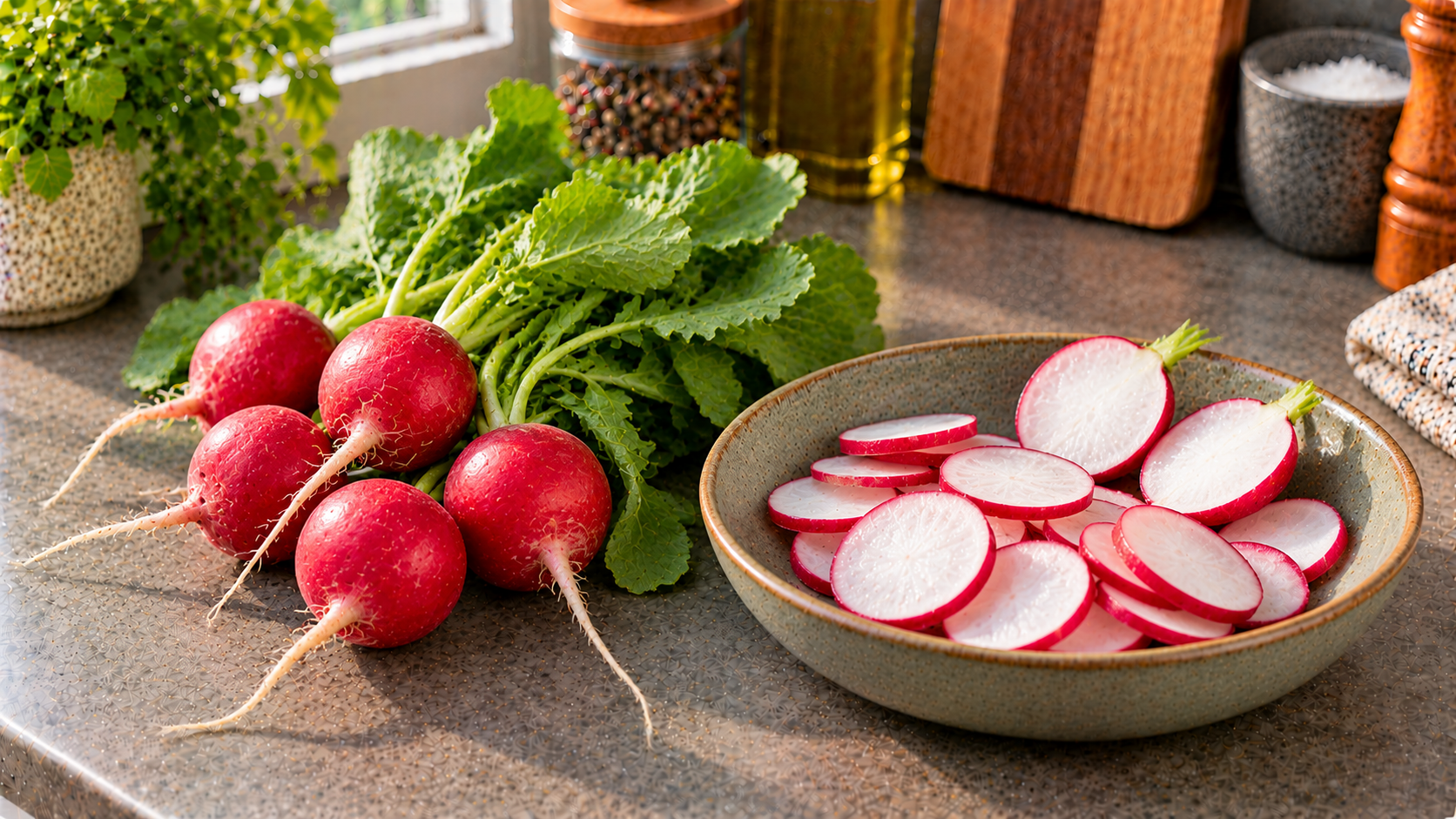
Raw radishes contain approximately 16 calories per 100 g of edible portion, according to USDA FoodData Central. The familiar small red radishes are mostly water and provide modest amounts of carbohydrate, fibre, vitamin C and potassium.
For everyday meals, the important questions are how much radish you actually eat and whether it is served plain, with dressing, roasted in oil or pickled with additional ingredients.
Radish nutrition per 100 g
The following figures refer to USDA FoodData Central SR Legacy entry 169276, Radishes, raw.
| Nutrient | Per 100 g raw |
|---|---|
| Calories | 16 kcal |
| Protein | 0.68 g |
| Carbohydrates | 3.40 g |
| Total sugars | 1.86 g |
| Fibre | 1.60 g |
| Fat | 0.10 g |
| Water | 95.27 g |
| Potassium | 233 mg |
| Vitamin C | 14.8 mg |
Source: USDA FoodData Central — Radishes, raw.
These values are for edible raw radish roots, not for radish leaves, pickled radishes or a finished salad. Nutrient composition can vary slightly between varieties and batches.
The high water content explains why even a fairly generous serving of raw radishes usually contributes relatively few calories.
Calories in typical radish portions
Using 16 kcal per 100 g, the following portions can be calculated directly.
| Edible raw portion | Calories | Carbohydrates | Fibre |
|---|---|---|---|
| 25 g | 4 kcal | 0.9 g | 0.4 g |
| 50 g | 8 kcal | 1.7 g | 0.8 g |
| 75 g | 12 kcal | 2.6 g | 1.2 g |
| 100 g | 16 kcal | 3.4 g | 1.6 g |
| 150 g | 24 kcal | 5.1 g | 2.4 g |
| 200 g | 32 kcal | 6.8 g | 3.2 g |
These are rounded calculations based on one reference entry, not independent measurements of individual servings.
Calories = edible raw weight in grams × 16 ÷ 100.
For example, 120 g of cleaned raw radishes contributes approximately 19 kcal before any dressing.
How many calories are in one radish?
A single radish does not have a fixed weight. Small globe radishes, larger red radishes and elongated varieties can differ substantially.
A radish with 10 g of edible root contains approximately 1.6 kcal. A larger 20 g root contains about 3.2 kcal. Those are weight-based examples, not guaranteed sizes.
If six trimmed radishes weigh 90 g in total, the calculation gives approximately 14 kcal.
For an accurate food diary, weigh the batch rather than assuming every radish has the same mass.
Remove the leaves and any discarded portions before weighing if you will eat only the roots. Radish leaves can be edible, but their weight and nutritional composition should be tracked separately.
What about a cup of sliced radishes?
The USDA portion reference lists approximately 116 g for a cup of sliced raw radishes. Applying 16 kcal per 100 g gives roughly 19 kcal.
That number is useful for estimation, but the weight of a cup varies with slice thickness, how tightly it is filled and the type of radish.
A loosely filled container and a firmly packed one can hold different quantities.
If precision matters, use grams rather than a cup measurement.
Raw radishes versus cooked radishes
Raw radishes are crisp, peppery and commonly eaten in salads, sandwiches or as a snack.
Cooking softens their texture and can mellow the sharp flavour. Roasting, sautéing and braising may also change their moisture content.
There is no reason to assume that 100 g of cooked radishes has exactly the same concentration of nutrients as 100 g raw. Weight can change during cooking.
For home cooking, one practical method is to calculate the total calories from the original edible radishes and all added ingredients, then divide the finished dish into portions.
Plain cooking does not create additional energy. Cooking oil, butter, honey and sauces do contribute calories.
How much does oil change the calorie count?
Consider a batch made from 300 g of raw radishes and 15 g of olive oil.
The radishes contribute approximately 48 kcal. The olive oil contributes approximately 135 kcal, assuming about 9 kcal per gram of oil.
The complete batch therefore contains approximately 183 kcal before any other ingredients, provided all the oil is consumed.
If three people share it equally, each portion contributes approximately 61 kcal.
That calculation describes the whole recipe. It should not be interpreted as a universal calorie value for roasted radishes.
If some oil remains on the baking tray, the exact consumed amount may be lower.
Pickled radishes and packaged preparations
Radishes may be pickled in vinegar, salt and sometimes sugar.
A product made without significant added sugar or fat may remain relatively low in calories, but sweetened pickles can have a different carbohydrate and energy content.
Do not automatically apply the raw USDA value to every jar of pickled radishes.
For a packaged product, read the manufacturer's values per 100 g and check whether they describe the drained radishes or the contents including liquid.
If you discard the brine, the weight actually eaten is more relevant than the full package weight.
Radishes in salads: the dressing often matters more
For a salad containing 100 g radishes, the radishes alone contribute about 16 kcal.
For a vegetable snack paired with a dip, the quark and herb dip snack plate offers an example; count the dip separately from any radishes you add.
If the salad also contains 10 g olive oil, that oil adds approximately 90 kcal. Other vegetables, cheese, nuts or dressing ingredients add their own energy.
A simple radish and cucumber salad may therefore have very different calories from a creamy radish salad.
Track each ingredient independently when calculating a homemade recipe.
The same principle applies to radishes served with bread and butter or cream cheese.
Carbohydrates, natural sugars and fibre
The USDA reference reports 3.40 g total carbohydrate and 1.86 g natural sugars per 100 g raw radishes.
It also reports 1.60 g fibre.
The natural sugars in the vegetable are not equivalent to sugar deliberately added to a sweetened product.
USDA total-carbohydrate values include fibre under the American reporting convention. European nutrition labels usually present available carbohydrates separately from fibre. Keep those conventions consistent when comparing figures.
Radishes contribute some fibre, but a small serving is not a major source of daily fibre by itself.
For more fibre, combine radishes with legumes, whole grains and other vegetables.
Vitamins, minerals and the peppery taste
The raw reference contains approximately 14.8 mg vitamin C and 233 mg potassium per 100 g.
Vitamin C contributes to normal collagen formation and immune function. Potassium has important roles in normal muscle and nerve function.
Radishes belong to the cruciferous vegetable family. Their characteristic sharp flavour is associated with compounds formed from naturally occurring glucosinolates.
The presence of these compounds does not mean that eating radishes prevents or treats disease.
A varied selection of vegetables is more useful than relying on one particular food for health benefits.
Are radishes useful for weight management?
Plain raw radishes have low energy density, a crisp texture and high water content.
They can replace some more calorie-dense snack ingredients or add volume to a meal, but they do not independently cause weight loss.
A practical snack could combine sliced radishes with a suitable protein source. In a main meal, radishes are a vegetable component rather than a complete source of protein or energy.
The effect on overall calorie intake depends on what is eaten with them.
How to record radishes accurately
For small fresh red radishes eaten raw, use 16 kcal per 100 g of edible roots as a reference.
If you roast them, calculate the starting ingredients and added fats. If you buy pickled radishes, use the product label.
Keep daikon, black radish and other distinct products separate when a more specific database entry is available; varieties and preparations are not nutritionally identical.
Source and calculation notes
All portion figures in this article are calculations from the raw-food reference. Real-world values vary with edible weight, variety, cooking method and added ingredients.