
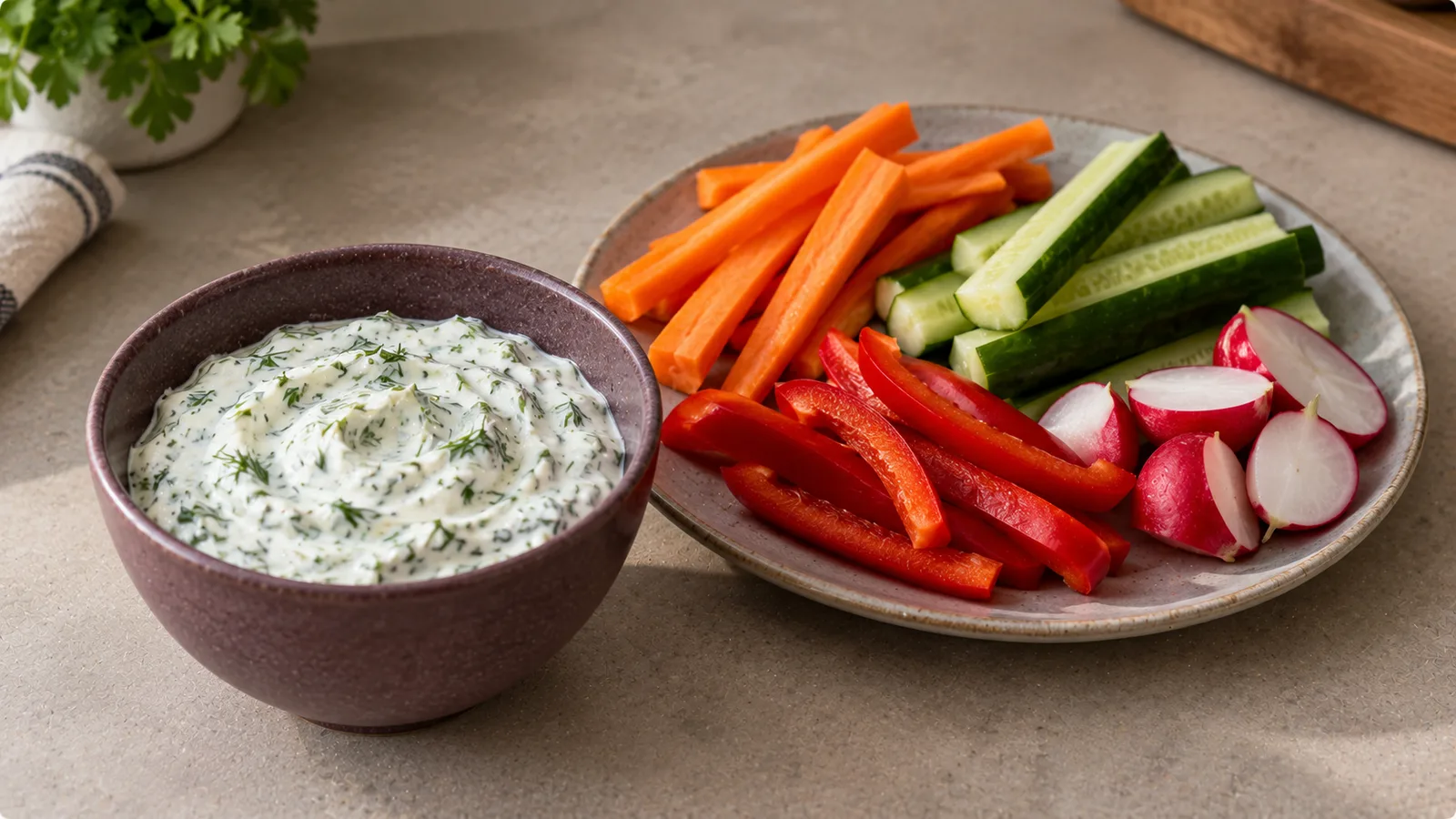
A quark and herb dip is an easy way to turn a selection of fresh vegetables into a substantial savoury snack. The dip combines plain quark with fresh herbs, lemon and a little olive oil, while cucumber, carrots, bell pepper and radishes provide different textures.
Unlike a complicated appetizer, this snack plate needs no oven and very little equipment. The dip can be prepared ahead, and the vegetables can be adjusted to what is available.
Preparation time: 15 minutes
Servings: 4
Cooking time: None
Equipment: Mixing bowl, knife, chopping board and serving plate
Ingredients for four servings
Quark and herb dip
| Ingredient | Quantity |
|---|---|
| Plain low-fat quark | 400 g |
| Plain Greek-style yogurt, approximately 2% fat | 100 g |
| Fresh chives | 15 g |
| Fresh parsley | 15 g |
| Fresh dill | 10 g |
| Lemon juice | 20 ml |
| Olive oil | 10 g |
| Garlic | 1 small clove, approximately 4 g |
| Fine salt | ¼ teaspoon, then adjust |
| Black pepper | To taste |
| Cold water | 1–3 tablespoons, if needed |
Vegetable snack plate
| Vegetable | Quantity |
|---|---|
| Cucumber | 250 g |
| Carrots | 250 g |
| Red bell pepper | 200 g |
| Radishes | 150 g |
These quantities make four snack-sized portions rather than four full meals.
The quark is the main protein-containing ingredient. The yogurt makes the mixture easier to stir and gives it a slightly lighter texture.
Use unsweetened, unflavoured dairy products. Sweetened quark or vanilla yogurt would not suit this savoury recipe.
Step 1: Prepare the herbs
Rinse the chives, parsley and dill under running water.
Dry them gently with a clean towel or salad spinner.
Finely chop the herbs. Cut the chives into short pieces and remove any particularly thick parsley or dill stems.
Finely mince or grate the garlic.
Fresh herbs provide the brightest flavour, but the exact combination can be adjusted.
For example, a dip made mainly with chives will taste milder than one containing a generous amount of dill and garlic.
Step 2: Mix the creamy base
Place the quark and yogurt in a mixing bowl.
Stir until the mixture is smooth and evenly combined.
Add the lemon juice and olive oil.
Mix again.
Quark varies considerably in thickness between brands. Some products are soft enough to use immediately, while others are very dense.
If the mixture is too thick for dipping, add cold water one tablespoon at a time.
Stop when the dip is creamy enough to coat a vegetable stick without sliding off immediately.
Avoid adding too much liquid at once. A thin dip is harder to serve neatly on a shared snack plate.
Step 3: Add the herbs and seasonings
Stir in the chopped chives, parsley, dill and garlic.
Add approximately ¼ teaspoon salt and a little black pepper.
Taste the mixture.
If it needs more freshness, add a small amount of lemon juice.
If it tastes too sharp, add a little more plain quark.
The flavours become more integrated after a short rest in the refrigerator.
For a milder version, use half the garlic or omit it entirely.
Step 4: Prepare the vegetables
Wash the cucumber, carrots, bell pepper and radishes.
Cut the cucumber into thick sticks or long wedges.
Peel the carrots if preferred, then cut them into sticks that are easy to pick up.
Remove the pepper seeds and white membranes. Slice the pepper into wide strips.
Trim the radishes and cut large ones in half.
Try to make the pieces large enough to dip comfortably without breaking.
Very thin cucumber slices are less practical for a thick quark dip than cucumber sticks.
Step 5: Assemble the snack plate
Spoon the herb dip into a bowl and place it in the centre or at one side of a large serving plate.
Arrange the vegetables in loose groups around the bowl.
Keep the vegetables relatively dry so the dip does not become watery during serving.
Serve immediately, or refrigerate the components separately until needed.
For individual portions, divide the dip into four small bowls and distribute the vegetables evenly.
How to get the best dip texture
Quark can be much thicker than ordinary yogurt. This is useful because it helps the dip cling to vegetable sticks, but it can also make the mixture difficult to stir.
Three adjustments are particularly helpful:
Use yogurt for creaminess. A modest quantity loosens the quark without making it excessively runny.
Add water gradually. Different quark products require different amounts.
Chop herbs finely. Large herb leaves can interfere with dipping and make the mixture feel uneven.
If the dip becomes too thin, stir in additional quark.
If it becomes too thick after refrigeration, add a teaspoon or two of water and mix again.
Estimated nutrition per serving
The following values are approximate estimates for one-quarter of the complete recipe, including dip and vegetables.
| Nutrient | Per serving, approximately |
|---|---|
| Energy | 210 kcal |
| Protein | 17 g |
| Carbohydrates | 19 g |
| Fat | 6 g |
| Fibre | 4 g |
The complete recipe provides approximately 840 kcal under the ingredient assumptions used.
These values are not laboratory-tested. Actual nutrition depends on the quark brand, yogurt fat content, vegetable weights and other ingredients.
Quark products can differ considerably in protein and fat content, so the package label is especially important.
For precise tracking, calculate the recipe using the actual products and edible quantities.
Can you use Skyr instead of quark?
Yes. Plain Skyr can replace quark in this recipe.
Skyr is generally thick and protein-rich, although exact nutrition varies by product.
The resulting dip may taste slightly more acidic.
Start with less lemon juice and adjust after tasting.
You can also use a mixture of Skyr and quark.
If using a thinner yogurt as the main ingredient, the dip may need straining or a smaller quantity of added liquid.
Which vegetables work best for dipping?
Choose vegetables that can be cut into pieces sturdy enough to hold the dip.
| Vegetable | Preparation | Texture |
|---|---|---|
| Cucumber | Thick sticks | Cool and crisp |
| Carrots | Long sticks | Firm and crunchy |
| Bell pepper | Wide strips | Juicy and crisp |
| Radishes | Halves or quarters | Peppery and crunchy |
| Celery | Short sticks | Very crisp |
| Kohlrabi | Peeled sticks | Firm and mild |
| Cherry tomatoes | Serve whole or halved | Juicy; better spooned with dip |
For cherry tomatoes, consider serving the dip with a small spoon rather than trying to scoop it with the tomato.
Raw broccoli and cauliflower can also be used, but some people prefer them briefly blanched and cooled.
The plate does not need to contain every vegetable listed. A smaller selection can work equally well.
Four flavour variations
Lemon and dill
Use extra dill, a little lemon zest and less parsley.
This variation is particularly good with cucumber.
Chive and garlic
Increase the chives and use one additional small garlic clove.
The result is more savoury and assertive.
Mustard and parsley
Stir in one teaspoon of mild mustard and use parsley as the main herb.
Check the mustard label if you are tracking sodium or allergens.
Smoked paprika
Add approximately ½ teaspoon smoked paprika and reduce the dill.
This produces a warmer flavour without making the dip spicy.
When changing ingredients, adjust the nutrition calculation accordingly.
How to make the plate more filling
As written, this is a snack plate rather than a complete meal.
For a larger lunch, consider adding wholegrain bread, cooked potatoes or another carbohydrate source.
You could also serve the dip alongside a bean salad or boiled eggs.
The appropriate addition depends on your energy requirements, preferences and the rest of the day's meals.
If you add bread or other sides, count them separately when estimating the nutrition of the complete meal.
Preparing the dip ahead
The dip can be made in advance and kept refrigerated.
Chilling for 20–30 minutes allows the herbs and garlic to flavour the dairy base more evenly.
For the best texture, prepare the vegetables separately and keep them dry.
Cut cucumber can release moisture during storage, so it is better not to mix it directly into the dip.
If the dip separates slightly after refrigeration, stir it before serving.
Food safety and storage
Quark and yogurt are perishable dairy products.
Keep the dip refrigerated at 4°C or below.
Use clean utensils and avoid leaving the prepared plate at room temperature for extended periods.
For best quality, consume the prepared dip within 2–3 days, provided the ingredients were fresh and it has been handled and refrigerated correctly.
Follow earlier use-by dates on the dairy packaging where applicable.
Wash fresh vegetables thoroughly under running water before cutting.
Do not wash vegetables with soap or household detergents.
If serving a shared plate, provide a spoon or separate individual portions to reduce repeated dipping into the communal bowl.
Can you freeze quark dip?
Freezing is not recommended when a smooth texture is important.
Quark and yogurt mixtures may separate or become grainy after thawing.
The herbs can also lose some of their fresh character.
The recipe is quick enough to prepare fresh, and refrigerated storage is generally the better option.
Common problems and fixes
The dip is too thick
Add cold water or plain yogurt a little at a time.
The dip is too runny
Stir in more quark and refrigerate briefly.
The garlic flavour is too strong
Use less garlic next time, or dilute the current batch with additional quark.
The vegetables make the plate watery
Dry the vegetables after washing and store them separately from the dip.
The dip tastes bland
Add a small amount of salt, lemon juice, fresh herbs or black pepper, tasting after each adjustment.
Recipe summary
This quark and herb dip combines a thick dairy base, fresh herbs, lemon and garlic with a selection of crisp raw vegetables.
The main preparation tasks are chopping, mixing and arranging.
There is no cooking, and the recipe can be adapted to different vegetables or herb combinations.
For a more accurate nutrition estimate, use the specific quark and yogurt labels and weigh the vegetables after trimming.
Sources
- USDA FoodData Central — reference nutrient composition for vegetables, yogurt and recipe ingredients.
- German Nutrition Society (DGE) — general guidance on balanced food choices.
- USDA Food Safety and Inspection Service: Refrigeration and Food Safety — refrigeration guidance.
- US FDA: Selecting and Serving Produce Safely — washing and handling fresh produce.
Nutrition estimates are illustrative and depend on the ingredients actually used.