
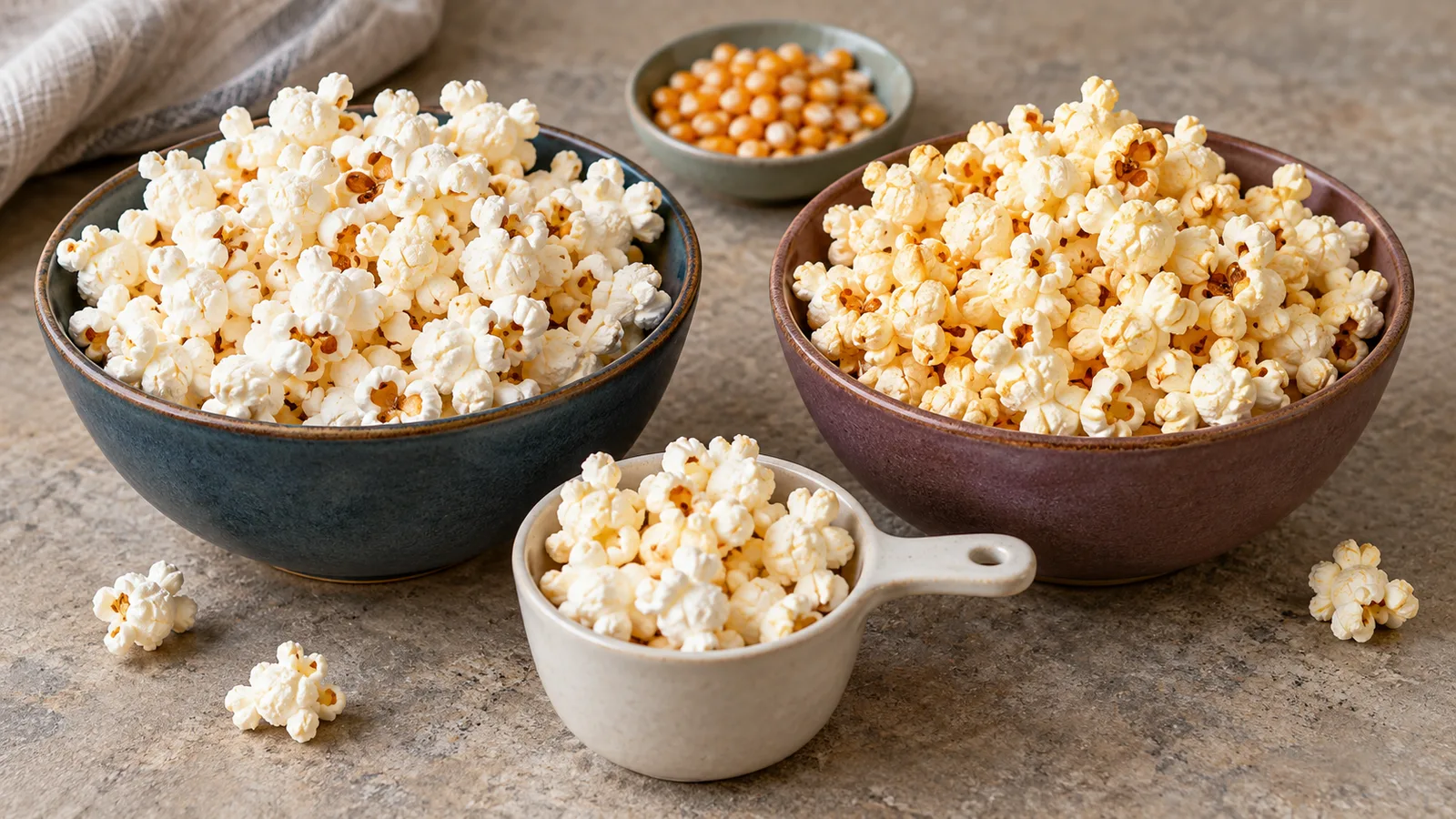
Popcorn can look like a large snack even when the popped corn itself weighs very little. The important question is not just how many cups are in your bowl, but how many grams of finished popcorn you eat and what was added during preparation. A plain air-popped serving is very different from a cinema tub with oil, sugar or buttery seasoning.
For the comparison below, “popcorn” means the finished, edible popped corn. It does not mean dry kernels before popping or the weight of a microwave bag before cooking. We use two separate USDA food entries and explain why volume measures are approximate.
Calories per 100 g: air-popped versus oil-popped
The USDA SR Legacy reference for plain air-popped popcorn reports about 387 kcal per 100 g. A separate entry for home-prepared oil-popped, unsalted popcorn reports about 500 kcal per 100 g. These are different finished foods: the second includes oil used in preparing the product. Neither figure is a promise about a specific supermarket bag.
The difference is 113 kcal per 100 g of the finished foods. But it would be misleading to say that simply switching the heating method always adds exactly 113 kcal: a home recipe can use very little oil or a lot. If you know the quantities used, calculating from the actual ingredients is more reliable than borrowing an average entry.
| Measure | Air-popped, plain | Oil-popped, home-prepared, unsalted |
|---|---|---|
| Energy / 100 g | 387 kcal | 500 kcal |
| Fat / 100 g | 4.5 g | 28.1 g |
| Protein / 100 g | 12.9 g | 9.0 g |
How many calories are in a cup or a bowl?
USDA's common measure for the air-popped reference is 1 US cup ≈ 8 g, yielding 31 kcal after rounding. At that same assumed weight of 8 g, the oil-popped reference gives approximately 40 kcal. The oil-popped product may not fill a cup at the same weight, however: oil, broken pieces and packing density all change how much fits into a volume measure.
A reference serving of 3 cups × 8 g = 24 g therefore provides about 93 kcal of plain air-popped popcorn. If the bowl actually weighs 35 g instead, the estimate becomes 35 × 387 ÷ 100 ≈ 135 kcal. That is why the scale is a better guide than the size of the bowl. A four-cup bowl is not automatically a four-cup serving if it is packed tightly or mixed with toppings.
| Reference US cups | Assumed weight, g | Energy (Air-popped, plain) |
|---|---|---|
| 1 | 8 g | 31 kcal |
| 2 | 16 g | 62 kcal |
| 3 | 24 g | 93 kcal |
| 4 | 32 g | 124 kcal |
What happens when you add oil?
The extra calories from oil are not mysterious: fat provides roughly 9 kcal per gram. If 5 g of edible oil remain in a batch, that adds about 45 kcal; 10 g adds about 90 kcal. These are ingredient calculations, separate from the USDA entry for popcorn that was already oil-popped. Do not count the oil twice.
Suppose you air-pop 24 g of finished plain popcorn and then toss all of it with 5 g oil. The illustrative bowl contains about 93 + 45 = 138 kcal, assuming all the oil is eaten. If part of the oil stays in the pan or at the bottom of a bowl, the actual intake may be lower. With stove-popped kernels, start from the dry kernels you used, plus the amount of oil retained; do not add a whole finished-food database portion on top of those ingredients.
Microwave, cinema and flavoured popcorn
“Microwave popcorn” is not one consistent recipe. Packets may contain added fat, salt, sugar and flavourings, and labels may specify nutrition as sold or as prepared. Check which basis is printed, how many servings the bag contains and the net amount you actually eat. A packet marked as “butter flavour” does not necessarily contain the same ingredients as popcorn topped with measured butter at home.
Cinema portions can be even harder to estimate because serving tubs differ in volume and preparation methods differ between venues. Ask for a nutrition statement where available; otherwise record the portion as an estimate, not a laboratory measurement. Caramel coatings, cheese dust, sauces and drizzles add ingredients that plain popcorn tables do not include.
Protein, fat, carbohydrate and fibre
For 100 g of air-popped popcorn, the reference entry provides approximately 12.9 g protein, 4.5 g fat and 14.5 g fibre. Its 77.8 g total carbohydrate by difference is reported under the USDA method and includes fibre; it must not be copied without qualification into an EU-style “carbohydrates” label that generally excludes fibre.
Air-popped popcorn is a whole-grain food, but that does not make toppings nutritionally invisible. A three-cup reference portion represents only 24 g of food and supplies roughly 3.1 g protein and 3.5 g fibre, not the same values as 100 g. If you want a fuller snack, pair popcorn with other foods you enjoy rather than treating the popcorn alone as a complete meal.
How to track your own portion without guesswork
First choose the correct food state: air-popped, oil-popped, or a specific packaged product. Second, place your bowl on a kitchen scale, tare it and weigh the finished portion in grams. Third, add separately any oil, butter, sugar or sauce not included in the selected entry. Finally, keep the recipe yield in mind: 30 g of dry kernels is not the same measurement as 30 g of finished popcorn if some kernels do not pop or other ingredients are added.
If you are using the recipe method, weigh the dry ingredients before cooking and divide the total by the portions actually eaten. If you are using the finished-food method, weigh the edible popped portion and avoid adding ingredient calories that the database entry already contains. This prevents two common errors: counting added oil twice and applying raw-kernel values to a differently measured serving.
Which number should you use?
For a plain bowl without oil, 31 kcal per reference cup or 387 kcal per 100 g is a useful starting point. For a homemade batch with known ingredients, calculate the actual popcorn and oil. For a packaged snack, the packet's correctly interpreted prepared-product label should generally be the first reference. The useful habit is to keep the weight basis, food state and added ingredients consistent throughout the calculation.
Sources and reference assumptions
USDA FoodData Central SR Legacy, entry 167959 (air-popped) and entry 169861 (home-prepared oil-popped, unsalted). The cup conversion is the USDA reference for air-popped popcorn. Values are averages; brand recipes differ.