
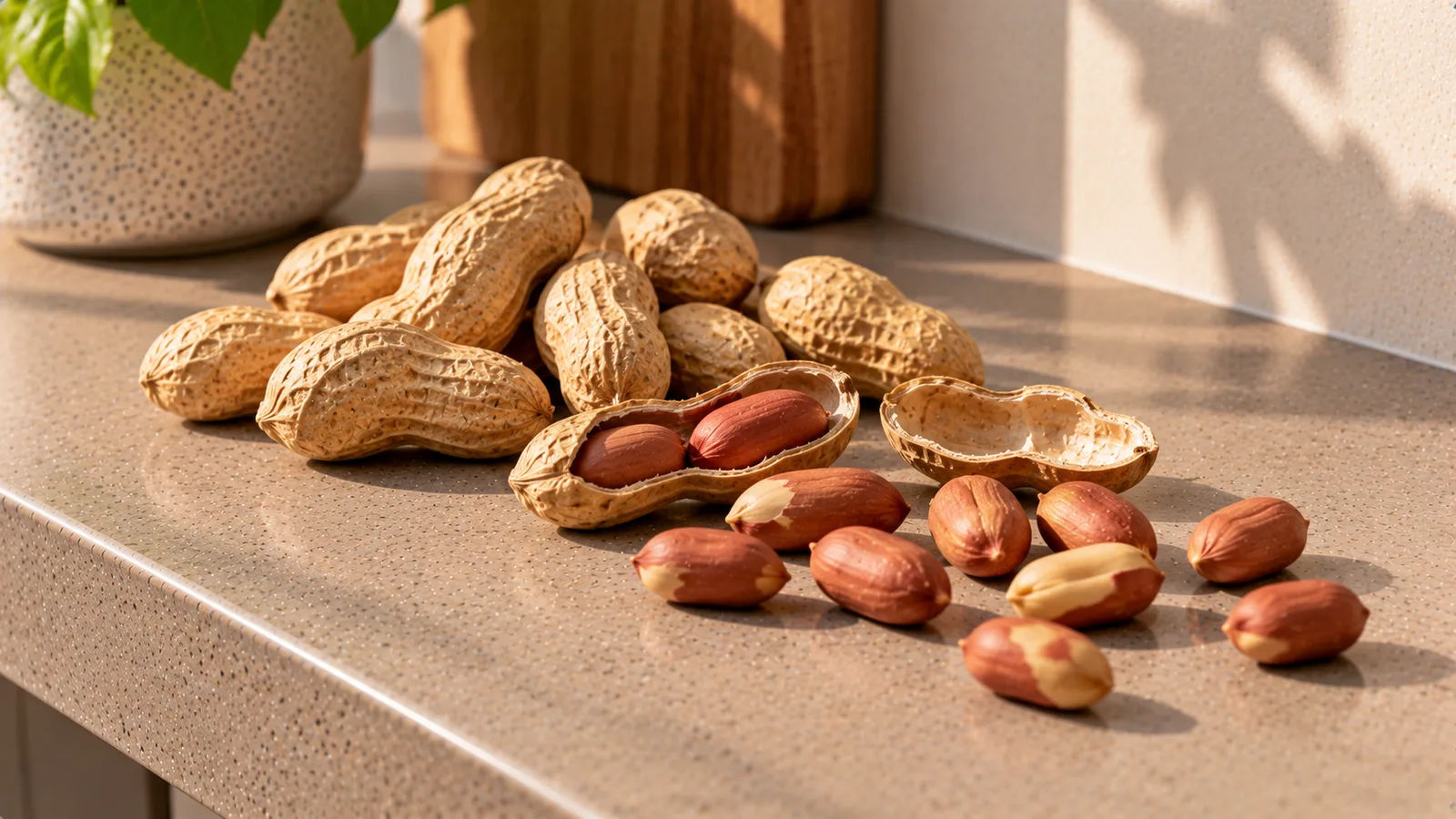
Peanuts are energy-dense because a large share of their calories comes from fat, while they also provide substantial protein.
For calorie tracking, portion size matters. A small handful and a large handful can look similar but differ considerably in weight and calories.
The values below use plain dry-roasted peanuts without added salt as a practical reference. Exact nutrition varies with variety, roasting method, added oil, coatings and brand, so use the package label when tracking a specific product.
Peanuts nutrition per 100 g
A typical 100 g portion of plain dry-roasted peanuts provides approximately:
| Nutrient | Per 100 g |
|---|---|
| Calories | 587 kcal |
| Protein | 24.4 g |
| Fat | 49.7 g |
| Carbohydrates | 21.3 g |
| Fiber | 8.4 g |
A 100 g serving is useful for comparing foods and calculating portions, but it is considerably larger than a typical snack portion.
Calories in common peanut portions
Using 587 kcal per 100 g as the reference:
| Peanut portion | Approx. calories |
|---|---|
| 10 g | 59 kcal |
| 15 g | 88 kcal |
| 20 g | 117 kcal |
| 25 g | 147 kcal |
| 28 g | 164 kcal |
| 30 g | 176 kcal |
| 40 g | 235 kcal |
| 50 g | 294 kcal |
| 100 g | 587 kcal |
The calculation is:
portion in grams × 587 ÷ 100
For example:
30 g × 587 ÷ 100 = 176 kcal
This method can be used with the calorie value from your own package.
What does a 28 g serving provide?
Around 28 g, or roughly 1 oz, is a common reference serving for peanuts.
Using the example nutrition values above, 28 g provides approximately:
- 164 kcal
- 6.8 g protein
- 13.9 g fat
- 6.0 g carbohydrates
- 2.4 g fiber
This is a useful reference portion, but there is no requirement for your actual serving to be exactly 28 g.
If you eat 18 g, 35 g or 42 g, tracking the actual weight gives a more useful estimate.
How many calories are in a handful of peanuts?
A “handful” is not a standardized serving.
One person's handful may be 20 g while another person's may be 40 g or more.
Using the reference value:
- 20 g ≈ 117 kcal
- 30 g ≈ 176 kcal
- 40 g ≈ 235 kcal
That range is large enough to matter when calories are being tracked.
If peanuts are a regular food in your diet, weighing your usual handful once or twice can help you learn what your personal portion looks like.
Calories and macros by portion
| Portion | Calories | Protein | Fat | Carbs |
|---|---|---|---|---|
| 15 g | 88 kcal | 3.7 g | 7.5 g | 3.2 g |
| 20 g | 117 kcal | 4.9 g | 9.9 g | 4.3 g |
| 28 g | 164 kcal | 6.8 g | 13.9 g | 6.0 g |
| 30 g | 176 kcal | 7.3 g | 14.9 g | 6.4 g |
| 40 g | 235 kcal | 9.8 g | 19.9 g | 8.5 g |
| 50 g | 294 kcal | 12.2 g | 24.9 g | 10.7 g |
These values are calculated from the same 100 g reference and rounded.
For a branded product, calculate from its own label instead.
Why peanuts are high in calories
Fat provides approximately 9 kcal per gram, compared with about 4 kcal per gram for protein and carbohydrate.
Because peanuts contain close to 50 g of fat per 100 g, they have a relatively high calorie density.
That does not make peanuts inherently “good” or “bad.” It simply means that a modest physical portion can contain a meaningful amount of energy.
Peanuts also provide protein, fiber and several micronutrients.
The useful question for tracking is therefore not whether peanuts are high in calories, but how much you actually ate.
Raw, roasted and oil-roasted peanuts
Nutrition can differ depending on the product and preparation.
Raw peanuts
Raw peanuts contain naturally occurring fat, protein and carbohydrate. Their calorie value per 100 g may differ somewhat from roasted peanuts because roasting changes water content.
Dry-roasted peanuts
Dry roasting removes some moisture. This can make nutrients and calories slightly more concentrated by weight.
Oil-roasted peanuts
Oil-roasted products may contain additional oil. The amount retained varies by product and processing method.
Do not automatically use one generic peanut entry for every form if a more accurate label or database entry is available.
Salted versus unsalted peanuts
Salt itself does not add meaningful calories.
Therefore, salted and unsalted versions can have similar calorie values when the rest of the product is equivalent.
The major nutritional difference is usually sodium.
However, some flavored or seasoned products contain additional ingredients such as:
- oil;
- sugar;
- starch;
- coatings;
- honey;
- spice mixtures.
Those additions can change calories and macros.
Flavored and coated peanuts
Honey-roasted, sugar-coated, chocolate-coated or crunchy-coated peanuts should not be tracked as plain peanuts.
For example, a coating may add carbohydrate and calories, while additional oil can increase fat.
Use the nutrition label for the exact product whenever possible.
The same principle applies to peanut snack mixes containing dried fruit, chocolate, crackers or other nuts: track the mixture rather than assuming the whole portion has the nutrition of plain peanuts.
Peanuts by count versus by weight
Counting individual peanuts is less reliable than weighing them because peanut size varies.
If a database gives a value for a certain number of kernels, it can be useful when no scale is available. But for repeatable tracking, grams are usually better.
For example, if your actual portion weighs 32 g and the package provides nutrition per 100 g, calculate from 32 g rather than trying to estimate how many “average” peanuts you ate.
How to calculate calories from the package
Suppose your peanut package states:
610 kcal per 100 g
and you eat 35 g.
Calculate:
35 × 610 ÷ 100 = 213.5 kcal
You would log approximately 214 kcal.
If the label instead gives nutrition per 30 g serving, you can calculate proportionally.
Suppose:
30 g = 180 kcal
and you eat 45 g.
45 ÷ 30 × 180 = 270 kcal
The product label should take priority over a generic reference when you know exactly which peanuts you ate.
How to weigh peanuts accurately
For a simple snack:
- place a bowl on a kitchen scale;
- tare the scale to zero;
- add the peanuts;
- record the displayed weight;
- use the matching product entry or package nutrition.
You can also weigh a container before and after eating.
If the container weighs 465 g before and 433 g afterward:
465 − 433 = 32 g eaten
This can be convenient when eating directly from a larger package.
Peanut portions when adding them to meals
Peanuts are often added to foods rather than eaten alone.
Examples include:
- oatmeal;
- yoghurt;
- salads;
- noodle dishes;
- stir-fries;
- smoothie bowls.
If you are tracking the meal, weigh the peanuts separately before adding them.
A small visual topping can still contribute a noticeable number of calories.
For example, using the reference value:
15 g ≈ 88 kcal
25 g ≈ 147 kcal
The difference is difficult to judge visually once the peanuts are mixed into a meal.
Peanuts versus peanut butter
Peanuts and peanut butter are related foods, but they should not automatically share the same database entry.
Peanut butter may contain:
- only peanuts;
- peanuts and salt;
- added oils;
- added sugar;
- other ingredients.
Its serving format is also different.
If you are tracking peanut butter, use nutrition data specifically for peanut butter rather than converting a spoonful into an assumed amount of whole peanuts.
What can make your peanut calorie estimate inaccurate?
Common causes include:
- estimating a handful instead of weighing it;
- using raw-peanut data for a different roasted product;
- ignoring added oil or coatings;
- logging a snack mix as plain peanuts;
- using an entry for peanut butter;
- confusing serving size with the amount actually eaten;
- entering the weight of a package rather than the consumed portion.
Most of these errors are avoided by matching the food form and weighing the portion.
Quick reference
For plain dry-roasted peanuts at approximately 587 kcal per 100 g:
- 10 g: ~59 kcal
- 20 g: ~117 kcal
- 28 g: ~164 kcal
- 30 g: ~176 kcal
- 40 g: ~235 kcal
- 50 g: ~294 kcal
- 100 g: ~587 kcal
Treat these as reference values, not universal numbers for every peanut product.
For the most accurate everyday estimate, use the nutrition label for your specific product and the actual weight you consumed.