
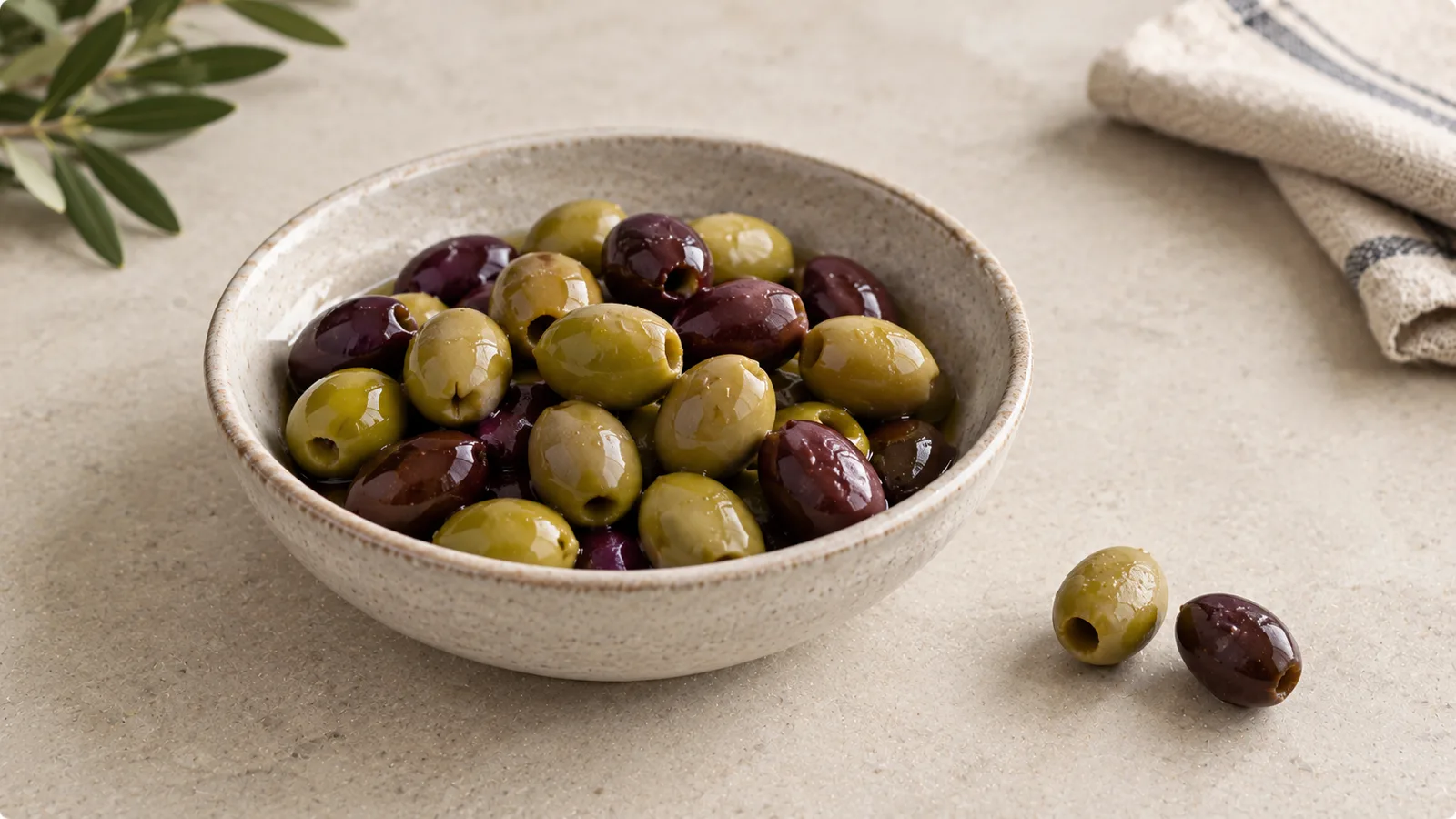
Olives are usually eaten in small portions, but their calorie content depends on the variety, preparation and amount of edible flesh. A jar's total weight is not the same as the weight of the olives you eat, especially when the olives contain pits or are packed in brine.
For accurate food tracking, start with calories per 100 g of edible olives, then calculate the calories in your actual portion.
How many calories are in olives?
As a practical reference, common green table olives provide approximately 145 kcal per 100 g, while some canned ripe black olives provide approximately 115 kcal per 100 g.
These are rounded examples based on food-composition data, not fixed values for every product.
| Olive type | Approximate calories per 100 g | Important detail |
|---|---|---|
| Green table olives | 145 kcal | Variety and curing affect values |
| Ripe black canned olives | 115 kcal | Water content and processing matter |
| Dry-cured olives | Varies | Often less water |
| Oil-marinated olives | Varies | Added oil may increase calories |
| Stuffed olives | Varies | Depends on filling |
Green olives are not always higher in calories than black olives. Colour alone does not reliably predict energy content. Check the label of the product you actually eat.
Calories in 5, 10 and 15 olives
Olive sizes differ considerably. The following calculations assume one pitted olive contains 4 g of edible flesh and the product provides 145 kcal per 100 g.
| Portion | Assumed edible weight | Estimated calories |
|---|---|---|
| 5 olives | 20 g | 29 kcal |
| 10 olives | 40 g | 58 kcal |
| 15 olives | 60 g | 87 kcal |
| 30 g | 30 g | 44 kcal |
| 50 g | 50 g | 73 kcal |
| 100 g | 100 g | 145 kcal |
These are calculation examples, not universal olive weights.
The formula is:
Calories = kcal per 100 g × edible portion in grams ÷ 100
For example, 45 g of olives containing 145 kcal per 100 g provides approximately 65 kcal.
If your product contains 115 kcal per 100 g, the same 45 g portion provides approximately 52 kcal.
Green vs black olives: nutrition comparison
Olives contain mostly water and fat. They provide relatively little protein and are not a substantial protein source.
| Nutrient per 100 g | Green olives, approximate | Ripe black canned olives, approximate |
|---|---|---|
| Calories | 145 kcal | 115 kcal |
| Fat | 15 g | 11 g |
| Protein | 1 g | 1 g |
| Carbohydrate | 4 g | 6 g |
| Fibre | 3 g | 2 g |
Values are rounded illustrations of common database entries. The carbohydrate definition and rounding rules may differ between US databases and European food labels.
The fat in olives is predominantly unsaturated, including monounsaturated fatty acids. Nevertheless, portion size still determines total energy intake.
For reference food-composition entries, consult USDA FoodData Central.
Net weight, drained weight and edible weight
Three different weights can appear when measuring olives.
Net weight includes the packaged contents, which may include brine.
Drained weight excludes the packing liquid.
Edible weight excludes pits and other discarded parts.
For example:
- Whole olives weighed before eating: 60 g.
- Pits discarded after eating: 12 g.
- Edible olive flesh: 48 g.
At 145 kcal per 100 g, the edible portion contains approximately 70 kcal.
This example does not establish a universal pit percentage. Large olives and small olives can have different ratios of flesh to pit.
When olives are packed in oil, the calories from any marinade actually consumed must also be considered.
Why olive calorie values differ
The nutritional composition of olives depends on several factors:
- Olive cultivar and maturity.
- Moisture content.
- Fermentation and curing method.
- Whether the product is canned, dry-cured or marinated.
- Added oil.
- Fillings such as peppers, cheese or fish.
- The amount of edible flesh in the serving.
This is why two packages of olives can display different calories even when both products are described as black olives.
For packaged olives, the manufacturer's nutrition declaration is generally the best practical source for the specific product.
Are olives high in fat?
Olives contain more fat than most fresh vegetables, but considerably less fat per 100 g than olive oil.
Whole olives contain water, fibre and other components. Olive oil consists almost entirely of fat.
For this reason, calories in olives and calories in olive oil are separate nutritional questions. Their values should not be substituted for each other.
A small portion of olives can add flavour to salads, grain bowls, sandwiches and cooked vegetables without requiring a large serving.
Salt and sodium in olives
Many table olives are preserved in brine and can contain substantial amounts of salt.
The salt content varies by product. Some labels display salt, while food databases may report sodium.
A useful conversion is:
Salt (g) ≈ sodium (g) × 2.5
For example, 1.2 g of salt corresponds to approximately 480 mg of sodium.
Rinsing olives may remove some surface brine, but it does not guarantee a specific reduction in total sodium.
People following a medically recommended sodium restriction should compare product labels and follow their clinician's guidance.
See the WHO salt-reduction fact sheet for general population guidance.
How to record olives in a food diary
A practical approach is:
- Identify the exact olive product.
- Check whether its nutrition information applies to the drained product.
- Remove the brine if it will not be consumed.
- Remove pits or subtract their measured weight.
- Weigh the edible portion.
- Calculate calories using the product's value per 100 g.
- Include any additional oil or fillings not already covered by the label.
For example, a salad containing 30 g of plain olives and two tablespoons of olive oil must account for the oil separately.
The same principle applies when olives are added to pasta, pizza, salads or homemade sauces.
Common questions
Are black olives lower in calories than green olives?
Some common canned black olives contain fewer calories than some green olives, but this is not a universal rule. Processing, moisture and added oil can change the comparison.
How many calories are in 10 olives?
Using an illustrative weight of 40 g of edible flesh and 145 kcal per 100 g, 10 olives contain approximately 58 kcal. Larger olives may contain more.
Do olive pits count toward calories?
No. If pits are discarded, their weight should not be included in the edible portion.
Are olives suitable for a calorie-conscious diet?
Yes, olives can fit into a calorie-conscious eating pattern. The important factors are portion size, preparation and the rest of the meal.
Do olives provide much protein?
No. Olives contain relatively little protein compared with foods such as beans, eggs, fish, dairy products or tofu.
Sources and interpretation
The example figures are rounded reference estimates, not laboratory results for a particular brand.
Sources:
- USDA FoodData Central — food-composition reference data.
- Regulation (EU) No 1169/2011 — European food-information and nutrition-labelling framework.
- World Health Organization: Salt reduction — general sodium and salt guidance.
For the olives you actually consume, prioritize the specific product label and the measured edible portion.