
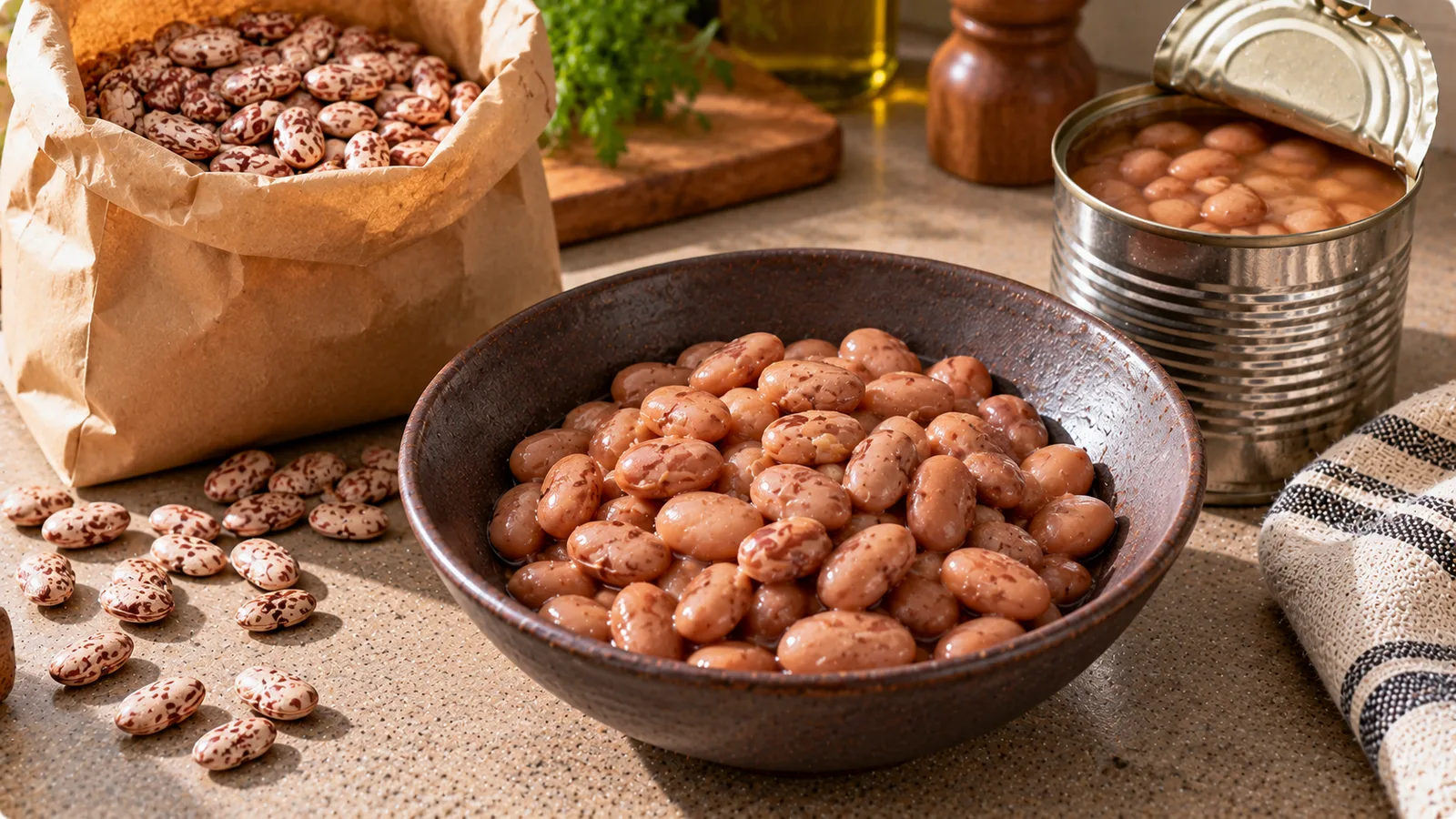
Pinto beans are a versatile legume used in soups, burritos, stews, salads and bean-based side dishes. Their calorie content depends strongly on whether you weigh them dry, cooked or canned.
Plain cooked pinto beans contain approximately 143 kcal per 100 g, based on a commonly used USDA reference for mature pinto beans boiled without added salt.
That figure is useful for a basic food diary entry, but it should not be applied to dry beans or a prepared dish containing oil, cheese or sauce.
Pinto bean nutrition per 100 g
The following values are approximate reference figures for plain pinto beans.
| Nutrient | Cooked pinto beans, 100 g |
|---|---|
| Calories | 143 kcal |
| Protein | 9.0 g |
| Carbohydrates | 26.2 g |
| Fat | 0.7 g |
| Fiber | 9.0 g |
Values are rounded. They represent beans cooked in water without added fat. Actual values can differ with variety, cooking time, water absorption and the data source.
Carbohydrate figures in US food composition data generally include fiber. European labels usually declare carbohydrate separately from fiber, so numbers from the two systems should not be compared without checking their definitions.
Calories by cooked serving size
If you are weighing plain cooked pinto beans, you can scale the reference values by weight.
| Cooked portion | Calories | Protein | Carbohydrates |
|---|---|---|---|
| 50 g | 72 kcal | 4.5 g | 13.1 g |
| 100 g | 143 kcal | 9.0 g | 26.2 g |
| 150 g | 215 kcal | 13.5 g | 39.3 g |
| 200 g | 286 kcal | 18.0 g | 52.4 g |
| 250 g | 358 kcal | 22.5 g | 65.5 g |
These calculations use the same cooked-bean reference throughout.
A cup measurement is less precise because bean size, packing and liquid content affect its weight. For accurate tracking, weigh the edible beans after cooking and draining.
Dry versus cooked pinto beans
Dry beans contain much less water than cooked beans.
That is why 100 g of dry pinto beans have substantially more calories than 100 g of cooked pinto beans.
A typical dry-bean reference is approximately 347 kcal per 100 g, compared with approximately 143 kcal per 100 g for the cooked reference used here.
| Form | Approximate calories per 100 g | Main difference |
|---|---|---|
| Dry pinto beans | 347 kcal | Little water |
| Boiled pinto beans | 143 kcal | Water absorbed during cooking |
| Canned, drained pinto beans | Product-dependent | Varies by brand, liquid and processing |
The total energy in a batch does not disappear when beans absorb water. Instead, the cooked batch weighs more, reducing calories per 100 g.
Some nutrients may be lost into soaking or cooking water, so the relationship is not perfectly explained by dilution alone.
Example: 100 g dry beans after cooking
Suppose you cook 100 g of dry pinto beans and the drained cooked batch weighs 250 g.
Using 347 kcal for the dry starting quantity, the approximate energy density would be:
347 ÷ 250 × 100 = 139 kcal per 100 g cooked.
This is a simplified illustration, not a guaranteed cooked yield or an exact nutrient-retention calculation.
For a homemade batch, the best method is to record the dry ingredient quantity and the actual final edible weight.
How many calories are in canned pinto beans?
Canned pinto beans are already hydrated.
Their nutrition can differ from the plain boiled reference because brands use different bean-to-liquid ratios, processing methods and recipes.
Some canned products contain added salt. Others include sauce, sugar or fat.
For accurate tracking:
- Check whether the label gives values for the entire contents or the drained beans.
- Weigh the beans after draining if that is the portion you eat.
- Use the label of the actual product.
- Include any sauce or liquid you consume when the label and recipe require it.
Do not use the dry-bean calorie value for canned beans.
Does rinsing change the calories?
Rinsing canned beans can remove some surface liquid and dissolved sodium. It does not remove the calories stored inside the beans.
Any change in the measured energy per portion depends on what liquid or sauce is removed and how the product was labeled.
Rinsing is not a reliable method of calculating a fixed percentage reduction in calories.
Protein, carbohydrates and fiber
Pinto beans provide plant protein and dietary fiber.
Using the cooked reference, a 200 g portion contains approximately:
- 286 kcal.
- 18 g protein.
- 52 g total carbohydrates, including fiber under the US convention.
- 18 g fiber.
- About 1.4 g fat.
The high fiber content contributes to the nutritional profile, but individual tolerance varies.
If you are not accustomed to eating legumes regularly, increasing portions gradually may be more comfortable.
Are pinto beans good for weight management?
Pinto beans can fit into weight-loss, maintenance and higher-calorie eating patterns.
Their combination of protein and fiber may help make meals satisfying, but weight change depends on overall energy intake over time.
Portion size and added ingredients are important.
For example, a serving of plain beans is not nutritionally identical to refried beans prepared with added fat or a burrito containing cheese, rice and sauces.
Track the full dish rather than treating every bean-based meal as plain cooked beans.
How to log pinto beans accurately
Choose the database entry that matches the food at the moment you weigh it.
| What you measured | Appropriate entry |
|---|---|
| Dry beans before cooking | Dry pinto beans |
| Plain beans after boiling | Cooked pinto beans |
| Canned beans after draining | Canned pinto beans, drained |
| Beans in tomato sauce | Exact prepared product or recipe |
| Homemade refried beans | Recipe including oil or other fat |
If you cook a large batch, record the dry weight and final cooked yield. That gives you a consistent basis for dividing the batch into portions.
For example, if a batch contains 200 g dry beans and yields 500 g cooked beans, a 125 g cooked serving represents one-quarter of that batch.
Add any cooking oil or other energy-containing ingredients separately.
Common tracking mistakes
Using dry values for cooked beans
This can greatly overestimate calories because the cooked weight includes absorbed water.
Using cooked values for dry weight
This can underestimate calories in the original dry ingredient quantity.
Treating all canned beans as identical
Drained weight, sauce and manufacturer formulations differ.
Forgetting added fat
Oil, butter, lard and cheese can materially change the energy content of a prepared bean dish.
Mixing carbohydrate definitions
US total carbohydrate values and European carbohydrate declarations may differ because fiber is handled differently.
Always check the source before comparing figures.
Sources and data notes
- USDA FoodData Central — food composition references for dry and cooked pinto beans.
- EU Regulation No 1169/2011 — European nutrition labeling requirements.
- USDA MyPlate: Beans, Peas and Lentils — dietary context for legumes.
The figures in this article are rounded reference estimates, not a laboratory analysis of a specific package. Check the current product label whenever you have it.
Key takeaway
For a simple food diary, 143 kcal per 100 g of plain cooked pinto beans is a useful reference.
Dry beans are much more calorie-dense by weight because they contain far less water. Canned beans should be logged using the product's own nutrition information, particularly when the values refer to drained contents or beans in sauce.
Matching the food form and portion weight is more important than choosing the first database result.