
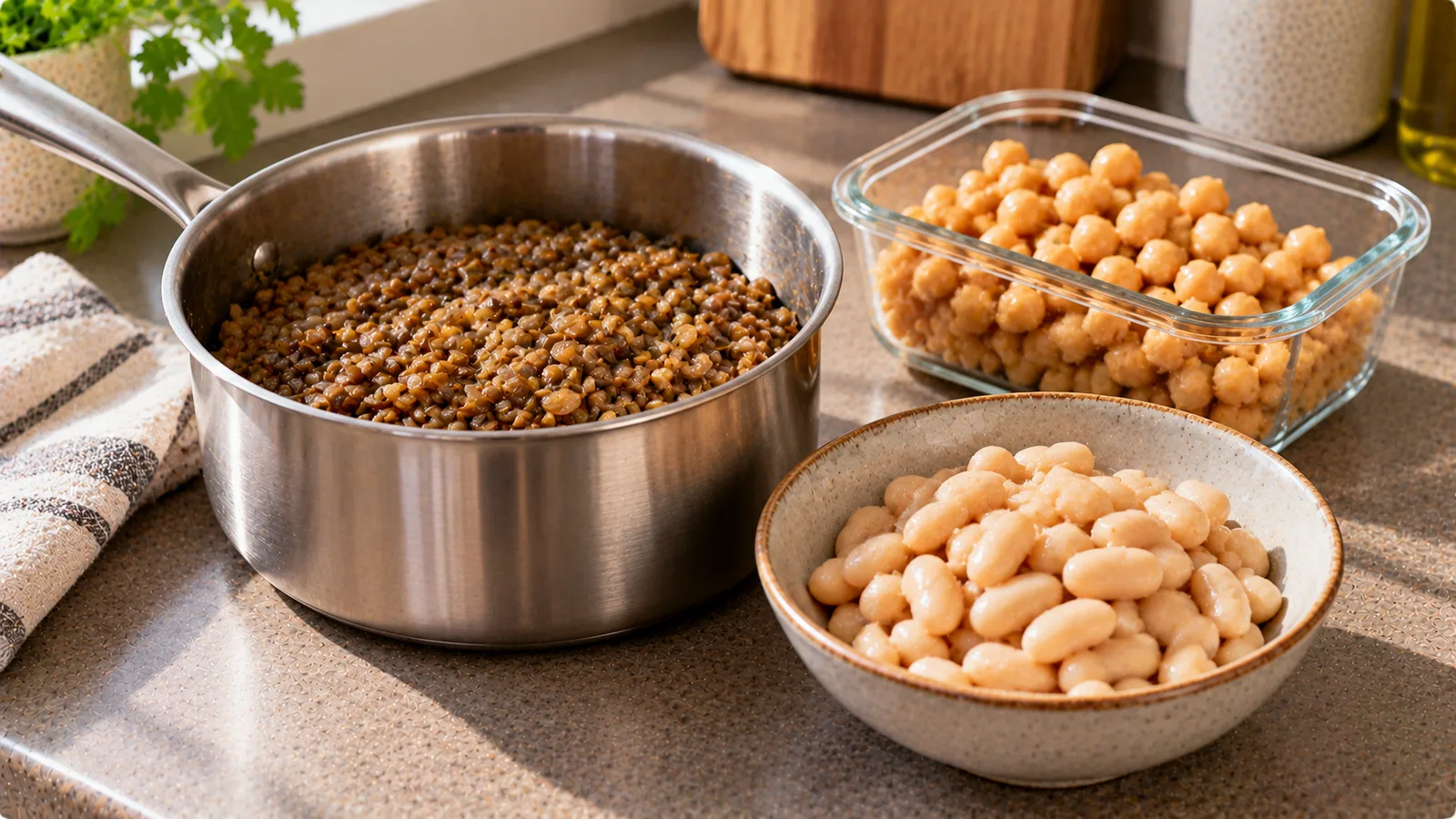
Legumes are a practical way to add variety to everyday meals. Beans, lentils, chickpeas and peas can be used in soups, salads, stews, grain bowls, sauces and many familiar recipes.
However, eating a large portion of beans after rarely consuming them may cause bloating, gas or abdominal discomfort.
A gradual approach can make the transition easier.
Instead of replacing several meals with large servings of legumes immediately, start with a small amount, observe how you feel and increase the portion over time.
The goal is not to follow a rigid schedule. It is to find an amount and preparation method that work for your appetite, digestive tolerance and overall diet.
Which foods count as legumes?
Legumes are plants in the Fabaceae family. Their edible seeds and pods appear in many different forms.
Common examples include:
| Legume | Common uses |
|---|---|
| Lentils | Soups, curries, salads, stews |
| Chickpeas | Hummus, salads, roasted snacks, curries |
| Black beans | Burritos, soups, rice dishes |
| Kidney beans | Chili, stews, bean salads |
| White beans | Soups, tomato dishes, spreads |
| Pinto beans | Burritos, refried beans, stews |
| Split peas | Thick soups and purées |
| Green peas | Vegetable sides, soups, rice dishes |
| Soybeans and edamame | Snacks, salads, mixed dishes |
Peanuts are botanically legumes, although they are generally used nutritionally and culinarily like nuts.
This guide focuses primarily on cooked beans, lentils, chickpeas and peas.
Soy products such as tofu and tempeh are also made from legumes, but their preparation and typical serving sizes differ from those of cooked whole beans.
Why increase legumes gradually?
Many legumes contain dietary fiber and carbohydrates that are not fully digested in the small intestine.
Some of these carbohydrates are fermented by bacteria in the large intestine.
Fermentation can produce gas.
This is a normal digestive process, but a sudden increase in the amount of fermentable food may be uncomfortable.
The effect varies between individuals and between different legumes.
Cooking methods, serving size, the rest of the meal and existing digestive conditions can also influence symptoms.
A smaller portion eaten regularly is often a more manageable starting point than a very large serving eaten occasionally.
However, gradual increases do not guarantee that everyone will tolerate every legume.
Persistent or severe symptoms deserve medical assessment rather than repeated attempts to force an increase.
A practical four-week introduction plan
The following plan is an example for an adult who currently eats legumes rarely and has no medical reason to restrict them.
It is not a medically validated progression or a mandatory schedule.
All quantities refer to cooked, drained legumes, not dry weight.
| Period | Example portion | Suggested frequency |
|---|---|---|
| Week 1 | 2–3 tablespoons, approximately 30–45 g | 2–3 meals |
| Week 2 | Approximately 50–75 g | 3 meals |
| Week 3 | Approximately 75–100 g | 3–4 meals |
| Week 4 | Approximately 100–150 g | According to tolerance and preferences |
There is no need to increase the portion every week if the previous amount causes discomfort.
You can repeat the same portion for longer, reduce it or try a different legume.
Some people already tolerate a full serving without difficulty and do not need a gradual introduction.
Week 1: Add a small amount to familiar food
Start with a meal you already enjoy.
For example:
- Add 30 g cooked lentils to vegetable soup.
- Mix 40 g chickpeas into a salad.
- Add 30 g black beans to a rice bowl.
- Stir a few tablespoons of mashed white beans into a tomato sauce.
The legumes should complement the meal rather than replace everything else.
Choose one addition at a time if you want to understand how your digestion responds.
Week 2: Increase the portion slightly
If the first portions are comfortable, try approximately 50–75 g cooked legumes per meal.
You might add lentils to a stew or serve chickpeas alongside roasted vegetables.
Continue eating other sources of fiber rather than making legumes your only fiber-containing food.
Week 3: Try different textures and recipes
At this stage, consider a 75–100 g portion.
Try a smooth lentil soup, a bean spread or chickpeas in a curry.
Different preparations may feel different in the digestive system.
A puréed legume dish can be easier to chew and incorporate into meals, although blending does not remove all fermentable carbohydrates.
Week 4: Build a repeatable routine
If comfortable, experiment with portions around 100–150 g cooked legumes.
You might have lentil soup one day, beans with rice another day and chickpeas in a salad later in the week.
The goal is regularity and variety, not reaching the largest possible portion.
How much is one portion of legumes?
Portion sizes depend on the context.
A small addition to a meal is different from a substantial serving used as a main ingredient.
| Cooked, drained quantity | Practical interpretation |
|---|---|
| 25–40 g | Small introduction or garnish |
| 50–75 g | Modest addition to a meal |
| 80–100 g | Medium side portion |
| 120–150 g | Substantial portion |
| 180–200 g | Large portion or major meal component |
These are practical examples, not universal nutritional requirements.
For comparison, the UK NHS uses 80 g of beans and pulses as one portion toward the five-a-day recommendation, with beans and pulses counting as a maximum of one portion per day in that system.
Source: NHS — 5 A Day.
That classification does not mean people should eat only 80 g of legumes daily.
It describes how they are counted within a particular fruit-and-vegetable recommendation.
Cooked weight versus dry weight
One of the most common measurement errors is confusing dry and cooked legumes.
Dry beans and lentils absorb water during soaking and cooking.
Their weight therefore increases substantially.
The exact yield depends on the variety, cooking time and amount of water retained.
As a rough planning illustration:
| Dry amount | Possible cooked yield |
|---|---|
| 50 g dry lentils | Approximately 110–150 g cooked |
| 100 g dry lentils | Approximately 220–300 g cooked |
| 100 g dry beans | Approximately 200–300 g cooked |
| 100 g dry chickpeas | Approximately 200–300 g cooked |
These are broad estimates, not fixed conversion factors.
For accurate food logging, use the nutritional data for the same state in which you weigh the food.
If you weigh 120 g cooked lentils, use values for cooked lentils.
Do not apply the calories per 100 g of dry lentils to 100 g cooked lentils.
Which legumes are easiest to start with?
There is no universally best-tolerated legume.
However, some preparations are convenient for beginners.
Red lentils
Split red lentils usually cook relatively quickly and soften into soups and sauces.
They generally do not require the same long soaking process as many dried beans.
Their soft texture makes it easy to add a small amount to an existing dish.
Canned lentils
Canned lentils are already cooked and convenient for measured portions.
Drain and rinse them according to the product instructions.
They can be added directly to salads or heated in soups.
Canned chickpeas
Canned chickpeas are easy to portion and can be mashed into a spread.
They work well in small additions to grain bowls or salads.
White beans
Cooked white beans have a relatively mild flavor.
They can be mashed into soups, sauces and spreads.
Split peas
Split peas are useful in thick soups.
Follow the cooking instructions for the specific product.
Individual tolerance matters more than a universal ranking.
If one type consistently causes discomfort, try a smaller amount or a different preparation rather than assuming all legumes will have the same effect.
Preparing canned legumes
Canned beans, lentils and chickpeas are among the simplest options for increasing legume intake.
Most conventional canned products are already fully cooked.
A practical method is:
- Check the label for ingredients and preparation instructions.
- Open the can.
- Drain the liquid.
- Rinse the legumes under running water if appropriate.
- Measure the amount needed.
- Add them to a salad or heat them in a cooked dish.
Rinsing can reduce some sodium from the canning liquid, although the amount removed varies.
For a lower-sodium option, choose products labeled without added salt or reduced sodium when available.
If a recipe uses the canning liquid, such as chickpea aquafaba, do not automatically discard it. Follow the recipe and product instructions.
Example: dividing a can into portions
Suppose a can provides 240 g drained chickpeas.
You can divide it into:
- Six portions of 40 g.
- Four portions of 60 g.
- Three portions of 80 g.
- Two portions of 120 g.
This makes it easier to begin with small servings without preparing a new batch each time.
Store leftovers promptly and follow safe refrigeration guidance.
Preparing dried lentils
Dried lentils are often convenient because many varieties cook without prolonged soaking.
A general method:
- Check the package for variety-specific instructions.
- Sort through the lentils and remove any foreign material.
- Rinse thoroughly.
- Place in a saucepan with sufficient fresh water.
- Bring to a boil and cook until fully tender.
- Drain if required by the recipe.
Cooking times vary substantially.
Split red lentils may soften quickly, while whole green or brown lentils usually take longer.
Follow the package instructions and verify that the lentils are properly cooked before eating.
Preparing dried beans safely
Dried beans require more care than ready-to-eat canned beans.
The correct preparation method depends on the variety.
Some beans contain naturally occurring lectins that must be adequately inactivated by cooking.
Raw or undercooked kidney beans can cause acute gastrointestinal illness because of phytohaemagglutinin.
A safe general approach is:
- Sort and rinse the dried beans.
- Soak them when required by the variety or package.
- Discard the soaking water.
- Add fresh water.
- Bring to a vigorous boil as directed by authoritative food-safety guidance.
- Continue cooking until fully tender.
For kidney beans, the UK Food Standards Agency advises soaking dried beans for at least 12 hours, discarding the soaking water and boiling them vigorously in fresh water for at least 10 minutes before further cooking.
Source: Food Standards Agency.
Slow cookers may not reach a sufficiently high temperature to make raw kidney beans safe if the beans have not first been adequately boiled.
Do not use a low-temperature slow cooker as the only cooking step for raw kidney beans.
If you are uncertain about preparation, use fully cooked canned beans instead.
Does soaking reduce bloating?
Soaking dried beans can help with hydration and cooking.
Some water-soluble compounds may move into the soaking water.
Discarding that water can alter the composition of the finished beans.
However, the effect on gas and bloating varies.
Soaking is not a guaranteed solution to digestive discomfort.
Adequate cooking, portion size and individual tolerance remain important.
For dried kidney beans, soaking and subsequent proper boiling are also food-safety steps, not merely digestive strategies.
Does rinsing canned beans help?
Rinsing canned beans is useful for removing some canning liquid and reducing some sodium.
It may also wash away some soluble compounds present in that liquid.
However, it is not possible to promise that rinsing will prevent gas.
A practical approach is to rinse when appropriate, begin with a modest portion and evaluate your own tolerance.
Other ways to make legumes easier to eat
Increase the amount slowly
Do not change from almost no legumes to several large portions per day overnight.
Smaller, repeated additions are easier to evaluate.
Cook them thoroughly
Properly cooked legumes are generally softer and more pleasant to eat.
Undercooking dried beans can create safety problems, especially with kidney beans.
Try different textures
Whole beans, mashed beans and smooth soups offer different eating experiences.
Texture changes may improve palatability, although they do not necessarily eliminate fermentable carbohydrates.
Consider the whole meal
A large meal containing beans, onions, garlic, cabbage and other fermentable foods may produce more symptoms than a small portion of beans alone.
The effect depends on individual sensitivity.
Avoid changing everything at once
If you simultaneously increase whole grains, raw vegetables, legumes and fiber supplements, it may be difficult to identify which change causes discomfort.
Introduce changes in manageable steps.
Drink fluids regularly
Adequate fluid intake is important as part of normal eating and digestive function.
There is no need to force excessive water consumption simply because you eat beans.
Legumes and protein: what should you expect?
Legumes contribute protein, but the amount varies by food and portion.
Representative values for cooked products include:
| Food | Approximate protein per 100 g |
|---|---|
| Cooked lentils | 9 g |
| Cooked chickpeas | 9 g |
| Cooked black beans | 9 g |
| Cooked kidney beans | 9 g |
| Cooked green peas | 5 g |
Values vary by variety, cooking method and moisture content.
Source: USDA FoodData Central.
A 50 g portion of cooked lentils contributes approximately 4.5 g protein.
A 150 g portion contributes approximately 13.5 g.
This illustrates why a small introductory serving should not be treated as equivalent to a large protein-rich main dish.
Legumes can contribute to protein intake without being the only protein source in the diet.
Legumes and fiber
Legumes are also useful sources of dietary fiber.
For example, cooked lentils commonly provide approximately 8 g fiber per 100 g, depending on the database entry and preparation.
A 40 g introductory portion would therefore provide approximately 3.2 g fiber.
A 150 g portion would provide approximately 12 g.
These are illustrative values.
The European Food Safety Authority considers 25 g dietary fiber per day an adequate intake for normal laxation in adults.
Source: EFSA — Dietary Reference Values.
The purpose of increasing legumes is not to obtain all daily fiber from one food.
Vegetables, fruits, whole grains, nuts and seeds can contribute as well.
Seven easy ways to add legumes to meals
1. Add lentils to vegetable soup
Begin with 30–50 g cooked lentils per bowl.
Increase gradually if comfortable.
2. Mix chickpeas into a salad
Add 40–60 g cooked chickpeas to tomatoes, cucumber and leafy greens.
Use your preferred dressing.
3. Add beans to rice
Mix a modest amount of black beans or kidney beans into cooked rice.
For dried kidney beans, ensure they were properly prepared before use.
4. Blend white beans into a sauce
Add a small amount of fully cooked white beans to a tomato or vegetable sauce.
Blend until smooth.
5. Make a small hummus serving
Use a measured portion of hummus as a spread or dip.
Remember that hummus may contain tahini and oil, so its calorie content differs from plain chickpeas.
6. Add peas to a pasta dish
Stir cooked green peas into pasta with vegetables.
This is a simple way to add legumes without changing the entire meal.
7. Replace part of a meat filling
In a chili or pasta sauce, replace a portion of the meat with cooked lentils or beans.
Start with a modest substitution and increase it if the flavor and texture work for you.
A sample week for someone new to legumes
This is a flexible example, not a prescribed meal plan.
| Day | Meal idea | Cooked legume amount |
|---|---|---|
| Monday | Vegetable soup with lentils | 40 g |
| Tuesday | No planned legume serving | — |
| Wednesday | Salad with chickpeas | 50 g |
| Thursday | No planned legume serving | — |
| Friday | Rice with black beans | 50 g |
| Saturday | No planned legume serving | — |
| Sunday | Tomato sauce with white beans | 40 g |
If this amount is well tolerated, portions or frequency can increase in subsequent weeks.
If symptoms appear, reduce the portion or reassess the food combination.
There is no requirement to eat legumes every day during the introduction period.
What if legumes cause bloating?
Mild gas after increasing fiber-rich foods can occur.
However, symptoms should not be ignored simply because legumes are considered nutritious.
Try noting:
- Which legume you ate.
- Whether it was canned or cooked from dry.
- The cooked portion weight.
- Other ingredients in the meal.
- How soon symptoms appeared.
- Whether symptoms repeat with the same food.
This record may help identify a pattern.
If symptoms are persistent, severe or accompanied by warning signs such as blood in the stool, unexplained weight loss, fever or significant pain, seek medical advice.
People with irritable bowel syndrome or other gastrointestinal conditions may need a more individualized approach.
A restrictive diet, including a low-FODMAP diet, should not be started unnecessarily or maintained long-term without appropriate guidance.
Important safety considerations
Legume allergies
Peanuts and soybeans are major food allergens.
Other legumes can also cause allergic reactions in susceptible individuals.
If you have a diagnosed legume allergy, do not introduce the relevant food without appropriate medical advice.
Kidney beans
Never eat raw or inadequately cooked dried kidney beans.
Follow authoritative soaking and boiling guidance.
Canned products
Check the label for added salt, sauces, allergens and preparation instructions.
Special medical diets
People with kidney disease, gastrointestinal disorders or other conditions requiring dietary restrictions may need personalized guidance about legume portions.
General portion suggestions are not a substitute for medical advice.
Tracking legumes in your diet
For a useful food record, note the actual food and its preparation state.
For example:
- Lentils, cooked, 80 g.
- Chickpeas, canned, drained, 60 g.
- Kidney beans, cooked, 100 g.
- Hummus, prepared, 40 g.
These entries are more informative than simply recording beans.
They also help distinguish a small introduction from a substantial portion.
If a meal contains several ingredients, record the other ingredients separately when accurate calorie or nutrient tracking is important.
Building a sustainable habit
Legumes do not need to replace every animal protein or become the main ingredient in every meal.
They can be used as a small addition, a side dish or a major component.
A sustainable approach is to choose a few recipes you already like, use convenient preparation methods and increase portions according to tolerance.
For many people, a few repeatable meals are more practical than a complicated new menu.
The useful question is not how quickly you can reach a large serving, but whether you can include legumes regularly in a way that is comfortable, enjoyable and nutritionally appropriate.
Sources
- USDA FoodData Central — representative nutrition values for cooked legumes.
- NHS — 5 A Day — how beans and pulses are counted in UK fruit-and-vegetable guidance.
- UK Food Standards Agency — food-safety information concerning dried beans and lectins.
- EFSA — Dietary Reference Values — reference information for dietary fiber.
Portion schedules are practical examples rather than medical prescriptions. Follow product-specific preparation instructions and obtain individualized advice when needed.